Practice Questions :Social Psychology and Personality

SECTION I: MULTIPLE CHOICE
Directions
Each of the questions or incomplete statements below is followed by four suggested answers or completions. Select the one that is best in each case and write your answer on a separate sheet of paper.
Question 1
Dr. Chen conducted a study examining conformity in group settings. Participants were placed in groups of seven, where six members were confederates instructed to give obviously incorrect answers to simple visual judgment tasks. The actual participant was always seated second-to-last and gave their answer after hearing five confederates respond. Results showed that 65% of participants conformed to the incorrect group answer at least once during the twelve trials.
Which classic social psychology study does Dr. Chen's research design most closely replicate?
- Milgram's obedience study
- Asch's conformity study
- Zimbardo's prison study
- Festinger's cognitive dissonance study
Question 2
Maria volunteers at a homeless shelter every Saturday morning. When her friends ask why she donates her time, she explains that helping others makes her feel good about herself and reinforces her self-concept as a compassionate person. Maria's stated motivation differs from true altruism primarily because her behavior is influenced by internal rewards rather than solely by concern for others' welfare.
Which psychological concept best explains Maria's motivation for volunteering?
- Kin selection theory
- Reciprocal altruism
- Egoistic motivation
- Bystander effect
Question 3
A researcher studying attribution styles presented participants with a scenario: "Alex failed an important chemistry exam." Participants were then asked to explain why Alex failed. The researcher categorized responses based on whether participants attributed the failure to internal factors (ability, effort) or external factors (test difficulty, bad luck), and whether the attribution was stable (enduring) or unstable (temporary).
According to Weiner's attribution theory, which attribution pattern would most likely lead to feelings of shame and decreased motivation in future academic situations?
- Internal, stable attribution (low ability)
- Internal, unstable attribution (insufficient effort)
- External, stable attribution (difficult course)
- External, unstable attribution (bad luck on test day)
Question 4
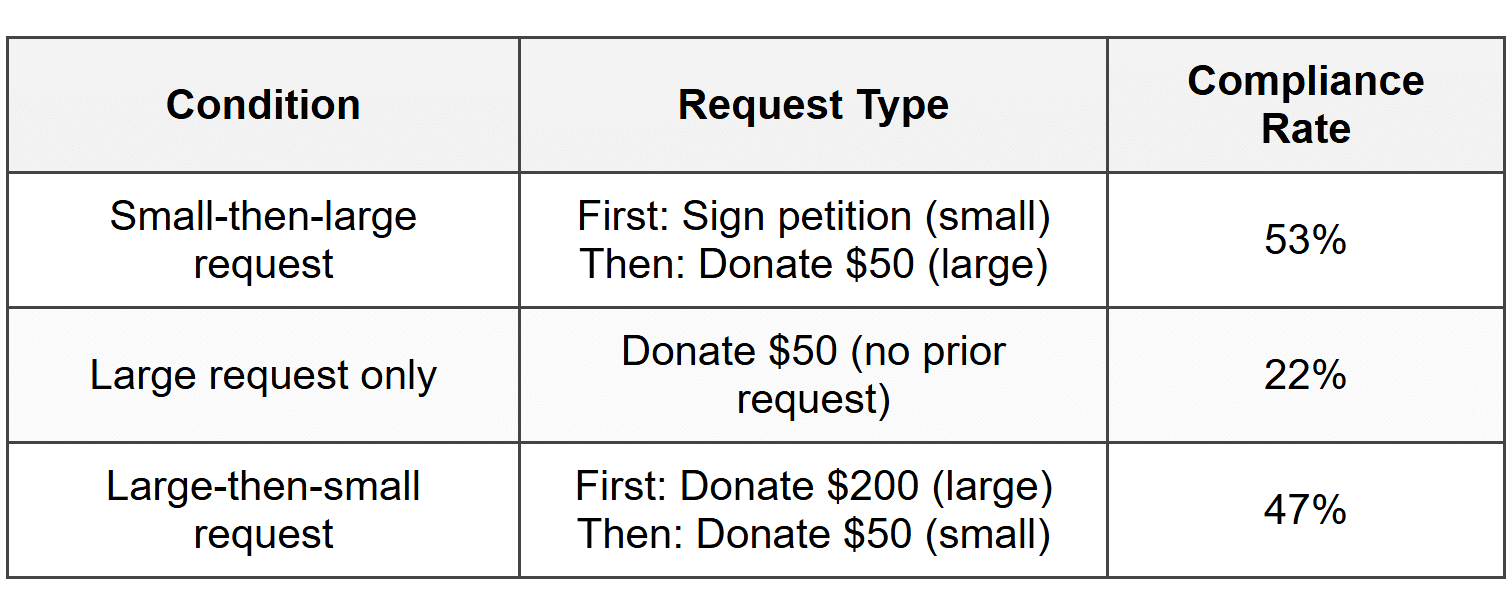
The data table above shows results from a study on compliance techniques. Which conclusion is best supported by the data?
- The door-in-the-face technique produced higher compliance than the foot-in-the-door technique
- Both sequential request techniques increased compliance compared to making only the large request
- Making a large request first always decreases the likelihood of subsequent compliance
- Small initial requests have no effect on compliance with later larger requests
Question 5
During a heated political debate, Thomas notices that members of his preferred political party are making logical arguments, while members of the opposing party are being emotional and irrational. However, independent fact-checkers later determine that both sides made approximately equal numbers of logical and emotional appeals.
Thomas's perception demonstrates which cognitive bias?
- Confirmation bias
- Self-serving bias
- Fundamental attribution error
- False consensus effect
Question 6
In a study of romantic relationships, researchers measured relationship satisfaction at the beginning of the study and again six months later. They found that couples who had initially idealized their partners (viewing them more positively than the partners viewed themselves) showed higher relationship satisfaction at the six-month follow-up compared to couples who viewed their partners more realistically.
This finding most directly challenges which assumption about healthy relationships?
- That accurate perception of a partner is always beneficial for relationship longevity
- That physical attraction decreases over time in long-term relationships
- That similarity in attitudes predicts relationship satisfaction
- That proximity is necessary for relationship formation
Question 7
A personality researcher administers the same personality inventory to the same group of participants on two occasions, six weeks apart. She calculates a correlation coefficient of r = 0.89 between the two sets of scores.
This correlation coefficient provides evidence for which psychometric property of the personality inventory?
- Content validity
- Test-retest reliability
- Construct validity
- Internal consistency
Question 8
Jason believes that most people share his preference for staying home on Friday nights rather than going out to social events. In reality, surveys of his peer group show that 70% prefer going out, while only 30% prefer staying home-the same preference Jason holds.
Jason's incorrect belief that others share his preference is an example of:
- The self-fulfilling prophecy
- The false consensus effect
- Social facilitation
- Deindividuation
Question 9
According to Carl Rogers' person-centered theory, psychological problems arise when there is incongruence between an individual's self-concept and their actual experiences. Rogers believed that unconditional positive regard from others, particularly during childhood, allows individuals to develop a realistic and integrated self-concept.
Which therapeutic technique would Rogers most likely recommend for reducing this incongruence?
- Free association to uncover unconscious conflicts
- Systematic desensitization to reduce anxiety responses
- Empathic listening and reflection to facilitate self-exploration
- Token economy to reinforce adaptive behaviors
Question 10
A research team studying prejudice reduction implemented a program in which students from different ethnic backgrounds worked together in small groups on interdependent tasks with common goals. Each student was assigned a specific role that was essential to the group's success. After six weeks, students showed significantly reduced prejudice toward members of other ethnic groups.
This intervention is most consistent with which theory of prejudice reduction?
- Social identity theory
- Mere exposure effect
- Contact hypothesis with optimal conditions
- Cognitive dissonance theory
Question 11
During a job interview, Rebecca mentions that she graduated from the same university as the interviewer. She also subtly mirrors the interviewer's body language and speaking pace. Later, the interviewer rates Rebecca more favorably than other equally qualified candidates.
Which social psychological principle best explains Rebecca's success?
- Social loafing
- Similarity and mimicry increase liking
- Fundamental attribution error
- Groupthink
Question 12
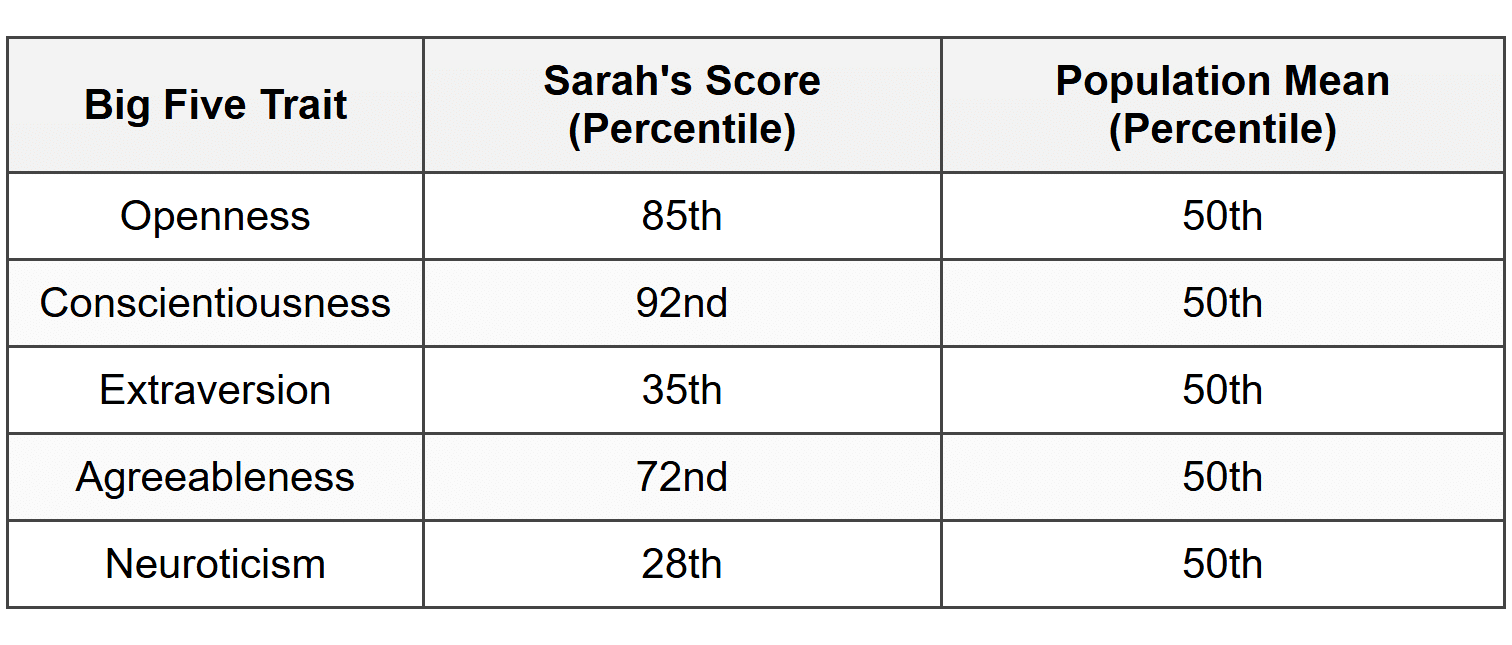
Based on Sarah's Big Five personality profile shown above, which career path would likely be the best fit according to person-environment fit theory?
- Sales representative requiring extensive social interaction and persuasion
- Research scientist requiring attention to detail and independent work
- Emergency room nurse requiring quick decisions under high stress
- Event planner requiring coordination of large social gatherings
Question 13
A news story reports that a woman was attacked in a crowded subway station while dozens of people watched without intervening. Social psychologists explain that the presence of many bystanders actually decreased the likelihood that any individual would help.
This phenomenon is best explained by which combination of psychological processes?
- Social facilitation and deindividuation
- Diffusion of responsibility and pluralistic ignorance
- Group polarization and social loafing
- Conformity and obedience to authority
Question 14
Marcus recently purchased an expensive hybrid car. Although he initially had some concerns about the high price, he now frequently tells his friends about the car's excellent fuel efficiency and environmental benefits while rarely mentioning its cost. He also actively seeks out positive reviews of hybrid vehicles online.
Marcus's behavior following his purchase is best explained by:
- Cognitive dissonance reduction
- The availability heuristic
- Social identity theory
- Operant conditioning
Question 15
In Sigmund Freud's psychoanalytic theory, personality develops through five psychosexual stages. Freud proposed that fixation at a particular stage, caused by either frustration or overindulgence, would result in specific personality characteristics in adulthood.
According to Freud, an adult who is extremely orderly, stingy, and stubborn likely experienced fixation during which psychosexual stage?
- Oral stage
- Anal stage
- Phallic stage
- Latency stage
Question 16
A social psychologist examines leadership effectiveness in corporate settings. She finds that leaders who score high on both initiating structure (task-oriented behaviors) and consideration (relationship-oriented behaviors) produce the most satisfied and productive teams, but only when team members have moderate experience and the tasks have moderate complexity.
This finding best supports which approach to understanding leadership?
- Great person theory
- Transformational leadership theory
- Contingency or situational approach
- Social identity theory of leadership
Question 17
Diana consistently attributes her successes to her own abilities and efforts ("I aced the test because I studied hard and I'm good at math"), but attributes her failures to external factors beyond her control ("I failed the test because the teacher wrote unfair questions").
Diana is demonstrating:
- The fundamental attribution error
- The self-serving bias
- The actor-observer bias
- Defensive pessimism
Question 18
A researcher studying attitude change randomly assigns participants to one of two conditions. In Condition A, participants are paid $50 to write an essay supporting a position they personally oppose. In Condition B, participants are paid only $1 to write the same essay. Afterward, participants rate their actual attitudes toward the position. Results show that Condition B participants showed significantly more attitude change in the direction of the essay they wrote.
These results are best explained by:
- Greater external justification in the low-payment condition leading to cognitive dissonance
- Insufficient external justification in the low-payment condition leading to cognitive dissonance
- The elaboration likelihood model's central route to persuasion
- Social facilitation enhancing attitude change
Question 19
Albert Bandura's social cognitive theory emphasizes reciprocal determinism-the idea that personal factors, behavior, and the environment all influence one another bidirectionally. Bandura also introduced the concept of self-efficacy, the belief in one's ability to succeed in specific situations.
According to Bandura, which experience is the MOST powerful source of self-efficacy beliefs?
- Vicarious experiences (observing others succeed)
- Verbal persuasion (encouragement from others)
- Mastery experiences (personal success on tasks)
- Physiological arousal (interpreting bodily states)
Question 20
A committee of twelve people is deciding whether to approve a controversial new policy. Before the discussion begins, most members are mildly in favor of the policy. After an hour of discussion in which members share their views, the committee becomes strongly in favor of the policy and decides to implement it immediately without further review.
This shift toward a more extreme position following group discussion is best described as:
- Groupthink
- Social loafing
- Group polarization
- Deindividuation
SECTION II: FREE RESPONSE
Directions
Answer both questions in this section. Each response should be written in complete sentences using appropriate psychological terminology. Budget your time carefully-spend approximately 25 minutes on Question 1 and approximately 25 minutes on Question 2.
Question 1: Article Analysis Question (AAQ)
Study Summary: The Effect of Social Norms on Charitable Giving
Researchers at a large public university investigated whether exposure to descriptive social norms (information about what others typically do) would increase charitable donations. The study used a field experiment design conducted during the university's annual charitable giving campaign.
Methodology: Participants (N = 480 university employees) were randomly assigned to one of three conditions when they received their annual donation solicitation email:
- Control condition (n = 160): Standard email requesting donations with information about the charity's mission
- Low-norm condition (n = 160): Same email plus a message stating "15% of employees donated last year"
- High-norm condition (n = 160): Same email plus a message stating "64% of employees donated last year"
The dependent variable was operationally defined as whether or not the participant made a donation of any amount within 30 days of receiving the email (binary outcome: yes/no). Researchers also recorded the dollar amount donated for those who gave.
Ethical Considerations: All participants provided informed consent for their employment data to be used in research studies at the time of hiring. Participation was voluntary, and choosing not to donate had no effect on employment status. The study was approved by the university's Institutional Review Board (IRB). Participants were debriefed about the study's purpose via email after the donation period ended, including clarification that the actual donation rate from the previous year was 42%.
Results:
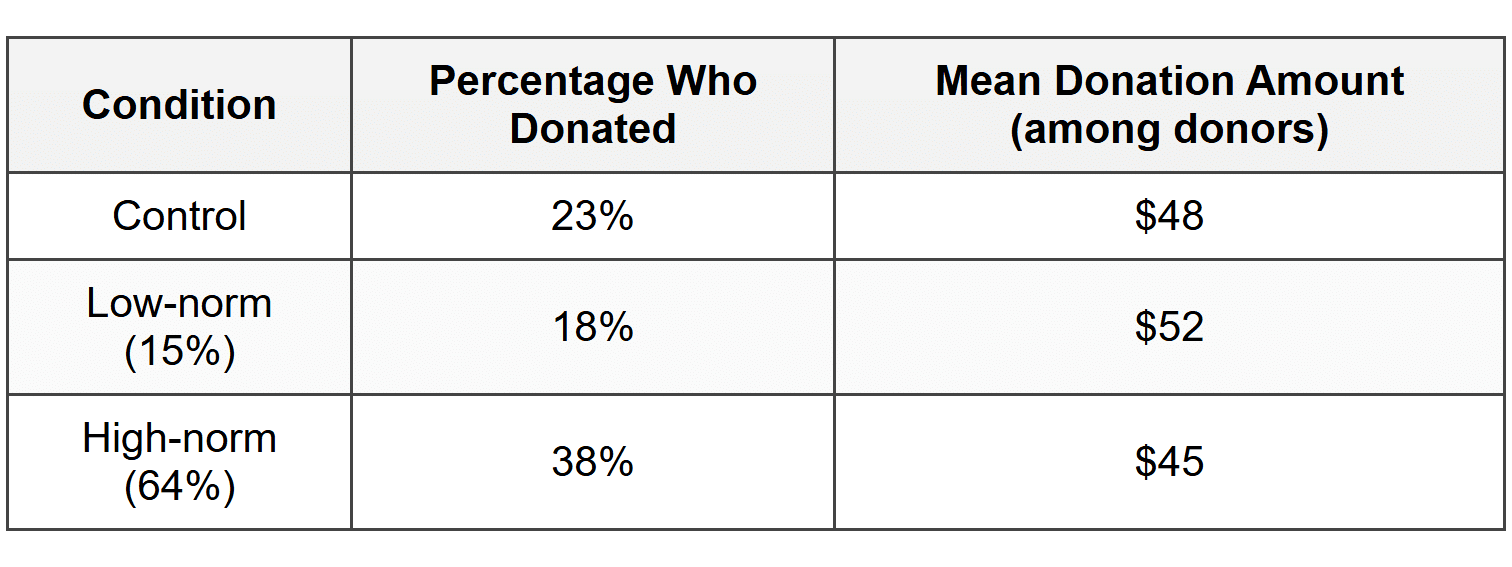
Statistical analysis revealed that the high-norm condition produced significantly higher donation rates than both the control condition (p < 0.01) and the low-norm condition (p < 0.001). The low-norm condition actually produced lower donation rates than the control condition, though this difference was not statistically significant (p = 0.17). There were no significant differences in donation amounts among those who chose to donate.
Use the study summary above to answer the following questions:
- Identify the research method used in this study.
- State the operational definition of the dependent variable used in this study.
- Describe what the data in the results table indicate about the effect of social norm information on donation behavior.
- Identify one ethical guideline that was followed in this study and explain how it was implemented.
- Explain one limitation to the generalizability of this study's findings, using specific information from the study summary to support your answer.
- Explain how the findings from the high-norm condition support the concept of descriptive social norms as presented in social psychology research.
Question 2: Evidence-Based Question (EBQ)
Study A: Stereotype Threat and Academic Performance
Researchers administered a challenging mathematics test to female college students. In the stereotype-threat condition, participants were told before the test that "this test has shown gender differences in the past." In the control condition, participants were told that "this test has been shown to be gender-fair and has not shown gender differences." Results showed that women in the stereotype-threat condition scored significantly lower (M = 5.8 out of 20, SD = 2.4) than women in the control condition (M = 12.1 out of 20, SD = 3.1). The researchers concluded that activating negative stereotypes about women's math abilities impaired performance through increased anxiety and cognitive load.
Study B: Self-Fulfilling Prophecies in the Classroom
Elementary school teachers were given false information about randomly selected students, being told that these students were "intellectual bloomers" who would show dramatic academic gains during the school year. In reality, these students did not differ from their classmates in ability. At the end of the school year, the designated "bloomers" showed significantly greater IQ gains (M = 12.2 points) compared to control students (M = 8.4 points). Classroom observations revealed that teachers gave "bloomer" students more attention, more time to answer questions, and more detailed feedback. The researchers concluded that teachers' expectations shaped their behavior toward students, which in turn influenced actual student achievement.
Researchers sent identical résumés to employers for job openings, varying only the names at the top to suggest different racial identities. Résumés with stereotypically white names (e.g., Emily, Greg) received callbacks for interviews 50% more often than identical résumés with stereotypically African American names (e.g., Lakisha, Jamal). Follow-up surveys showed that employers consciously reported no racial bias and expressed commitment to equal opportunity hiring. The researchers concluded that unconscious or implicit biases influenced hiring decisions despite conscious egalitarian attitudes.
Use the three study summaries above to answer the following questions:
- Identify one common theme or concept that connects all three studies.
- Evaluate the consistency of findings across the three studies. Do the studies support similar conclusions about how social perceptions influence behavior and outcomes? Use specific evidence from at least two studies to support your answer.
- Explain how the concept of cognitive schemas can account for the patterns observed across these three studies.
ANSWER KEY
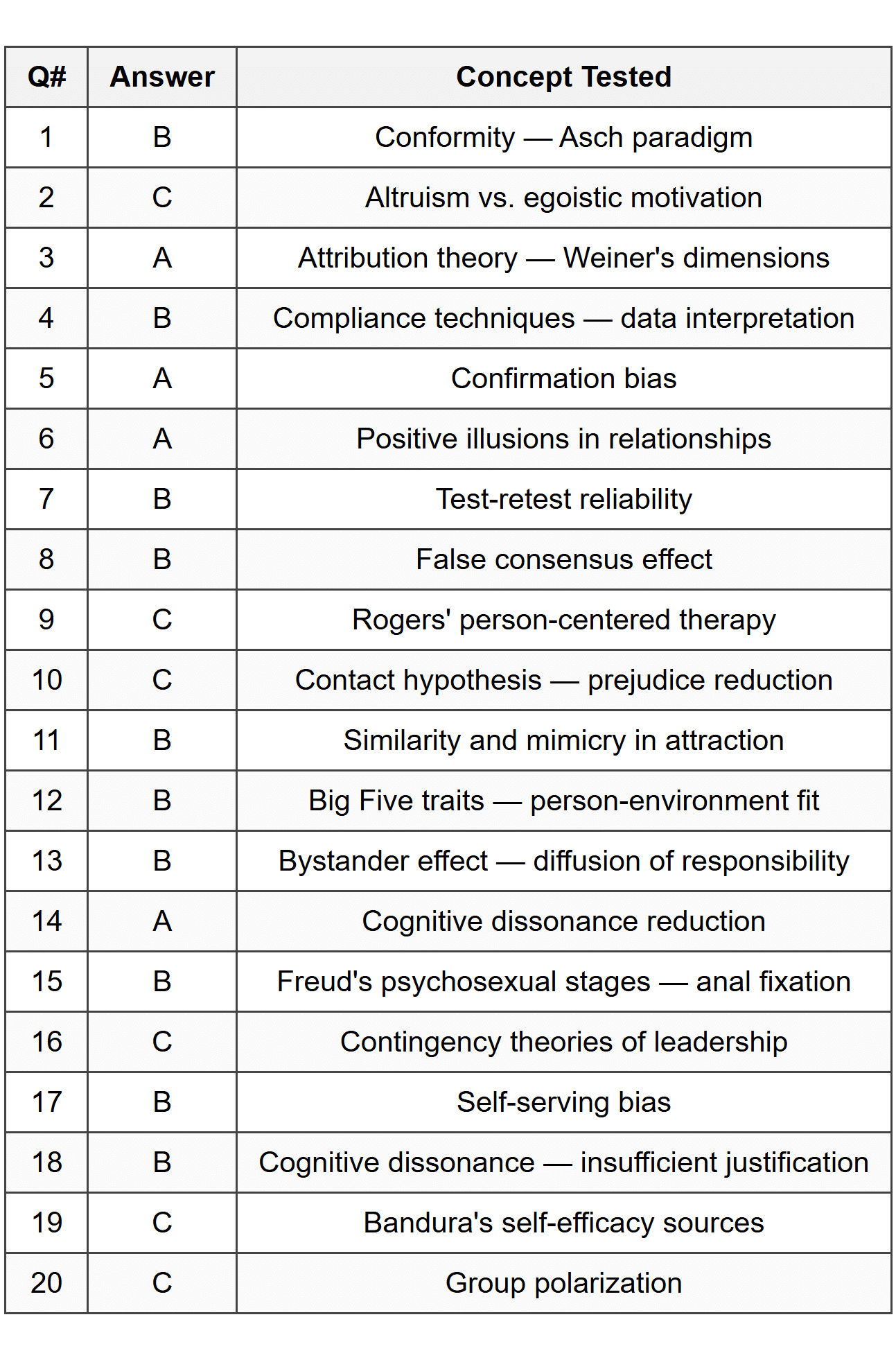
Part A - Multiple Choice Answer Table
Part B - Free Response Question Answer Keys
FRQ 1 - Answer Key (Article Analysis Question)
Part A: Identify the research method
The research method used in this study was a field experiment (or simply experiment). The researchers randomly assigned participants to different conditions and manipulated the independent variable (type of social norm information presented) while measuring the effect on the dependent variable (donation behavior). The study was conducted in a naturalistic setting (the actual university donation campaign) rather than in a laboratory, making it a field experiment.
Part B: State the operational definition of the dependent variable
The operational definition of the dependent variable was whether or not the participant made a donation of any amount within 30 days of receiving the email, measured as a binary yes/no outcome. The researchers also measured donation amount as a secondary dependent variable, operationally defined as the dollar amount donated.
Part C: Describe what the data indicate
The data indicate that exposure to high descriptive social norms (64% donation rate) significantly increased donation behavior, with 38% of participants in that condition donating compared to only 23% in the control condition. In contrast, exposure to low descriptive social norms (15% donation rate) actually decreased donation behavior, with only 18% donating, though this decrease was not statistically significant. The data show that social norm information can have a boomerang effect when the norm describes undesirable behavior-telling people that few others donate may decrease their likelihood of donating. Among those who did donate, the amounts were similar across all conditions (ranging from $45-$52), suggesting that social norms influenced the decision to donate but not the amount given.
Part D: Identify an ethical guideline and explain implementation
Informed consent was followed in this study. The researchers ensured that all participants had provided consent for their employment data to be used in research studies at the time of hiring. Additionally, debriefing was conducted after the study-participants received an email explaining the study's purpose and clarifying that the social norm percentages presented were experimental manipulations, with the true previous-year donation rate being 42%. Another ethical guideline followed was protection from harm-the researchers ensured that choosing not to donate had no negative consequences for employment status, protecting participants from potential coercion or workplace retaliation.
Part E: Explain a limitation to generalizability
One significant limitation to generalizability is that the sample consisted exclusively of university employees at a single public university (N = 480). This limits generalizability because university employees may have stronger institutional loyalty and connection to university-related charities than the general population would have to other charitable causes. Additionally, the sample was limited to individuals with stable employment and regular income, which may not represent populations with different financial circumstances. Therefore, these findings may not generalize to charitable giving in response to social norms in other contexts, such as door-to-door solicitation, online crowdfunding, or appeals to unemployed or lower-income populations. The specific workplace setting may also create unique social pressures that would not exist in more anonymous donation contexts.
Part F: Explain how findings support the concept of descriptive social norms
The findings from the high-norm condition strongly support the concept of descriptive social norms, which are beliefs about what behaviors are typical or common in a given situation. According to social norms theory, people use information about others' behavior as a guide for their own actions, particularly in ambiguous situations. The study showed that when participants were told that 64% of their colleagues donated (a high descriptive norm suggesting that donating is common behavior), they were significantly more likely to donate themselves (38%) compared to the control condition (23%). This demonstrates that descriptive norms function as social proof-people assume that if many others are performing a behavior, it must be appropriate, beneficial, or expected. The finding also supports the theory that descriptive norms are most influential when the reference group is similar or relevant-in this case, fellow university employees represent a relevant comparison group, making their behavior particularly influential in shaping donation decisions.
FRQ 2 - Answer Key (Evidence-Based Question)
Part A: Identify a commonality
One common theme connecting all three studies is that social expectations, stereotypes, or beliefs about individuals can influence actual behavior and outcomes, even when these expectations are inaccurate or unconsciously held. Alternatively, students might identify the common theme as the power of cognitive biases and stereotypes to shape real-world outcomes, or the self-fulfilling nature of social beliefs. All three studies demonstrate that preexisting beliefs-whether about gender and mathematics ability (Study A), student potential (Study B), or race and job qualifications (Study C)-meaningfully impact behavior, performance, or decision-making.
Part B: Evaluate consistency of findings
The three studies show highly consistent findings regarding how social perceptions influence outcomes, though through different mechanisms. Study A demonstrated that activating negative stereotypes about women's math abilities caused actual performance decrements-women scored much lower when stereotype threat was activated (M = 5.8) compared to the control condition (M = 12.1). Study B showed a parallel pattern through a different pathway: teachers' positive expectations about "intellectual bloomers" led to differential treatment (more attention, time, and feedback), which produced actual IQ gains (12.2 points vs. 8.4 points for control students). Both studies show that beliefs about ability-whether negative stereotypes or positive expectations-translate into measurable performance differences. Study C extends this pattern to employment contexts, showing that implicit racial biases led to discriminatory callback rates (50% higher for stereotypically white names) despite employers' conscious egalitarian attitudes. The consistency across all three studies supports the conclusion that social cognitions systematically bias behavior and outcomes across diverse contexts (academic testing, classroom instruction, hiring decisions), even when individuals are unaware of these biases or actively reject them.
Part C: Apply cognitive schemas to explain patterns
Cognitive schemas-organized mental frameworks that help people process information about social groups and situations-can comprehensively account for the patterns observed across these studies. Schemas are activated automatically and guide both perception and behavior, often outside conscious awareness. In Study A, participants held schemas associating women with lower mathematical ability; when these schemas were activated through the stereotype-threat manipulation, they triggered anxiety, increased cognitive load, and negative performance expectations that interfered with test performance. In Study B, teachers activated "gifted student" schemas when told certain students were "bloomers," leading them to unconsciously process these students' behavior through a positive lens and provide schema-consistent treatment (more support and opportunities), which facilitated the students' development. In Study C, employers held schemas linking racial categories to job-relevant characteristics; when processing identical résumés, these schemas were automatically activated by names, biasing perception of qualifications and leading to discriminatory decisions despite conscious commitments to equality. Across all three studies, schemas operated as cognitive filters that shaped interpretation of information, guided behavioral responses, and ultimately created outcomes consistent with the schema-demonstrating that schemas are not merely descriptive beliefs but powerful mechanisms that actively construct social reality through their influence on perception, judgment, and action.