Practice Questions :Population and Migration Patterns and Processes

SECTION I: MULTIPLE CHOICE
Directions
Answer all 20 questions in this section. Each question has four answer choices (A-D). Select the one best answer for each question. Questions in this section may include data tables, maps, graphs, and other visual stimuli that require interpretation and application of human geography concepts.
Questions 1-3 refer to the following table.
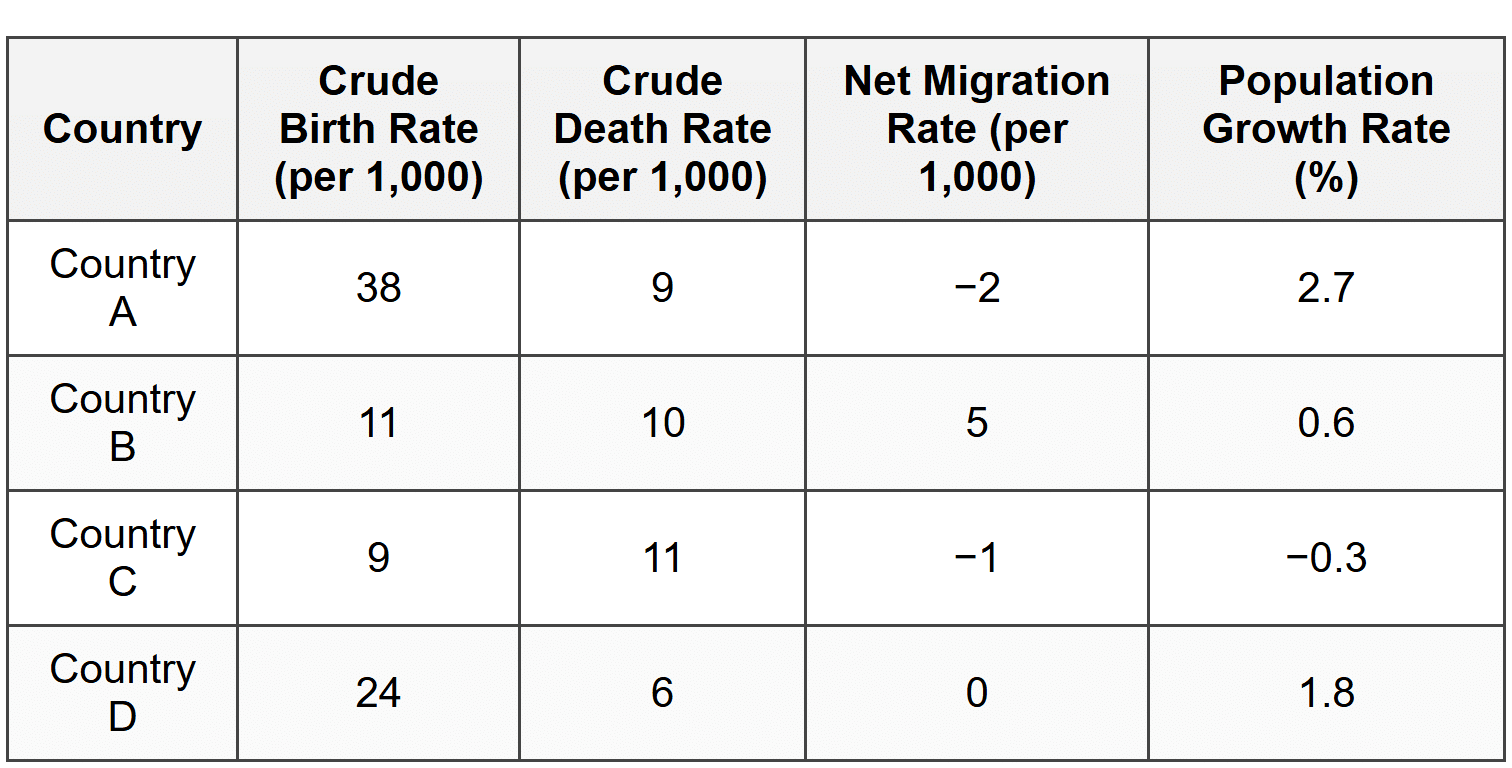
1. Based on the data in Table 1, which country is most likely in Stage 2 of the Demographic Transition Model?
- Country A
- Country B
- Country C
- Country D
2. Country B's population growth is primarily attributable to which demographic factor?
- High natural increase due to declining death rates
- Immigration offsetting low natural increase
- High birth rates characteristic of pro-natalist policies
- Emigration reducing the effects of high fertility
3. Which country in Table 1 faces the most significant demographic challenges associated with an aging population?
- Country A, because emigration reduces the working-age population
- Country B, because immigration creates cultural tensions
- Country C, because deaths exceed births and migration is negative
- Country D, because rapid growth strains healthcare systems
Questions 4-5 refer to the following information.
During the period from 2010 to 2020, approximately 1.2 million Mexican nationals migrated to the United States, while approximately 1.0 million Mexican-born individuals returned to Mexico from the United States. The primary destinations for Mexican migrants within the U.S. were California, Texas, Arizona, and Illinois. Survey data indicate that 62% of Mexican migrants cited employment opportunities as their primary motivation, 18% cited family reunification, 12% cited educational opportunities, and 8% cited violence or insecurity in their home regions.
4. The migration pattern described above between 2010 and 2020 is best characterized as
- net out-migration from Mexico because more people left than returned
- chain migration because family reunification was the primary motivation
- forced migration because violence was a significant push factor
- circular migration because flows occurred in both directions simultaneously
5. The concentration of Mexican migrants in California, Texas, Arizona, and Illinois best illustrates the geographic concept of
- distance decay, as migrants settled in states closest to Mexico
- spatial clustering, as migrants concentrated in specific destination areas
- intervening opportunities, as migrants bypassed closer destinations
- step migration, as migrants moved progressively through multiple locations
Questions 6-7 refer to the following table.
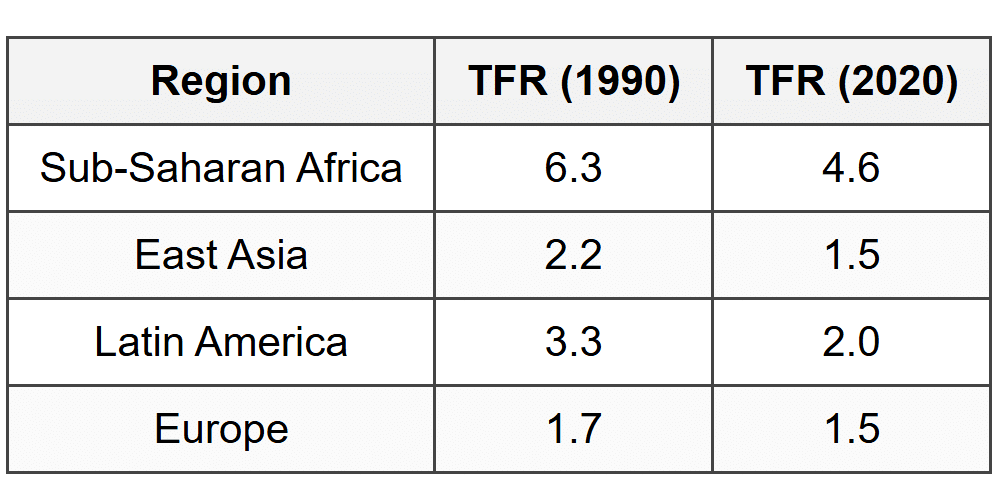
6. Which region experienced the largest absolute decline in total fertility rate between 1990 and 2020?
- Sub-Saharan Africa
- East Asia
- Latin America
- Europe
7. The fertility data for Europe in 2020 most directly suggests that this region will likely experience
- rapid population growth requiring expansion of urban infrastructure
- population decline unless offset by immigration or pro-natalist policies
- a youth bulge creating pressure on educational systems
- increasing crude birth rates as women delay childbearing
8. Ravenstein's laws of migration would predict that
- most international migrants are highly educated professionals seeking better opportunities
- most migrants travel short distances and migration increases with industrialization
- migration flows are primarily driven by political persecution rather than economics
- rural-to-urban migration has decreased with improvements in agricultural technology
Questions 9-10 refer to the following information.
A certain country's population pyramid shows a narrow base, with the 0-14 age cohort representing 16% of the population. The 15-64 age cohort represents 68% of the population, and the 65+ cohort represents 16% of the population. The pyramid shows relatively equal widths across most age groups with a slight narrowing in the youngest cohorts.
9. The population structure described above is most characteristic of a country in which stage of the Demographic Transition Model?
- Stage 2, with high birth rates and declining death rates
- Stage 3, with declining birth rates and low death rates
- Stage 4, with low birth rates and low death rates
- Stage 5, with very low birth rates and increasing death rates
10. A country with the population structure described would most likely face which economic challenge?
- Insufficient jobs for a rapidly growing youth population
- Strain on pension and healthcare systems from an aging population
- Shortage of workers due to high infant mortality rates
- Difficulty providing universal primary education due to rapid growth
11. The gravity model of migration suggests that migration between two places is influenced by
- the cultural similarity between origin and destination populations
- the population size of both places and the distance between them
- government policies restricting or encouraging population movement
- historical colonial relationships between sending and receiving countries
Questions 12-13 refer to the following table.
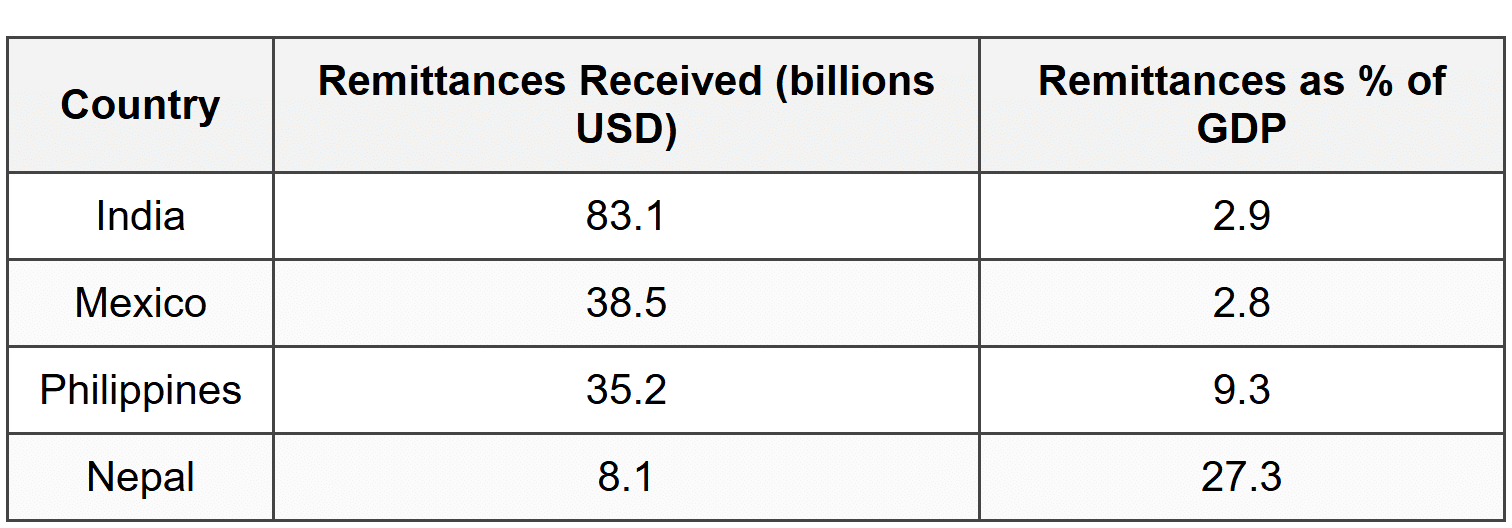
12. Based on the data in Table 3, which country's economy is most dependent on remittances from migrants working abroad?
- India, because it receives the highest absolute amount of remittances
- Mexico, because it has significant emigration to the United States
- Philippines, because remittances represent nearly 10% of its GDP
- Nepal, because remittances account for more than one-quarter of its GDP
13. Remittances sent by international migrants primarily represent
- a form of foreign direct investment in the origin country's industries
- capital flow from destination countries to origin countries supporting families
- development aid provided by governments to reduce emigration pressure
- trade revenue generated by export of labor services to other countries
14. Which of the following scenarios best exemplifies forced migration?
- A software engineer moves from India to the United States for a higher-paying job
- A family relocates from rural Iowa to Chicago seeking better educational opportunities
- Syrian families flee to Turkey and Lebanon to escape civil war and persecution
- Retirees from Canada move to Florida to enjoy warmer winter weather
Questions 15-16 refer to the following information.
According to the United Nations High Commissioner for Refugees (UNHCR), as of 2021, there were approximately 26.6 million refugees worldwide. The top three countries of origin for refugees were Syria (6.8 million), Venezuela (4.6 million), and Afghanistan (2.7 million). The top three host countries were Turkey (3.7 million), Colombia (1.7 million), and Uganda (1.5 million). Notably, 73% of all refugees were hosted in countries neighboring their countries of origin.
15. The fact that 73% of refugees are hosted in neighboring countries best supports which migration principle?
- Distance decay, as refugees typically travel the shortest distance necessary to find safety
- Step migration, as refugees move progressively through multiple countries
- Chain migration, as refugees follow family members who migrated earlier
- Counter-urbanization, as refugees move from urban to rural areas
16. The displacement of 6.8 million people from Syria represents which type of migration factor?
- Economic pull factors attracting migrants to neighboring countries
- Political and social push factors forcing people to leave their homeland
- Environmental push factors due to natural disasters and climate change
- Cultural pull factors related to language and religious similarities
17. The concept of "brain drain" refers to
- the loss of highly skilled and educated workers from developing countries to developed countries
- the cognitive decline associated with aging populations in developed nations
- the reduction in educational quality when schools become overcrowded due to population growth
- the unemployment of educated workers when economic development is insufficient
Questions 18-19 refer to the following table.
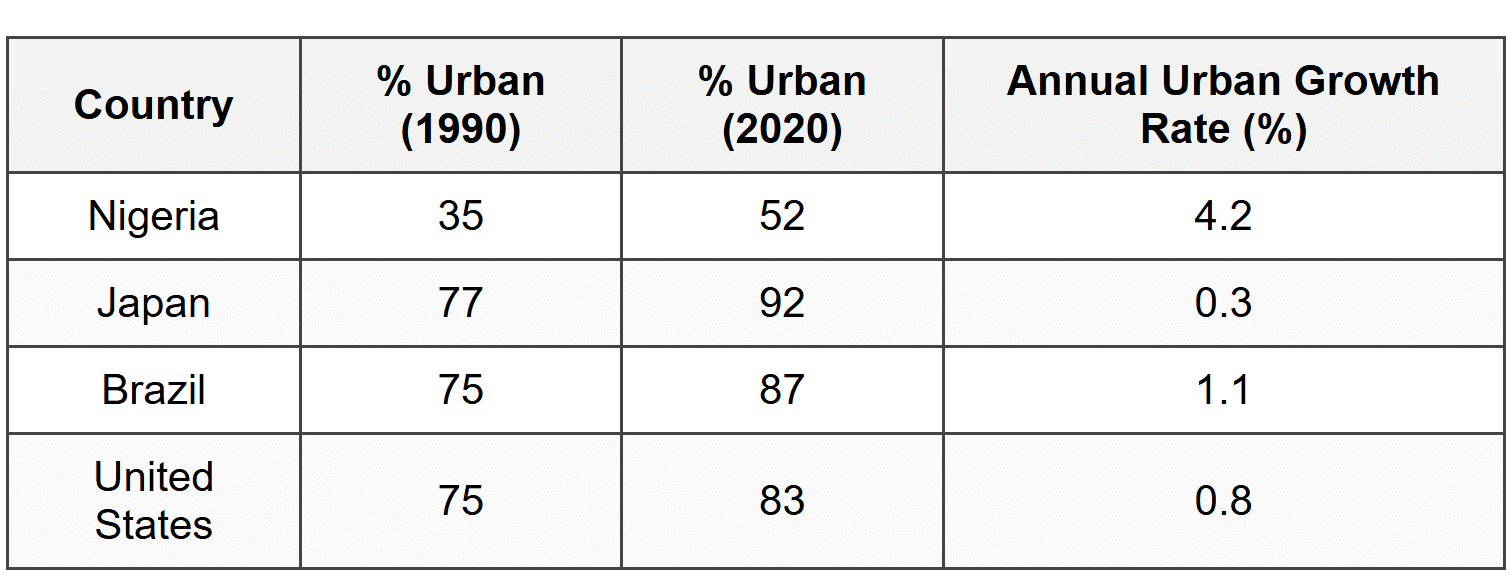
18. Which country is experiencing the most rapid rural-to-urban migration?
- Nigeria
- Japan
- Brazil
- United States
19. The urbanization pattern shown for Nigeria is most characteristic of
- a post-industrial country with slow, stable urban growth
- a developing country experiencing rapid urbanization and internal migration
- a country with counter-urbanization as people leave cities for suburbs
- a country with minimal population growth and stable settlement patterns
20. Which of the following best describes the relationship between the Demographic Transition Model and migration patterns?
- Countries in Stage 2 typically experience high emigration due to limited economic opportunities for growing populations
- Countries in Stage 4 typically experience high emigration as aging populations seek retirement destinations
- Countries in Stage 5 typically experience high emigration as young workers seek opportunities in developing nations
- Countries in Stage 3 typically experience high immigration as labor demands increase with declining birth rates
SECTION II: FREE RESPONSE
Directions
Answer both questions in this section. Each question has three sub-parts (A, B, C). Use complete sentences; a formal essay is not required. Clearly label each part of your response (A, B, C) to ensure proper credit. Read each question carefully and respond directly to all parts. Your responses should demonstrate your ability to define concepts, explain geographic patterns and processes, and apply human geography principles to real-world situations.
Question 1
[Description: The population pyramid shows a triangular shape with a very wide base. The 0-4 age cohort is the largest, representing approximately 14% of the total population. Each successive age group is progressively smaller. The 65+ age cohort represents only about 3% of the population. The male and female distributions are roughly symmetrical. The overall shape indicates high birth rates and relatively high death rates, with few people surviving to old age.]
- Identify the stage of the Demographic Transition Model represented by Country X's population pyramid.
- Explain how the population structure shown in the pyramid creates specific economic challenges for Country X related to dependency ratios.
- Describe TWO policies that Country X could implement to address the challenges created by its current demographic structure, and explain how each policy would help.
Question 2
Countries in the Arabian Gulf region, including the United Arab Emirates, Qatar, Saudi Arabia, and Kuwait, have experienced massive immigration over the past four decades. In these countries, migrant workers from South Asia, Southeast Asia, and other regions often constitute 50-90% of the total workforce. Most migrants work in construction, domestic service, and hospitality industries. These workers typically arrive on temporary work visas (kafala system), live in labor camps separated from the citizen population, send significant portions of their earnings home as remittances, and have limited pathways to permanent residency or citizenship.
- Define the concept of guest worker programs as illustrated by the kafala system in Gulf states.
- Explain how the migration pattern described above reflects the push-pull model of migration, identifying specific push factors in origin countries and pull factors in destination countries.
- Analyze ONE positive economic impact and ONE negative social impact of guest worker migration on either the origin countries or the destination countries, using specific evidence from the scenario.
ANSWER KEY
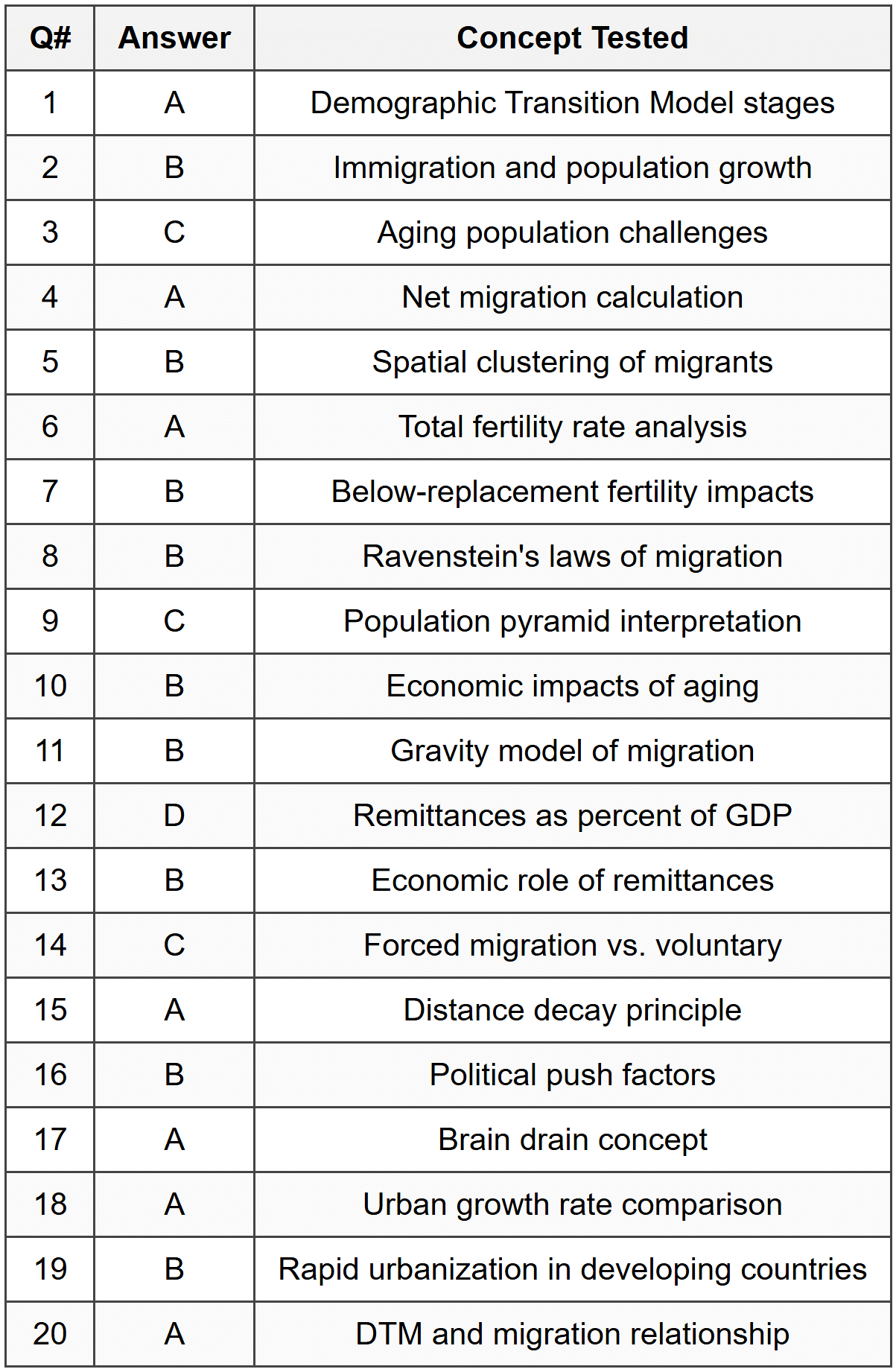
Part A - Multiple Choice Answer Table
Part B - Free Response Question Answers
FRQ 1 - Answer Key
Part A: Identify the stage of the Demographic Transition Model
Country X is in Stage 2 of the Demographic Transition Model. The very wide base of the pyramid indicates high birth rates, while the rapid tapering toward older age groups suggests that death rates have begun to decline but remain relatively high compared to developed countries. The small proportion of elderly people (only 3% aged 65+) and the large youth cohort (14% in the 0-4 age group) are characteristic features of Stage 2, often seen in developing countries that have experienced improvements in healthcare and sanitation but have not yet experienced significant fertility decline.
Part B: Explain economic challenges related to dependency ratios
The population structure creates a high youth dependency ratio, meaning that a large proportion of the population is under age 15 and economically dependent on the working-age population. This creates several economic challenges: First, Country X must invest heavily in education infrastructure, building schools and training teachers to accommodate the large youth cohort, which diverts resources from other development priorities. Second, as these young people enter the labor force over the next 10-20 years, the economy must create millions of new jobs to employ them; failure to do so can lead to high youth unemployment, social instability, and potential emigration of young workers (brain drain). Third, families must support many children on limited incomes, which can perpetuate cycles of poverty and limit household savings and investment capacity.
Part C: Describe TWO policies to address demographic challenges
Policy 1: Expand access to family planning and reproductive health services. By providing education about contraception and making family planning services widely available, especially in rural areas, Country X can help reduce birth rates over time. This would gradually reduce the youth dependency ratio, allowing families to invest more in each child's education and health, and reducing pressure on the government to expand schools and create jobs at an unsustainable rate. This policy has been successfully implemented in countries like Thailand and Bangladesh, which saw fertility declines from above 6 children per woman to around 2-3 within a few decades.
Policy 2: Invest in labor-intensive industries and vocational education. Country X should focus economic development on sectors that can absorb large numbers of young workers, such as manufacturing, construction, and services. By establishing vocational training programs that teach practical skills aligned with labor market demands, the government can help ensure that young people entering the workforce have employable skills. This addresses the challenge of creating sufficient employment opportunities for the demographic bulge and can transform the large youth population into a "demographic dividend" if workers are productively employed, generating economic growth and tax revenue that can support continued development.
FRQ 2 - Answer Key
Part A: Define guest worker programs
Guest worker programs are temporary labor migration systems in which workers are admitted to a country for a specific period to fill labor shortages, typically in low-skilled sectors, but are not granted permanent residency or a pathway to citizenship. The kafala system in Gulf states exemplifies this concept: migrant workers receive temporary work visas sponsored by a specific employer (the kafeel), must work for that employer for the duration of their visa, have limited rights to change employers or remain in the country after their contract ends, and are expected to return to their home countries rather than settle permanently. This system treats labor as a temporary commodity rather than as a basis for permanent immigration.
Part B: Explain the push-pull model in this context
The massive labor migration to Gulf states clearly reflects the push-pull model of migration. Push factors in origin countries include limited economic opportunities and low wages in South Asian and Southeast Asian countries like India, Pakistan, Bangladesh, the Philippines, and Nepal, where large populations face unemployment or underemployment; poverty and lack of economic development in rural areas where many migrants originate; and in some cases, political instability or environmental challenges that limit livelihood options. Pull factors in Gulf destination countries include significantly higher wages than available in origin countries-even low-skilled construction or domestic work may pay 3-10 times what workers could earn at home; abundant employment opportunities created by oil wealth funding massive infrastructure and real estate development; and relatively accessible entry through established recruitment networks and kafala sponsorship systems. The large remittance flows from Gulf states back to origin countries demonstrate that wage differentials remain the primary motivation for this migration pattern.
Part C: Analyze one positive economic impact and one negative social impact
Positive economic impact on origin countries: Guest worker migration generates substantial remittance income that supports economic development in origin countries. As stated in the scenario, migrant workers send significant portions of their earnings home, and in countries like the Philippines, Nepal, and parts of India, these remittances represent a major source of foreign exchange and household income. For example, remittances allow families to invest in children's education, improve housing, start small businesses, and purchase consumer goods, which stimulates local economic activity. At the national level, remittances can exceed foreign aid and contribute significantly to GDP, helping to reduce poverty rates and improve living standards even while workers are abroad. This creates a direct economic benefit that can help fund development in areas with limited other sources of capital.
Negative social impact on destination countries: The guest worker system creates social segregation and limited integration of the migrant population in Gulf states. As described in the scenario, migrant workers live in labor camps separated from the citizen population, have no pathway to permanent residency or citizenship, and constitute 50-90% of the workforce but remain socially and legally marginalized. This creates a highly stratified society with a privileged citizen class and a large subordinate migrant underclass, limited social cohesion between groups, and potential for exploitation and human rights concerns since workers have limited legal protections and cannot easily change employers under the kafala system. The temporary and segregated nature of this migration prevents the development of a multicultural society and ensures that despite migrants' essential economic role, they remain perpetual outsiders with no stake in the long-term development of the destination country.




