Practice Questions :Cultural Patterns and Processes

SECTION I: MULTIPLE CHOICE
Directions
Select the best answer for each question. Each question has four possible responses labeled A through D. Questions may include data tables, statistical information, or descriptive scenarios that you will need to interpret and analyze.
Questions 1-3 refer to the following table:
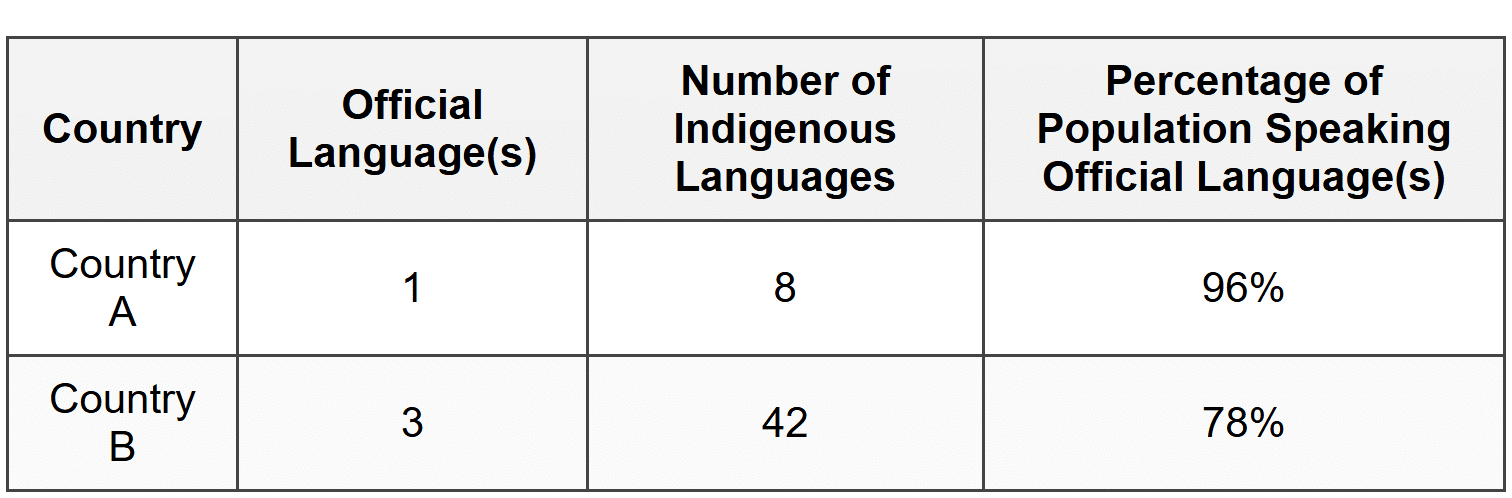
1. Based on the data in Table 1, which of the following best explains the difference between Country A and Country B in terms of cultural identity?
- Country A likely has a stronger sense of national unity due to linguistic homogeneity, while Country B demonstrates greater cultural pluralism
- Country B has eliminated indigenous cultures more effectively through language policy than Country A
- Country A demonstrates greater respect for indigenous populations by maintaining fewer official languages
- Country B has a higher literacy rate due to its multiple official languages
2. The pattern shown in Table 1 for Country B is most characteristic of which of the following types of states?
- A nation-state with strong centripetal forces
- A multi-ethnic state with potential centrifugal forces
- A microstate with limited linguistic diversity
- A city-state with a homogeneous population
3. Which of the following processes would most likely explain why Country A has only 8 indigenous languages compared to Country B's 42?
- Country A experienced more extensive language extinction through historical assimilation policies
- Country A has greater geographic area allowing for linguistic isolation
- Country B adopted lingua francas more recently than Country A
- Country B has lower population density preventing language contact
Questions 4-5 refer to the following information:
In Region X, census data from 1980 showed that 85% of the population identified with Religion A, 10% with Religion B, and 5% as non-religious. By 2020, the composition had shifted: 52% identified with Religion A, 28% with Religion B, 15% as non-religious, and 5% with other religions. During this period, the region experienced significant immigration from countries where Religion B is predominant, as well as increased urbanization and education levels.
4. The change in religious composition in Region X between 1980 and 2020 best illustrates which of the following cultural processes?
- Religious fundamentalism driven by reaction to globalization
- Syncretism resulting from the blending of two distinct religious traditions
- Cultural divergence caused by isolated communities maintaining traditions
- Secularization combined with increased religious pluralism through migration
5. Which of the following would be the most effective method for geographers to analyze the spatial distribution of these religious changes within Region X?
- Calculate the arithmetic density of religious buildings per square kilometer
- Create a choropleth map showing the percentage change in Religion A adherents by district
- Measure the distance decay effect from the region's original settlement hearth
- Conduct a gravity model analysis of religious pilgrim flows
Questions 6-8 refer to the following table:
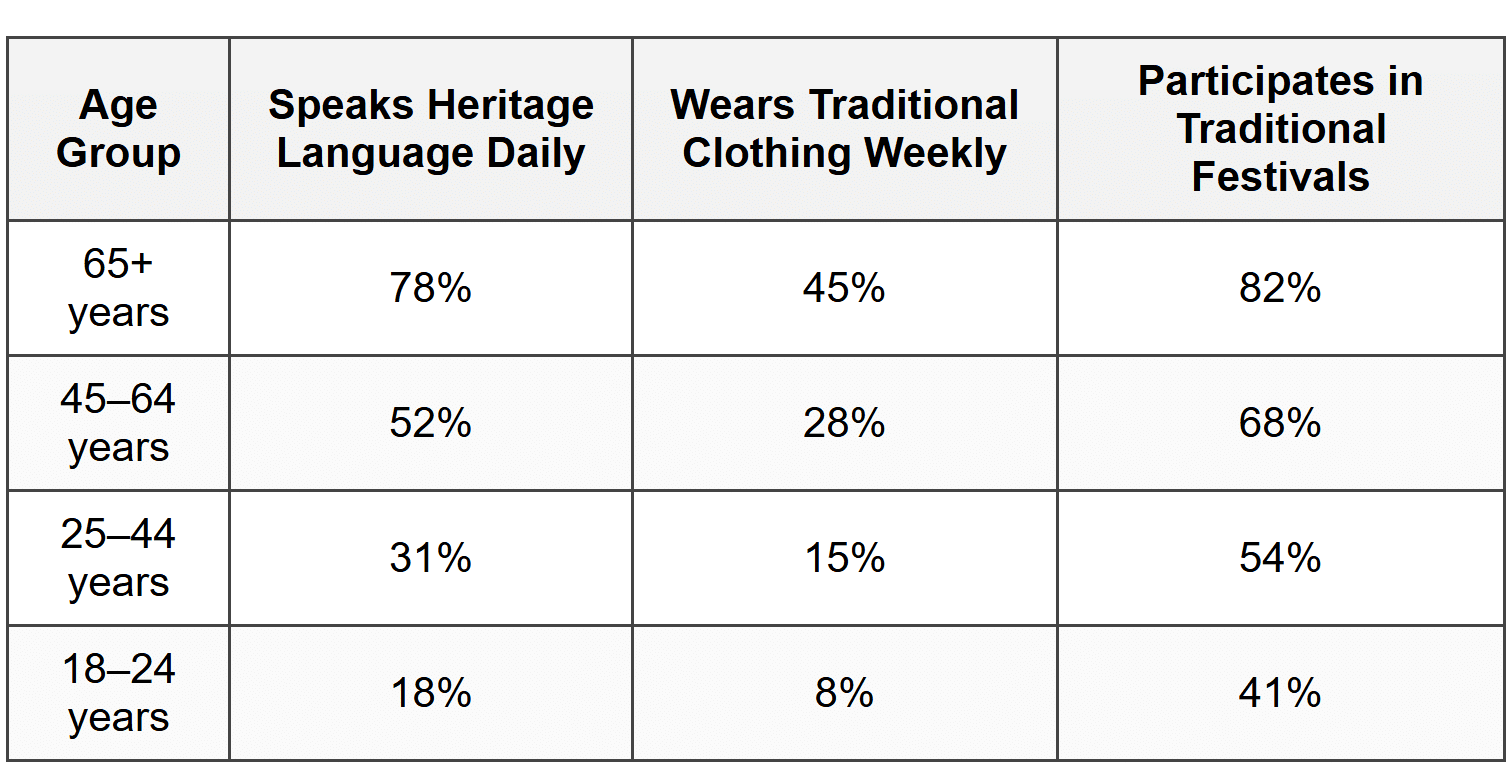
6. The pattern shown in Table 2 most strongly supports which of the following conclusions about cultural transmission?
- Younger generations are experiencing cultural assimilation as traditional practices decline with age
- Traditional festivals are more resistant to cultural change than language and clothing practices
- Heritage language use increases as individuals age due to retirement patterns
- Cultural globalization has equally affected all aspects of traditional culture
7. Based on the data in Table 2, which of the following strategies would most likely be effective in preserving the heritage language for future generations?
- Requiring traditional clothing in public schools
- Implementing immersion language programs for children and young adults
- Restricting festival participation to fluent speakers only
- Documenting language usage patterns among elderly speakers
8. The trend shown in Table 2 is most similar to patterns observed in which of the following cultural contexts?
- The revival of Gaelic language in Ireland through government education policies
- The decline of indigenous languages among Native American youth in the United States
- The spread of English as a lingua franca in international business
- The invention of new pidgin languages in trade centers
9. A geographer studying the diffusion of hip-hop culture from the United States to South Korea observes that Korean artists have adapted the music style while incorporating traditional Korean instruments and language. This process best exemplifies which of the following concepts?
- Relocation diffusion resulting in cultural extinction
- Stimulus diffusion leading to cultural hybridization
- Hierarchical diffusion creating cultural convergence
- Contagious diffusion producing cultural imperialism
Questions 10-11 refer to the following information:
Neighborhood Z in a large metropolitan area is characterized by signage in both the dominant national language and Language Y, numerous restaurants serving cuisine from Country Y, cultural centers offering Language Y classes, and shops selling imported goods from Country Y. Census data shows that 68% of residents were born in Country Y or have parents who were born there. The neighborhood developed primarily between 1990 and 2010 following changes in immigration policy.
10. Neighborhood Z is best described as an example of which of the following cultural landscape features?
- A cultural hearth where new cultural practices originate
- An ethnic enclave formed through chain migration
- A squatter settlement resulting from rural-to-urban migration
- A gated community designed for cultural isolation
11. Which of the following best explains why ethnic enclaves like Neighborhood Z often form in urban areas?
- Zoning laws require immigrants to settle in designated cultural districts
- Social networks among immigrants provide economic support and cultural familiarity
- Property values are universally lower in neighborhoods with ethnic businesses
- Urban planning policies mandate ethnic segregation for administrative purposes
Questions 12-13 refer to the following table:
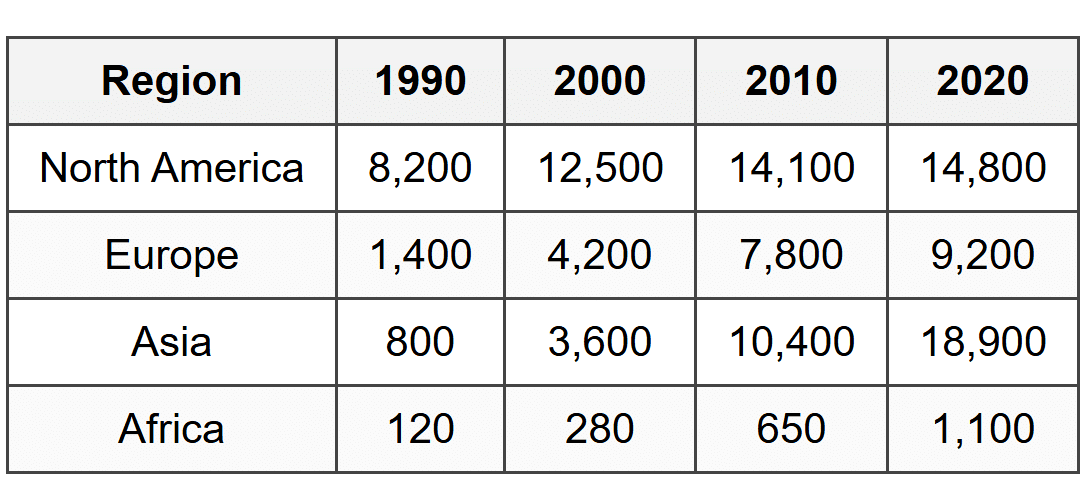
12. The data in Table 3 best illustrate which type of diffusion pattern?
- Contagious diffusion from rural to urban areas within each region
- Hierarchical diffusion from the hearth region to major global cities before spreading to smaller cities
- Relocation diffusion through migration of restaurant workers
- Stimulus diffusion as local restaurants imitate the business model without franchise ownership
13. Which of the following conclusions is best supported by the growth rate pattern shown in Table 3 between 1990 and 2020?
- Africa experienced the highest absolute growth in locations, indicating the most successful market expansion
- Asia's growth rate accelerated most dramatically, suggesting increased globalization and economic development in that region
- North America reached market saturation earliest, as indicated by declining growth rates after 2010
- Europe maintained consistent linear growth throughout the period due to cultural resistance to fast food
14. A country passes legislation declaring one language as the official national language and requiring all government services, education, and business to be conducted in that language, despite having significant minority populations speaking other languages. This policy is most likely intended to promote which of the following?
- Centrifugal forces by emphasizing cultural diversity
- Centripetal forces by creating linguistic unity
- Balkanization by encouraging regional autonomy
- Devolution by transferring power to linguistic minorities
Questions 15-16 refer to the following information:
In Region M, traditional houses are built with thick adobe walls, small windows, flat roofs with interior courtyards, and rooms arranged around a central open space. These architectural features have been used for over 500 years. Recently, newer construction in the region features large glass windows, peaked roofs, and open floor plans, similar to designs popular in Western Europe and North America.
15. The traditional architecture described in Region M most likely developed in response to which of the following environmental or cultural factors?
- A tropical rainforest climate requiring protection from heavy rainfall and humidity
- An arid climate requiring thermal regulation and a cultural emphasis on private family space
- A subarctic climate requiring insulation from extreme cold temperatures
- A maritime climate requiring ventilation to prevent moisture accumulation
16. The shift from traditional to modern architectural styles in Region M is best explained by which of the following processes?
- Environmental determinism forcing adaptation to climate change
- Cultural convergence through globalization and media exposure
- Possibilism limiting the range of available building materials
- Sequent occupance as different ethnic groups replace one another
Questions 17-18 refer to the following table:
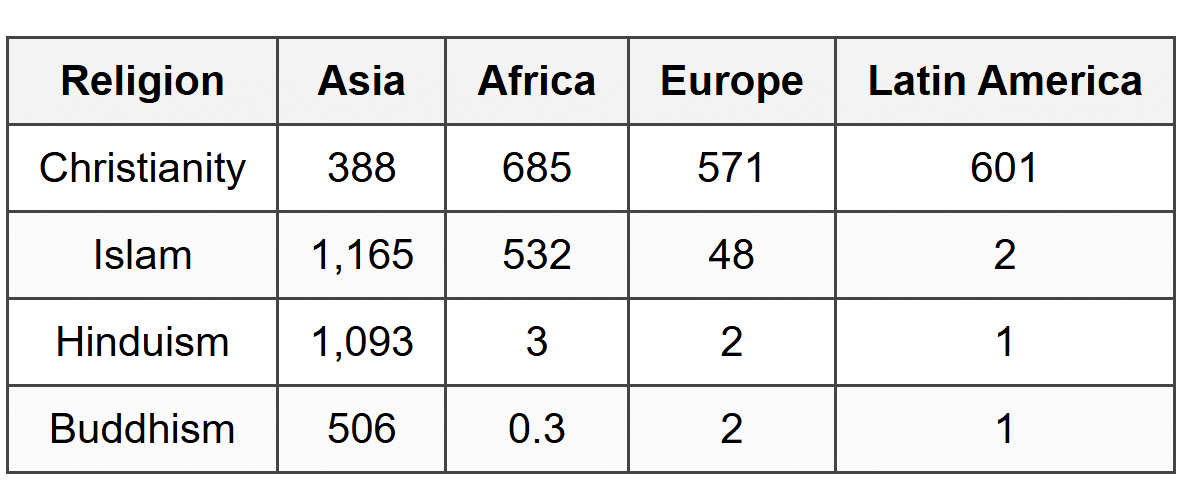
17. The distribution pattern shown in Table 4 indicates that Hinduism and Buddhism are best classified as which type of religion?
- Universalizing religions with active missionary traditions
- Ethnic religions concentrated near their hearth regions
- Syncretic religions formed by blending multiple traditions
- Monotheistic religions originating in Southwest Asia
18. Which of the following best explains why Christianity has relatively high numbers of adherents in Africa and Latin America compared to its hearth region in Southwest Asia?
- Environmental factors in Africa and Latin America were more conducive to Christian practices
- Christianity spread through relocation diffusion as the entire population of Southwest Asia migrated
- Colonial expansion and missionary activity promoted Christianity's hierarchical diffusion through expansion diffusion
- Christianity emerged independently in multiple hearth regions including Africa and Latin America
19. A cultural geographer studying gender roles observes that in Country P, women traditionally have limited access to education and employment outside the home, while in Country Q, women participate equally in higher education and the workforce. These differences are most directly explained by variations in which of the following?
- The physiological density of agricultural populations
- Cultural attitudes and social norms regarding gender
- The stage of the demographic transition model
- Absolute location and distance from the equator
20. Indigenous groups in the Amazon rainforest have increasingly used social media and GPS technology to document illegal logging and mining on their traditional lands. This use of modern technology while maintaining traditional territorial practices best exemplifies which of the following concepts?
- Cultural extinction as traditional practices are completely abandoned
- Folk culture resisting all forms of technological innovation
- Cultural adaptation where traditional goals are pursued through new methods
- Cultural relativism evaluating practices without judgment
SECTION II: FREE RESPONSE
Directions
Answer both questions in this section. It is recommended that you spend approximately 25 minutes on each question. Use complete sentences; an outline or bulleted list alone is not acceptable. Each free response question has three sub-parts (A, B, and C). Sub-part A typically asks you to define or identify a concept; sub-part B asks you to explain a pattern or process; and sub-part C asks you to analyze, evaluate, or apply geographic concepts using real-world examples.
FRQ 1
A map shows the distribution of major language families across Europe. The Indo-European language family dominates most of the continent, subdivided into Romance languages (Spanish, French, Italian, Portuguese, Romanian) in southern and western Europe; Germanic languages (German, English, Dutch, Swedish, Norwegian, Danish) in northern and central Europe; and Slavic languages (Russian, Polish, Czech, Serbian, Bulgarian) in eastern Europe. Isolated within this Indo-European dominance are three notable exceptions: Basque (a language isolate in northern Spain and southern France), Finnish and Estonian (Uralic language family in northern Europe), and Hungarian (also Uralic, in central Europe). The map uses different colors to distinguish language families and patterns to show subdivisions within the Indo-European family.
- Define the term "language family" as used in linguistic geography.
- Explain how the distribution of Slavic languages in Eastern Europe reflects historical migration and cultural diffusion patterns.
- Analyze why Basque has survived as a language isolate despite being surrounded by Indo-European languages, using the concept of cultural geography and at least one specific geographic factor.
FRQ 2
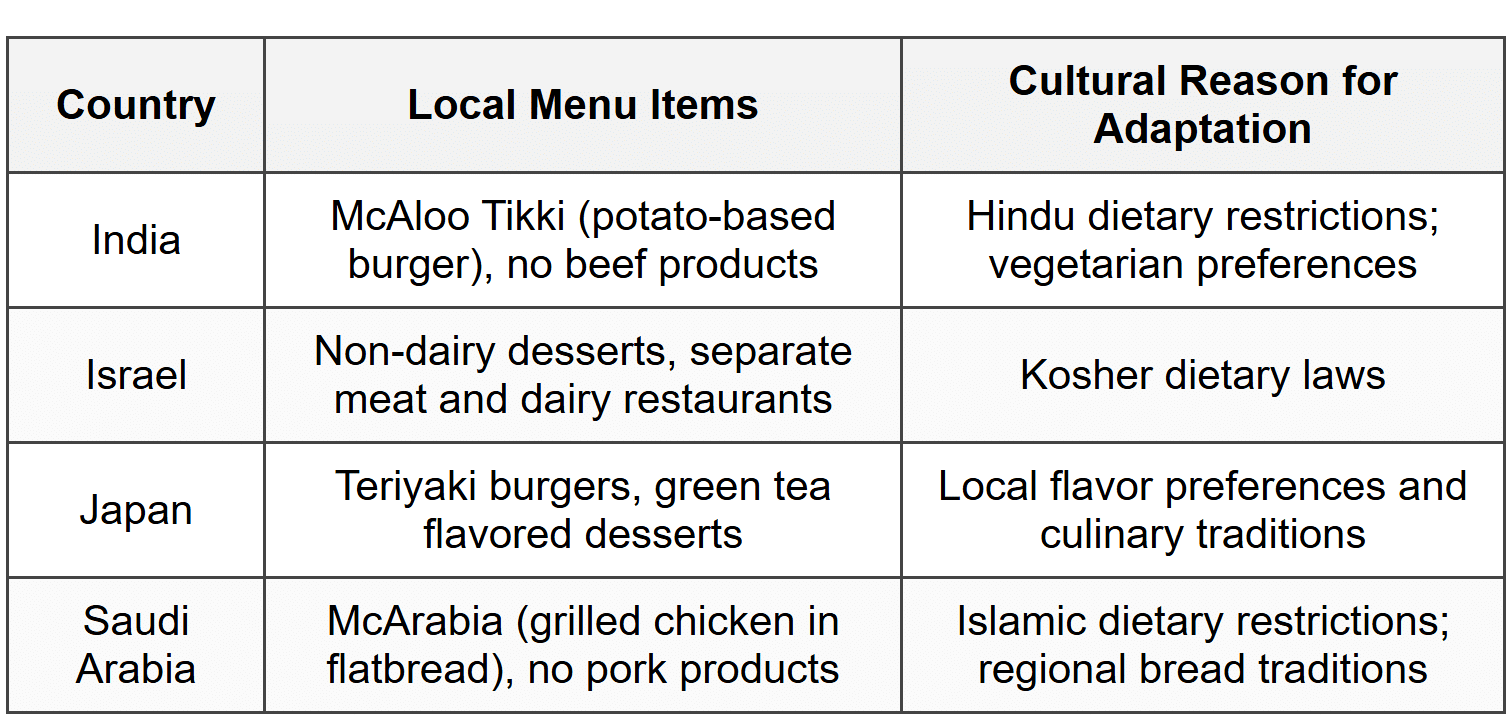
- Identify the cultural phenomenon illustrated by McDonald's menu adaptations in different countries.
- Explain how the process of globalization has led to both cultural convergence and cultural divergence in the fast food industry.
- Evaluate the extent to which transnational corporations like McDonald's contribute to the loss of traditional food cultures, using specific examples from the table or other real-world evidence.
ANSWER KEY
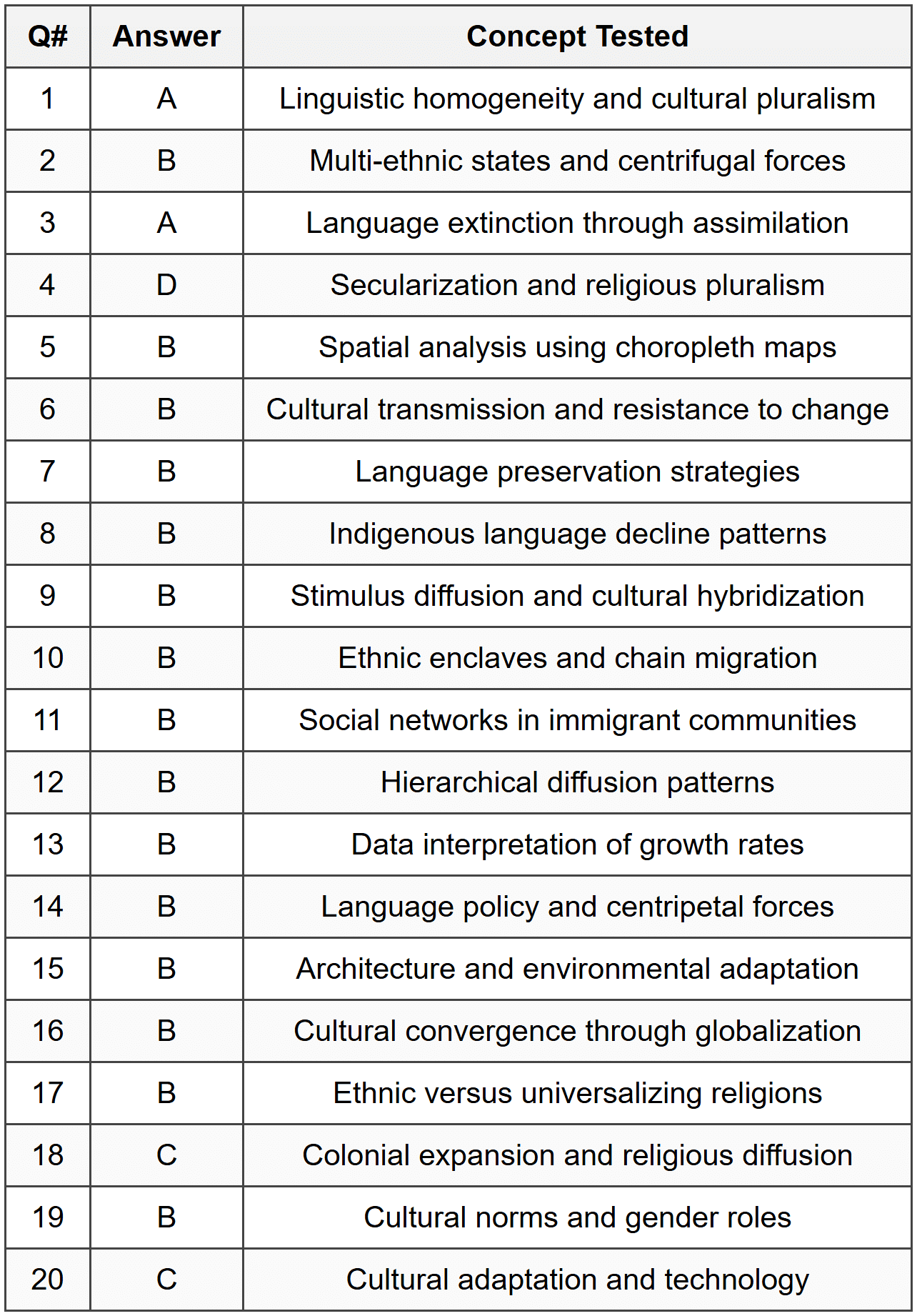
Part A - Multiple Choice Answer Table
Part B - Free Response Question Answer Key
FRQ 1 - Answer Key
Part A: Define language family
A language family is a collection of languages that share a common ancestral language (proto-language) and have evolved from it over time through processes of linguistic divergence and spatial separation. Languages within the same family exhibit similarities in vocabulary, grammar, and phonetic structures that reflect their shared origin. For example, the Indo-European language family includes languages as diverse as Spanish, English, Hindi, and Russian, all of which descended from a common proto-Indo-European ancestor spoken thousands of years ago.
Part B: Explain Slavic language distribution
The distribution of Slavic languages across Eastern Europe reflects historical migration patterns from their hearth region in present-day Ukraine and Belarus. During the early medieval period (approximately 500-1000 CE), Slavic-speaking peoples migrated in three major directions: westward into areas that became Poland and the Czech Republic (West Slavic languages); southward into the Balkans, displacing or assimilating earlier populations and creating South Slavic languages like Serbian, Bulgarian, and Croatian; and eastward into Russia, where East Slavic languages including Russian, Ukrainian, and Belarusian developed. This expansion pattern represents relocation diffusion, as speakers physically moved to new territories and established linguistic dominance through settlement, political control, and cultural influence. The geographic continuity of Slavic languages from Poland to Russia demonstrates how migration corridors and lack of major physical barriers facilitated the spread of these related languages across a vast territory.
Part C: Analyze Basque survival as language isolate
Basque has survived as a language isolate despite complete encirclement by Indo-European languages due to a combination of geographic isolation and strong cultural identity. The geographic factor most responsible is the rugged terrain of the Pyrenees Mountains and the Basque highlands, which created physical barriers that limited contact with surrounding populations and invasions by groups speaking Indo-European languages (including Romans, Visigoths, and later Spanish and French speakers). This isolation reduced the influence of more widespread languages and allowed Basque communities to maintain linguistic continuity over thousands of years. Additionally, the Basque people developed a strong sense of ethnic and cultural identity distinct from surrounding Spanish and French populations, which manifested in resistance to assimilation and deliberate efforts to preserve the language through family transmission, cultural institutions, and more recently through education policy and political advocacy for regional autonomy. The combination of topographic isolation protecting early Basque speakers and conscious cultural preservation by later generations explains why this pre-Indo-European language survived in a region otherwise dominated by languages from a different family. This case illustrates how physical geography can create cultural regions that resist broader linguistic diffusion patterns.
FRQ 2 - Answer Key
Part A: Identify cultural phenomenon
The cultural phenomenon illustrated by McDonald's menu adaptations is glocalization (also acceptable: cultural hybridization or adaptation). Glocalization refers to the process by which global corporations or cultural practices are modified to accommodate local cultural preferences, religious requirements, and traditions, creating products that blend global standardization with local customization.
Part B: Explain globalization's dual effects
Globalization has led to both cultural convergence and cultural divergence in the fast food industry through simultaneous but opposing processes. Cultural convergence occurs as McDonald's and similar chains establish restaurants worldwide, introducing standardized restaurant formats, service models, and core menu items (like hamburgers and french fries) to diverse populations. This spreads American fast food culture globally and creates similarities in dining experiences across countries-for example, the familiar golden arches, counter service, and quick meal concept are now recognizable from Tokyo to São Paulo. However, cultural divergence simultaneously occurs as these corporations adapt to local cultural contexts to ensure acceptance and commercial success. The table demonstrates this through religiously-motivated menu modifications (removing beef in India due to Hindu beliefs, eliminating pork in Saudi Arabia due to Islamic dietary laws, separating meat and dairy in Israel for kosher compliance) and flavor adaptations (teriyaki burgers in Japan, McArabia flatbread in Saudi Arabia). These adaptations acknowledge and reinforce cultural differences rather than eliminating them. The result is a paradox of globalization: while the physical presence of global brands creates surface-level homogeneity (convergence), the actual products and practices maintain or even emphasize local cultural distinctions (divergence), producing a complex landscape where global and local influences coexist.
Part C: Evaluate impact on traditional food cultures
Transnational corporations like McDonald's have a mixed but significant impact on traditional food cultures, contributing to some cultural loss while simultaneously adapting in ways that may preserve certain elements. Evidence supporting cultural loss includes the displacement of traditional eating patterns, particularly among younger generations who may prefer fast food's convenience and global cachet over time-intensive traditional meals. For example, in Japan, the proliferation of fast food has contributed to declining consumption of traditional washoku (Japanese cuisine) among urban youth, representing a shift away from cultural food heritage. The standardization of flavors and globalization of palates may reduce demand for regional specialties and traditional preparation methods. However, the evidence also suggests limitations to this cultural homogenization. The adaptations shown in the table-such as India's McAloo Tikki using local ingredients and preparation styles, or Saudi Arabia's McArabia incorporating traditional flatbread-demonstrate that global corporations must accommodate rather than replace deeply-rooted cultural practices, especially those connected to religion. These adaptations paradoxically keep certain traditional elements (vegetarianism, kosher practices, flatbread) viable in a modern context. Furthermore, the presence of foreign fast food has sometimes sparked culinary nationalism and movements to preserve traditional foodways as a form of cultural resistance-for instance, Italy's Slow Food movement emerged partly in response to the opening of a McDonald's in Rome. Overall evaluation: While McDonald's and similar corporations do contribute to dietary homogenization and may erode some traditional food cultures through convenience-based replacement, their need to adapt to local norms demonstrates the resilience of deeply-embedded cultural practices, and their presence has sometimes catalyzed efforts to consciously preserve traditional cuisines. The impact is neither total cultural destruction nor complete preservation, but rather a complex negotiation between global and local forces.