Writing Bridges and Hooks


Writing Bridges and Hooks
1. Understanding Hooks: Your Song's Magnetic Centre
Think about the last song you couldn't get out of your head. What was it? The opening guitar riff? A phrase that kept repeating? That unforgettable melody in the chorus? Congratulations-you've just identified a hook. Hooks are the sticky, memorable elements that grab your listener's attention and refuse to let go.
A hook isn't always just one thing. It can be a melodic phrase, a rhythmic pattern, a lyrical line, or even a unique sound. What makes it a hook is simple: it's memorable and it makes people want to hear it again. Picture the "na na na na" in The Beatles' Hey Jude, or the opening piano notes of Adele's Someone Like You. These elements lodge themselves in your brain because they combine simplicity with emotional or sonic impact.
1.1. Types of Lyrical Hooks
When we talk about hooks in lyric writing specifically, we're focusing on words and phrases that create that magnetic pull. Let's explore the main types:
- Title hooks: The song title repeated at key moments, usually in the chorus. Think of Katy Perry's Firework-the word "firework" appears at the emotional peak of the chorus and becomes inseparable from the song's identity.
- Refrain hooks: A repeated line or phrase that may or may not be the title. In Taylor Swift's Shake It Off, the entire "shake it off" refrain becomes the hook through repetition and rhythmic placement.
- Conversational hooks: Phrases that sound like something people actually say. Carly Rae Jepsen's Call Me Maybe uses everyday speech patterns to create instant familiarity.
- Question hooks: Lines posed as questions that engage the listener directly. Gotye's Somebody That I Used to Know asks relational questions that many listeners have asked themselves.
- Contrast hooks: Lines that stand out because they're different from everything around them-shorter, punchier, or using unexpected words.
1.2. Crafting Effective Hooks
Let's get practical. How do you actually write a hook that works? Here are the core principles:
Simplicity and Clarity
Your hook should be easy to understand and remember. This doesn't mean dumbing down your writing-it means being economical with words. Compare these two options:
Weak: "I find myself contemplating the various possibilities of our potential future together"
Strong: "I can't help falling in love with you" (Elvis Presley)
The second example uses simple, direct language that anyone can grasp immediately. Notice it's also singable-the syllables flow naturally.
Repetition with Purpose
Repetition is your friend, but only when it serves a purpose. You want to repeat your hook enough that people remember it, but not so much that it becomes annoying. Listen to Daft Punk's Get Lucky-the title phrase repeats throughout, but it's placed strategically and supported by varying musical elements that keep it fresh.
Try this exercise: Take a phrase you're considering as a hook. Say it out loud ten times in a row. Does it still sound good on the tenth repetition? Does it feel natural to say? If it starts to feel awkward or loses meaning, it might not be hook-worthy.
Rhythmic Punch
Great lyrical hooks often have a distinctive rhythmic pattern that makes them stick. The syllable count, the stressed beats, the pauses-all of these create a sonic fingerprint. Consider Queen's We Will Rock You: "We will, we will rock you" has a boom-boom-CLAP rhythm that's inseparable from the words themselves.
When you're writing, clap out the rhythm of your potential hook. Does it have a pattern you can feel in your body? Can you tap it out without the words?
Emotional Resonance
The best hooks connect to universal emotions or experiences. They make listeners think "Yes! That's exactly how I feel" or "I've been there." Whitney Houston's I Will Always Love You works because the sentiment is both specific and universal-everyone has loved someone, and the promise of eternal love resonates across cultures and generations.
1.3. Placement: Where Do Hooks Live?
You can place hooks strategically throughout your song, but certain positions are particularly powerful:
- At the beginning of the chorus: This is prime real estate. The first line of your chorus often becomes the most memorable part of the entire song.
- At the end of the chorus: The last thing people hear before moving to the next section. Bruno Mars' Just the Way You Are ends each chorus with the title phrase.
- In the pre-chorus: A hook here can create anticipation and make the chorus even more satisfying. Imagine Dragons' Radioactive uses "I'm radioactive" as both a pre-chorus hook and a chorus element.
- Opening line of the song: Start strong. Beyoncé's Crazy in Love opens with her distinctive "uh-oh" vocal hook that immediately grabs attention.
2. Understanding Bridges: The Song's Turning Point
Now let's talk about the section that many songwriters struggle with: the bridge. If your song were a story, the bridge would be the plot twist-the moment where something shifts, where we see things from a new angle, where the emotional stakes get raised.
Think of Adele's Rolling in the Deep. The verses and choruses establish anger and heartbreak, but then the bridge arrives: "We could have had it all..." Suddenly, there's reflection, regret, a glimpse of what was lost. That's what a great bridge does-it takes you somewhere you haven't been yet in the song.
2.1. Why Songs Need Bridges
You might wonder: if my verses and choruses are strong, why do I need a bridge at all? Here's why bridges matter:
- They prevent monotony: After you've heard two verses and two choruses, your brain craves something different. A bridge provides sonic and lyrical variety.
- They deepen the narrative: Bridges offer space to add new information, a different perspective, or a resolution to the song's emotional journey.
- They create dynamic contrast: A well-placed bridge makes the return to the final chorus more powerful through contrast.
- They provide lyrical breathing room: Bridges can break free from the rhyme schemes and structures you've established, giving you creative freedom.
Not every song needs a bridge-many great songs work perfectly with just verses and choruses. But when you feel like something is missing, or when your song feels repetitive, a bridge might be the answer.
2.2. What Makes a Bridge Different
A bridge should feel distinct from your verses and chorus while still belonging to the same song. Here's how you achieve that balance:
Lyrical Shift
Your bridge lyrics should do at least one of these things:
- Introduce new information: Tell us something we didn't know. In Kelly Clarkson's Stronger (What Doesn't Kill You), the bridge shifts from talking about getting stronger to directly addressing the ex: "Thanks to you, I got a new thing started."
- Change perspective: Switch from "I" to "you," from past to future, from specific to universal. This shift creates fresh energy.
- Offer resolution or revelation: The bridge can be where understanding dawns, where a decision is made, where truth emerges.
- Build to a climax: Sometimes bridges simply intensify the emotion, taking it to its peak before the final chorus releases it.
Structural Contrast
Think about the shape and length of your bridge compared to your verses:
- If your verses are four lines, your bridge might be two or six lines
- If your verses use ABAB rhyme scheme, your bridge might use AABB or no rhyme at all
- If your verses have short, punchy phrases, your bridge might have longer, flowing sentences
Try this: Look at a song you've written or are working on. Write out just the structure-how many lines in each section, where the rhymes fall. Does your bridge look visually different on the page? If it's identical to your verses, you might need to rethink it.
2.3. Timing: When Does the Bridge Arrive?
In most popular song structures, the bridge appears after the second chorus. The typical flow looks like this:
Verse 1 → Chorus → Verse 2 → Chorus → Bridge → Final Chorus
This placement works because by the second chorus, you've established the song's pattern. The listener knows what to expect. That's precisely when you surprise them with the bridge.
Some songs place the bridge earlier or later, or use multiple bridge-like sections, but this standard placement is popular for good reason-it creates a satisfying arc of familiarity, surprise, and resolution.
2.4. Bridge Length and Intensity
Bridges are typically shorter than verses-usually 4 to 8 lines of lyric. They're meant to be a focused burst of something new, not an extended exploration. Think of it as a concentrated dose of perspective or emotion.
However, the bridge often builds in emotional or dynamic intensity. Listen to Sia's Chandelier-the bridge is brief but intense, with lyrics that reveal the darker undercurrents of the party lifestyle described in the verses. The intensity sets up the final chorus to hit even harder.
3. The Relationship Between Hooks and Bridges
Here's something important: hooks and bridges aren't opposites-they're collaborators. Understanding how they work together will elevate your songwriting dramatically.
3.1. Bridges Can Contain Hooks
Just because a bridge should be different doesn't mean it can't be catchy. Some of the most memorable moments in pop music are bridge hooks. Consider Katy Perry's Teenage Dream-the bridge ("I'ma get your heart racing in my skin-tight jeans") is melodically and lyrically distinct from the chorus, yet it's incredibly hooky in its own right.
A bridge hook serves a different purpose than a chorus hook. It doesn't need to repeat throughout the song; it just needs to make that one moment unforgettable.
3.2. Bridges Set Up the Final Hook
One of the most powerful uses of a bridge is to create contrast that makes your main hook shine even brighter. Think of it like this: if you want the sun to look brilliant, show some clouds first.
In Coldplay's Fix You, the bridge builds tension and complexity ("Tears stream down your face...") before exploding back into the simple, powerful hook of the chorus. The bridge's introspection makes the final chorus feel like release, like breaking through to the other side.
Exercise: Listen to a song with both a strong hook and a strong bridge-perhaps Journey's Don't Stop Believin' or Rihanna's Umbrella. Notice how different the bridge feels from the chorus. Then pay attention to how returning to the chorus after the bridge creates a sense of coming home, of resolution. That's the bridge doing its job.
3.3. Using Contrast Effectively
The key to making both hooks and bridges work is intentional contrast. Here are practical ways to create it:
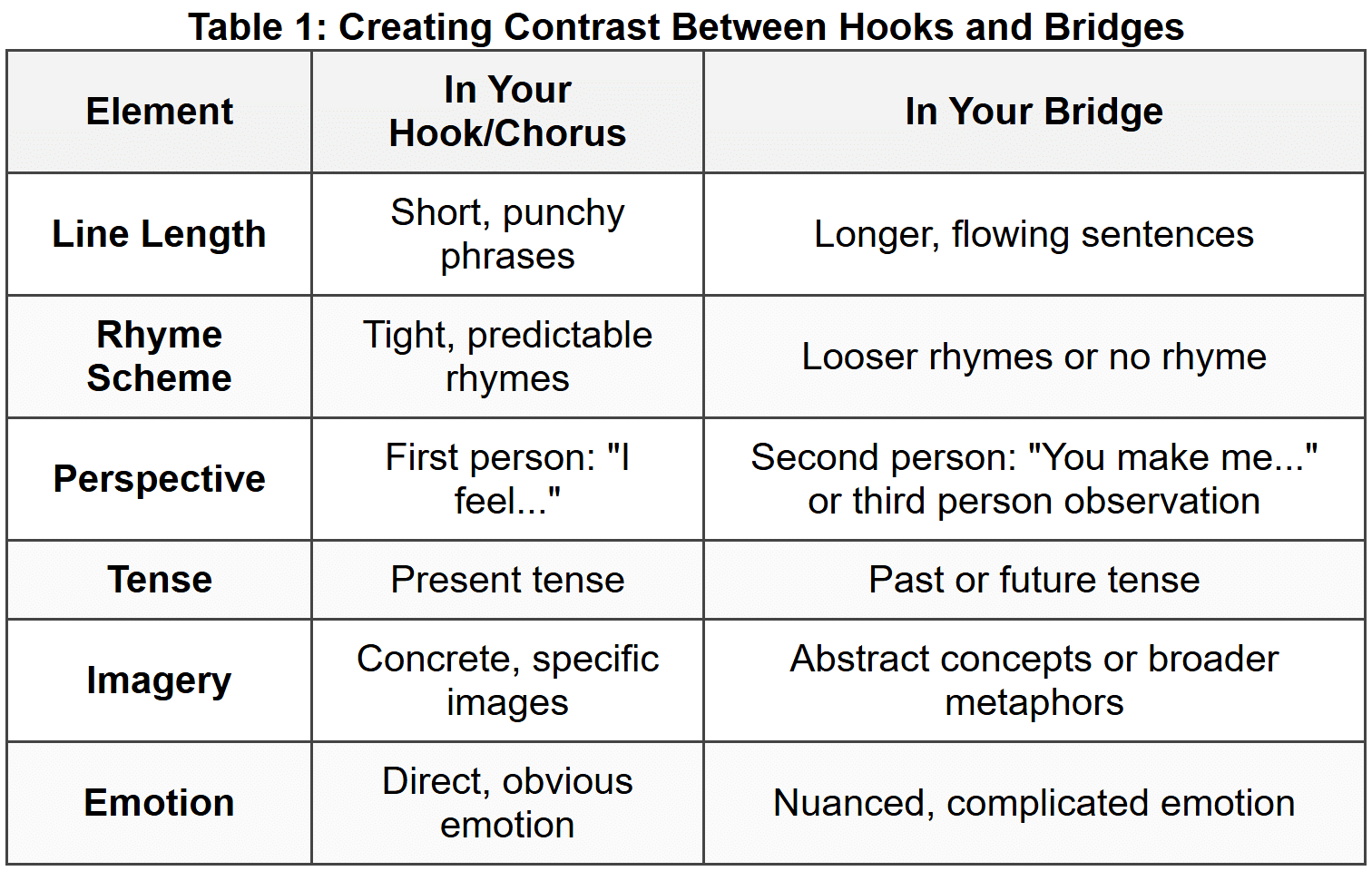
You don't need to contrast every element-that would be chaotic. But choosing two or three areas where your bridge clearly differs from your hook will create the necessary distinction.
4. Practical Techniques for Writing Powerful Bridges
Let's move from theory to practice. You're sitting with your guitar or at your keyboard, you've got solid verses and a killer chorus, and now you need to write a bridge. Where do you start?
4.1. The "What If" Approach
This technique uses questions to generate new lyrical territory. Look at what your verses and chorus have established, then ask:
- What if the opposite were true?
- What if I zoomed out to see the bigger picture?
- What if I zoomed in to a specific moment?
- What if I addressed someone directly who I've only talked about?
- What if I revealed the deeper why behind the what?
For example, if your chorus is about missing someone, your bridge might ask: "What if instead of dwelling on missing them, I acknowledge what they taught me?" This shift creates fresh lyrical ground while staying connected to your song's theme.
4.2. The Time-Shift Method
If your verses and chorus exist in the present moment, your bridge can jump to the past or future. This temporal shift automatically creates new perspective.
Taylor Swift does this masterfully in All Too Well. The verses and choruses recount specific memories, but the bridge shifts to present-tense realization: "Maybe we got lost in translation." The time shift adds layers of meaning.
Try this: Write your bridge lyrics as if they're happening at a different time than your verses. If you're writing about a breakup happening now, write a bridge that imagines a moment six months from now, or recalls the moment you first met. See how that changes the emotional color.
4.3. The Conversation Turn
Think of your song as one side of a conversation. Your verses and chorus have been making a statement. The bridge is where you can:
- Acknowledge the other person's perspective: "I know you think I'm crazy, but..."
- Reveal vulnerability: After showing strength, admit fear or doubt
- Issue a challenge or ultimatum: Raise the stakes emotionally
- Make a confession: Admit something you haven't said yet
In Adele's Set Fire to the Rain, the bridge shifts from describing what happened to directly confronting the emotions: "Sometimes I wake up by the door, that heart you caught must be waiting for you." It's a vulnerable admission that adds depth to the anger expressed earlier.
4.4. The Resolution or Revelation
Your bridge can be where understanding dawns, decisions are made, or truths are spoken. After verse and chorus have circled around the issue, the bridge cuts to the heart of it.
This approach works especially well for songs dealing with internal conflict or difficult realizations. The bridge becomes the moment of clarity-for better or worse.
4.5. The Musical Conversation
Remember that your lyrics don't exist in isolation-they're married to melody and music. When writing your bridge lyrics, think about how they'll interact with the musical change that typically happens in a bridge.
If the music strips down to something sparse, your lyrics might become more intimate or confessional. If the music builds to a peak, your lyrics might become more declarative or powerful. Let the music guide your lyrical choices.
5. Common Pitfalls and How to Avoid Them
Even experienced songwriters fall into certain traps when writing hooks and bridges. Let's identify them so you can steer clear.
5.1. Hook Pitfalls
The "Too Clever" Hook
You write something you think is brilliant-a complex metaphor, a witty wordplay, a literary reference. But if your listener has to work too hard to understand it, it won't hook them. Clarity trumps cleverness every time.
Test: Can a twelve-year-old understand your hook on first listen? If not, it might be too complex. This doesn't mean writing down to people-it means writing with universal accessibility.
The Vague Hook
The opposite problem: your hook is so general it could apply to anything. "I feel something" or "This is amazing" don't give listeners anything specific to hold onto. Specific emotional truth creates universal connection, paradoxically.
Compare "I love you" (vague, overused) with "I'm never gonna dance again, guilty feet have got no rhythm" from George Michael's Careless Whisper (specific, vivid, unique but universally understandable).
The Overcooked Hook
You repeat your hook so many times that it loses impact. Repetition is powerful, but there's a tipping point where "catchy" becomes "annoying." Trust your instincts-if you're getting sick of your own hook while writing it, your listeners will too.
5.2. Bridge Pitfalls
The "Verse 3" Bridge
This is the most common bridge mistake: you simply write another verse and call it a bridge. It has the same structure, similar rhyme scheme, same perspective as your verses. If your bridge could work equally well as Verse 3, it's not a bridge-it's a verse.
Fix: Go back to the contrast techniques we discussed. Change at least two or three elements to make your bridge genuinely distinct.
The Disconnected Bridge
The opposite problem: your bridge is so different it feels like it belongs to another song. While bridges should contrast, they must still feel thematically and emotionally connected to the rest of your song.
Fix: Make sure your bridge addresses the same core theme or emotion as your verses and chorus, even if it approaches it from a new angle. The perspective can change; the subject shouldn't.
The Anticlimactic Bridge
Your bridge arrives, offers something mildly different, then just... ends. No build, no revelation, no reason for existing. Bridges should heighten something-tension, emotion, understanding, or energy.
Fix: Think of your bridge as having its own mini-arc. It should start somewhere and end somewhere else, creating movement that propels you into the final chorus with renewed energy or deeper meaning.
The Too-Long Bridge
You get excited about the new lyrical territory and write 12 or 16 lines. By the time the bridge ends, your listener has forgotten what song they're listening to. Bridges are meant to be departures, not destinations.
Fix: Edit ruthlessly. Most effective bridges are 4 to 8 lines. Say what you need to say, then get out. Leave them wanting more, not checking their watch.
6. Advanced Integration: Hooks and Bridges Working Together
Now that you understand both elements individually, let's explore how master songwriters use them in combination to create unforgettable songs.
6.1. The Callback Technique
Sometimes the most powerful bridge references or transforms the main hook in a new context. This creates a satisfying sense of unity while still providing contrast.
In Kelly Clarkson's Because of You, the bridge doesn't repeat the "because of you" hook directly, but it deepens our understanding of why those words matter: "I watched you die, I heard you cry every night in your sleep." When we return to "because of you" in the final chorus, it carries more weight because the bridge has filled in the story.
6.2. The Setup and Payoff
Think of your bridge as a setup that makes the final hook more impactful. The bridge can create tension, ask a question, or build anticipation that the return to the chorus resolves.
This is why many bridges end with a slight pause or musical breath before launching into the final chorus-it's that moment of "wait for it..." before the payoff hits.
6.3. The Lyric-Music Partnership
The most sophisticated songwriting happens when lyrics and music work in perfect partnership. Your lyrical hooks should align with melodic or rhythmic hooks, and your bridge lyrics should complement the musical departure happening simultaneously.
Exercise: Sing or speak your hook without any musical accompaniment. Does it still have rhythm and melody in the words themselves? The best lyrical hooks have musical qualities built into the language-alliteration, assonance, rhythmic patterns.
For bridges, pay attention to how syllable count and stressed syllables create a different flow than your verses. If your verse lines are mostly 8 syllables with stress on beats 1 and 3, your bridge might use 10-syllable lines with stress on beats 2 and 4. This creates both lyrical and musical contrast.
7. Exercises to Strengthen Your Skills
Knowledge is valuable, but skill comes from practice. Here are specific exercises to develop your hook and bridge writing abilities.
7.1. The Hook Catalog
Activity: Listen to 10 popular songs from different genres and identify the main hook in each. Write down:
- What type of hook it is (title, refrain, question, etc.)
- Where it appears in the song
- How many times it repeats
- What makes it memorable (rhythm, rhyme, emotional content, etc.)
Notice patterns. What do successful hooks have in common? This analytical listening will train your ear to recognize hookiness in real-world context.
7.2. The One-Line Challenge
Activity: Set a timer for 10 minutes. Write as many potential hook lines as you can on a single theme-let's say "letting go" or "new beginnings." Don't overthink; just write.
After 10 minutes, review your list. Which lines have:
- Clear, simple language?
- Rhythmic interest?
- Emotional resonance?
- Something unexpected or fresh?
Circle your top three. These are your hook candidates. This exercise trains you to generate options quickly rather than fixating on the first idea that comes.
7.3. The Bridge Makeover
Activity: Take a song you've already written that either has no bridge or has a weak bridge. Write three completely different bridge options:
- The Time-Shift Bridge: Move to a different time period
- The Perspective-Flip Bridge: Change who's speaking or being addressed
- The Revelation Bridge: Reveal new information or understanding
Sing each option in the context of your full song. Which one creates the most satisfying contrast? Which one makes the final chorus hit harder? You might discover that your song needs something different than you initially thought.
7.4. The Contrast Matrix
Activity: Create a simple chart for a song you're working on. List these elements down the left side:
- Line length
- Rhyme scheme
- Perspective (I/you/we/they)
- Tense (past/present/future)
- Concrete vs. abstract language
Across the top, make columns for Verse, Chorus, and Bridge. Fill in what you currently have for each section. Now look at your bridge column-how many elements are different from your verse and chorus? If fewer than two, revise your bridge to create more contrast.
7.5. The Melody-First Hook
Activity: This exercise flips the usual process. Create a melodic hook first-hum it, play it on an instrument, record it on your phone. Make it simple and catchy. Now write lyrics that fit that melody.
This approach forces you to think about how words sound and feel rather than just what they mean. You'll discover that certain syllables and vowel sounds work better in certain melodic positions. The constraint of an existing melody often leads to more creative lyrical choices.
8. Real-World Application: Analyzing Complete Songs
Let's put all these concepts together by examining how successful songs integrate hooks and bridges. Understanding how the pros do it will inform your own practice.
8.1. Case Study: "Someone Like You" by Adele
This song demonstrates masterful hook and bridge integration. The main hook-"Never mind, I'll find someone like you"-is simple, direct, and emotionally loaded. It appears at the beginning of each chorus, giving it maximum impact.
Notice that the hook uses conversational language ("never mind") that feels like something you might actually say to an ex. The specificity of "someone like you" (not "someone better" or "someone new" but "someone like you") creates emotional complexity-she's not over him; she's looking for a replacement.
The bridge arrives after two verse-chorus cycles and does something brilliant: it shifts from talking about finding someone new to admitting the raw truth: "Nothing compares, no worries or cares, regrets and mistakes, they're memories made." This is revelation-she's been putting on a brave face, but the bridge admits the deeper pain.
When we return to the hook after this vulnerable bridge, "I'll find someone like you" carries new meaning. We now understand it's not confident; it's desperate hope. The bridge has recontextualized the hook.
8.2. Case Study: "Shake It Off" by Taylor Swift
This song uses repetition as its primary hook strategy. The phrase "shake it off" repeats extensively, but Swift makes it work through rhythmic variation and context changes.
The verses establish haters and critics-specific scenarios of being judged. The chorus responds with the hook, but it's the rhythmic delivery that makes it stick: "I'm just gonna shake, shake, shake, shake, shake." The stutter-repetition creates a dance-like quality that mirrors the song's message of resilience through movement.
The bridge breaks from the established pattern completely: "Hey, hey, hey, just think..." It's spoken rather than sung in some versions, creating stark contrast. Lyrically, it shifts from defending herself to directly addressing the audience: "I never miss a beat." This confidence boost makes the return to "shake it off" feel triumphant rather than defensive.
8.3. Case Study: "Bohemian Rhapsody" by Queen
Now let's look at something unconventional. This song doesn't follow standard pop structure, yet it's one of the most beloved songs ever written. Why? Because it understands contrast and dynamics at a profound level.
The song doesn't have a traditional chorus-hook, but it has multiple sections that function as hooks through sheer memorability: "Mama, just killed a man," "Galileo, Galileo," "Nothing really matters to me." Each section has its own hooky element.
What would normally be a "bridge" in this song is the hard rock "So you think you can stone me" section. It provides massive contrast to the gentle piano opening and the operatic middle, creating emotional catharsis before the quiet resolution. Even in an unconventional structure, the principle holds: contrast creates impact.
9. Writing for Different Genres and Contexts
While the fundamental principles of hooks and bridges apply across genres, different musical styles have different conventions and expectations. Let's explore how to adapt your approach.
9.1. Pop Music
Pop prioritizes immediate accessibility and maximum catchiness. Your hooks need to be memorable on first listen, and your bridges should be concise and purposeful.
- Keep hooks to one or two short lines maximum
- Use repetition liberally but strategically
- Make bridges 4-8 lines, focused on emotional intensification
- Don't be afraid of simplicity-"I want to hold your hand" is six simple words, and it conquered the world
9.2. Folk and Singer-Songwriter
These genres value storytelling and lyrical depth over pure catchiness. Your hooks can be more subtle, and your bridges have more room to breathe.
- Hooks might be entire couplets rather than single lines
- Bridges can introduce new narrative information or shift perspective
- Emotional honesty often trumps clever wordplay
- Consider how Bob Dylan or Joni Mitchell use refrains-they're hooky through meaning and placement, not always through simplicity
9.3. Hip-Hop and R&B
These genres often use rhythmic hooks and melodic bridges as contrast to rapped verses.
- Hooks frequently use melodic singing even when verses are rapped
- Bridges might introduce sung vulnerability after confident rapped verses
- Rhythmic wordplay and internal rhyme create hookiness even without traditional melodic hooks
- Consider how Drake moves between rapping and singing, or how Lauryn Hill uses melodic hooks in Doo Wop (That Thing)
9.4. Rock and Alternative
Rock values energy and authenticity, sometimes prioritizing raw emotion over polish.
- Hooks might be yelled or screamed rather than prettily sung
- Bridges often build in intensity, leading to explosive final choruses
- Repetition can be aggressive rather than sweet
- Think of Nirvana's Smells Like Teen Spirit-the "hello, hello, hello" is a hook through sheer repetition and attitude
10. From Draft to Refinement
You've written your hooks and bridges. Now comes the crucial part: revision. Great songwriting is rewriting. Here's how to polish your work.
10.1. The 24-Hour Test
After writing your song, step away for at least 24 hours. Don't listen to it, don't think about it. Let your brain reset.
When you come back, listen with fresh ears. What do you remember? If you can't recall the hook or the bridge doesn't stand out, that's valuable information. The parts that stuck with you are probably working; the parts you forgot might need strengthening.
10.2. The Sing-Along Test
Play your song for someone who's never heard it before-a friend, family member, or fellow songwriter. Don't teach them the song; just play it once or twice.
Then ask them to sing along on the third play. Which parts can they join in on? Those are your effective hooks. What do they remember about the bridge? If they can't recall it at all, it might not be providing enough contrast or interest.
10.3. The Syllable Count Review
Count the syllables in your hook lines. Shorter is usually better-4 to 8 syllables per line tends to be the sweet spot for memorability. If your hook is 15 syllables, it might be too complex to stick.
For your bridge, check that the syllable counts and rhythmic patterns differ from your verses. Even a small difference (verse lines of 8 syllables, bridge lines of 7 or 9) creates subtle but effective contrast.
10.4. The Emotional Truth Check
Read your lyrics as poetry, without music. Do your hooks express something genuinely felt? Does your bridge reveal or deepen emotion in a truthful way?
Cliché check: Are you using overused phrases? "Heart of gold," "head over heels," "time will tell"-these might work in certain contexts, but fresh language almost always creates stronger hooks. Challenge yourself to say the same thing in a way nobody has said it before.
10.5. The Contrast Checklist
Make a final pass specifically checking for contrast between sections:
- Does my bridge look and sound different from my verses?
- Does my hook stand out clearly from surrounding lyrics?
- Have I created enough repetition for memorability but not so much that it's annoying?
- Does my bridge make the final chorus more impactful through contrast?
If you can answer "yes" to all four questions, you're on solid ground.
Key Terms
- Hook
- A memorable lyrical, melodic, or rhythmic element that captures listener attention and creates the most memorable part of a song; the "sticky" component that makes people want to hear the song again.
- Bridge
- A contrasting section in a song, typically appearing after the second chorus, that provides new perspective, information, or emotional depth before returning to the final chorus; creates dynamic variety and prevents monotony.
- Refrain
- A repeated line or phrase within a song, often containing the title and serving as the primary hook; appears at consistent points, usually in the chorus.
- Title Hook
- A hook that uses the song's title as its central repeated element, usually positioned prominently in the chorus for maximum impact and memorability.
- Conversational Hook
- A hook that uses everyday speech patterns and phrases people might actually say in real life, creating instant familiarity and relatability.
- Lyrical Contrast
- The intentional creation of differences between sections of a song through variations in line length, rhyme scheme, perspective, tense, or imagery; essential for effective bridge writing.
- Rhythmic Pattern
- The arrangement of stressed and unstressed syllables in a lyric line, creating a distinct beat or pulse that contributes to memorability and musical feel.
- Time-Shift
- A bridge technique that moves the lyrical narrative to a different time period (past, present, or future) than the verses and chorus, creating fresh perspective.
- Callback
- A technique where the bridge references or transforms elements from earlier in the song, particularly the main hook, in a new context to create unity while maintaining contrast.
- Perspective-Flip
- A bridge technique that changes the point of view from which the song is being told-such as shifting from first person to second person, or from talking about someone to addressing them directly.
- Pre-Chorus
- A transitional section between verse and chorus that builds anticipation; can contain its own hook that differs from the main chorus hook.
- Climax
- The point of highest emotional or dynamic intensity in a song, often occurring in or after the bridge, before the final chorus provides resolution.
- Resolution
- The lyrical or emotional conclusion or answer provided by a bridge, offering understanding, decision, or clarity about the song's central theme or conflict.
- Syllabic Stress
- The emphasis placed on certain syllables in words and phrases, creating rhythm and flow; crucial for making lyrics feel natural and musical when sung.