Practice Questions :Industrial and Economic Development Patterns and Processes

SECTION I: MULTIPLE CHOICE
Directions
Answer all 20 questions in this section. Each question has four answer choices (A, B, C, D). Select the one best answer for each question. Questions may be based on data tables, statistics, maps, and other stimulus materials. Each correct answer is worth 1 point.
Question 1
The table below shows economic data for four countries in 2020.
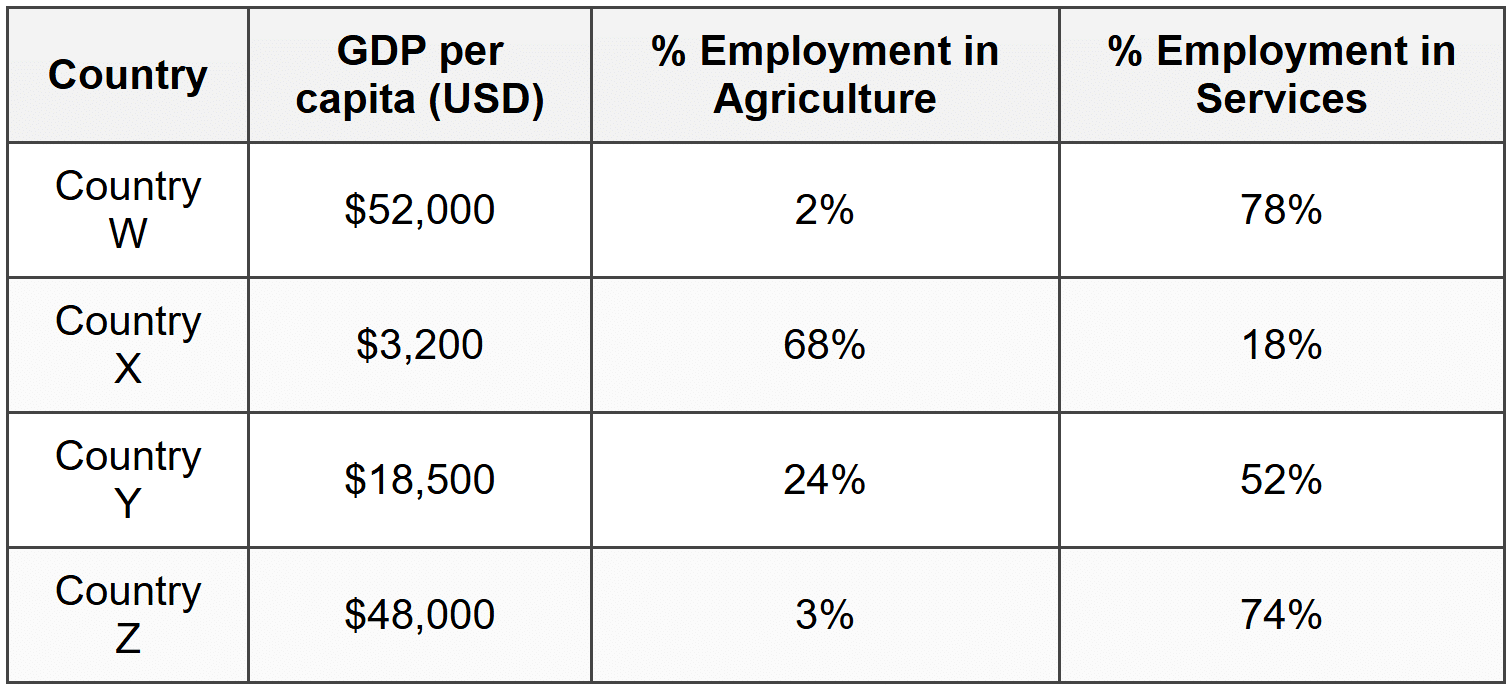
Based on Rostow's stages of economic development model, which country is most likely in the traditional society stage?
- Country W
- Country X
- Country Y
- Country Z
Question 2
A transnational corporation relocates its manufacturing facilities from Germany to Vietnam primarily to take advantage of lower labor costs. This practice is best described as an example of which geographic concept?
- Economies of scale
- Comparative advantage
- Just-in-time delivery
- Agglomeration economies
Question 3
Data Table: Manufacturing Employment Changes (2000-2020)
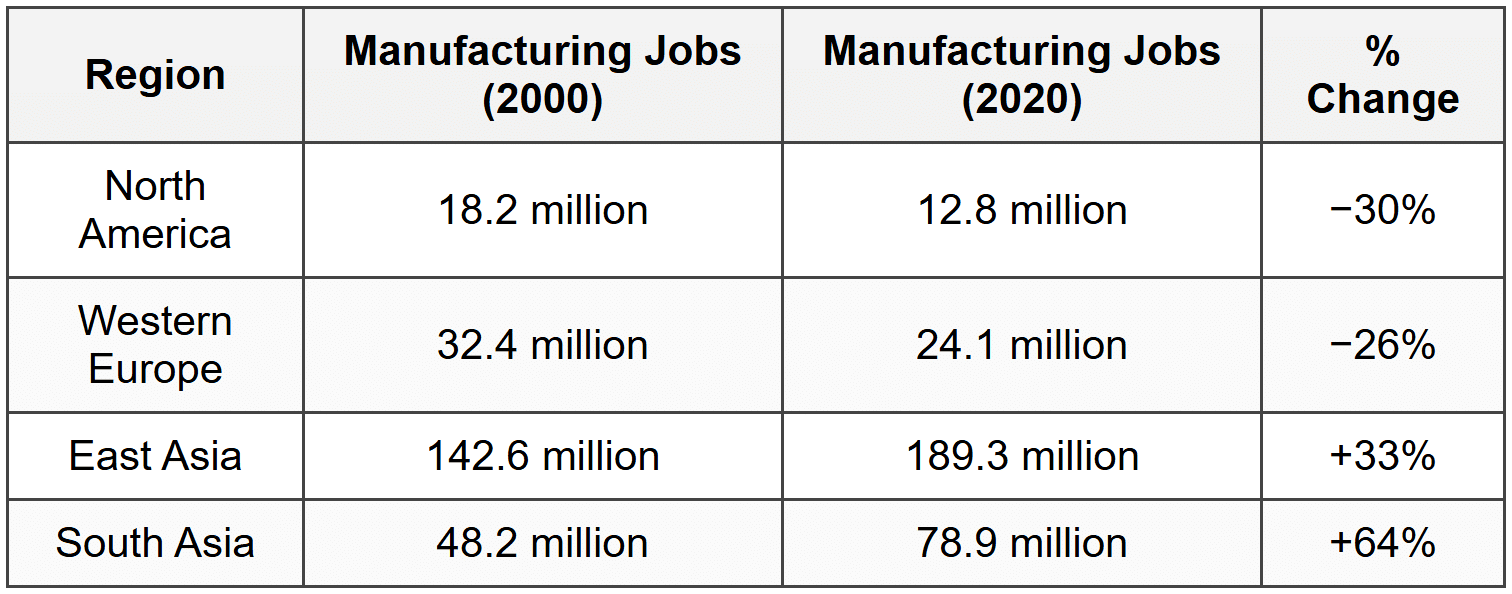
The data above best illustrate which economic process?
- Deindustrialization in more developed countries and industrial growth in newly industrialized countries
- The replacement of manufacturing jobs by service sector jobs in all world regions
- The concentration of heavy industry in core countries due to infrastructure advantages
- The decline of manufacturing globally due to automation and technological change
Question 4
Weber's least cost theory of industrial location emphasizes which three main factors in determining the optimal location for manufacturing facilities?
- Labor, capital, and government regulation
- Transportation costs, labor costs, and agglomeration benefits
- Raw materials, market access, and environmental conditions
- Energy sources, skilled workforce, and political stability
Question 5
A technology company establishes its headquarters in Silicon Valley, California, specifically because of the presence of venture capital firms, research universities, and a large pool of specialized engineers. This location decision best exemplifies which concept?
- Break-of-bulk point
- Footloose industry
- Agglomeration economies
- Maquiladora zone
Question 6
Human Development Index (HDI) Components for Selected Countries (2020)
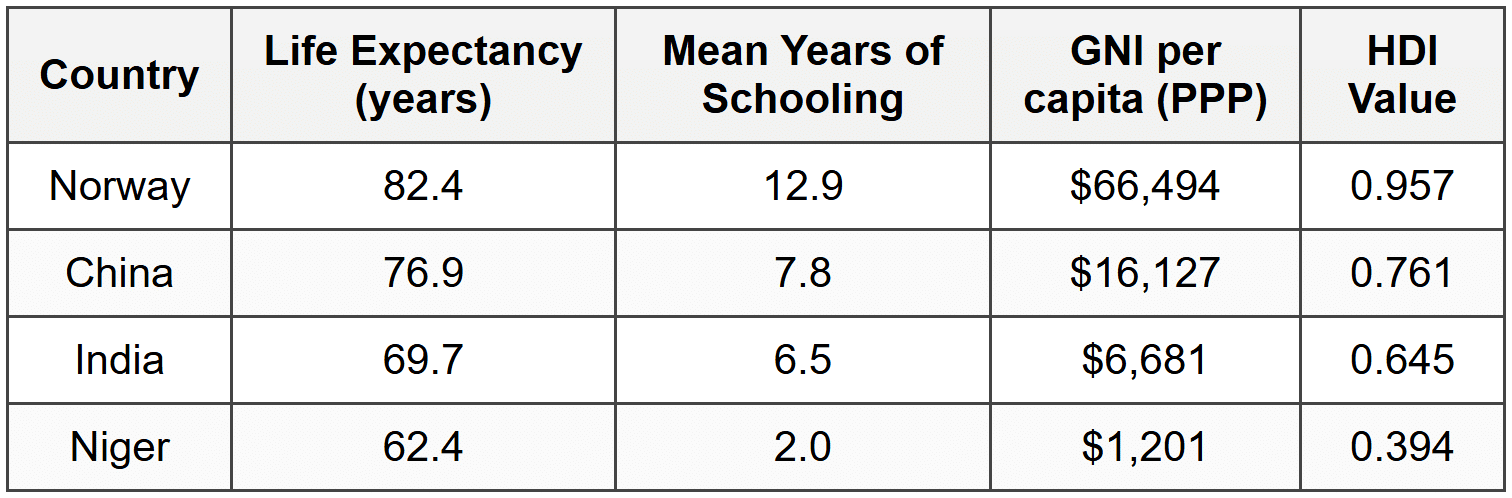
Which statement best explains why the Human Development Index (HDI) is considered a more comprehensive measure of development than Gross Domestic Product (GDP) alone?
- HDI measures only economic output, making it more precise than GDP
- HDI incorporates social indicators such as health and education alongside economic measures
- HDI focuses exclusively on income inequality within countries
- HDI accounts for environmental sustainability better than GDP
Question 7
The Gender Inequality Index (GII) measures disparities between men and women in which three dimensions?
- Income, political representation, and life expectancy
- Reproductive health, empowerment, and labor force participation
- Education, healthcare access, and property ownership
- Employment rates, voting rights, and household decision-making
Question 8
Special Economic Zones (SEZs) in countries such as China and India are designed to promote economic development by
- imposing higher tariffs on imported goods to protect domestic industries
- restricting foreign investment to maintain government control over production
- offering tax incentives and relaxed regulations to attract foreign direct investment
- limiting industrial development to environmentally sustainable technologies only
Question 9
Energy Consumption by Sector (2020)
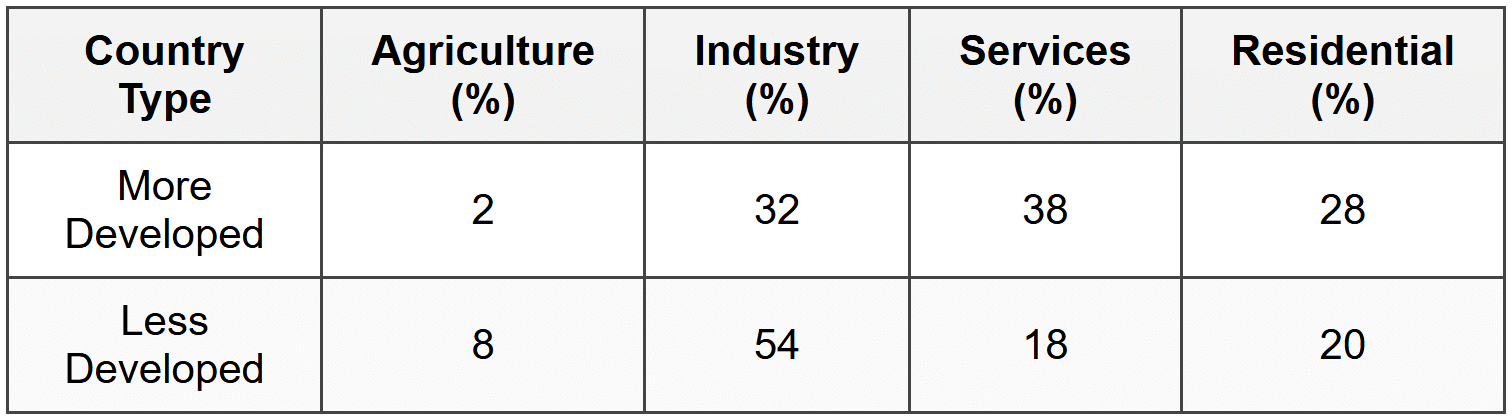
The data in the table above best support which conclusion about patterns of economic development?
- Less developed countries have lower total energy consumption than more developed countries
- More developed countries have shifted toward service-based economies while less developed countries remain more industry-focused
- Agricultural energy use is the primary driver of development in both country types
- Residential energy consumption decreases as countries develop economically
Question 10
Rostow's modernization model has been criticized for which of the following reasons?
- It assumes all countries will follow the same linear path of development as Western nations
- It places too much emphasis on the role of international trade in economic growth
- It ignores the importance of manufacturing in economic development
- It overestimates the speed at which countries can industrialize
Question 11
Dependency theory argues that less developed countries remain poor primarily because
- they lack the cultural values necessary for economic modernization
- their economies are structurally tied to and exploited by more developed countries
- they have not yet reached Rostow's "take-off" stage of development
- they invest too heavily in the tertiary sector before developing manufacturing
Question 12
Foreign Direct Investment (FDI) Flows in Billions USD (2019)
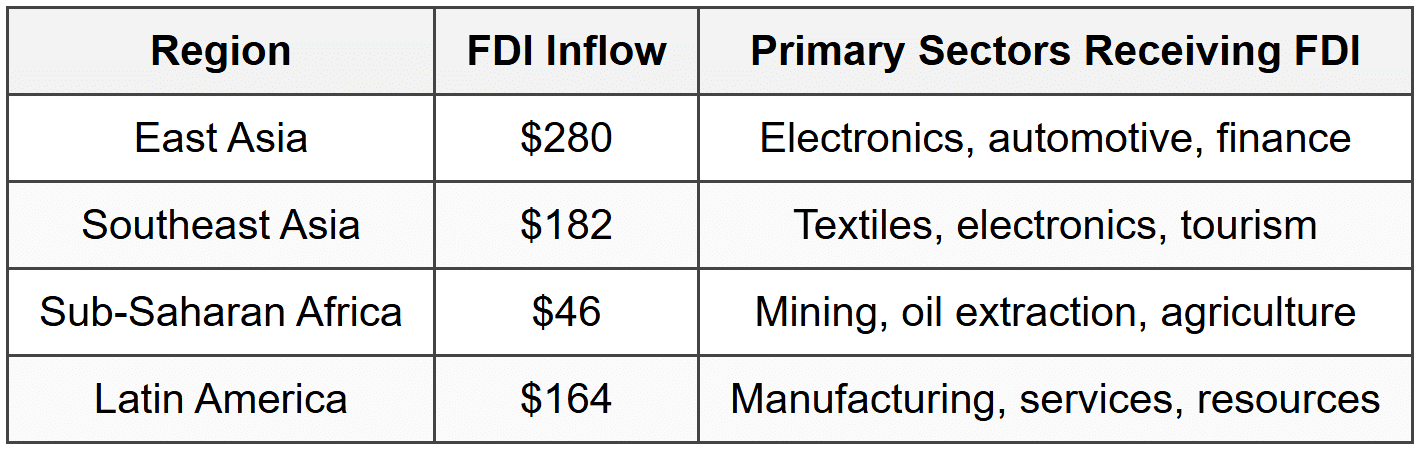
Based on the data, which region's FDI pattern most strongly reflects characteristics of extractive economies associated with dependency theory?
- East Asia
- Southeast Asia
- Sub-Saharan Africa
- Latin America
Question 13
Microfinance initiatives, which provide small loans to entrepreneurs in developing countries, are examples of which approach to economic development?
- Top-down development focused on large infrastructure projects
- Bottom-up development emphasizing local empowerment and small-scale enterprise
- Export-oriented industrialization targeting global markets
- Import substitution designed to reduce dependence on foreign goods
Question 14
A country implements policies to protect its domestic automobile industry by imposing high tariffs on imported vehicles and restricting foreign ownership of manufacturing plants. This strategy is best classified as
- export-oriented industrialization
- free trade liberalization
- import substitution industrialization
- comparative advantage specialization
Question 15
Economic Sectors and Employment Distribution
Country A has undergone significant economic transformation over the past 30 years. In 1990, 65% of the workforce was employed in agriculture, 20% in manufacturing, and 15% in services. By 2020, the distribution had shifted to 18% in agriculture, 28% in manufacturing, and 54% in services. During this period, GDP per capita increased from $2,400 to $23,600.
The pattern described above best illustrates which economic development process?
- Deindustrialization and economic decline
- Sectoral evolution consistent with economic modernization
- Agricultural intensification and rural development
- Premature deindustrialization without manufacturing growth
Question 16
Which statement best explains why break-of-bulk points, such as ports and rail terminals, often become favorable locations for manufacturing?
- They provide access to large consumer markets in urban areas
- They minimize transportation costs by processing materials where they are transferred between modes of transport
- They offer tax incentives and subsidies from local governments
- They are typically located in areas with abundant natural resources
Question 17
The establishment of the maquiladora zone along the United States-Mexico border primarily benefits manufacturers by providing
- access to subsidized raw materials from government-owned suppliers
- proximity to the U.S. market combined with lower Mexican labor costs
- exemption from all environmental and safety regulations
- guaranteed long-term contracts with the Mexican government
Question 18
Women's Economic Participation Data (2020)
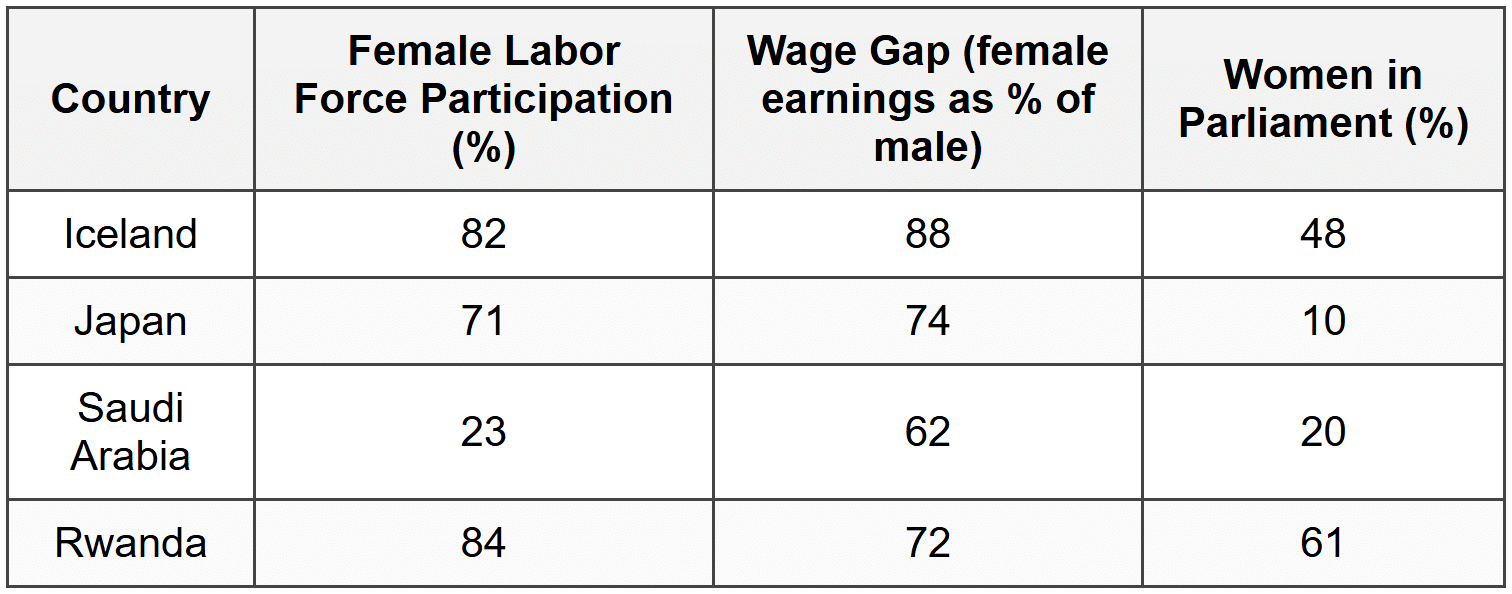
The data illustrate that gender equality in economic development
- is directly correlated with a country's overall GDP per capita
- varies significantly even among countries with different levels of development
- is consistently highest in countries with the longest democratic traditions
- can be accurately predicted using only labor force participation rates
Question 19
Just-in-time delivery systems used by automobile manufacturers reduce inventory costs but require which geographic condition?
- Suppliers located in low-wage countries regardless of distance
- Manufacturing facilities near deepwater ports for international shipping
- Proximity of parts suppliers to assembly plants to minimize delivery time
- Government-operated transportation networks with subsidized shipping
Question 20
A "footloose" industry is characterized by
- heavy reliance on proximity to bulky raw materials
- location flexibility due to low transportation costs relative to production value
- mandatory location in government-designated industrial zones
- dependence on hydroelectric power sources for manufacturing processes
SECTION II: FREE RESPONSE
Directions
Answer both questions in this section. Each question has three sub-parts (A, B, C). Use complete sentences for all responses. Where questions require examples, provide specific, real-world cases. Make sure to address all components of each sub-part. Suggested time: 25 minutes per question.
FRQ 1
Map Reference: Global Distribution of Export Processing Zones
The map (not shown) depicts the locations of Export Processing Zones (EPZs) worldwide. Concentrations of EPZs are visible in coastal regions of Mexico, Central America, Southeast Asia, South Asia, and North Africa. Very few EPZs appear in North America, Western Europe, or Australia. The highest density of EPZs is found along coastal areas with access to major shipping routes.
- Define the term Export Processing Zone (EPZ).
- Explain one reason why Export Processing Zones are predominantly located in less developed or newly industrializing countries rather than in more developed countries.
- Using a specific country or region as an example, analyze how the establishment of Export Processing Zones can lead to both economic benefits and social or environmental challenges.
FRQ 2
The concept of comparative advantage is central to international trade theory and influences patterns of global economic specialization.
- Define the term comparative advantage.
- Explain how comparative advantage influences the spatial distribution of manufacturing industries at the global scale.
- Using a specific example, evaluate the extent to which reliance on comparative advantage in primary commodities (such as agriculture or resource extraction) can limit long-term economic development in a country.
ANSWER KEY
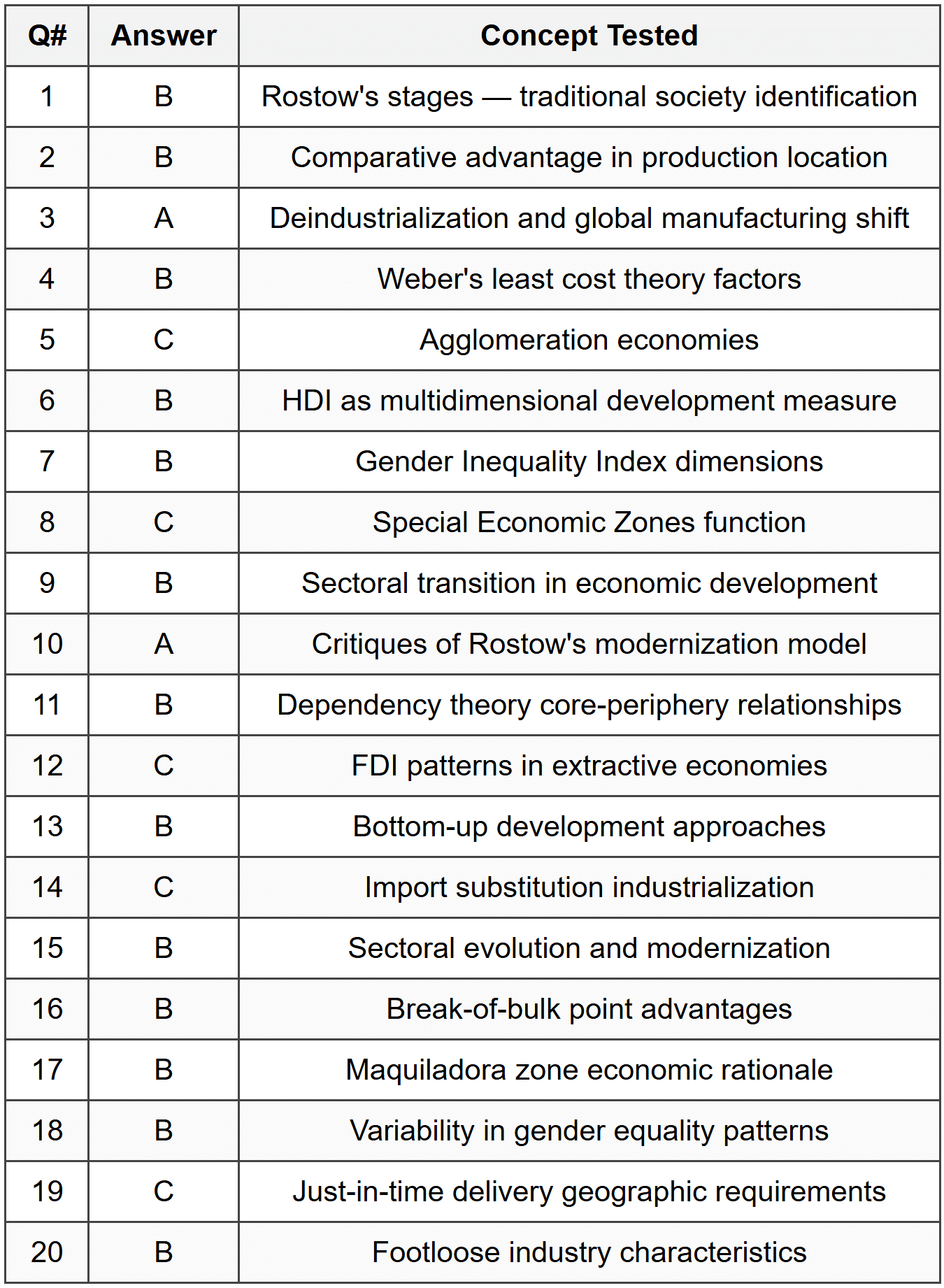
Part A: Multiple Choice Answer Table
Part B: Free Response Question Answer Keys
FRQ 1 - Answer Key
Part A: Define Export Processing Zone (EPZ)
An Export Processing Zone (EPZ) is a designated industrial area within a country, typically near ports or border regions, where foreign and domestic companies can import raw materials or components duty-free, manufacture goods using local labor, and then export finished products with reduced taxes and tariffs. EPZs are created by governments to attract foreign direct investment, create employment opportunities, and stimulate manufacturing for global markets. Companies operating in EPZs often benefit from relaxed labor and environmental regulations compared to the rest of the country.
Part B: Explain one reason for EPZ location in less developed countries
Export Processing Zones are predominantly located in less developed or newly industrializing countries rather than more developed countries because these nations offer significantly lower labor costs, which attract foreign manufacturers seeking to reduce production expenses. For example, textile and electronics companies from Japan, the United States, and Europe establish factories in EPZs in Bangladesh, Vietnam, or Mexico because workers in these countries earn a fraction of what workers in developed countries command, sometimes as little as $2-5 per day compared to $15-25 per hour in developed nations. This wage differential allows companies to manufacture products at much lower costs while still accessing global markets through export-oriented production. More developed countries, with their higher wages and stronger labor protections, do not offer the same cost advantages, making them less attractive locations for EPZs focused on labor-intensive manufacturing.
Part C: Analyze EPZ benefits and challenges with specific example
The establishment of Export Processing Zones in Bangladesh, particularly in the garment manufacturing sector, illustrates both significant economic benefits and serious social and environmental challenges. On the economic benefit side, EPZs in Bangladesh have created approximately 4 million jobs, primarily for women who previously had limited formal employment opportunities. The garment industry accounts for over 80% of Bangladesh's export earnings, contributing substantially to GDP growth and poverty reduction. Foreign direct investment through EPZs has helped Bangladesh transition from an agriculture-based economy toward industrialization, lifting millions out of extreme poverty.
However, these economic gains come with considerable social and environmental costs. Social challenges include poor working conditions, including extremely low wages (often $100-150 per month), excessive working hours (60-80 hours per week), and dangerous factory conditions that have resulted in tragedies such as the 2013 Rana Plaza building collapse that killed over 1,100 garment workers. Workers, predominantly young women, often face harassment, lack job security, and have limited ability to organize unions due to weak labor law enforcement in EPZs. Environmental challenges include severe water pollution from textile dyeing processes that discharge untreated chemical waste into rivers, air pollution from factories operating with minimal environmental controls, and contribution to Bangladesh's growing solid waste problem from fabric scraps and packaging materials.
This example demonstrates the complex trade-offs inherent in EPZ development: while they can generate much-needed employment and export revenue for developing countries, they often do so at the expense of worker welfare and environmental sustainability, raising questions about the long-term desirability of this development pathway.
FRQ 2 - Answer Key
Part A: Define comparative advantage
Comparative advantage is an economic principle stating that countries or regions should specialize in producing goods and services they can produce at a lower opportunity cost relative to other goods, even if they are not the most efficient producer in absolute terms. When countries specialize according to their comparative advantages and engage in trade, total global production increases and all trading partners can benefit. Comparative advantage is determined by factors such as labor costs, natural resource availability, technological capabilities, climate conditions, and accumulated expertise in particular industries.
Part B: Explain how comparative advantage influences global manufacturing distribution
Comparative advantage influences the spatial distribution of manufacturing industries at the global scale by encouraging geographic specialization based on regional production advantages. Countries and regions concentrate on manufacturing products where they have relative cost or quality advantages, leading to distinct global patterns of industrial location. For example, labor-intensive manufacturing such as textiles and apparel has concentrated in countries like Bangladesh, Vietnam, and Cambodia where low wages provide a comparative advantage in cost-sensitive production. In contrast, high-technology manufacturing such as semiconductors and precision electronics concentrates in locations like Taiwan, South Korea, and Singapore, where advanced technical education systems, established supply chains, and accumulated engineering expertise provide comparative advantage in skill-intensive production.
This specialization creates global production networks where different stages of manufacturing occur in different countries based on their comparative advantages: raw materials might be extracted in resource-rich African or South American countries, processed into components in middle-income Asian countries with moderate labor costs and developing industrial capacity, assembled into finished products in low-wage countries like Vietnam or Bangladesh, and finally designed and marketed by corporations headquartered in high-income countries like the United States or Germany. Transportation and communication technologies enable this spatial fragmentation of production, allowing companies to locate each production stage in the location with the greatest comparative advantage for that specific activity, resulting in complex global supply chains that span multiple continents.
Part C: Evaluate limitations of comparative advantage in primary commodities
Reliance on comparative advantage in primary commodities can significantly limit long-term economic development, as illustrated by the experience of Zambia and its dependence on copper exports. Zambia possesses abundant copper deposits and low extraction costs, giving it a clear comparative advantage in copper production. Copper mining accounts for approximately 70% of Zambia's export earnings and contributes substantially to government revenue through mining taxes and royalties. This specialization follows the logic of comparative advantage-Zambia produces what it can produce most efficiently relative to other goods.
However, this specialization has created several development limitations. First, price volatility: global copper prices fluctuate dramatically based on demand cycles in manufacturing countries, causing Zambia's export revenues and government budgets to swing unpredictably. When copper prices collapsed in the 1970s and again in the 2000s, Zambia experienced severe economic crises, demonstrating the vulnerability of commodity-dependent economies. Second, limited value addition: Zambia exports raw or minimally processed copper rather than higher-value manufactured products. This means that most of the value chain-refining, manufacturing copper wire, producing electrical components, and final product assembly-occurs in other countries, limiting the employment, technological learning, and economic multiplier effects that remain in Zambia. Third, Dutch disease effects: the dominance of copper mining has attracted investment and skilled labor away from other potentially productive sectors, preventing economic diversification. The mining sector employs relatively few workers despite its large economic output, limiting employment generation.
Furthermore, primary commodity dependence perpetuates unequal trade relationships described by dependency theory. Zambia has limited bargaining power with multinational mining corporations and copper purchasers because it lacks alternative export sectors. Manufacturing countries that purchase Zambian copper benefit from stable raw material supplies at competitive prices, then add substantial value through manufacturing, capturing most of the economic benefits from the final products.
This example demonstrates that while comparative advantage in primary commodities may appear economically rational in the short term, it can trap countries in low-value positions within global production networks, limit technological advancement, create economic vulnerability to price shocks, and ultimately constrain long-term development prospects. Successful development often requires strategic policies that move beyond initial comparative advantages toward building new capabilities in higher-value manufacturing and services, even if this requires temporary protection or support for emerging industries-a lesson learned by countries like South Korea that transformed from commodity exporters to manufacturing powerhouses.




