Major vs Minor Emotion


Major vs Minor Emotion
1. The Emotional Power of a Single Note
Picture this: you're listening to a song that makes you want to dance and smile. Then another song comes on that suddenly makes you feel contemplative, maybe even sad. What changed? Often, it's just one note in the underlying harmony that creates this dramatic emotional shift.
Let's try something right now. If you have an instrument nearby, play a C major chord: C, E, and G together. Listen to how it sounds. Now change just the middle note-lower that E down to E♭-and you've got a C minor chord: C, E♭, and G. That single half-step difference transforms the entire emotional landscape.
The major chord tends to sound bright, stable, happy, or triumphant. The minor chord often feels darker, sadder, more introspective, or mysterious. This isn't just your imagination-this emotional distinction has been recognized across cultures and centuries of music-making.
Think about the opening of Happy by Pharrell Williams. It's built entirely around major chords, and the emotional message is right there in the title. Now think about Someone Like You by Adele-those opening piano chords are minor, and they immediately set a tone of longing and heartache.
2. What Makes Major Sound Major
When we talk about what makes a chord sound "major," we're really talking about the intervals-the distances between the notes in that chord. Let's break down a major chord to understand why it sounds the way it does.
2.1. The Major Triad Structure
A basic major chord, called a major triad, is built from three notes stacked in a specific pattern. Let's use C major as our example:
- The root: C (this is your home base, the note that names the chord)
- The major third: E (four half-steps above C)
- The perfect fifth: G (seven half-steps above C)
That major third-the distance from C to E-is what gives the chord its "major" quality. It's a wider, more open interval than a minor third, and it creates that bright, stable sound you hear.
A major triad = Root + Major Third (4 half-steps) + Perfect Fifth (7 half-steps from root)
You can build a major chord starting from any note using this formula. Want a G major chord? Start on G, count up four half-steps to B, then add the perfect fifth D. The pattern stays the same: root, major third, perfect fifth.
2.2. Why Major Sounds "Happy"
This is where music gets fascinating. The major third interval creates a particular relationship between sound waves that our ears perceive as consonant and stable. When you play C and E together, their frequencies align in a ratio of approximately 5:4-a simple mathematical relationship that sounds pleasing to most human ears.
But it's not just physics. We've also been culturally conditioned to associate major chords with positive emotions. Western music has used major tonality for celebrations, victories, and joyful moments for centuries. Listen to the main theme from Star Wars by John Williams-those triumphant brass fanfares are drenched in major chords, reinforcing themes of heroism and hope.
Try this listening exercise: play or listen to the opening of Here Comes the Sun by The Beatles. That guitar riff centers around A major and D major chords. Notice how the major quality supports George Harrison's optimistic lyrics about dark winters ending.
3. What Makes Minor Sound Minor
Now let's explore the other side of this emotional coin. Minor chords and keys have been the go-to choice for expressing sadness, tension, mystery, and introspection throughout music history.
3.1. The Minor Triad Structure
A minor triad is almost identical to a major triad-with one crucial difference. Let's look at C minor:
- The root: C (same as major)
- The minor third: E♭ (three half-steps above C-one half-step lower than the major third)
- The perfect fifth: G (same as major)
That's it. That's the only difference. By lowering the third by just one half-step, you transform the entire emotional character of the chord.
A minor triad = Root + Minor Third (3 half-steps) + Perfect Fifth (7 half-steps from root)
This minor third-from C to E♭ in our example-creates a narrower interval with a different frequency ratio (approximately 6:5). It's still consonant, still stable, but it has a darker, more closed quality compared to the major third.
3.2. Why Minor Sounds "Sad"
The connection between minor chords and sadness is one of the most consistent emotional associations in Western music. Play the opening chords of Mad World by Tears for Fears (or the Gary Jules cover)-those haunting minor chords immediately establish a mood of melancholy and alienation.
But here's something important to understand: minor doesn't always mean sad. Minor tonality can also convey:
- Mystery and suspense: Think of the theme from The Pink Panther by Henry Mancini-it's in minor, but it's playful and sneaky, not sad
- Intensity and power: Bohemian Rhapsody by Queen uses minor sections for dramatic, operatic intensity
- Sophistication and depth: Jazz musicians love minor chords for their complex, sophisticated sound
- Introspection and reflection: The Sound of Silence by Simon & Garfunkel uses minor tonality for contemplative depth
The emotional impact of minor depends heavily on context-the tempo, rhythm, instrumentation, lyrics, and cultural associations all play a role.
4. Hearing the Difference in Real Music
Understanding the theory is one thing, but you need to train your ears to instantly recognize major versus minor in the songs you hear every day. Let's work on that skill together.
4.1. Comparative Listening Exercise
Here's a powerful way to hear the difference: many songs have been recorded in both major and minor versions. Listen to these pairs:
Major version turned minor: Search online for minor key versions of normally major songs. There are countless YouTube videos where musicians re-harmonize Happy Birthday in minor-it suddenly sounds like a funeral dirge instead of a celebration. Same melody, completely different emotion.
Minor version turned major: Similarly, you can find major key arrangements of typically minor songs. When Creep by Radiohead gets transformed into a major key, the anguished quality vanishes-it becomes almost cheerful, which actually makes it sound strange and unsettling.
4.2. Instant Recognition in Song Intros
Let's practice identifying major versus minor in the opening seconds of famous songs. When you hear the first chord or two, ask yourself: does this sound bright and open, or darker and more closed?
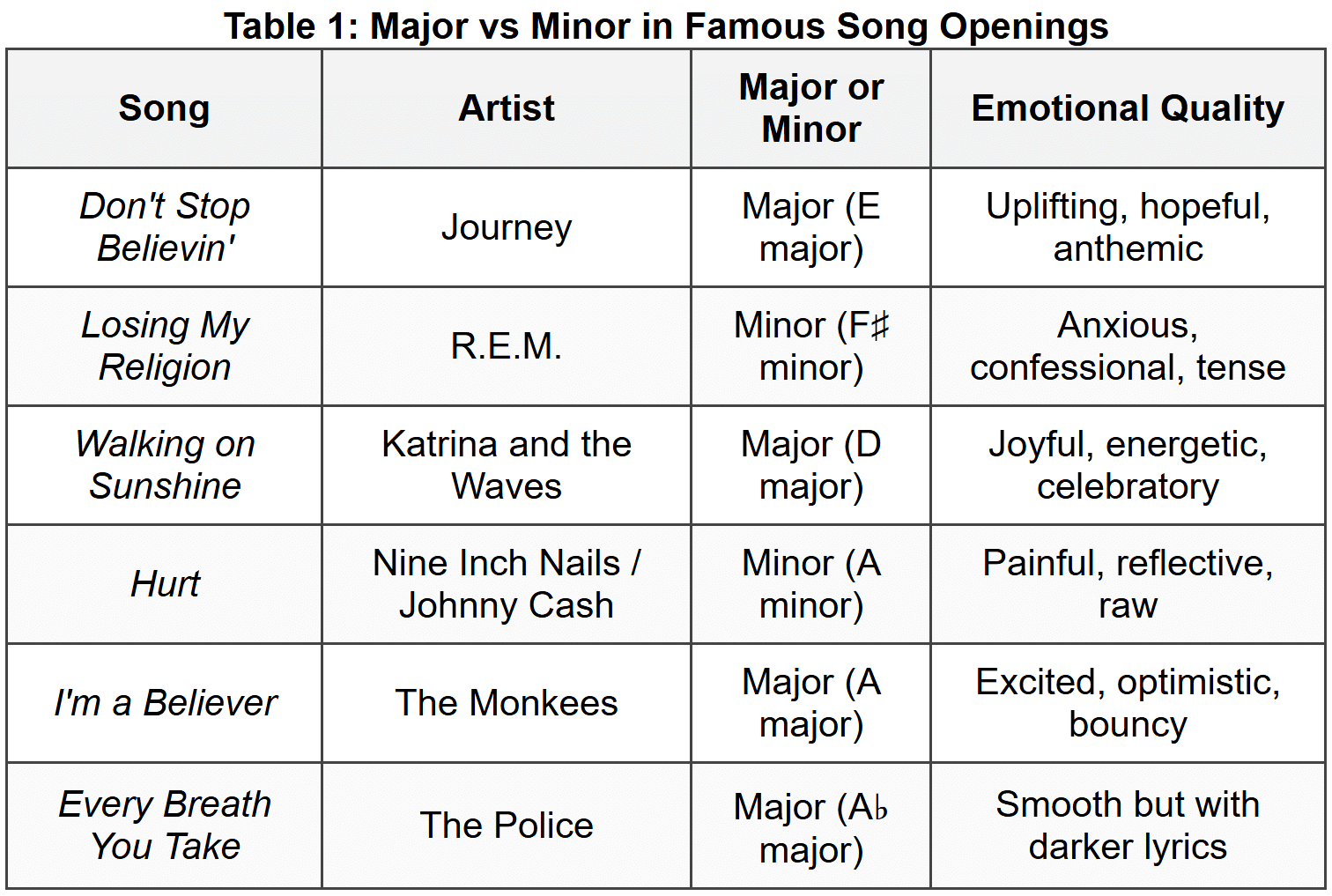
Notice something interesting in that last example? Every Breath You Take is actually in a major key, but the lyrics are about obsessive surveillance. This shows you that major doesn't automatically equal "happy"-context matters. But the major harmony does make the song feel smoother and more palatable than the stalker lyrics might otherwise suggest.
4.3. The Ear Training Challenge
Here's your assignment: for the next week, every time you hear a new song, try to identify within the first 10 seconds whether it's primarily in major or minor. Don't worry about getting it right every time-you're training your instincts. Over time, you'll find you can distinguish them instantly, often before you consciously think about it.
If you have a piano or keyboard, try this physical exercise:
- Play a C major chord (C-E-G). Hold it and really listen.
- Now play a C minor chord (C-E♭-G). Hold it and listen to the difference.
- Alternate between them several times: major, minor, major, minor.
- Close your eyes and have someone else play one or the other. Can you tell which it is?
- Try the same exercise starting on different root notes: D major vs D minor, G major vs G minor, etc.
5. The Role of the Third
We've mentioned the "third" several times, but let's really dig into why this particular note has so much emotional power. Understanding the third is key to understanding major versus minor.
5.1. What Is a Third?
In music, we name intervals by counting the letter names involved. From C to E, we count C (1), D (2), E (3)-that's a third. But not all thirds are created equal.
There are two types of thirds:
- Major third: Four half-steps (also called semitones). Examples: C to E, F to A, G to B
- Minor third: Three half-steps. Examples: C to E♭, D to F, A to C
That single half-step difference is what determines whether a chord sounds major or minor. The root and the fifth stay the same-it's all about the third.
5.2. The Third as an Emotional Switch
Think of the third as an emotional light switch. Flip it one way (major third), and you get brightness. Flip it the other way (minor third), and you get shadow. This makes the third the most tonally sensitive note in the chord.
Songwriters and composers know this instinctively. When Leonard Cohen wanted to shift from brightness to darkness in Hallelujah, he moved between major and minor versions of the same chords. The verse centers around C major, but he borrows from C minor at key moments, and the chorus shifts to F major and then hints at minor colors-these shifts mirror the lyrics' movement between sacred and broken, hallelujah and despair.
Try this songwriting experiment: take a simple chord progression in major, like C-G-Am-F (used in countless pop songs). Now change just the thirds to create a minor version: Cm-Gm-Am-Fm. Play both versions. You've got the same root movement, but completely different emotional terrain.
5.3. Melodies and the Third
The major versus minor quality isn't just about chords-it affects melodies too. When you sing or play a melody over a chord progression, the notes you choose will either reinforce the major/minor quality or create interesting tensions against it.
Listen to Yesterday by The Beatles. The song is in F major, but Paul McCartney's melody emphasizes the major third (A) in emotionally important moments, reinforcing the bittersweet nostalgia. When a melody lands on the third of the underlying chord, it really brings out that major or minor character.
6. Relative and Parallel Relationships
Now we're going to explore two important relationships between major and minor keys. These relationships will help you understand why certain songs can shift between major and minor so smoothly, and why some major and minor keys feel closely related.
6.1. Relative Major and Minor
Every major key has a relative minor-a minor key that shares the exact same notes, the exact same key signature. They're like siblings who share the same DNA but have different personalities.
Here's how it works: the relative minor is always built on the sixth degree of the major scale. Let's use C major as our example:
C major scale: C, D, E, F, G, A, B, C
Count up to the sixth note: A
Therefore, A minor is the relative minor of C major
Both C major and A minor use the same notes-no sharps or flats. But they feel completely different because they use different notes as their home base (their tonic). C major feels stable when you land on a C chord. A minor feels stable when you land on an A minor chord.
To find the relative minor of any major key: count up to the 6th degree of the major scale, or think down three half-steps from the major tonic.
Here are some common relative pairs:
- C major ↔ A minor (no sharps or flats)
- G major ↔ E minor (one sharp: F♯)
- F major ↔ D minor (one flat: B♭)
- D major ↔ B minor (two sharps: F♯, C♯)
- B♭ major ↔ G minor (two flats: B♭, E♭)
Many songs exploit this relationship. Stairway to Heaven by Led Zeppelin begins in A minor and gradually shifts toward its relative major, C major, as the song builds from darkness to light, from mystery to epic celebration. The fact that both keys share the same notes makes this shift feel natural and inevitable.
6.2. Parallel Major and Minor
A completely different relationship exists between parallel major and minor keys-keys that share the same tonic (root note) but have different key signatures.
C major and C minor are parallel keys. They both center around C as their home note, but they use different sets of notes:
C major: C, D, E, F, G, A, B
C minor: C, D, E♭, F, G, A♭, B♭
Notice that three notes are different: the third (E becomes E♭), the sixth (A becomes A♭), and the seventh (B becomes B♭). That lowered third is the most important difference-it's what makes C minor sound darker than C major.
Parallel major and minor keys don't share notes-they share an emotional home base. Songs in parallel keys feel like they're exploring two sides of the same emotional experience.
Tears in Heaven by Eric Clapton moves between A major and A minor sections. Both keys revolve around A as home, but the shift to A minor in certain moments adds poignancy and depth to an already emotionally complex song about loss and longing.
6.3. Borrowing Between Major and Minor
Many songs don't stay purely in major or purely in minor-they borrow chords from the parallel key to add emotional color. This technique is sometimes called modal interchange or modal mixture.
For example, a song in C major might borrow the A♭ major chord from C minor. Suddenly you've got a chord that doesn't "belong" in C major, but it adds a darker, more sophisticated color. The Beatles did this constantly-listen to While My Guitar Gently Weeps, which is in A minor but borrows chords from A major to create emotional contrast.
Try this on an instrument: play a progression in C major, like C-Am-F-G. Now replace the F major with F minor (borrowed from C minor). Hear how that Fm chord adds a shadow? You've just borrowed from the parallel minor, and it creates an emotional moment that stands out.
7. Major and Minor Scales
We've focused mainly on chords so far, but major and minor qualities exist in scales too. Understanding the scales helps you see the bigger picture of how major and minor organize entire musical landscapes.
7.1. The Major Scale
The major scale is the foundation of Western music. It's the "do-re-mi" you learned as a child. Let's look at C major, the easiest to visualize because it uses only white keys on the piano:
C major scale: C, D, E, F, G, A, B, C
This scale follows a specific pattern of whole steps (W) and half steps (H):
W - W - H - W - W - W - H
Let's spell that out:
C to D = whole step
D to E = whole step
E to F = half step
F to G = whole step
G to A = whole step
A to B = whole step
B to C = half step
This pattern works starting from any note. Want a G major scale? Start on G and follow the same pattern of whole and half steps: G, A, B, C, D, E, F♯, G. You need that F♯ to maintain the correct pattern.
The major scale has a bright, complete quality. When you sing it, it feels resolved when you reach the top note and come back to the bottom. This is the scale behind Do-Re-Mi from The Sound of Music-Maria literally sings the major scale to teach the children music theory!
7.2. The Natural Minor Scale
The natural minor scale (sometimes just called "minor scale") has a different pattern of whole and half steps, which gives it that characteristic darker sound:
W - H - W - W - H - W - W
Let's look at A natural minor:
A to B = whole step
B to C = half step
C to D = whole step
D to E = whole step
E to F = half step
F to G = whole step
G to A = whole step
A natural minor scale: A, B, C, D, E, F, G, A
Notice anything? These are the exact same notes as C major-just starting from a different place. This is why A minor is the relative minor of C major. Same notes, different starting point, completely different emotional quality.
The minor scale has a more somber, introspective character. The distance from the first note to the third note is a minor third (three half-steps), which reinforces that minor quality we hear in minor chords.
7.3. Harmonic and Melodic Minor
Here's where it gets interesting: there are actually three types of minor scales commonly used in Western music. We just covered natural minor, but there are also harmonic minor and melodic minor.
Harmonic minor raises the seventh degree of the natural minor scale by a half-step. In A harmonic minor, that means changing G to G♯:
A harmonic minor: A, B, C, D, E, F, G♯, A
This creates a distinctive sound with an exotic, sometimes Middle Eastern flavor. You can hear this scale in countless classical pieces and in songs like Misirlou (the surf rock song used in Pulp Fiction). That raised seventh creates a stronger pull back to the tonic, which is useful for creating dramatic resolutions.
Melodic minor is even more complex-it raises both the sixth and seventh degrees when ascending, but returns to natural minor when descending. In A melodic minor ascending:
A melodic minor (ascending): A, B, C, D, E, F♯, G♯, A
A melodic minor (descending): A, G, F, E, D, C, B, A
This scale is primarily used in classical music and jazz. It smooths out the large interval gap in the harmonic minor scale, making it easier to sing.
For most contemporary songwriting, you'll primarily use the natural minor scale, with occasional borrowing from harmonic minor for dramatic effect. But knowing these variations helps you understand the full minor family.
8. Creating Emotional Contrast in Songwriting
Now let's apply everything you've learned. As a songwriter, understanding major versus minor emotion gives you powerful tools to shape your listener's experience. Let's explore how to use these tools deliberately.
8.1. The Verse-Chorus Shift
One classic technique is to use different major/minor qualities for verses versus choruses. The contrast creates emotional drama and makes your chorus hit harder.
Minor verse → Major chorus: This creates a journey from darkness to light, from question to answer. Livin' on a Prayer by Bon Jovi does this brilliantly-the verses are in E minor, dealing with struggle and hardship, but the chorus explodes into the relative major (G major) with hope and determination: "We're halfway there!"
Major verse → Minor chorus: This less common approach creates introspection or adds weight to the chorus. Pumped Up Kicks by Foster the People has upbeat major verses, but shifts to minor tonality in moments that hint at the song's darker subject matter.
8.2. Strategic Chord Borrowing
You don't need to shift the entire key to create major/minor contrast. Sometimes just one borrowed chord at the right moment creates emotional impact.
Let's say you're writing in C major. Your chorus is uplifting, using chords like C, G, Am, and F. But in the bridge, you want to introduce doubt or complexity. Try borrowing A♭ major from C minor. That single chord-foreign to C major-will create a moment of darkness or uncertainty before you resolve back to the bright major chords.
David Bowie was a master of this. In Space Oddity, he's primarily in C major, but he borrows E♭ major (from C minor) at key dramatic moments, creating that otherworldly, uncertain feeling that matches Major Tom's isolation.
8.3. The Ambiguous Opening
Some of the most intriguing songs open with ambiguity-you're not immediately sure if you're in major or minor. This creates tension and draws the listener in.
Imagine by John Lennon opens with C major and F major chords, clearly major-but then quickly introduces an Am chord and other minor colors. The song hovers between major optimism and minor realism, which perfectly matches the idealistic-yet-pragmatic lyrics.
Try starting your song with a chord that exists in both the major and minor versions of your key, or begin with the vi chord (the relative minor's tonic), which keeps listeners guessing about where you're headed.
8.4. Emotional Arc Through a Song
Think of your song as having an emotional journey, and major versus minor as tools to shape that journey. Here's a framework to consider:
- Establish: Open in major or minor to set the initial mood
- Complicate: Introduce the opposite quality (borrow chords, shift to relative or parallel key) to create contrast
- Intensify: Use the contrast to build tension or emotional complexity
- Resolve: Return to your original quality, or deliberately stay in the contrasting space if you want an unresolved ending
Hotel California by The Eagles follows this arc beautifully. The verses are in B minor, creating mystery and unease. The instrumental sections introduce major chords that feel brighter, almost hopeful-but the song ultimately stays rooted in minor, reinforcing the "you can never leave" lyric. The refusal to resolve to major becomes part of the song's haunting message.
9. Cultural and Historical Context
While the emotional associations we've discussed are powerful and widespread, it's important to understand that they're not universal or fixed. Major and minor have different meanings in different musical cultures and have evolved over time.
9.1. Western Classical Tradition
The major-minor system as we know it crystallized during the Baroque period (roughly 1600-1750). Composers like Bach, Vivaldi, and Handel established conventions where major was used for joyful, triumphant pieces and minor for more serious, sorrowful works.
Bach's Brandenburg Concertos are mostly in major keys-they're celebratory, virtuosic works. But his Mass in B Minor, though it has major sections, uses B minor for its overall key, lending gravitas and spiritual depth.
During the Romantic period (roughly 1800-1900), composers like Chopin, Brahms, and Tchaikovsky explored minor keys extensively for expressing intense emotions-not just sadness, but passion, drama, and inner turmoil. Chopin's Funeral March (from Piano Sonata No. 2) is in B♭ minor and has become synonymous with death and mourning.
9.2. Blues and Jazz Traditions
In Blues music, the major-minor distinction becomes more fluid. The blue notes-particularly the flattened third and seventh degrees-create a sound that's neither purely major nor purely minor. This ambiguity is a defining characteristic of the blues.
When B.B. King plays a blues in E, he's using an E major chord as his foundation, but his melody and lead guitar bend that third degree (G♯) down toward G natural, creating a blue note that expresses melancholy, suffering, and soul-all while sitting on top of a major chord. This bittersweet combination is part of why blues music is so emotionally powerful.
Jazz musicians inherited this approach and expanded it. A jazz standard might be in a major key but use so many altered chords, extensions, and chromatic movement that the simple major/minor distinction becomes just one color in a much larger palette.
9.3. Non-Western Musical Systems
Many musical traditions around the world don't use the major-minor system at all. Indian classical music uses ragas-melodic frameworks that create specific moods (rasas) through different scale patterns, ornaments, and phrase shapes, not through major versus minor thirds.
Middle Eastern music often uses scales with intervals smaller than the Western half-step (microtones), creating emotional landscapes that don't map onto major or minor at all.
Traditional Chinese music uses pentatonic scales that don't have all the notes needed to create major or minor triads in the Western sense.
This reminds us that the emotional associations we've discussed are culturally specific. If you grew up immersed in Western music, major sounds happy and minor sounds sad because you've internalized thousands of examples of this association. But it's learned, not innate.
9.4. Contemporary Genre Variations
Different contemporary genres use major and minor in characteristic ways:
Pop music frequently uses major keys for mainstream appeal, but often incorporates minor-key verses or borrowed chords for depth. The most successful pop songs often balance major brightness with minor complexity.
Metal and hard rock gravitate heavily toward minor keys and modes, using them to convey power, aggression, and intensity rather than sadness. Bands like Metallica and Black Sabbath built their sound on minor-key riffs that sound menacing and heavy.
Country music uses both major and minor, but often with a different emotional mapping-major keys can carry stories of heartbreak and loss, where the major harmony provides a sense of acceptance or stoic resilience rather than happiness.
Electronic and ambient music often use modal systems that blur major and minor distinctions, creating atmospheres that feel neither happy nor sad, but rather spacious, hypnotic, or otherworldly.
10. Advanced Applications and Techniques
As you become more comfortable with major and minor, you can start exploring more sophisticated techniques that professional composers and songwriters use to create nuanced emotional effects.
10.1. Modal Mixture and Chromatic Mediant Relationships
We touched on borrowing chords earlier, but let's go deeper. Modal mixture (also called modal interchange) is the technique of borrowing chords from the parallel major or minor key.
In C major, you might borrow:
- A♭ major (the ♭VI chord from C minor)
- E♭ major (the ♭III chord from C minor)
- F minor (the iv chord from C minor)
These borrowed chords create unexpected emotional colors. The Beatles used ♭VI extensively-listen to the A♭ major chord in In My Life (in the key of A major), which creates a nostalgic, bittersweet moment.
Chromatic mediant relationships involve moving between chords whose roots are a third apart but that don't belong to the same key. For example, moving from C major to E major-both major chords, roots a major third apart, but they don't share a key signature. This creates a dreamy, surreal quality. Film composers use this constantly for magical or otherworldly moments.
10.2. Tierce de Picardie
The Picardy third (tierce de Picardie) is a Baroque-era technique where a piece in minor ends on a major chord instead. You're in A minor the whole time, but the final chord is A major.
This creates a sense of resolution, of light breaking through darkness, or of finding peace after struggle. It was especially common in sacred music, symbolizing hope and redemption.
You can hear modern versions of this in songs like A Day in the Life by The Beatles-the primarily minor song ends with a massive E major chord that rings out, creating a sense of transcendence.
10.3. Major-Minor Seventh Chords
Once you start adding seventh notes to chords, you open up more emotional possibilities. A major-minor seventh chord (also called a dominant seventh) combines a major triad with a minor seventh above the root.
Take a G7 chord: G (root), B (major third), D (perfect fifth), F (minor seventh). This chord has both a major third (B) giving it brightness and a minor seventh (F) adding tension and pull. It's neither purely major nor purely minor-it's restless and wants to resolve.
The dominant seventh chord is fundamental to blues, jazz, and rock. It's what gives Johnny B. Goode by Chuck Berry its driving energy, and it's the backbone of twelve-bar blues progressions.
10.4. Using Minor for Intensity, Not Sadness
Challenge yourself to write something in minor that doesn't sound sad. Focus instead on:
- Fast tempo and driving rhythm: Smooth Criminal by Michael Jackson is in A minor but sounds urgent and dangerous, not sad
- Aggressive instrumentation: Distorted guitars, heavy drums, and aggressive vocals can make minor sound powerful rather than melancholic
- Major chord destinations: Keep moving through minor chords but resolve to major chords at key moments
- Rhythmic emphasis: Strong, syncopated rhythms can override the inherent darkness of minor tonality
Many dance and electronic tracks use minor keys for mysterious, cool, sophisticated vibes rather than sadness-think of Blue Monday by New Order or Satisfaction by Benny Benassi.
Key Terms
- Major Triad
- A three-note chord consisting of a root, major third (4 half-steps above root), and perfect fifth (7 half-steps above root), typically associated with bright, happy, or stable emotions.
- Minor Triad
- A three-note chord consisting of a root, minor third (3 half-steps above root), and perfect fifth (7 half-steps above root), typically associated with darker, sadder, or more introspective emotions.
- Major Third
- An interval spanning four half-steps (semitones), such as from C to E, which gives major chords their characteristic bright sound.
- Minor Third
- An interval spanning three half-steps (semitones), such as from C to E♭, which gives minor chords their characteristic darker sound.
- Perfect Fifth
- An interval spanning seven half-steps, present in both major and minor triads, providing stability and consonance to the chord.
- Relative Major and Minor
- Two keys that share the same notes and key signature but have different tonics (starting points). The relative minor begins on the sixth degree of the major scale; the relative major begins on the third degree of the minor scale.
- Parallel Major and Minor
- Two keys that share the same tonic (root note) but have different key signatures and sets of notes, such as C major and C minor.
- Major Scale
- A seven-note scale following the pattern W-W-H-W-W-W-H (where W = whole step, H = half step), forming the foundation of major tonality.
- Natural Minor Scale
- A seven-note scale following the pattern W-H-W-W-H-W-W, forming the foundation of minor tonality, also known as the Aeolian mode.
- Harmonic Minor Scale
- A minor scale with a raised seventh degree, creating a distinctive sound with an augmented second interval between the sixth and seventh degrees.
- Melodic Minor Scale
- A minor scale that raises both the sixth and seventh degrees when ascending, but returns to natural minor when descending.
- Modal Mixture (Modal Interchange)
- The technique of borrowing chords from the parallel major or minor key to add color and emotional complexity to a progression.
- Chromatic Mediant
- A chord relationship where roots are a third apart but the chords don't belong to the same key, creating unexpected harmonic color.
- Picardy Third (Tierce de Picardie)
- A technique where a piece in minor ends on a major chord, creating a sense of resolution or hope.
- Blue Notes
- Notes that fall between the major and minor third (and sometimes other scale degrees), characteristic of blues music, creating an ambiguous major-minor quality.
- Tonic
- The home note or chord of a key; the note of ultimate stability and rest in a tonal system.
- Consonance
- A stable, pleasing sound created by certain interval relationships, such as major and minor thirds and perfect fifths.
- Interval
- The distance between two pitches, measured in half-steps (semitones) or by counting letter names.