Practice Questions :Cell Structure and Function

SECTION I: MULTIPLE CHOICE
Directions
Select the best answer for each of the following questions. Questions may require analysis of experimental data, diagrams, or biological scenarios. For questions marked "Select TWO answers," you must choose exactly two options that correctly answer the question; both must be selected to earn credit.
Questions 1-2 refer to the following experimental data:
Experimental Setup: Researchers investigated membrane permeability by placing plant cells in solutions of varying osmolarity. They measured the rate of plasmolysis (cell shrinkage) over 30 minutes. The table below shows their results.
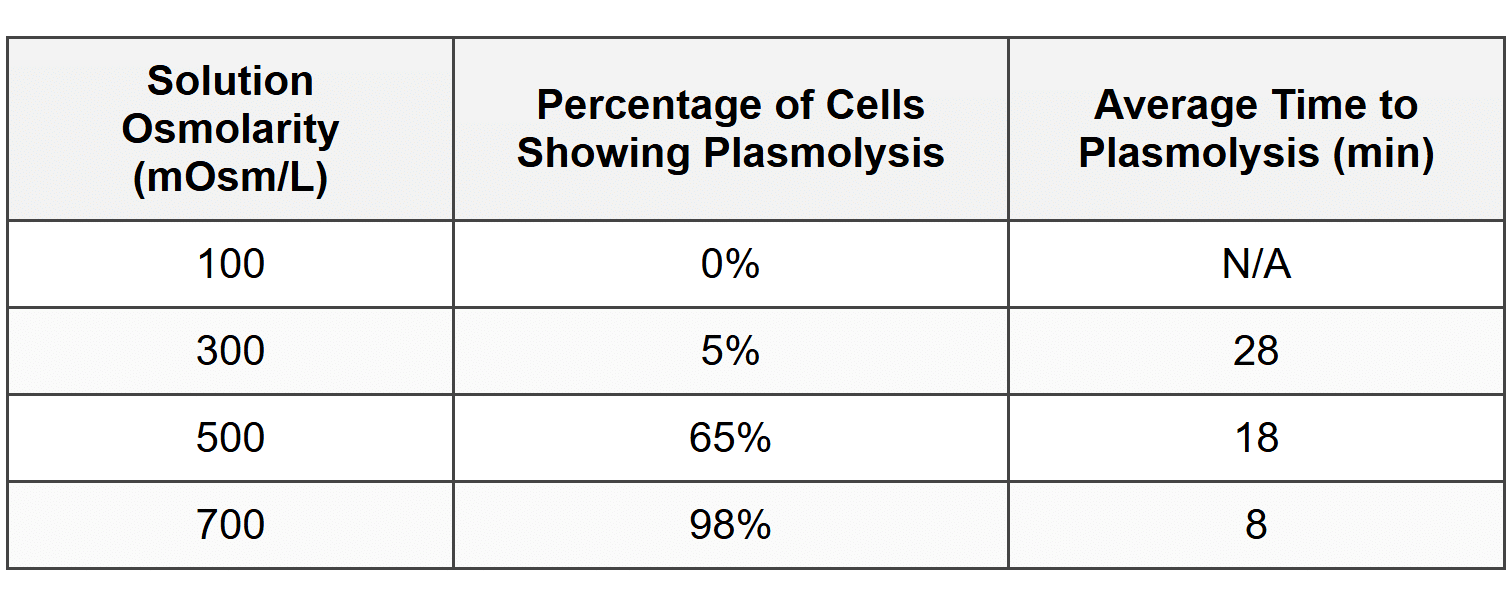
1. Based on the data, which statement best explains the relationship between solution osmolarity and the rate of plasmolysis?
- As osmolarity increases, water moves into the cell more rapidly due to increased concentration of solutes inside the cell.
- As osmolarity increases, water moves out of the cell more rapidly because the water potential gradient between the cell and the solution increases.
- As osmolarity decreases, the cell wall prevents water from entering the cell, which explains why no plasmolysis occurs at 100 mOsm/L.
- The rate of plasmolysis is independent of solution osmolarity because the cell membrane maintains constant permeability to water.
2. The internal osmolarity of the plant cells used in this experiment is most likely closest to which value?
- 100 mOsm/L
- 200 mOsm/L
- 400 mOsm/L
- 600 mOsm/L
Questions 3-4 refer to the following diagram:
Figure 1: Electron micrograph analysis of two cell types
Cell A: Contains numerous membrane-bound structures including extensive folded membranes with attached ribosomes, a prominent double-membrane structure containing circular DNA, and multiple small vesicles near the plasma membrane.
Cell B: Contains a single circular chromosome in a nucleoid region, ribosomes scattered throughout the cytoplasm (not membrane-bound), and no membrane-enclosed organelles. The cell wall contains peptidoglycan.
3. Which of the following correctly identifies the two cell types and provides the best reasoning?
- Cell A is prokaryotic and Cell B is eukaryotic, because Cell A has circular DNA characteristic of bacteria.
- Cell A is eukaryotic and Cell B is prokaryotic, because Cell A has membrane-bound organelles and Cell B has a nucleoid region.
- Both cells are prokaryotic because they both contain ribosomes, which are found only in prokaryotic organisms.
- Both cells are eukaryotic because they both have DNA, which is a defining characteristic of eukaryotic cells.
4. (Select TWO answers) Which TWO cellular components visible in Cell A would allow it to perform functions that Cell B cannot?
- The folded membranes with attached ribosomes allow for protein modification and sorting through the endomembrane system.
- The circular DNA allows for rapid replication compared to linear chromosomes.
- The double-membrane structure containing DNA allows for aerobic cellular respiration to produce ATP.
- The peptidoglycan cell wall provides structural support that is absent in Cell B.
Questions 5-6 refer to the following experimental scenario:
A researcher is studying active transport in intestinal epithelial cells. She uses a fluorescent dye to mark glucose molecules and observes their movement across the cell membrane. She conducts three trials:
- Trial 1: Normal conditions with ATP present
- Trial 2: ATP synthesis is blocked with a metabolic inhibitor
- Trial 3: Normal ATP levels, but sodium ions (Na+) are removed from the extracellular fluid
In Trial 1, glucose is transported into the cell against its concentration gradient. In Trial 2, minimal glucose transport occurs. In Trial 3, glucose transport is significantly reduced but not completely eliminated.
5. Which mechanism best explains the glucose transport observed in Trial 1?
- Simple diffusion through the phospholipid bilayer, driven by the concentration gradient
- Facilitated diffusion through glucose channel proteins, which does not require energy
- Secondary active transport coupled to the sodium-potassium pump, which establishes an Na+ gradient
- Primary active transport using a glucose-specific ATPase pump
6. The results from Trial 3 suggest that when Na+ is removed from the extracellular fluid, glucose transport is reduced because:
- glucose cannot cross the membrane without binding to sodium ions due to the chemical properties of glucose
- the Na+/glucose cotransporter requires the sodium gradient to drive glucose uptake against its concentration gradient
- sodium ions are required to maintain the structural integrity of glucose transport proteins
- the absence of sodium causes the cell to stop producing ATP, which is needed for glucose transport
7. The surface area-to-volume ratio is an important constraint on cell size. As a cell increases in size, which of the following best describes the effect on the surface area-to-volume ratio and the resulting consequence for cellular function?
- The ratio increases, allowing for more efficient nutrient uptake and waste removal per unit of cell volume.
- The ratio decreases, making it more difficult for the cell to exchange materials with its environment efficiently.
- The ratio remains constant because both surface area and volume increase proportionally as the cell grows.
- The ratio becomes negative, which triggers programmed cell death to prevent the cell from growing too large.
Questions 8-9 refer to the following data:
Experimental Data: Researchers measured the rate of oxygen consumption in isolated mitochondria under different conditions. Results are shown below.
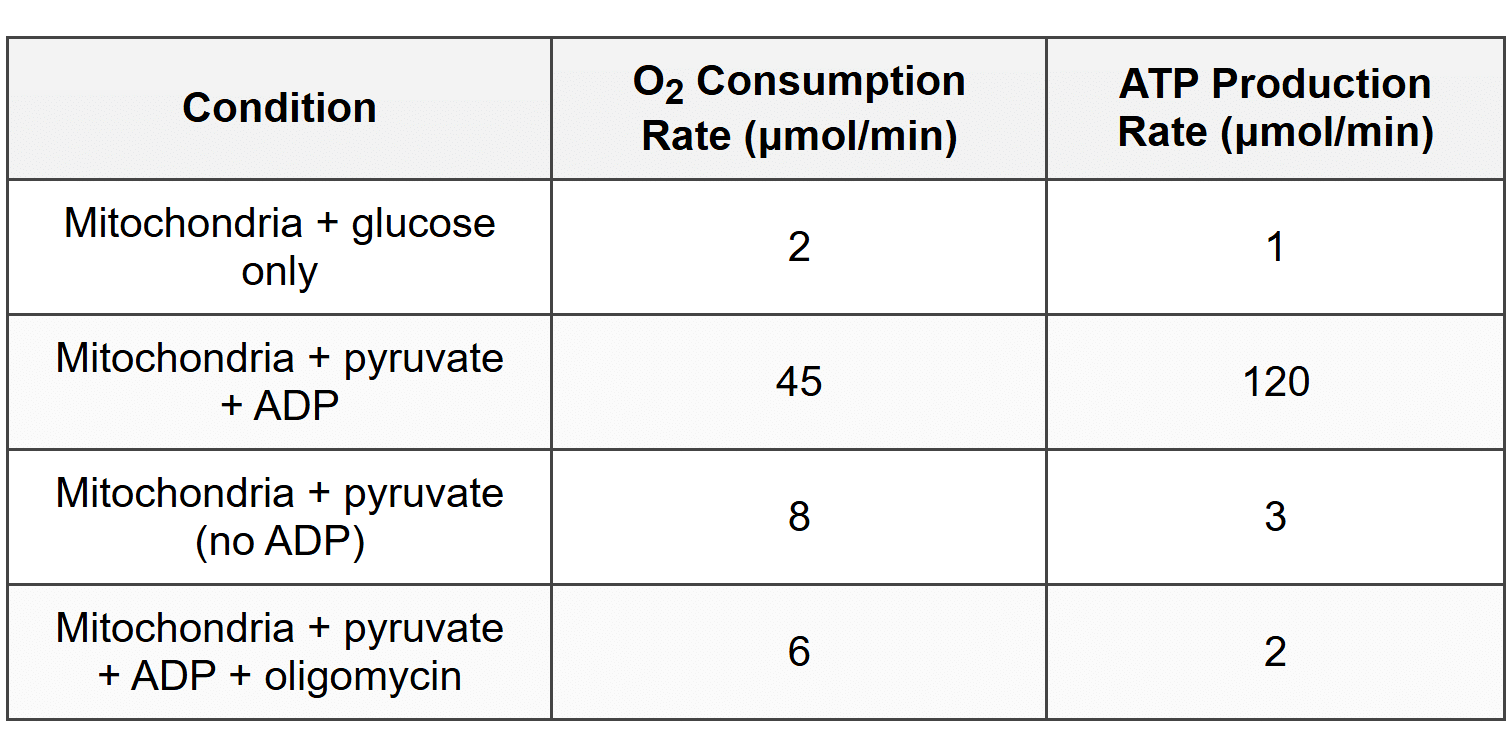
Note: Oligomycin is an inhibitor of ATP synthase
8. Why is oxygen consumption low when only glucose is provided to isolated mitochondria?
- Glucose cannot cross the mitochondrial membrane and therefore cannot be used as a substrate for cellular respiration.
- Mitochondria lack the enzymes necessary to break down glucose into usable substrates.
- Glucose is transported out of the mitochondria as quickly as it enters, preventing its accumulation.
- The mitochondrial membrane is impermeable to all six-carbon sugars as a regulatory mechanism.
9. The data from the condition with pyruvate but no ADP demonstrate which important principle of mitochondrial function?
- Mitochondria can produce ATP through substrate-level phosphorylation even without oxygen present.
- The electron transport chain requires ADP to accept electrons from NADH and FADH2.
- Oxygen consumption and ATP production are coupled; when ATP synthesis is limited, electron transport slows down.
- Pyruvate dehydrogenase is inactive in the absence of ADP, preventing the citric acid cycle from proceeding.
10. (Select TWO answers) Which TWO statements correctly describe structural features of the plasma membrane and their functional significance?
- Cholesterol molecules embedded in the membrane decrease fluidity at high temperatures, preventing the membrane from becoming too fluid.
- The hydrophobic tails of phospholipids face outward toward the aqueous environment to repel water molecules.
- Transmembrane proteins with hydrophobic regions interact with the fatty acid tails of phospholipids, anchoring the proteins in the membrane.
- Glycoproteins on the extracellular surface function in cell-cell recognition and immune system responses.
Questions 11-12 refer to the following diagram:
Figure 2: Diagram of protein trafficking in a eukaryotic cell
A newly synthesized protein follows this pathway:
- Protein synthesis begins on a free ribosome in the cytoplasm
- Signal sequence is recognized, and ribosome attaches to Structure X
- Protein is synthesized into the lumen of Structure X
- Protein is packaged into a transport vesicle
- Vesicle fuses with Structure Y, where the protein is modified (glycosylation occurs)
- Protein is packaged into secretory vesicles
- Vesicles fuse with the plasma membrane, releasing protein outside the cell
11. Structures X and Y in the diagram represent which two organelles, respectively?
- Smooth endoplasmic reticulum and lysosome
- Rough endoplasmic reticulum and Golgi apparatus
- Golgi apparatus and rough endoplasmic reticulum
- Mitochondrion and smooth endoplasmic reticulum
12. If a mutation disrupted the signal sequence in step 2, which of the following would most likely occur?
- The protein would be synthesized normally but would remain in the cytoplasm instead of being secreted.
- The ribosome would be unable to synthesize the protein, resulting in no protein production.
- The protein would be targeted to the mitochondria instead of Structure X.
- The protein would be immediately degraded by proteases in the cytoplasm before synthesis is complete.
13. Lysosomes contain hydrolytic enzymes that function optimally at pH 5. The lysosomal membrane contains proton pumps that actively transport H+ ions into the lysosome. Which of the following best explains why this mechanism is important for cellular function?
- The acidic environment denatures proteins entering the lysosome, making them easier to digest.
- Maintaining a low pH inside lysosomes ensures that if the membrane ruptures, the released enzymes will be inactive in the neutral pH of the cytoplasm.
- The pH gradient between the lysosome and cytoplasm drives ATP synthesis through chemiosmosis.
- The acidic pH prevents the lysosomal membrane from degrading due to enzyme activity.
Questions 14-15 refer to the following experimental data:
Chloroplast Structure Experiment: Scientists isolated chloroplasts and mechanically disrupted them to separate the thylakoid membranes from the stroma. They then measured the ability of each fraction to perform different reactions when provided with appropriate substrates and cofactors.
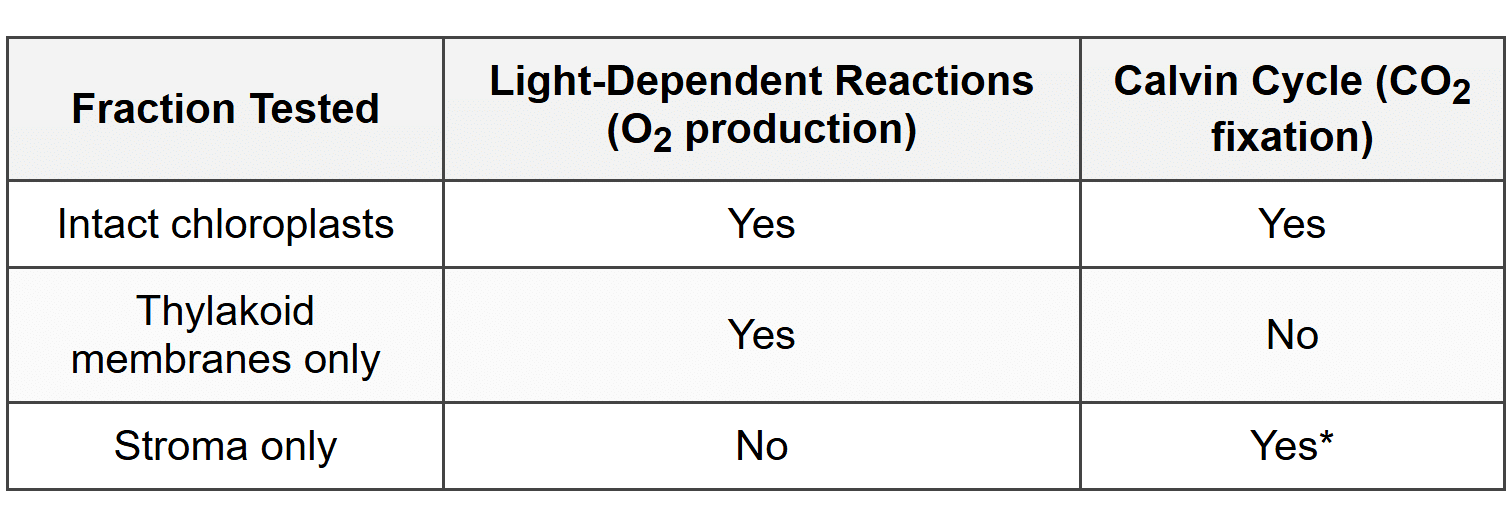
*When provided with ATP and NADPH
14. These results support which conclusion about the compartmentalization of photosynthesis?
- The light-dependent reactions occur in the stroma, while the Calvin cycle occurs in the thylakoid membranes.
- The enzymes and proteins required for the light-dependent reactions are embedded in or associated with the thylakoid membranes.
- Both the light-dependent reactions and Calvin cycle require the intact chloroplast structure to function.
- The thylakoid membranes contain all the enzymes necessary for complete photosynthesis.
15. The fact that isolated stroma can perform the Calvin cycle only when ATP and NADPH are provided demonstrates that:
- the stroma cannot produce its own ATP and must import it from mitochondria
- the Calvin cycle depends on products generated by the light-dependent reactions
- ATP and NADPH are required to transport CO2 across the chloroplast membrane
- the stroma lacks the enzymes necessary to synthesize ATP and NADPH from ADP and NADP+
16. (Select TWO answers) The endosymbiotic theory proposes that mitochondria and chloroplasts originated from free-living prokaryotes that were engulfed by ancestral eukaryotic cells. Which TWO observations provide evidence supporting this theory?
- Mitochondria and chloroplasts contain their own circular DNA molecules similar to bacterial chromosomes.
- Mitochondria and chloroplasts are surrounded by a single membrane derived from the plasma membrane of the host cell.
- Mitochondria and chloroplasts contain ribosomes that are similar in size and structure to bacterial ribosomes (70S rather than 80S).
- Mitochondria and chloroplasts can synthesize all of their own proteins without any nuclear gene involvement.
Questions 17-18 refer to the following scenario:
A researcher is studying protein synthesis and observes the following:
- In cells treated with Drug A, proteins continue to be synthesized, but they lack their normal three-dimensional structure and are nonfunctional.
- In cells treated with Drug B, protein synthesis stops completely within minutes of treatment.
- In cells treated with Drug C, proteins are synthesized normally but accumulate in the endoplasmic reticulum and are not secreted.
Further analysis reveals:
- Drug A interferes with the function of chaperone proteins
- Drug B binds to ribosomes and prevents tRNA binding
- Drug C disrupts the Golgi apparatus structure
17. Based on this information, which statement best describes the normal function of chaperone proteins?
- Chaperone proteins transcribe DNA into mRNA, which is then translated into proteins.
- Chaperone proteins assist in the proper folding of polypeptide chains into their functional three-dimensional conformations.
- Chaperone proteins transport amino acids to the ribosome during translation.
- Chaperone proteins package proteins into vesicles for transport to the Golgi apparatus.
18. The observation that proteins accumulate in the endoplasmic reticulum when the Golgi apparatus is disrupted provides evidence that:
- the Golgi apparatus is required for protein synthesis to occur
- proteins must pass through the Golgi apparatus as part of the secretory pathway
- the endoplasmic reticulum cannot function without signals from the Golgi apparatus
- protein folding occurs exclusively in the Golgi apparatus, not in the endoplasmic reticulum
19. Peroxisomes are organelles that contain enzymes involved in various metabolic reactions, including the breakdown of fatty acids and the detoxification of hydrogen peroxide (H2O2). The enzyme catalase converts H2O2 to water and oxygen. A genetic disorder that prevents peroxisome formation would most likely result in:
- an inability to perform photosynthesis due to the lack of oxygen production
- accumulation of toxic levels of H2O2 and impaired fatty acid metabolism
- increased ATP production because fatty acids would be redirected to mitochondria
- complete loss of all cellular enzyme activity because peroxisomes produce all cellular enzymes
20. The nuclear envelope is a double membrane structure with nuclear pores that regulate transport between the nucleus and cytoplasm. Large molecules such as mRNA and ribosomal subunits must pass through these pores. Which of the following statements best explains why this selective transport is critical for proper cellular function?
- It prevents DNA from leaving the nucleus while allowing mRNA to exit, maintaining separation between transcription and translation.
- It allows proteins to enter the nucleus but prevents mRNA from exiting, ensuring that translation occurs in the nucleus.
- It maintains equal concentrations of all molecules on both sides of the nuclear envelope through passive diffusion.
- It prevents all RNA molecules from leaving the nucleus, ensuring that genetic information remains protected.
SECTION II: FREE RESPONSE
Directions
Answer both questions in this section. Where calculation is required, clearly show your work and include appropriate units. Where explanation or discussion is required, support your answers with relevant evidence and biological principles. Use complete sentences in all explanations.
FRQ 1 (Long Free Response - 10 points)
Experimental Context:
A team of scientists investigated the effect of temperature on membrane permeability in beet root cells. Beet roots contain a red pigment (betalain) stored in the central vacuole. When membrane integrity is compromised, this pigment leaks into the surrounding solution, which can be measured using a spectrophotometer.
The researchers cut uniform beet root cylinders and exposed them to different temperatures for 30 minutes. They then measured the absorbance of the surrounding solution at 475 nm (higher absorbance indicates more pigment leakage). The results are shown in the table and graph below.
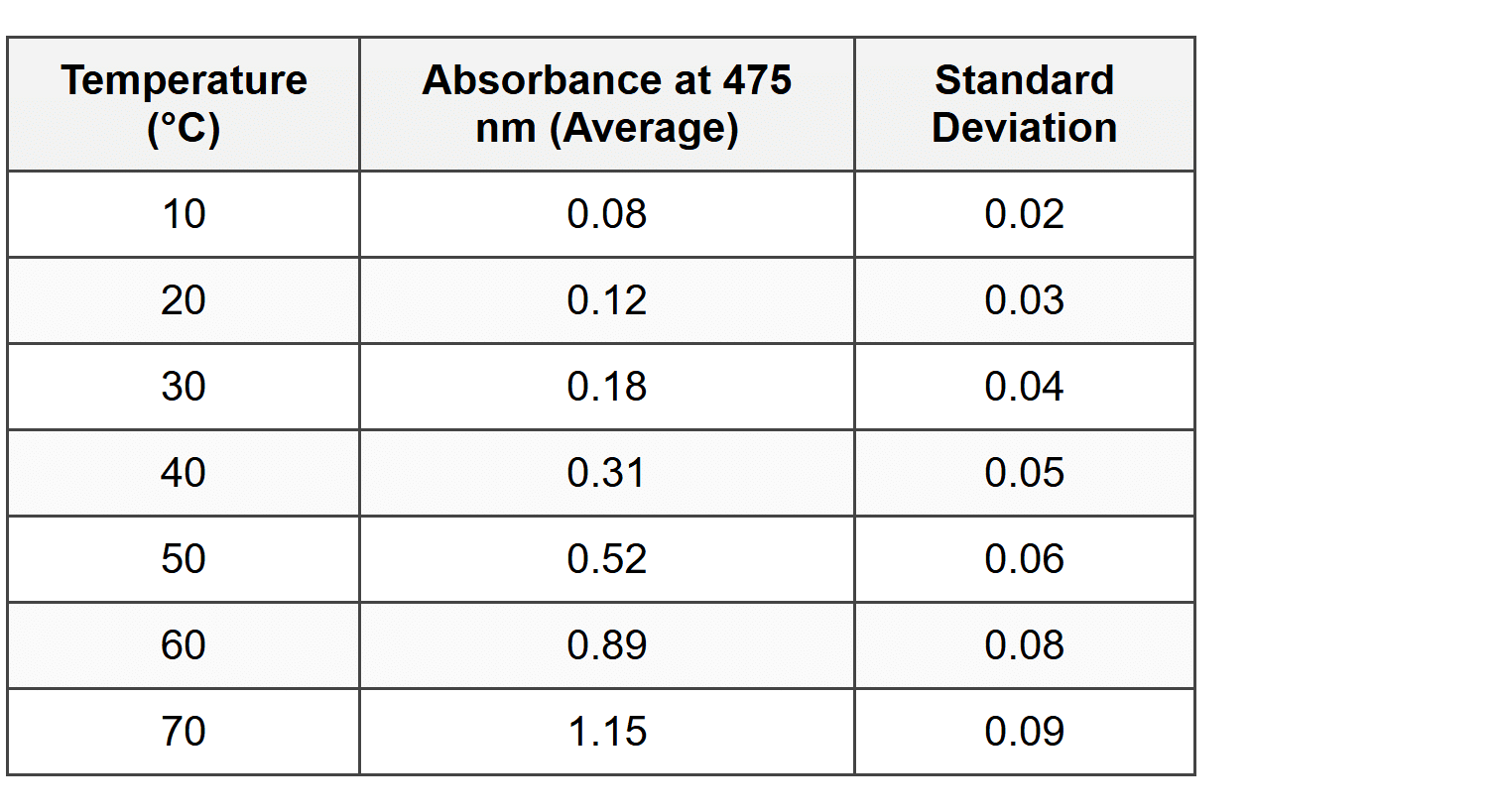
Note: Each temperature treatment was replicated 5 times using beet root cylinders from the same plant. The plant was grown under standard greenhouse conditions.
- Identify the independent variable and the dependent variable in this experiment.
- Describe the relationship between temperature and membrane permeability as shown by the data. Include specific data points in your answer.
- Explain how the fluid mosaic model of membrane structure accounts for the observed changes in permeability at higher temperatures. Your explanation should reference specific membrane components.
- Calculate the rate of change in absorbance per degree Celsius between 30°C and 50°C. Show your work and include units.
- Design a controlled experiment to test whether membrane permeability changes are reversible when beet root cells are returned to lower temperatures after heat exposure. Your description should include:
- The specific procedure for conducting the experiment
- The data you would collect
- How you would analyze the results to determine if the changes are reversible
- Predict how the results might differ if the experiment were conducted using cells from an Arctic plant species adapted to cold environments. Justify your prediction using the concept of membrane adaptation.
FRQ 2 (Short Free Response - 4 points)
Eukaryotic cells maintain distinct compartments with specialized functions. The compartmentalization of cellular processes allows for greater efficiency and regulation.
- Identify the organelle in which each of the following processes primarily occurs:
- Synthesis of secreted proteins
- Modification and sorting of proteins
- Breakdown of damaged organelles
- Synthesis of lipids for membrane production
- Explain how the compartmentalization of cellular respiration in mitochondria increases the efficiency of ATP production compared to ATP production in prokaryotic cells. Your answer should reference the role of the inner mitochondrial membrane.
- Describe one specific example of how a defect in intracellular transport between compartments could disrupt normal cellular function. Include both the transport mechanism affected and the resulting cellular consequence.
ANSWER KEY
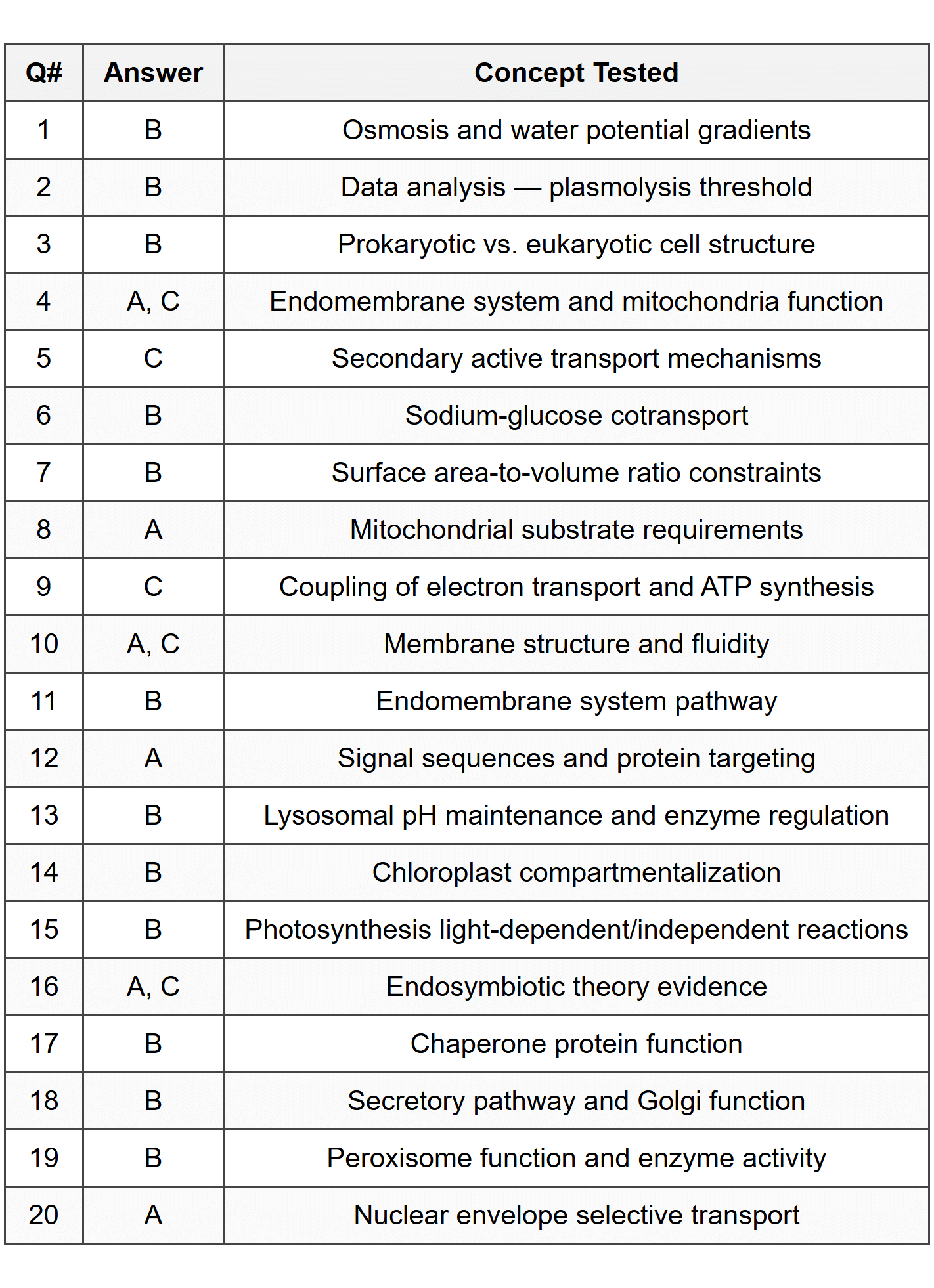
Part A - Multiple Choice Answer Table
Part B - FRQ Detailed Answers
FRQ 1 - Answer Key
Part A: Identify variables (1 point)
Independent variable: Temperature (°C)
Dependent variable: Absorbance at 475 nm (which indicates the amount of betalain pigment that leaked from the cells)
Part B: Describe the relationship (2 points)
As temperature increases, membrane permeability increases, as indicated by higher absorbance values. The relationship shows a gradual increase at lower temperatures and accelerates at higher temperatures. Specifically, absorbance increases from 0.08 at 10°C to 0.31 at 40°C (a change of 0.23), but then increases more dramatically from 0.31 at 40°C to 1.15 at 70°C (a change of 0.84). This suggests that membrane integrity is increasingly compromised at temperatures above 40°C, resulting in greater pigment leakage.
Scoring note: Award 1 point for identifying the positive relationship between temperature and permeability/absorbance. Award 1 point for citing specific data values to support the description.
Part C: Explain using fluid mosaic model (2 points)
According to the fluid mosaic model, the plasma membrane consists of a phospholipid bilayer with embedded proteins. The phospholipids have hydrophobic fatty acid tails that interact through weak van der Waals forces. At higher temperatures, the kinetic energy of the phospholipid molecules increases, causing them to move more rapidly and creating larger gaps between molecules. This increased fluidity disrupts the normally selective barrier function of the membrane. Additionally, at very high temperatures (above approximately 50-60°C), membrane proteins may denature and lose their structural integrity, further compromising membrane function. The combination of increased phospholipid movement and protein denaturation explains why pigment molecules that are normally retained in the vacuole are able to leak across multiple membranes (vacuolar membrane, plasma membrane) into the surrounding solution at elevated temperatures.
Scoring note: Award 1 point for explaining that increased temperature increases phospholipid movement/fluidity and disrupts membrane structure. Award 1 point for connecting this structural change to the functional consequence of increased permeability and referencing specific membrane components (phospholipids and/or proteins).
Part D: Calculate rate of change (1 point)
Rate of change = \(\frac{\Delta \text{Absorbance}}{\Delta \text{Temperature}}\)
Rate of change = \(\frac{0.52 - 0.18}{50 - 30}\)
Rate of change = \(\frac{0.34}{20}\)
Rate of change = 0.017 absorbance units per °C
Scoring note: Award 1 point for correct calculation with proper units. Accept equivalent forms such as 0.017 AU/°C or 1.7 × 10⁻² per °C.
Part E: Design reversibility experiment (2 points)
Procedure:
- Cut uniform beet root cylinders from the same plant and divide them into three groups.
- Group 1 (control): Maintain at 20°C for 60 minutes.
- Group 2 (heat only): Incubate at 60°C for 30 minutes.
- Group 3 (heat + recovery): Incubate at 60°C for 30 minutes, then transfer to 20°C for 30 minutes.
- After treatments, place all samples in fresh water at 20°C and measure absorbance of the surrounding solution after 30 minutes.
- Replicate each treatment at least 3 times.
Data to collect: Absorbance at 475 nm for each sample and calculate mean absorbance for each treatment group.
Analysis: If the membrane damage is reversible, Group 3 should show absorbance values similar to Group 1 (control). If the damage is irreversible, Group 3 should show absorbance values similar to Group 2 (heat only). Statistical analysis using a t-test or ANOVA could determine if differences between groups are significant.
Scoring note: Award 1 point for a procedure that includes a heat treatment followed by a recovery period, with appropriate controls. Award 1 point for explaining how to analyze results by comparing the recovery group to both the control and heat-only groups to determine reversibility.
Part F: Predict and justify for Arctic plant (2 points)
Prediction: Arctic plant cells would likely show less pigment leakage at low temperatures (10-30°C) but would begin to show significant membrane damage at lower temperatures than the plant tested in the original experiment.
Justification: Plants adapted to cold environments typically have membranes with a higher proportion of unsaturated fatty acids in their phospholipids. Unsaturated fatty acids contain double bonds that create kinks in the hydrocarbon chains, preventing tight packing and maintaining membrane fluidity at lower temperatures. This adaptation allows Arctic plants to maintain normal membrane function in cold conditions. However, this also means their membranes are adapted to function optimally at lower temperatures, so they may lose structural integrity at temperatures that temperate plants tolerate well. The increased proportion of unsaturated fatty acids would make Arctic plant membranes excessively fluid at moderate to high temperatures, potentially causing increased permeability at lower temperature thresholds (perhaps 40-50°C instead of 60-70°C).
Scoring note: Award 1 point for predicting different temperature sensitivity based on membrane adaptation. Award 1 point for correctly explaining that cold-adapted plants have more unsaturated fatty acids to maintain fluidity at low temperatures, and connecting this to altered temperature sensitivity.
FRQ 2 - Answer Key
Part A: Identify organelles (1 point)
- Synthesis of secreted proteins: Rough endoplasmic reticulum (RER)
- Modification and sorting of proteins: Golgi apparatus
- Breakdown of damaged organelles: Lysosome
- Synthesis of lipids for membrane production: Smooth endoplasmic reticulum (SER)
Scoring note: Award 1 point for correctly identifying all four organelles. Deduct 0.25 points for each incorrect answer (minimum score of 0).
Part B: Explain mitochondrial compartmentalization and ATP efficiency (2 points)
The compartmentalization of cellular respiration in mitochondria increases ATP production efficiency through the creation of separate compartments by the inner mitochondrial membrane. During the electron transport chain, protons (H+) are actively pumped from the mitochondrial matrix into the intermembrane space, creating a high concentration of protons in this narrow space between the inner and outer membranes. This restricted compartment allows for the rapid buildup of a steep proton gradient (high concentration in intermembrane space, low concentration in matrix), which represents stored potential energy. The inner mitochondrial membrane is folded into cristae, which greatly increases its surface area and allows for more ATP synthase enzymes and electron transport chain complexes to be embedded in the membrane. When protons flow back through ATP synthase down their concentration gradient, the potential energy is converted to chemical energy in ATP through chemiosmosis.
In prokaryotic cells, which lack mitochondria, the electron transport chain is located in the plasma membrane, and protons are pumped into the space between the plasma membrane and cell wall. This space is much larger and less contained than the mitochondrial intermembrane space, making it more difficult to maintain a steep proton gradient. Therefore, prokaryotes are less efficient at ATP production per unit of membrane area compared to the highly compartmentalized mitochondria of eukaryotic cells.
Scoring note: Award 1 point for explaining that the inner mitochondrial membrane creates compartments that allow buildup of a proton gradient in the intermembrane space. Award 1 point for explaining that this compartmentalization is more efficient than in prokaryotes, with specific reference to either the small volume of the intermembrane space, the increased surface area of cristae, or the comparison to prokaryotic membrane organization.
Part C: Describe transport defect example (1 point)
One example is I-cell disease (mucolipidosis II), which results from a defect in the addition of mannose-6-phosphate tags to lysosomal enzymes in the Golgi apparatus. These tags normally serve as signals for packaging enzymes into vesicles destined for lysosomes. Without proper tags, lysosomal enzymes are not transported to lysosomes but instead are secreted from the cell. As a result, lysosomes lack the hydrolytic enzymes needed to break down cellular waste products, leading to accumulation of undigested materials in lysosomes and severe cellular dysfunction, particularly in connective tissue cells.
Alternative acceptable answer: Defects in COPII coat proteins prevent the formation of transport vesicles from the ER to the Golgi. This blocks the secretory pathway, causing proteins to accumulate in the ER, triggering ER stress and potentially leading to cell death if unresolved.
Scoring note: Award 1 point for describing a specific transport defect (must name or describe the mechanism) and explaining the cellular consequence. Must include both the transport mechanism and the functional outcome to earn the point.




