Grade 9 Exam > Grade 9 Notes > AP World History > Practice Questions :Networks Of Exchange
Practice Questions :Networks Of Exchange

# AP World History: Modern - Networks of Exchange Practice Worksheet --- ## SECTION I: MULTIPLE CHOICE ### Directions **Questions 1-20** are based on historical sources, data, and excerpts. Each question is followed by four suggested answers or completions. Select the one that best answers the question or completes the statement. --- ### Questions 1-3 refer to the excerpt below.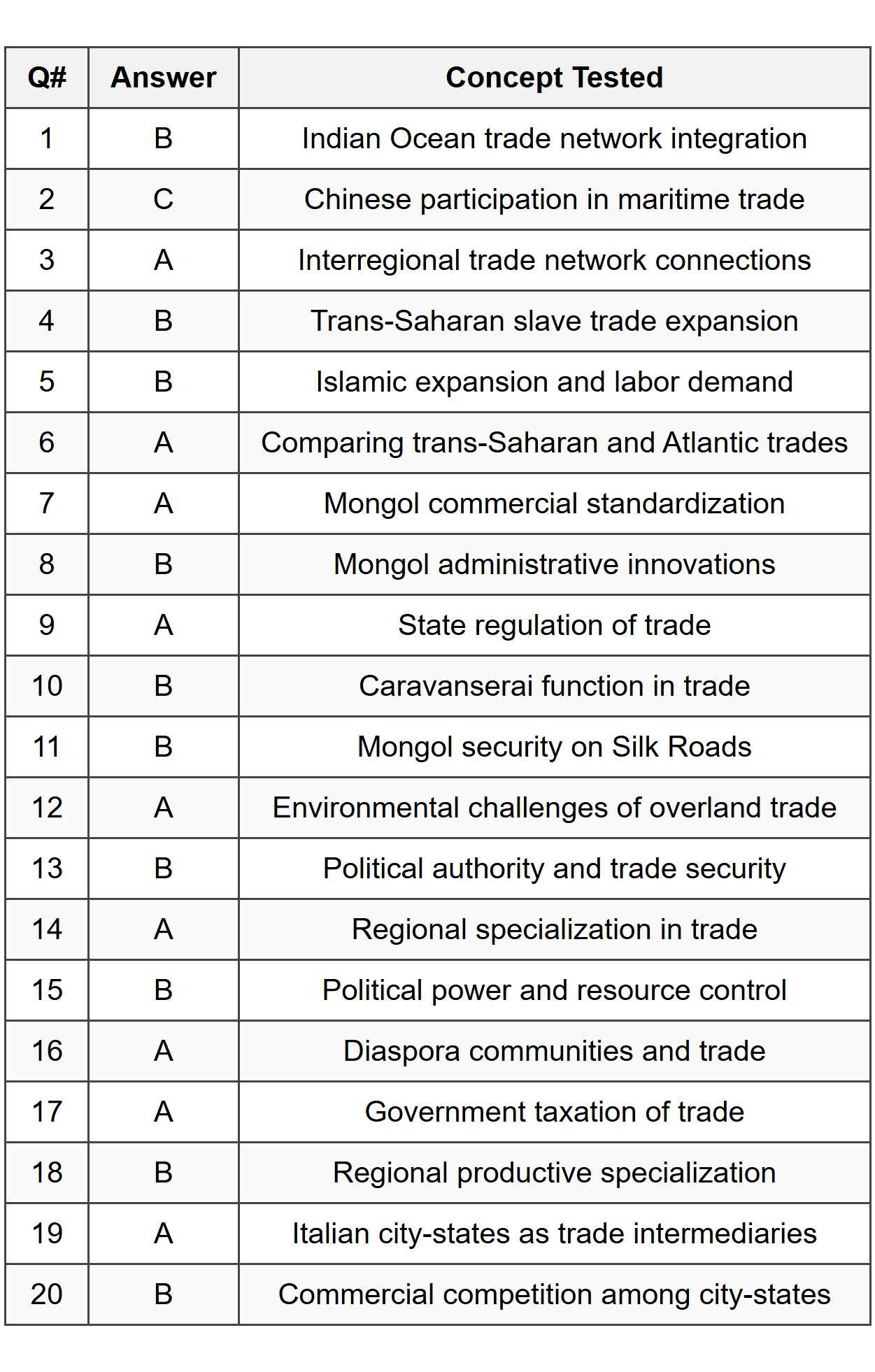 --- ### Part B: Free Response Question Model Answers --- ### FRQ 1 - Answer Key (Short Answer Question)
Source: Ibn Battuta, travel account, 14th century**Question 1:** The trade patterns described in the excerpt best illustrate which of the following features of the Indian Ocean trade network between 1200 and 1450?
"The merchants of Kilwa are engaged in trade with the lands of the Zanj [East African coast]. They import into Kilwa ivory, gold, and slaves, and export manufactured goods, cloth from Egypt and India, and porcelain from China. The sultan is a generous man who gives freely to those who come from distant lands. I observed Chinese vessels in the harbor and saw how the monsoon winds determine when ships arrive and depart."
- The exclusive control of maritime trade by Arab merchants who prevented other groups from participating
- The integration of diverse regions through monsoon wind patterns and the exchange of luxury goods and raw materials
- The dominance of overland caravan routes over sea-based commerce in connecting Africa to Asia
- The replacement of traditional trade goods with European manufactured products
- Chinese military conquest of East African coastal cities
- The establishment of Chinese agricultural colonies along the East African coast
- The participation of Chinese merchants and officials in long-distance Indian Ocean trade
- The forced migration of Chinese laborers to work in African gold mines
- Trade networks connected multiple regions, allowing for the distribution of specialized products across vast distances
- All participating regions produced identical goods, leading to economic stagnation
- European merchants controlled the production and distribution of all luxury goods
- Religious differences prevented meaningful economic exchange between Islamic and non-Islamic regions
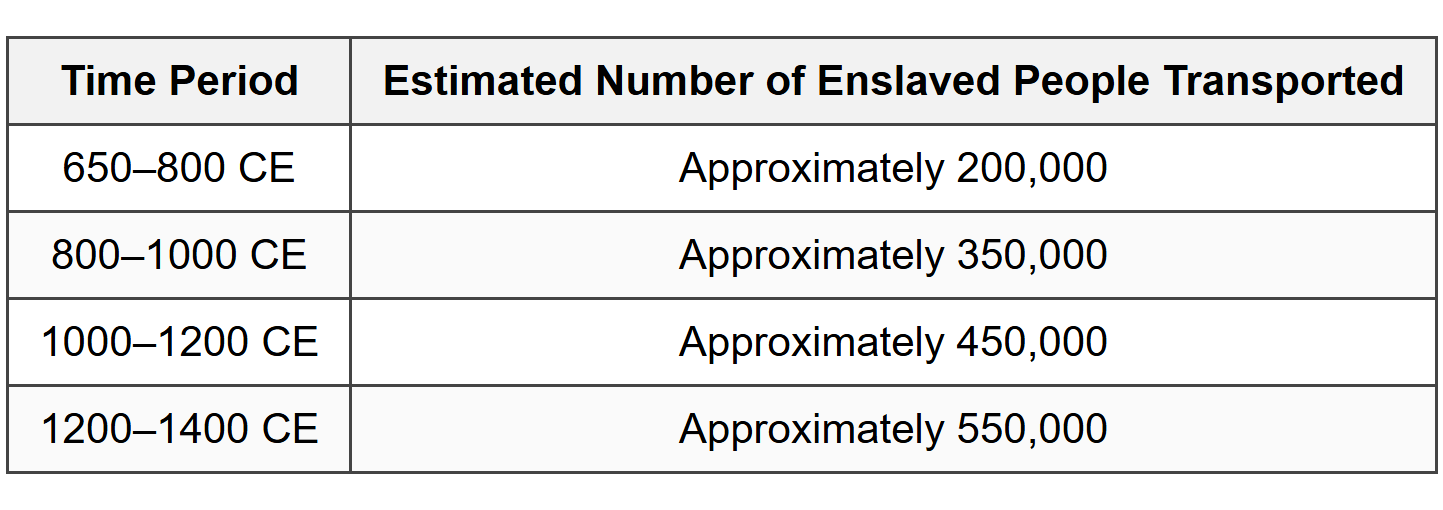
Estimated Volume of Trans-Saharan Slave Trade (approximate numbers per century)**Question 4:** The data in the table best support which of the following conclusions about trans-Saharan trade between 650 and 1400 CE?
- The volume of enslaved people transported across the Sahara decreased steadily as Islamic law prohibited slavery
- The trans-Saharan slave trade expanded gradually over time, likely in response to increased demand in North Africa and the Middle East
- European merchants dominated the trans-Saharan slave trade throughout this period
- The trans-Saharan slave trade ended completely by 1200 CE due to the collapse of Saharan trade routes
- The decline of Islamic empires in North Africa reduced demand for enslaved labor
- The expansion of Islamic states and commercial networks increased demand for enslaved people as laborers, soldiers, and domestic servants
- Christian European kingdoms in West Africa exported enslaved people to Muslim merchants
- Chinese merchants redirected the slave trade from the Sahara to the Indian Ocean
- involved significantly smaller numbers of enslaved people per century and more diverse roles for enslaved individuals
- was conducted exclusively by European merchants seeking laborers for plantation agriculture
- did not involve the forced migration of people across long distances
- was outlawed by Islamic authorities in all participating regions
Source: Marco Polo, account of travels in China, late 13th century**Question 7:** Marco Polo's description of paper currency in the Mongol Empire illustrates which broader development in Eurasian networks of exchange during the period 1200-1450?
"The Great Khan [Mongol emperor] causes the bark of trees, made into something like paper, to be circulated as money all over his empire. Nobody dares to refuse it on pain of death. All merchants arriving from India or other countries must exchange their gold, silver, and gems for this paper money. With this currency, the Khan purchases such a quantity of gold and silver and pearls and precious stones that the amount is beyond calculation."
- The Mongol Empire's promotion of standardized commercial practices that facilitated long-distance trade
- The rejection of traditional precious metals in favor of exclusively agricultural barter systems
- The decline of merchant activity due to excessive government regulation
- The complete isolation of China from contact with Indian and Central Asian traders
- The fragmentation of trade networks into isolated regional markets
- The implementation of administrative innovations that promoted economic integration across conquered territories
- The elimination of all forms of metallic currency from global trade
- The prohibition of merchant activity along the Silk Roads
- The Mongol government sought to control and regulate foreign trade by requiring the use of state-issued currency
- Indian merchants were prohibited from entering Mongol territories
- The Mongol Empire had no interest in obtaining precious metals or luxury goods
- Paper money was used only for local transactions and not for international trade
Map: Major Trade Routes of the Silk Roads, circa 1300 CE**Question 10:** The presence of caravanserais along the Silk Roads, as shown on the map, most directly facilitated trade by
The map shows multiple overland routes connecting the Mediterranean region (including cities such as Constantinople and Venice) through Central Asia (including Samarkand and Bukhara) to East Asia (including Beijing and Hangzhou). The routes pass through various geographical features including mountain ranges, deserts, and steppes. Caravanserais (rest stops) are marked at intervals along the routes. The map also indicates the location of major trading cities and the approximate extent of Mongol control during this period.
- eliminating the need for merchants to carry their own supplies
- providing secure rest stops, storage facilities, and protection that made long-distance overland trade more viable
- preventing any cultural exchange between different regions
- restricting trade to government officials only
- The complete cessation of trade due to constant warfare
- Increased security and reduced banditry along trade routes under a single political authority
- The permanent closure of all routes passing through Central Asia
- The requirement that all merchants convert to Mongol religious practices
- faced significant environmental challenges that required specialized knowledge and technology to overcome
- traveled exclusively by sea to avoid all land-based obstacles
- found the journey so easy that no specialized equipment was necessary
- were required by law to avoid all difficult terrain
Source: Account of the Mali Empire by Al-Umari, Syrian scholar, 14th century (based on reports from travelers)**Question 13:** The description of security for merchants in the Mali Empire best illustrates which factor that facilitated trans-Saharan trade?
"The king of Mali is the most powerful ruler in the land of the blacks. Gold is abundant in his country, and he controls the trade in gold dust. Merchants come from Egypt and other lands to trade salt, cloth, and horses for gold. The king maintains order along the trade routes and guarantees the safety of merchants. It is said that a merchant may travel alone through his realm carrying great wealth and no harm will come to him."
- The absence of any valuable trade goods in West Africa
- Strong political authority that maintained safe conditions for commercial exchange
- The requirement that all merchants travel in large armed caravans
- The decline of gold production in West Africa
- The exchange of goods based on regional specialization and differing resource availability
- The exclusive use of barter with no role for currency
- The prohibition of luxury goods in Islamic territories
- The equal distribution of natural resources across all regions
- Political rulers had no involvement in economic activities
- Control over valuable resources and trade routes was an important source of wealth and authority for states
- All gold was consumed locally and none was exported
- Merchants operated completely independently of any political authority
Source: Chinese government record regarding maritime trade, Song Dynasty, 12th century**Question 16:** The presence of "Arabs, Persians, and others" who "established communities in our port cities" best illustrates which consequence of Indian Ocean trade?
"The Superintendent of Maritime Trade reports that foreign merchants from the South Seas bring to our ports aromatics, medicines, pearls, and ivory. In return, they purchase our silk, porcelain, and iron goods. The court has established offices in the ports of Quanzhou and Guangzhou to collect tariffs on this trade, which provide considerable revenue to the imperial treasury. We observe that these merchants include Arabs, Persians, and others who have established communities in our port cities."
- The creation of diaspora communities that facilitated cross-cultural exchange and commerce
- The complete cultural isolation of Chinese ports from foreign influence
- The military conquest of Chinese cities by Arab and Persian armies
- The abandonment of Chinese culture by all residents of port cities
- States sought to regulate and profit from commercial activity through taxation and administrative oversight
- Governments always prohibited all forms of international trade
- Political authorities had no interest in commercial revenues
- Tariffs were used exclusively to stop all foreign trade
- All regions produced identical goods, making trade unnecessary
- Maritime networks connected regions with different productive specializations, creating demand for diverse goods
- Only agricultural products were traded across long distances
- Chinese merchants refused to purchase any foreign products
Source: Letter from a Venetian merchant operating in Constantinople, 13th century**Question 19:** The Venetian merchant's description of obtaining goods "that originate in the distant lands of India and China" and selling them "throughout Europe" best illustrates which role of Italian city-states in Afro-Eurasian trade networks?
"From this city, we obtain spices, silk, and precious stones that originate in the distant lands of India and China. These goods arrive here by caravan and by ship. We then transport them to Venice, where they are sold throughout Europe at great profit. The Genoese also compete for this trade, and conflicts sometimes arise between our merchants. Nevertheless, the demand for Eastern luxuries in Europe continues to grow."
- Italian merchants served as intermediaries who connected Asian and European markets
- Venice produced all the spices and silk consumed in Europe
- Italian city-states prohibited all trade with Asia
- European demand for Asian goods declined during this period
- European trading cities cooperated perfectly with no economic rivalry
- Intense commercial competition among Italian city-states for control of profitable Mediterranean trade routes
- The complete absence of trade between Europe and Asia
- Government prohibition of all merchant activity in Europe
Source: Description of a Chinese maritime expedition**A.** Identify ONE specific economic purpose of Zheng He's voyages as described in the source. **B.** Explain ONE way in which Zheng He's voyages reflect continuity with earlier patterns of Indian Ocean trade. **C.** Explain ONE way in which the Ming Dynasty's decision to end the voyages after 1433 affected China's role in maritime trade networks. --- ### Question 2: Long Essay Question (LEQ) **Historical Reasoning Skill: Causation** Some historians have argued that the expansion of trade networks between 1200 and 1450 had significant effects on the development of states and empires during this period. Develop an argument that evaluates the extent to which the growth of interregional trade networks contributed to state formation and expansion in Afro-Eurasia during the period circa 1200-1450 CE. In your response, you should:
Between 1405 and 1433, the Ming Dynasty sponsored seven major naval expeditions led by Admiral Zheng He. These voyages included fleets of hundreds of ships carrying thousands of sailors, soldiers, and officials. The expeditions traveled throughout Southeast Asia, to India, the Persian Gulf, the Arabian Peninsula, and the east coast of Africa. Zheng He's fleets carried Chinese goods including silk, porcelain, and metalwork, and returned with tribute goods and exotic items including giraffes, which were presented to the imperial court. The expeditions demonstrated Chinese naval capabilities and established diplomatic and commercial relationships with dozens of states.
- Present a thesis that makes a historically defensible claim and responds to all parts of the question
- Provide context relevant to the prompt by describing broader historical developments or processes
- Use specific and relevant examples as evidence to support your argument
- Use historical reasoning to explain the relationships among the pieces of evidence and how they support your argument
- Demonstrate a complex understanding by explaining multiple causes or effects, explaining both similarities and differences, or explaining relevant connections across time and space
- The Mongol Empire and its successor states
- West African states such as Mali
- Italian city-states such as Venice or Genoa
--- ### Part B: Free Response Question Model Answers --- ### FRQ 1 - Answer Key (Short Answer Question)Part A: Identify ONE specific economic purpose of Zheng He's voyages
Model Answer: One specific economic purpose of Zheng He's voyages was to establish and expand trade relationships with foreign states and acquire valuable tribute goods and exotic items that could be brought back to China. The source explicitly states that the expeditions "carried Chinese goods including silk, porcelain, and metalwork, and returned with tribute goods and exotic items," demonstrating the exchange of commercial goods. This trade activity enriched the Ming court and reinforced China's economic connections with the Indian Ocean world.Part B: Explain ONE way in which Zheng He's voyages reflect continuity with earlier patterns of Indian Ocean trade
Model Answer: Zheng He's voyages reflect continuity with earlier patterns of Indian Ocean trade in that they followed established maritime routes that had been used by merchants for centuries and engaged in the exchange of similar types of goods. Prior to the Ming voyages, merchants from various regions including Arabia, Persia, India, and Southeast Asia had long traded along Indian Ocean routes, exchanging items such as spices, textiles, and porcelain. Zheng He's expeditions used these same established networks and routes, visiting ports in Southeast Asia, India, and East Africa that had been commercial centers for generations, thus continuing rather than creating these patterns of maritime exchange.Part C: Explain ONE way in which the Ming Dynasty's decision to end the voyages after 1433 affected China's role in maritime trade networks
Model Answer: The Ming Dynasty's decision to end the voyages after 1433 reduced China's direct state involvement in maritime trade and allowed other powers, particularly European states in later periods, to play a more dominant role in Indian Ocean commerce. After the expeditions ended, the Ming government turned inward, focusing on land-based threats and limiting state-sponsored naval activity. This withdrawal meant that China did not maintain the same level of political and military presence in the Indian Ocean region, even though private Chinese merchants continued some trade activities. The absence of Chinese state-sponsored fleets created opportunities for other powers to expand their influence in maritime trade networks. --- ### FRQ 2 - Answer Key (Long Essay Question)Model Thesis Statement
Model Thesis: During the period circa 1200-1450, the growth of interregional trade networks contributed significantly to state formation and expansion in Afro-Eurasia by providing states with vital revenues through taxation of trade, enabling rulers to acquire luxury goods that enhanced their prestige and legitimacy, and facilitating the spread of technologies and administrative practices that strengthened governmental capacity; however, the extent of this contribution varied, as some states were more strategically positioned to benefit from trade than others, and political stability was also necessary to take advantage of commercial opportunities. This thesis is historically defensible because it makes a clear argument about the relationship between trade and state power, acknowledges complexity by noting variation across different contexts, and sets up a line of reasoning that can be supported with specific evidence. ---Key Contextual Elements a Strong Response Should Include
- Broader historical context: The period 1200-1450 saw the expansion and intensification of trade along the Silk Roads, Indian Ocean maritime routes, and trans-Saharan networks, facilitated by factors including the Mongol conquests (which created security across much of Eurasia), improvements in maritime technology (such as the compass and improvements in ship design), and the spread of credit instruments and merchant communities.
- Connection to state development: During this period, states increasingly sought to control and profit from trade, recognizing that commercial revenues could fund military forces, administrative bureaucracies, and monumental building projects that enhanced state power.
Specific Evidence that Could Earn Points (Examples)
Evidence supporting the argument that trade contributed to state power:- The Mali Empire: Control over trans-Saharan gold trade routes provided the rulers of Mali with enormous wealth. Mansa Musa's famous pilgrimage to Mecca in 1324-1325, during which he distributed vast quantities of gold, demonstrated the wealth derived from trade and enhanced Mali's prestige. The empire's control of gold-producing regions and trading cities like Timbuktu made it one of the most powerful states in West Africa.
- The Mongol Empire: The Mongol conquest of much of Eurasia created political stability along Silk Road routes, facilitating trade. The Mongols implemented policies such as protection of merchants, standardized weights and measures, and the use of paper currency in China, all of which promoted commerce. Tax revenues from trade enriched the Mongol state and helped fund continued military expansion and administrative governance.
- Italian city-states (Venice and Genoa): These merchant republics grew wealthy and powerful through their control of trade routes connecting Europe to Asian markets via the Mediterranean and Black Sea. Profits from trade in spices, silk, and other luxury goods funded the construction of naval fleets, impressive architecture, and systems of governance. Their strategic position as intermediaries between Asian and European markets was central to their political and economic power.
- The Delhi Sultanate: Control over trade routes in northern India brought revenue through tariffs and also facilitated the importation of horses from Central Asia, which were essential for maintaining military power. The sultanate's position along routes connecting the Middle East to South and Southeast Asia contributed to its wealth and ability to maintain its army.
- The Yuan Dynasty in China: Under Mongol rule, China became integrated into broader Eurasian trade networks. The government collected substantial revenues from maritime trade through ports such as Quanzhou, and these funds supported the Mongol administration. The presence of foreign merchant communities in Chinese ports reflected the international character of this trade.
Historical Reasoning: Demonstrating Causation
A strong response must explain the causal relationship between trade expansion and state development, not just describe them as co-occurring phenomena. Example of effective causal reasoning: "The Mali Empire's control over gold trade routes directly caused an increase in state revenues, which in turn enabled Malian rulers to maintain larger armies, build impressive mosques and palaces, and project power over a wider territory. The wealth from gold exports attracted Muslim scholars and merchants to cities like Timbuktu, creating centers of learning that further enhanced the empire's prestige and cultural influence. Without this control over valuable trade commodities, Mali would not have been able to expand and maintain its political authority over such a large area. This demonstrates that trade was not merely correlated with state power, but was a fundamental cause of Mali's expansion during the 14th century." ---Demonstrating Complexity
A sophisticated response should address complexity in one or more of these ways:- Explaining nuance: While trade generally contributed to state power, the relationship was not automatic-states needed effective institutions to tax and regulate commerce, and political instability could disrupt trade regardless of geographic advantages.
- Explaining multiple causes: State formation and expansion resulted from multiple factors beyond trade, including military organization, ideological legitimacy, agricultural productivity, and administrative capacity. Trade was one important factor among several.
- Explaining both continuity and change: Some aspects of the relationship between trade and state power were longstanding (states had always sought to control valuable trade routes), while others were new in this period (such as the Mongol creation of unprecedented security across Eurasia, or the scale of Ming maritime expeditions).
- Explaining differences across regions: The impact of trade on state formation varied-coastal states benefited from maritime trade networks, while interior states like Mali benefited from overland routes. States positioned at key junctures or controlling valuable resources gained more from trade than those in less strategic locations.
- Considering counter-evidence or limitations: Some powerful states, such as the expanding Muscovite state in Russia, developed primarily through territorial conquest and agricultural resources rather than long-distance trade, suggesting that trade was not the only path to state expansion during this period.
The document Practice Questions :Networks Of Exchange is a part of the Grade 9 Course AP World History.
All you need of Grade 9 at this link: Grade 9
About this Document

4.74/5 Rating

Apr 21, 2026 Last updated
Related Exams
Document Description: Practice Questions :Networks Of Exchange for Grade 9 2026 is part of AP World History preparation. The notes and questions for Practice Questions :Networks Of Exchange have been prepared according to the Grade 9 exam syllabus. Information about Practice Questions :Networks Of Exchange covers topics like and Practice Questions :Networks Of Exchange Example, for Grade 9 2026 Exam. Find important definitions, questions, notes, meanings, examples, exercises and tests below for Practice Questions :Networks Of Exchange.
Introduction of Practice Questions :Networks Of Exchange in English is available as part of our AP World History for Grade 9 & Practice Questions :Networks Of Exchange in Hindi for AP World History course. Download more important topics related with notes, lectures and mock test series for Grade 9 Exam by signing up for free. Grade 9: Practice Questions :Networks Of Exchange
Description
Practice Questions :Networks Of Exchange of AP World History - variety of important questions with solutions, helping you prepare for exam. Download free PDF from EduRev.
Information about Practice Questions :Networks Of Exchange
In this doc you can find the meaning of Practice Questions :Networks Of Exchange defined & explained in the simplest way possible. Besides explaining types of Practice Questions :Networks Of Exchange theory, EduRev gives you an ample number of questions to practice Practice Questions :Networks Of Exchange tests, examples and also practice Grade 9 tests



Related Searches
Important questions, pdf , Sample Paper, Extra Questions, Previous Year Questions with Solutions, Objective type Questions, past year papers, ppt, Free, video lectures, Summary, mock tests for examination, practice quizzes, study material, Exam, Practice Questions :Networks Of Exchange, Practice Questions :Networks Of Exchange, shortcuts and tricks, Practice Questions :Networks Of Exchange, MCQs, Viva Questions, Semester Notes;