Practice Questions :Transoceanic Interconnections

SECTION I: MULTIPLE CHOICE
Directions
This section contains 20 multiple-choice questions. Each question is followed by four possible responses lettered A through D. Select the one best response for each question and mark it on your answer sheet. Each question is designed to test your ability to analyze historical evidence, including written documents, maps, and other sources.
Time: Approximately 40 minutes
"The discovery of America, and that of a passage to the East Indies by the Cape of Good Hope, are the two greatest and most important events recorded in the history of mankind. Their consequences have already been very great: but, in the short period of between two and three centuries which has elapsed since these discoveries were made, it is impossible that the whole extent of their consequences can have been seen. What benefits, or what misfortunes to mankind may hereafter result from those great events, no human wisdom can foresee."
- Adam Smith, The Wealth of Nations, 1776
Question 1
Based on the excerpt, Adam Smith's perspective on transoceanic exploration in the late eighteenth century can best be characterized as:
- Unequivocally celebratory of European technological superiority and its civilizing mission
- Cautiously optimistic while acknowledging the impossibility of predicting long-term global consequences
- Fundamentally critical of the exploitation and violence that accompanied maritime expansion
- Dismissive of the significance of maritime trade routes in favor of overland commerce
Question 2
Smith's reference to "the Cape of Good Hope" route most directly reflects which of the following developments in the period 1450-1750?
- The Ottoman Empire's monopolization of Indian Ocean trade networks forcing European states to seek alternative routes
- Portuguese development of maritime technology and navigational knowledge enabling direct sea access to Asian markets
- The Ming Dynasty's withdrawal from maritime exploration creating a power vacuum in the Indian Ocean
- Spanish competition with Portugal for control of Southeast Asian spice production centers
Question 3
Smith's observation that "no human wisdom can foresee" the full consequences of transoceanic connections most directly foreshadowed which of the following nineteenth-century developments?
- The establishment of the Silk Road as the primary conduit for transcontinental exchange
- The colonization of interior Africa facilitated by new technologies and medical advances
- The complete isolation of the Americas from European economic influence
- The voluntary dissolution of maritime empires by European powers
"When the Spanish first arrived in our lands, they brought with them a sickness that we had never known. Within weeks, entire villages were emptied. The elders say that for every ten people who lived before the strangers came, only one remained after the great dying. Our temples stood empty, our fields returned to forest, and the Spanish took our lands claiming they were unused and abandoned."
- Adapted from indigenous accounts of the Spanish conquest, mid-16th century
Question 4
The demographic catastrophe described in the source was primarily the result of:
- Indigenous populations' deliberate military resistance leading to sustained warfare
- The Columbian Exchange introducing pathogens to populations with no prior exposure or immunity
- Spanish colonial policies mandating the forced relocation of indigenous communities
- Environmental degradation caused by European agricultural techniques incompatible with American ecosystems
Question 5
The demographic collapse described in the source most directly contributed to which of the following labor systems in the Americas?
- The guild system organizing skilled craftworkers in colonial urban centers
- The expansion of indentured servitude drawing exclusively from European populations
- The transatlantic slave trade forcibly transporting millions of Africans to the Americas
- The self-sufficient yeoman farmer model adopted throughout Spanish colonial territories
Question 6
The pattern described in the source, where "fields returned to forest," most directly illustrates which broader consequence of transoceanic interconnections?
- The intentional preservation of wilderness areas by colonial administrators for resource extraction
- Ecological transformation resulting from dramatic population decline and agricultural abandonment
- Indigenous peoples' voluntary return to nomadic hunting-gathering lifestyles
- The immediate replacement of indigenous crops with European agricultural systems
"The Portuguese have established factories along our coast and demand exclusive rights to trade. They bring textiles from India, weapons from their homeland, and desire our gold and enslaved people. Some of our chiefs have prospered greatly through this trade, building larger compounds and acquiring more followers. Others warn that this commerce disrupts our traditional authority and creates conflicts between neighboring kingdoms who compete for Portuguese favor."
- Account based on West African perspectives, circa 1550
Question 7
The "factories" mentioned in the source primarily functioned as:
- Large-scale manufacturing centers producing European goods for African markets
- Permanent trading posts where European merchants stored goods and conducted commerce
- Military fortifications designed to support Portuguese territorial conquest of coastal regions
- Agricultural plantations cultivating cash crops for export to European markets
Question 8
The concerns expressed by "others" in the source about the disruption of "traditional authority" most directly reflected which change in West African political structures during this period?
- The complete replacement of indigenous political systems with Portuguese colonial administration
- The increasing power of coastal chiefs who controlled access to European trade at the expense of interior kingdoms
- The voluntary adoption of Christianity as the official religion throughout West African kingdoms
- The establishment of democratic governance structures modeled on European parliamentary systems
Question 9
The trade network described in the source represented a continuation of which pre-existing pattern?
- Trans-Saharan trade networks that had long connected West Africa to Mediterranean and Islamic trade systems
- The isolation of West African kingdoms from all external commercial and cultural exchange
- Direct maritime trade between West Africa and the Americas predating European involvement
- West African kingdoms' exclusive reliance on subsistence agriculture without any long-distance trade
"The silver from Potosí flows like a great river through our hands but never remains. It travels first to Panama, then to Seville, and ultimately to the markets of Asia where our merchants purchase silks, porcelain, and spices. The galleons that sail from Acapulco to Manila carry more silver in one year than the royal treasury holds. Some say this trade enriches Spain, but I observe that prices rise continually while our manufactures decline, unable to compete with foreign goods."
- Spanish colonial official's observations, circa 1630
Question 10
The economic pattern described in the source, where silver "flows like a great river" but "never remains," best illustrates:
- The mercantilist principle that colonies existed primarily to benefit the mother country's treasury
- Spain's role as an intermediary in global silver flows that ultimately benefited Asian economies
- The complete absence of monetary circulation within the Spanish colonial system
- China's rejection of silver as a medium of exchange in favor of barter systems
Question 11
The trade route from Acapulco to Manila mentioned in the source most directly facilitated:
- The exchange of American silver for Asian luxury goods, connecting the Americas to Asian markets
- The transportation of enslaved laborers from the Philippines to Mexican silver mines
- The spread of Christianity from Asia to the Americas through Jesuit missionaries
- The transfer of administrative control of the Philippines from Spain to Mexico
Question 12
The official's observation that "prices rise continually while our manufactures decline" most directly describes which economic phenomenon?
- The intentional devaluation of currency by the Spanish crown to reduce foreign debt
- Inflation resulting from increased money supply without corresponding growth in goods and services
- The establishment of price controls that artificially suppressed the cost of imported goods
- Deflation caused by hoarding of precious metals by colonial elites
"Our Mandate is to trade with all nations under Heaven, but the European barbarians have nothing of value to offer. They bring us woolens and mechanical curiosities, but these are mere playthings compared to the products of the Middle Kingdom. They desire our tea, silk, and porcelain in vast quantities, yet possess nothing we require in exchange save their silver. Let them trade at Canton under strict supervision, but they shall not roam freely through our domains."
- Adapted from Qing Dynasty official correspondence, circa 1760
Question 13
The trade restrictions described in the source reflected which Chinese imperial policy?
- Complete closure of all Chinese ports to foreign vessels regardless of origin
- The Canton System limiting European trade to a single port under government supervision
- Free trade policies encouraging unrestricted European commercial access throughout China
- The establishment of joint Sino-European trading companies with shared governance
Question 14
The Qing official's dismissal of European goods as "mere playthings" contrasted most sharply with which nineteenth-century development?
- The continued expansion of the Canton System to include additional Chinese ports
- European industrial production creating technological and military advantages that forced open Asian markets
- China's voluntary adoption of European manufacturing techniques and industrial organization
- The complete cessation of trade between China and European powers
Question 15
The trade imbalance described in the source, where Europeans "possess nothing we require in exchange save their silver," most directly contributed to which of the following?
- European development of triangular trade routes bypassing China entirely
- British cultivation and smuggling of opium into China to reverse the trade deficit
- The abandonment of Asian trade by European merchants in favor of American markets
- Chinese adoption of European silver mining technology to develop domestic sources
"We have established plantations on these islands where sugar grows abundantly. The work is arduous and requires many hands. The native population has proven insufficient, whether by disease or disinclination to labor. We therefore purchase enslaved Africans who are brought across the ocean in specialized vessels. A single plantation may hold three hundred such workers. The sugar they produce is shipped to Bristol and Amsterdam where it fetches excellent prices. The profits allow us to purchase more land, more workers, and more equipment, creating a most efficient system."
- Caribbean plantation owner's correspondence, circa 1680
Question 16
The labor system described in the source was most directly shaped by:
- The high profitability of sugar cultivation combined with the demographic collapse of indigenous populations
- African peoples' voluntary migration to the Americas seeking agricultural employment
- Legal prohibitions against employing European indentured servants in tropical climates
- Native American populations' exclusive control of sugar cultivation knowledge
Question 17
The "most efficient system" praised by the plantation owner depended most fundamentally on:
- Technological innovations that mechanized sugar cultivation and processing
- The brutal exploitation of enslaved labor producing commodities for transatlantic markets
- Cooperation between plantation owners and enslaved workers sharing profits equally
- Government subsidies that made sugar cultivation artificially profitable
Question 18
The economic pattern described in the source, connecting African labor, American production, and European consumption, exemplified:
- Bilateral trade relationships involving only two continents at a time
- Triangular trade networks integrating Africa, the Americas, and Europe into an interdependent system
- The complete economic independence of each colonial region from European markets
- Subsistence agriculture with minimal commercial exchange
"The foods brought from the New World have transformed our agriculture. The maize yields more abundantly than our traditional grains and grows in poor soil. The potato thrives in our cool climate and provides sustenance through the winter months. Even the tomato, once viewed with suspicion, now appears regularly in our cuisine. Our population has grown considerably since these crops were introduced, as families that once struggled to feed four children can now support six or seven."
- European peasant community record, circa 1750
Question 19
The agricultural transformation described in the source most directly resulted from:
- The Columbian Exchange transferring crops between the Eastern and Western Hemispheres
- The development of chemical fertilizers enabling cultivation of previously unproductive lands
- Government mandates requiring farmers to abandon traditional crops in favor of imports
- Climate change making European environments more suitable for tropical agriculture
Question 20
The population growth attributed to American crops in the source most directly paralleled which development in other regions during the same period?
- Universal population decline across all continents due to increased warfare
- Demographic expansion in China facilitated by New World crops like sweet potatoes and maize
- The complete replacement of all traditional food sources with American domesticates
- Population stagnation despite agricultural innovation due to increased disease transmission
SECTION II: FREE RESPONSE
Directions
This section contains two questions. Read each question carefully and write your response on lined paper. Your responses should demonstrate your ability to analyze historical evidence, construct historical arguments, and use specific evidence to support your claims.
Question 1 is a Short Answer Question (SAQ). You should spend approximately 15 minutes on this question. Answer all three parts (A, B, and C).
Question 2 is a Long Essay Question (LEQ). You should spend approximately 40 minutes on this question. You must develop a thesis, provide historical contextualization, use specific evidence, and apply the stated historical reasoning skill.
Question 1: Short Answer Question (SAQ)
"The year 1571 marked the establishment of a permanent trade route between Manila in the Philippines and Acapulco in New Spain. Spanish galleons carried silver from American mines across the Pacific to Manila, where it was exchanged for Chinese silks, porcelain, and other Asian goods. These goods were then transported to Acapulco and distributed throughout the Americas and Europe. This Manila Galleon Trade created the first sustained commercial link connecting Asia, the Americas, and Europe in a truly global exchange network."
- Historian's analysis of early modern trade networks
Using the source and your knowledge of world history, answer all parts of the question.
- Identify ONE specific commodity, other than silver, that was exchanged through the Manila Galleon Trade.
- Explain ONE way in which the Manila Galleon Trade represented a significant development in the creation of a global economy during the period 1450-1750.
- Explain ONE way in which the pattern of exchange described in the source was similar to earlier long-distance trade networks such as the Silk Roads or Indian Ocean trade.
Question 2: Long Essay Question (LEQ)
Historical Reasoning Skill: Causation
Evaluate the extent to which the Columbian Exchange transformed global populations and societies in the period 1450-1750.
In your response, you should:
- Develop a thesis or claim that responds to the prompt and establishes a line of reasoning
- Provide historical context relevant to the prompt
- Use specific historical evidence to support your argument
- Use historical reasoning to explain relationships among the evidence, such as causation
- Demonstrate a complex understanding of the historical development that is the focus of the prompt, using evidence to corroborate, qualify, or modify your argument
Choose ONE of the following time periods or regions to focus your argument:
- The Americas, 1492-1750
- Europe and Africa, 1500-1750
- Global economic systems, 1450-1750
ANSWER KEY
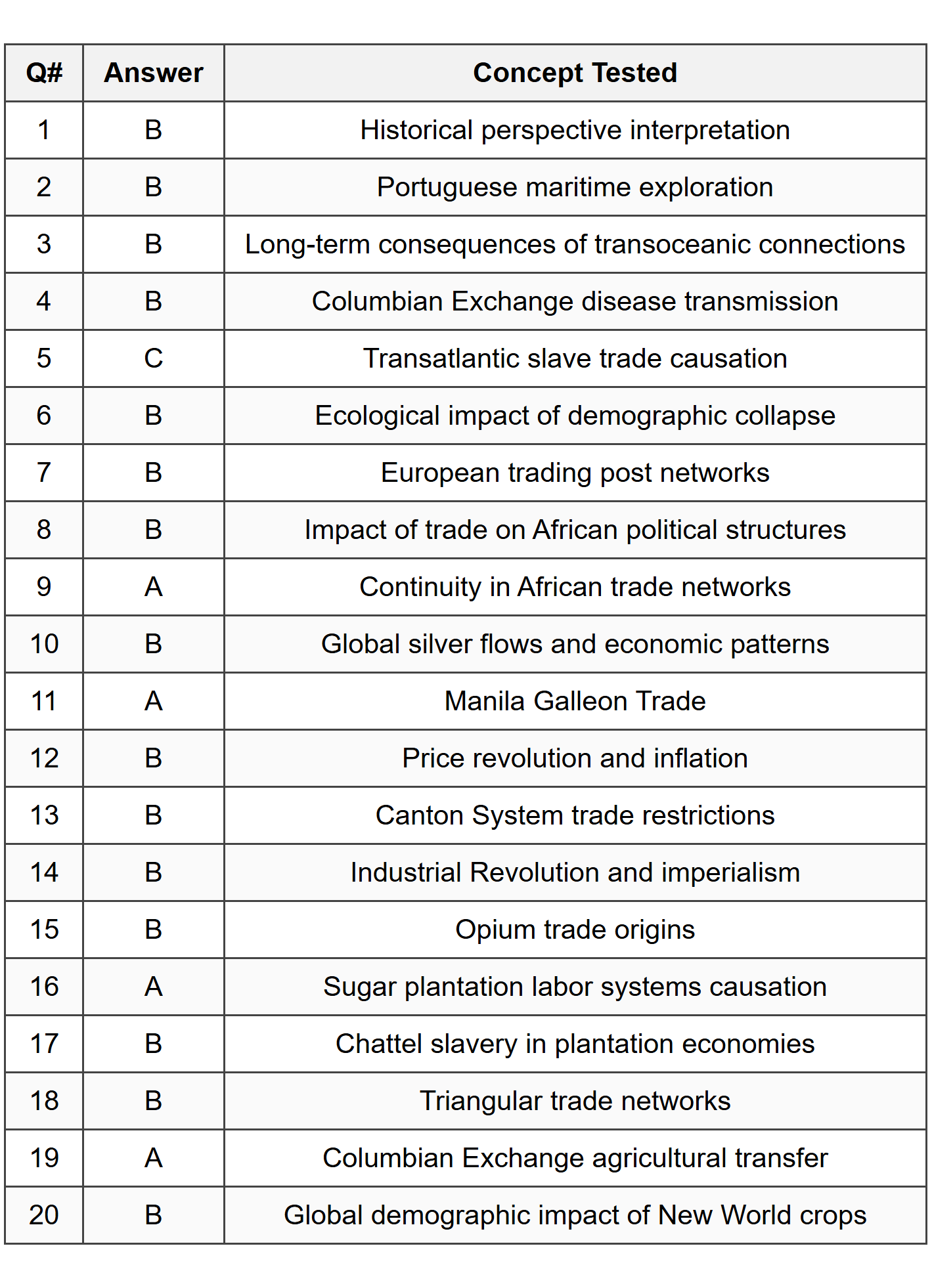
Part A: Multiple-Choice Answer Table
Part B: Free-Response Question Detailed Answers
FRQ 1 - Answer Key (Short Answer Question)
Part A: Identify ONE specific commodity
Model Answer: Chinese porcelain was a major commodity exchanged through the Manila Galleon Trade. Spanish merchants purchased fine porcelain in Manila using American silver and transported it across the Pacific to markets in Mexico and eventually Europe, where it was highly valued by elite consumers.
Scoring Note: Students must identify a specific commodity other than silver. Acceptable answers include: Chinese silk, Asian spices (such as cinnamon or pepper), Chinese tea, Mexican cocoa, or tobacco. The answer must be specific-"luxury goods" alone is insufficient.
Part B: Explain ONE way the Manila Galleon Trade represented a significant development
Model Answer: The Manila Galleon Trade represented a significant development because it created the first sustained, direct commercial connection across the Pacific Ocean, thereby linking Asian, American, and European markets into a truly global economic system. Prior to 1571, no regular transoceanic route connected Asia and the Americas; the establishment of this trade route meant that for the first time, goods produced in China could be purchased directly with American silver and consumed in the Americas and Europe, creating an integrated commercial network spanning all major continents. This integration laid the foundation for the modern global economy.
Scoring Note: Students must provide both a claim and an explanation showing why this development was significant. Strong answers will explicitly connect the Manila Galleon Trade to the concept of global economic integration and explain what was new or unprecedented about this connection.
Part C: Explain ONE similarity to earlier trade networks
Model Answer: The Manila Galleon Trade was similar to earlier networks like the Silk Roads and Indian Ocean trade in that it facilitated the exchange of luxury goods across vast distances, connecting regions with different resources and consumer demands. Just as the Silk Roads transported Chinese silk and Central Asian goods to Mediterranean markets, and Indian Ocean trade moved spices from Southeast Asia to East African and Middle Eastern ports, the Manila Galleon Trade specialized in moving high-value, low-bulk commodities (silks, porcelain, silver) that could bear the costs of long-distance transportation. In all these networks, merchants profited by exploiting geographic differences in the supply and demand for luxury items.
Scoring Note: Students must identify a genuine similarity and explain it with reference to both the Manila Galleon Trade and at least one earlier network. Acceptable similarities include: luxury good exchange, cultural diffusion, creation of merchant communities, use of monsoon winds/trade winds for navigation, or the role of intermediary trading posts.
FRQ 2 - Answer Key (Long Essay Question)
Model Thesis Statement
Sample Thesis: While the Columbian Exchange profoundly transformed global populations and societies through unprecedented biological transfers that caused demographic catastrophe in the Americas and population growth in Afro-Eurasia, it also maintained significant continuities in social hierarchies and labor systems, ultimately creating a global system more characterized by European dominance and coerced labor than by egalitarian exchange.
Thesis Evaluation Notes: A strong thesis must:
- Directly address the prompt's call to "evaluate the extent"
- Make a historically defensible claim (not simply restate the prompt)
- Establish a clear line of reasoning that will organize the essay
- Acknowledge both transformation AND limits to that transformation (addressing "extent")
Historical Context (Contextualization)
Sample Context: Prior to 1492, the Eastern and Western Hemispheres had developed independently for thousands of years following the end of the last Ice Age, resulting in distinct biological environments, agricultural systems, and disease pools. While Afro-Eurasian populations had domesticated horses, cattle, and pigs, and had developed immunity to diseases like smallpox through centuries of urban living and animal husbandry, indigenous American populations had domesticated different species (llamas, turkeys) and lacked exposure to many epidemic diseases. The voyages of Columbus and subsequent European exploration created sustained contact between these previously isolated biological zones, initiating unprecedented transfers of plants, animals, diseases, and people.
Contextualization Evaluation Notes: Successful contextualization must situate the Columbian Exchange within broader historical developments occurring before, during, or continuing after the period in question. Students should explain relevant historical context, not simply mention contextual factors.
Specific Evidence and Application of Historical Reasoning (Causation)
Evidence Point 1 - Demographic Catastrophe in the Americas:
The Columbian Exchange caused devastating demographic collapse in the Americas through the introduction of Old World diseases. Smallpox, measles, typhus, and other pathogens devastated indigenous populations who lacked immunity. In central Mexico, the pre-contact population of approximately 25 million declined to roughly 1 million by 1600-a mortality rate exceeding 90 percent in some regions. This demographic catastrophe represented a complete transformation of American societies: political systems collapsed, agricultural lands were abandoned and returned to forest, and survivors were incorporated into Spanish colonial structures under systems like the encomienda and later the hacienda. The scale of death was unprecedented in human history and fundamentally altered the trajectory of American development.
Evidence Point 2 - Population Growth in Afro-Eurasia:
Conversely, the transfer of American crops to Afro-Eurasia contributed to significant population growth. The potato, native to the Andes, thrived in the cool, damp climates of northern Europe where traditional grain crops struggled; its introduction contributed to European population growth from approximately 81 million in 1500 to 180 million by 1800. Similarly, maize and sweet potatoes enabled agricultural expansion in China, supporting population growth from about 100 million in 1500 to over 300 million by 1800. These New World crops were more calorie-dense, required less labor, and could grow in marginal soils, allowing families to support more children and settle previously unproductive lands. This demographic expansion transformed social structures by enabling urbanization and creating labor surpluses that would later fuel industrialization.
Evidence Point 3 - Labor Systems and the African Diaspora:
The demographic collapse of indigenous Americans combined with European demand for plantation commodities caused the forced migration of approximately 12.5 million enslaved Africans to the Americas between 1500 and 1866, with about 10.7 million surviving the Middle Passage. This represented a complete transformation of American demographic composition and created new African diaspora societies throughout Brazil, the Caribbean, and North America. The plantation complex-producing sugar, tobacco, cotton, and coffee using enslaved labor-generated enormous wealth for European merchants and investors while creating brutal systems of chattel slavery racialized along African lines. This transformation had profound long-term consequences: the establishment of racist ideologies justifying enslavement, the creation of new syncretic cultures blending African, European, and indigenous elements, and economic dependencies that persisted long after formal slavery ended.
Evidence Point 4 - Ecological Transformations:
The Columbian Exchange also transformed global ecosystems through the transfer of plants and animals. European introduction of horses fundamentally changed indigenous societies on the Great Plains, enabling nomadic hunting lifestyles and transforming groups like the Lakota into powerful mounted warriors. The introduction of cattle, pigs, and sheep altered American landscapes as these animals consumed vegetation and altered soil composition. European honeybees, earthworms, and weeds like dandelions established themselves in American environments, sometimes displacing native species. Meanwhile, American crops like tobacco created new consumer markets in Europe and Asia, generating economic dependencies and health consequences that persisted for centuries.
Complex Understanding
Sample Complex Understanding Argument: While the Columbian Exchange unquestionably transformed global populations through unprecedented biological transfers, the extent of transformation must be qualified by recognition of significant continuities. Social hierarchies persisted: Spanish colonial societies maintained rigid caste systems (castas) that replicated European class structures despite incorporating new racial categories; West African kingdoms maintained their political authority even as they engaged in the Atlantic slave trade; and European states continued mercantilist economic policies that had existed before American contact. Moreover, the transformation was highly unequal-European societies gained population, crops, and wealth, while indigenous Americans suffered catastrophic losses and Africans experienced forced diaspora. Thus, while the Columbian Exchange created a genuinely new global biological and economic system, it did so in ways that reinforced rather than challenged existing patterns of hierarchy, coercion, and unequal power relations.
Complex Understanding Evaluation Notes: Students can demonstrate complex understanding by:
- Explaining nuance by analyzing multiple variables or considering diverse perspectives
- Explaining both similarities and differences, or both continuity and change
- Qualifying or modifying the argument by considering alternative views or evidence
- Explaining relevant connections across time periods or geographical areas
Summary of Causation Application
The historical reasoning skill of causation requires students to:
- Identify causes: Explain what factors led to the Columbian Exchange (European maritime exploration, desire for Asian trade routes, development of navigational technology)
- Identify effects: Explain the consequences of the Columbian Exchange (demographic transformation, ecological change, creation of global trade networks, establishment of plantation slavery)
- Analyze relationships: Explain how and why certain causes produced certain effects (disease transmission caused demographic collapse because isolated populations lacked immunity; demographic collapse caused African slave trade because European plantation owners needed replacement labor)
Strong essays will move beyond simply listing causes and effects to explain the mechanisms by which causes produced effects and to evaluate the relative importance of different causal factors.




