Practice Questions :Revolutions

SECTION I: MULTIPLE CHOICE
Directions
Each of the questions or incomplete statements below is followed by four suggested answers or completions. Select the one that is best in each case and record your choice on the answer sheet. Each question is based on a stimulus: a primary source excerpt, secondary source passage, map, image, or data table.
Source for Questions 1-3:
"The representatives of the French people, organized as a National Assembly, believing that the ignorance, neglect, or contempt of the rights of man are the sole cause of public calamities and of the corruption of governments, have determined to set forth in a solemn declaration the natural, unalienable, and sacred rights of man... Men are born and remain free and equal in rights. Social distinctions may be founded only upon the general good. The aim of all political association is the preservation of the natural and imprescriptible rights of man. These rights are liberty, property, security, and resistance to oppression."
- Declaration of the Rights of Man and of the Citizen, August 1789
1. The passage above reflects which Enlightenment principle most directly?
- Divine right of kings as the basis for legitimate government authority
- Natural rights theory as developed by John Locke and other Enlightenment philosophers
- Mercantilist economic policies designed to increase state power
- Social contract theory emphasizing absolute obedience to sovereign authority
2. The Declaration's assertion that "social distinctions may be founded only upon the general good" most directly challenged which aspect of French society under the Old Regime?
- The system of estates that granted legal privileges based on hereditary status
- The practice of religious toleration for Protestant minorities
- The influence of Enlightenment salons in shaping public opinion
- The power of the National Assembly to create legislation
3. Which of the following groups would have been most likely to oppose the principles articulated in this declaration?
- Bourgeois merchants seeking greater political representation
- Peasants demanding the abolition of feudal obligations
- Nobles who benefited from tax exemptions and seigneurial rights
- Urban artisans facing rising bread prices
Source for Questions 4-6:
"We hold these truths to be self-evident, that all men are created equal, that they are endowed by their Creator with certain unalienable Rights, that among these are Life, Liberty and the pursuit of Happiness. That to secure these rights, Governments are instituted among Men, deriving their just powers from the consent of the governed. That whenever any Form of Government becomes destructive of these ends, it is the Right of the People to alter or to abolish it, and to institute new Government."
- Declaration of Independence, July 1776
4. The philosophical justification for revolution expressed in this document most directly influenced which subsequent revolutionary movement?
- The Glorious Revolution in England (1688)
- The Haitian Revolution (1791-1804)
- The English Civil War (1642-1651)
- The Reconquista in Spain (1492)
5. The contradiction between the declaration's assertion that "all men are created equal" and the continuation of slavery in the United States is best explained by which of the following?
- The influence of mercantilist economic theory on American political thought
- The economic dependence of Southern plantation economies on enslaved labor and racial ideologies that excluded people of African descent from the category of "men"
- The lack of Enlightenment influence on American revolutionary leaders
- The absence of any abolitionist movement in North America during the eighteenth century
6. Which of the following best explains why the American Revolution served as an inspiration for revolutionary movements in Latin America in the early nineteenth century?
- It demonstrated that colonial territories could successfully break away from European imperial powers and establish independent republics
- It resulted in the immediate abolition of slavery throughout the Western Hemisphere
- It established a system of government based on absolute monarchy
- It promoted mercantilist economic policies that benefited colonial economies
Source for Questions 7-9:
"The colonial slavery system in Saint-Domingue was among the most brutal in the Americas. Enslaved Africans outnumbered free colonists by a ratio of approximately 10 to 1 by 1789. When news of the French Revolution reached the colony, free people of color (gens de couleur) demanded equal rights with white colonists. In August 1791, enslaved people in the northern province launched a massive rebellion. Under the leadership of Toussaint Louverture, the rebels eventually defeated French, Spanish, and British forces, and in 1804, Saint-Domingue became the independent nation of Haiti-the first nation in the world established by formerly enslaved people."
- Historical summary of the Haitian Revolution
7. The Haitian Revolution differed from the American and French Revolutions primarily in that it
- was led by elite creole landowners seeking greater autonomy from European control
- resulted in the complete overthrow of the plantation system and the abolition of slavery by formerly enslaved people themselves
- received substantial military support from European powers throughout the conflict
- maintained the colonial social hierarchy while achieving political independence
8. Which of the following was a significant global consequence of the Haitian Revolution?
- European colonial powers immediately abolished slavery in all their Caribbean colonies
- Slaveholding societies throughout the Americas became increasingly fearful of slave rebellions and often strengthened laws restricting enslaved people
- The French Empire expanded its territorial holdings in the Caribbean
- The plantation economy spread from the Caribbean to West Africa
9. Toussaint Louverture's ability to defeat European military forces can best be attributed to
- superior European military technology provided by British allies
- tactical military leadership, knowledge of local terrain, high motivation among formerly enslaved fighters, and European forces' vulnerability to tropical diseases
- the absence of any European military intervention in the conflict
- immediate recognition and support from the United States government
Source for Questions 10-12:
"Simón Bolívar, writing from Jamaica in 1815, reflected on the challenges facing Latin American independence movements: 'We are... neither Indian nor European, but a species midway between the legitimate proprietors of this country and the Spanish usurpers. In short, though Americans by birth we derive our rights from Europe, and we have to assert these rights against the rights of the natives, and at the same time we must defend ourselves against the invaders. This places us in a most extraordinary and involved situation... The role of the inhabitants of the American hemisphere has for centuries been purely passive. Politically they were nonexistent... We are still in a position lower than slavery, and therefore it is more difficult for us to rise to the enjoyment of freedom.'"
- Simón Bolívar, "Letter from Jamaica," 1815
10. Bolívar's description of Latin Americans as "neither Indian nor European" most directly reflects
- the complex social hierarchy of colonial Latin America, in which creoles occupied a position between peninsulares and indigenous peoples
- the complete absence of indigenous peoples in Latin America by 1815
- the racial equality achieved in Spanish colonial societies
- the rejection of all European cultural influences by independence movements
11. Which of the following events most directly created the opportunity for Latin American independence movements in the early nineteenth century?
- The establishment of the Holy Alliance in Europe
- Napoleon's invasion of Spain in 1808, which weakened Spanish imperial control over its American colonies
- The Congress of Vienna's decision to grant immediate independence to all European colonies
- The abolition of slavery throughout the Spanish Empire
12. Bolívar's statement that Latin Americans had played "a purely passive" role politically under Spanish rule most directly supports which interpretation of Latin American independence movements?
- Creoles sought independence primarily to gain political power and representation that had been denied them under colonial rule
- Indigenous peoples were the primary leaders of independence movements throughout Latin America
- Spanish colonial rule had granted extensive self-government to colonial subjects
- Economic factors played no role in motivating independence movements
Source for Questions 13-15:
"The Mexican Revolution of 1910 began as a political movement against the decades-long dictatorship of Porfirio Díaz but quickly evolved into a broad social revolution. Emiliano Zapata led peasant armies in southern Mexico demanding 'Land and Liberty' and the return of communal lands (ejidos) that had been taken by large estate owners. Francisco 'Pancho' Villa commanded revolutionary forces in the north. The Constitution of 1917 included Article 27, which declared that the nation owned all land and water resources and could expropriate private property for public benefit, including land redistribution to peasant communities."
- Historical summary of the Mexican Revolution
13. The Mexican Revolution differed most significantly from earlier Latin American independence movements in that it
- focused primarily on separating from European colonial control
- sought to maintain the existing social and economic hierarchies
- included demands for land reform and social justice for peasants and workers, not merely political independence
- received no support from rural populations
14. Article 27 of the 1917 Mexican Constitution, which asserted national ownership of land and resources, most directly challenged which principle?
- Absolute private property rights favored by liberal economic ideology
- Universal male suffrage
- Freedom of the press
- Separation of church and state
15. The demand for return of communal lands (ejidos) by Zapata's forces reflected
- the influence of European feudal systems on Mexican agriculture
- indigenous and colonial-era traditions of communal landholding that had been disrupted by nineteenth-century liberal land reforms
- the complete absence of private property in pre-revolutionary Mexico
- support for industrial development in urban areas
Source for Questions 16-18:
"The Bolshevik Revolution of October 1917 (November by the Western calendar) overthrew the Provisional Government that had replaced the Tsar earlier that year. Vladimir Lenin and the Bolsheviks promised 'Peace, Land, and Bread'-immediate withdrawal from World War I, redistribution of land to peasants, and relief from food shortages. The revolution led to Russia's exit from World War I, a brutal civil war between Reds (Bolsheviks) and Whites (anti-Bolsheviks), and the eventual establishment of the Soviet Union in 1922. The Soviet state nationalized industry, collectivized agriculture, and established a single-party communist system."
- Historical summary of the Russian Revolution
16. The Bolshevik slogan "Peace, Land, and Bread" was effective in gaining popular support primarily because it
- promised to continue Russian participation in World War I until total victory
- addressed the immediate concerns of war-weary soldiers, land-hungry peasants, and starving urban workers
- advocated for the restoration of the Tsarist autocracy
- rejected all forms of land redistribution
17. Which of the following revolutionary movements was most directly inspired by the ideological model provided by the Russian Revolution?
- The American Revolution of 1776
- The French Revolution of 1789
- The Chinese Communist Revolution of 1949
- The Glorious Revolution of 1688
18. The Russian Revolution differed from the French Revolution most significantly in that the Russian Revolution
- resulted in the execution of the monarch
- established a communist single-party state that nationalized all major industries, while the French Revolution ultimately preserved private property rights
- was preceded by military defeats and economic hardship
- produced a declaration of rights
Source for Questions 19-20:
Table 1: Comparison of Revolutionary Outcomes, 1770s-1920s
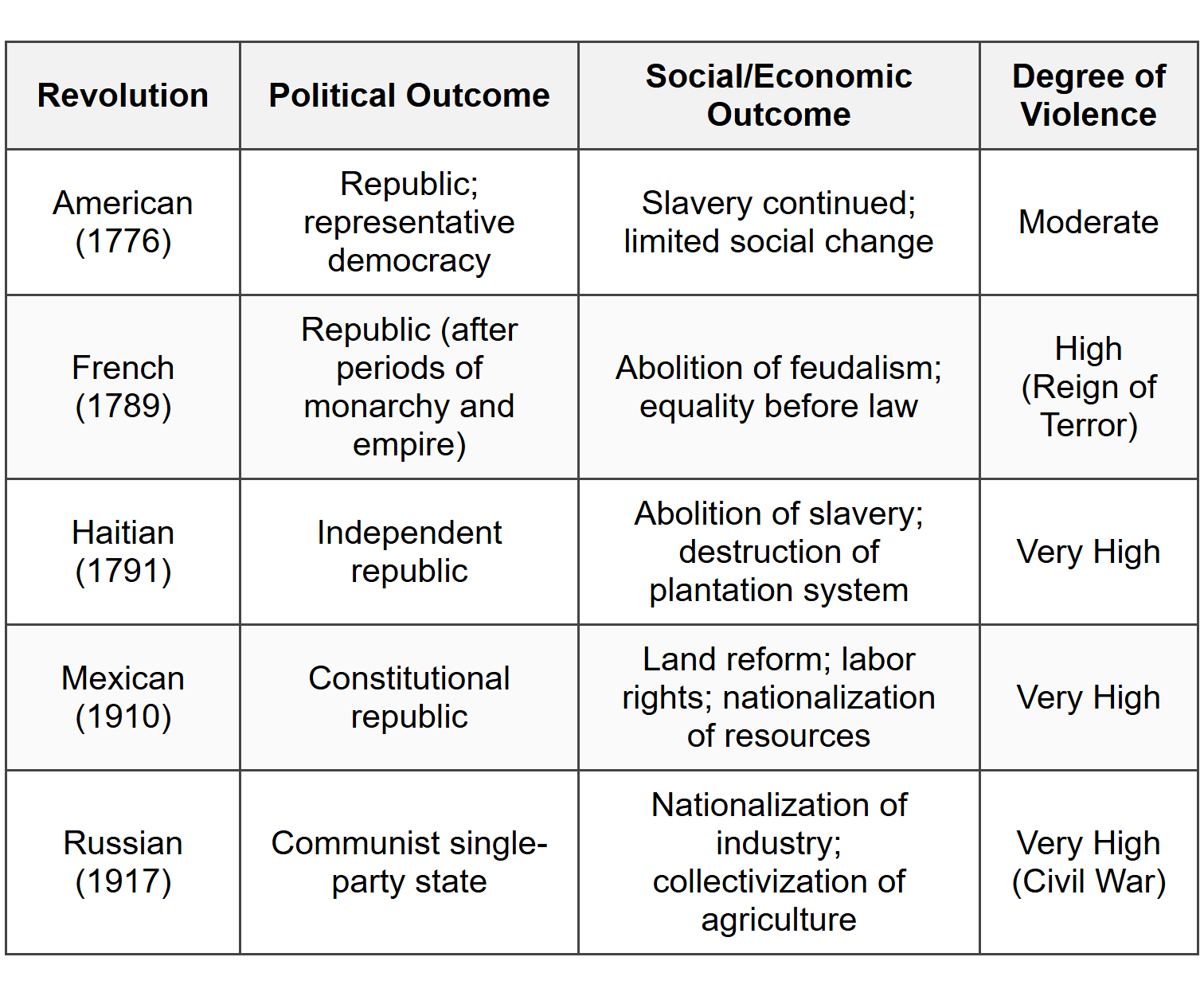
19. Based on the table above, which generalization about the relationship between the degree of violence and the extent of social and economic transformation is most accurate?
- Revolutions with limited violence consistently produced greater social and economic transformation than highly violent revolutions
- Revolutions that involved higher levels of violence tended to produce more radical social and economic transformations
- The degree of violence in a revolution had no relationship to the extent of social and economic change
- All revolutions regardless of violence levels maintained existing social and economic structures
20. Which of the following best explains why the Haitian Revolution resulted in the most complete transformation of the social order compared to other revolutions listed?
- It received the strongest military and financial support from European powers
- It was led by and benefited formerly enslaved people who had the greatest interest in completely dismantling the existing racial and economic hierarchy
- It occurred in a society with minimal economic inequality
- It was the only revolution influenced by Enlightenment ideas
SECTION II: FREE RESPONSE
Directions
Section II of this exam contains two free-response questions. You should spend approximately 40 minutes on Question 1 and 40 minutes on Question 2. Write your responses on separate sheets of paper or in your exam booklet.
In your responses, be sure to address all parts of the questions you answer. Use complete sentences; an outline or bulleted list alone is not acceptable. You may plan your essays in the unlined space provided, but only your final essay will be scored.
Question 1: Short Answer Question (SAQ)
Suggested time: 15 minutes
Source:
"The revolution was effected before the war commenced. The revolution was in the minds and hearts of the people... This radical change in the principles, opinions, sentiments, and affections of the people was the real American Revolution."
- John Adams, letter to Hezekiah Niles, 1818
Answer all parts of the question that follows.
- Identify ONE way in which Enlightenment ideas contributed to the "radical change in principles, opinions, sentiments, and affections" that John Adams describes.
- Explain ONE way in which the American Revolution influenced subsequent revolutionary movements in the Atlantic World between 1789 and 1825.
- Explain ONE significant difference between the outcomes of the American Revolution and the outcomes of the Haitian Revolution.
Question 2: Long Essay Question (LEQ)
Suggested time: 40 minutes
Historical Reasoning Skill: Causation
In your response, you should do the following:
- Respond to the prompt with a historically defensible thesis or claim that establishes a line of reasoning.
- Describe a broader historical context relevant to the prompt.
- Support an argument in response to the prompt using specific and relevant examples of historical evidence.
- Use historical reasoning (e.g., causation) to frame or structure an argument that addresses the prompt.
- Use evidence to corroborate, qualify, or modify an argument that addresses the prompt.
Choose ONE of the following three prompts and respond to it:
Option 1: Evaluate the extent to which economic factors caused revolutions in the Atlantic World in the period circa 1750-1850.
Option 2: Evaluate the extent to which Enlightenment ideas caused revolutionary movements in Europe and the Americas in the period circa 1750-1850.
Option 3: Evaluate the extent to which social inequalities caused revolutions in Latin America in the period circa 1800-1920.
ANSWER KEY
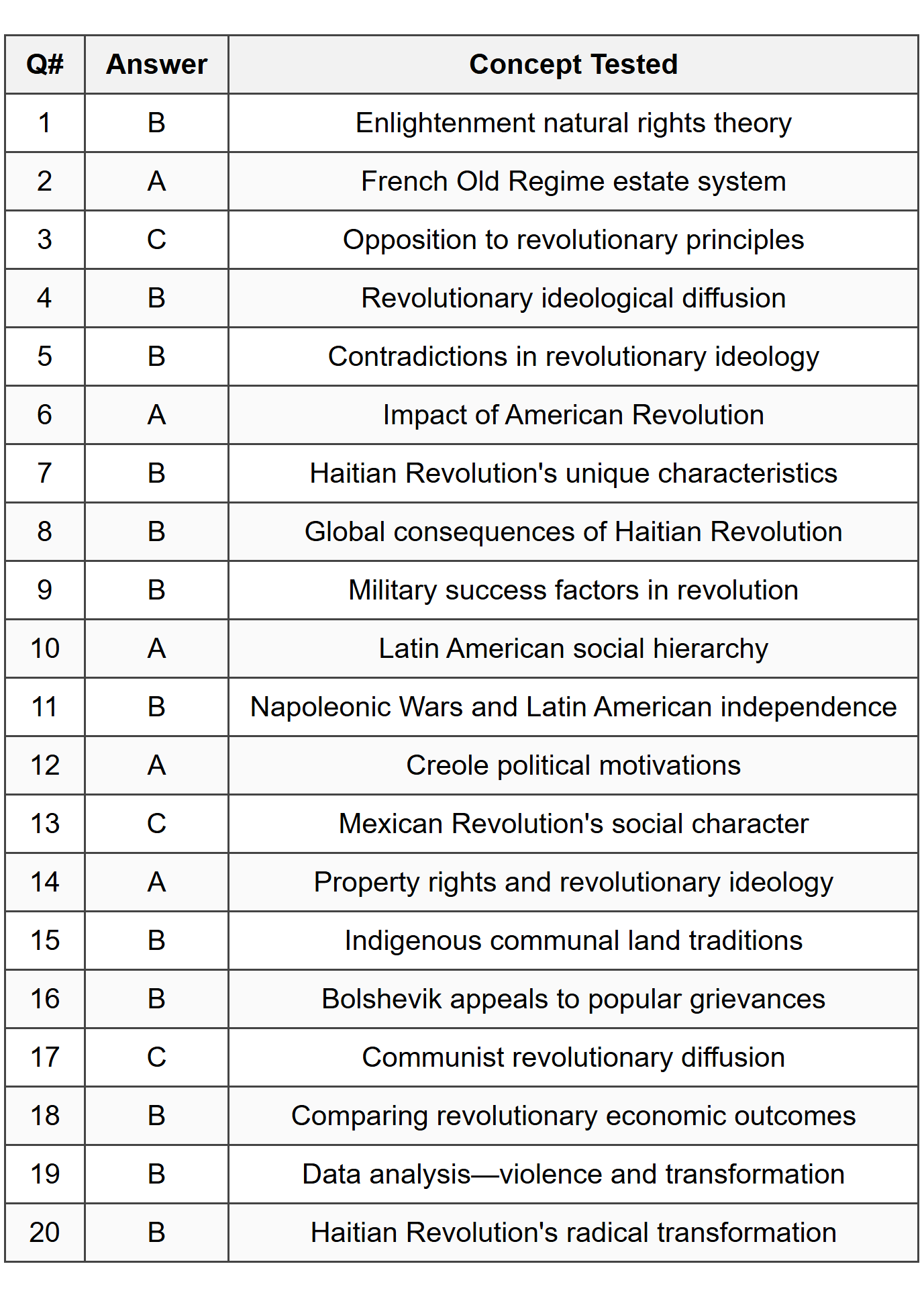
Part A - Multiple Choice Answer Table
Part B - Free Response Answer Keys
FRQ 1 - Answer Key (Short Answer Question)
Part A: Identify ONE way in which Enlightenment ideas contributed to the radical change that John Adams describes
Model Answer: Enlightenment thinkers such as John Locke promoted the concept of natural rights, arguing that all people possess inherent rights to life, liberty, and property that governments must protect. This idea fundamentally challenged the traditional notion of divine right monarchy and hereditary privilege. American colonists increasingly embraced the belief that legitimate government derives from the consent of the governed rather than from royal authority, which represented a radical transformation in political thinking that justified resistance to British policies perceived as violating colonists' natural rights.
Scoring note: Student must identify a specific Enlightenment idea (natural rights, social contract, popular sovereignty, reason over tradition), cite a specific thinker or text if possible, and explain how this idea represented a change in thinking.
Part B: Explain ONE way in which the American Revolution influenced subsequent revolutionary movements in the Atlantic World between 1789 and 1825
Model Answer: The success of the American Revolution demonstrated that colonial subjects could militarily defeat a major European power and establish an independent republic based on Enlightenment principles. This example directly inspired French revolutionaries in 1789, who cited American precedents when drafting the Declaration of the Rights of Man and of the Citizen. Similarly, Latin American independence leaders such as Simón Bolívar and José de San Martín looked to the United States as proof that Spanish colonial rule could be successfully challenged, and they adopted republican forms of government modeled in part on American constitutional structures. The American Revolution thus provided both an ideological framework and a practical demonstration that colonial independence was achievable.
Scoring note: Student must identify a specific revolutionary movement (French Revolution, Haitian Revolution, Latin American independence movements), explain the mechanism of influence (ideological model, practical example, constitutional precedent), and provide specific evidence of this influence.
Part C: Explain ONE significant difference between the outcomes of the American Revolution and the outcomes of the Haitian Revolution
Model Answer: While the American Revolution resulted in political independence but preserved the institution of slavery and maintained many existing social hierarchies, the Haitian Revolution achieved both political independence and the complete abolition of slavery, fundamentally transforming the social and economic order. In Haiti, formerly enslaved people destroyed the plantation system that had been the foundation of the colonial economy and established the first nation in the world founded by formerly enslaved people. In contrast, the United States Constitution protected slavery and even included provisions (such as the Three-Fifths Compromise) that strengthened slaveholders' political power, meaning that the American Revolution produced far less radical social and economic transformation than the Haitian Revolution.
Scoring note: Student must identify a specific difference in outcomes (treatment of slavery, extent of social transformation, economic restructuring, racial hierarchy), provide specific evidence from both revolutions, and explain the significance of this difference.
FRQ 2 - Answer Key (Long Essay Question)
Note: The following model answer addresses Option 2. Acceptable responses to Options 1 or 3 would follow the same structural requirements with different evidence.
Model Thesis Statement
Example thesis: "While Enlightenment ideas were a significant cause of revolutionary movements in Europe and the Americas between 1750 and 1850, providing intellectual justification for challenging traditional authority and established social hierarchies, economic grievances and social inequalities were equally important causal factors, and the specific influence of Enlightenment thought varied considerably across different revolutionary contexts, with its impact being greatest among educated elites and more limited among popular classes whose participation was often motivated primarily by material concerns."
Scoring note: A successful thesis must make a historically defensible claim, establish a clear line of reasoning, and address the "extent" language in the prompt (not simply "yes, Enlightenment ideas caused revolutions" but evaluating how much they mattered relative to other factors).
Contextualization
What a strong response must include: A description of the broader historical context in which these revolutions occurred. This should mention relevant developments such as: the growth of Enlightenment thought in the eighteenth century emphasizing reason, natural rights, and criticism of traditional authority; the economic changes brought by increased global trade and emerging capitalism; the social tensions created by rigid hierarchical systems (estates in France, slavery in Haiti, colonial subordination in America and Latin America); and the political structures of absolute monarchy and colonial rule that revolutionaries challenged. The contextualization must go beyond simply restating the prompt.
Evidence and Argumentation
Specific evidence that would earn points (students need multiple examples):
- French Revolution: The Declaration of the Rights of Man and of the Citizen (1789) drew directly on Enlightenment natural rights theory, particularly Locke's ideas. Enlightenment salons and publications like Rousseau's Social Contract spread ideas of popular sovereignty among educated bourgeoisie and nobility. However, the immediate trigger was the fiscal crisis of the French monarchy and peasant anger over feudal dues and bread prices, showing economic factors worked alongside ideology.
- American Revolution: Colonial leaders such as Thomas Jefferson explicitly incorporated Lockean natural rights philosophy into the Declaration of Independence. Pamphlets like Thomas Paine's Common Sense popularized Enlightenment arguments against monarchy. Yet American colonists were also motivated by specific economic grievances (taxation without representation, restrictions on westward expansion, trade regulations) and political concerns about local self-government, demonstrating that Enlightenment ideas provided justification for resistance rooted in material interests.
- Haitian Revolution: Free people of color initially cited the Declaration of the Rights of Man to demand equal rights, showing Enlightenment influence. However, the massive slave rebellion of 1791 was motivated primarily by the brutal conditions of plantation slavery rather than abstract philosophy. The revolution's leaders eventually adopted Enlightenment language of universal rights, but the driving force was the enslaved population's desire for freedom and land, suggesting Enlightenment ideas were more important as legitimating discourse than as primary cause.
- Latin American independence: Simón Bolívar and other creole leaders were educated in Enlightenment thought and used natural rights language to justify independence. However, the immediate opportunity came from Napoleon's invasion of Spain (1808) creating a political vacuum, and creole motivations included resentment of peninsular privilege and desire for free trade, indicating Enlightenment ideology combined with political opportunity and economic interest.
Historical Reasoning - Causation
What the essay must demonstrate: The response must explicitly analyze causation by:
- Identifying Enlightenment ideas as one cause among multiple causes of revolutionary movements
- Distinguishing between different types of causes (ideological, economic, social, political) and explaining their relative importance
- Explaining how Enlightenment ideas interacted with other causal factors-for example, how economic grievances created conditions in which Enlightenment critiques of existing authority became persuasive, or how Enlightenment ideas provided legitimating language for movements driven by material interests
- Recognizing variation across cases-Enlightenment ideas had different levels of influence among different social groups (greater among educated elites than among peasants or enslaved people) and in different revolutionary contexts
Complexity
Ways to demonstrate sophisticated understanding:
- Explaining nuance by recognizing that Enlightenment ideas were necessary but not sufficient causes-they provided intellectual justification but required combination with economic crisis, social inequality, or political opportunity to produce revolution
- Qualifying the argument by noting that the same Enlightenment principles were interpreted differently in different contexts (e.g., "all men are created equal" was used to justify independence in America while slavery continued, but in Haiti it was used to justify abolition)
- Analyzing multiple variables by explaining how ideological, economic, social, and political factors interacted to cause revolutions rather than treating them as separate
- Corroborating the argument with diverse evidence from multiple revolutionary movements showing patterns and variations in the role of Enlightenment thought




