Practice Questions :Global Conflict

SECTION I: MULTIPLE CHOICE
Directions
This section contains 20 multiple-choice questions. Each question is followed by four answer choices labeled A through D. Select the one answer choice that best answers each question or completes each statement. Each question is based on a provided stimulus-read the stimulus carefully before answering.
"The immediate cause of the war lies in the decisions taken by statesmen and generals during the July Crisis of 1914. But we cannot understand those decisions without reference to the long-term structural factors that shaped the environment in which they were made. The alliance system created a network of obligations that transformed a regional dispute into a continental war. The arms race, particularly the naval competition between Britain and Germany, created mutual suspicion and a climate of fear. The rise of nationalism gave populations and their leaders powerful emotional reasons to resist compromise."
- Excerpt from a modern historian's analysis of World War I origins, 2010
1. Which of the following best explains the historian's argument about the causes of World War I?
- World War I was caused exclusively by the assassination of Archduke Franz Ferdinand in Sarajevo
- World War I resulted from both immediate triggers and long-term structural conditions that made escalation likely
- World War I was inevitable due to economic competition between industrial powers
- World War I was primarily caused by the personal ambitions of individual political leaders
2. The "alliance system" referenced in the passage most directly contributed to the expansion of World War I by:
- Providing economic subsidies to smaller nations to encourage their participation in the conflict
- Creating a chain reaction of military mobilizations as nations honored commitments to their allies
- Establishing international organizations that failed to prevent the outbreak of war
- Encouraging colonial territories to declare independence from European powers
3. The historian's emphasis on nationalism as a factor preventing compromise most directly reflects which broader development in early 20th-century Europe?
- The decline of monarchical authority and the rise of parliamentary democracy
- The spread of mass politics and the increased importance of public opinion in foreign policy
- The weakening of religious identity as a source of political loyalty
- The emergence of international socialist movements opposed to imperialist wars
"We are not Europeans, we are not Indians, we are but a mixed species of aborigines and Spaniards. Americans by birth and Europeans by law, we find ourselves engaged in a dual conflict: against the invaders and against our own people... We were left in a permanent state of childhood with respect to public affairs. If we could at least have managed our domestic concerns, we would have some familiarity with the workings of government."
- Simón Bolívar, "Jamaica Letter," 1815
4. Bolívar's description of Latin Americans as "a mixed species" and "Americans by birth and Europeans by law" most directly reflects which colonial legacy?
- The economic dependency of Latin American colonies on European manufactured goods
- The complex racial hierarchies and political exclusion of creoles from meaningful governance
- The predominance of Catholicism as the official religion throughout Spanish America
- The geographic isolation of Latin American colonies from one another
5. The "dual conflict" that Bolívar describes can best be understood as referring to:
- Fighting against Spanish colonial forces while also managing internal divisions among independence supporters
- Resisting both British and French attempts to establish new colonial control
- Balancing indigenous rights with the interests of European settlers
- Maintaining Catholic traditions while adopting Enlightenment political ideas
6. Bolívar's complaint about being kept in "a permanent state of childhood with respect to public affairs" most directly supports which conclusion about colonial governance?
- Spanish colonial authorities deliberately limited creole participation in government to maintain metropolitan control
- The Spanish Empire provided extensive education in democratic principles to colonial populations
- Latin American independence movements were primarily motivated by economic rather than political grievances
- The Catholic Church was the only institution that provided training in administrative affairs
"The proletarians have nothing to lose but their chains. They have a world to win. Working men of all countries, unite! The history of all hitherto existing society is the history of class struggles. Freeman and slave, patrician and plebeian, lord and serf, guild-master and journeyman, in a word, oppressor and oppressed, stood in constant opposition to one another, carried on an uninterrupted fight that each time ended either in a revolutionary reconstitution of society at large, or in the common ruin of the contending classes."
- Karl Marx and Friedrich Engels, The Communist Manifesto, 1848
7. The call for workers to "unite" across national boundaries most directly challenged which 19th-century political development?
- The growth of mass literacy and public education systems
- The expansion of voting rights to include propertyless men
- The rise of nationalist movements that emphasized shared ethnic and cultural identities
- The establishment of labor unions focused on workplace safety regulations
8. Marx and Engels' description of history as fundamentally driven by "class struggles" most directly influenced which 20th-century revolutionary movement?
- The Indian independence movement led by Mohandas Gandhi
- The Bolshevik Revolution in Russia in 1917
- The decolonization movements in sub-Saharan Africa in the 1960s
- The Iranian Revolution of 1979
9. Which of the following developments in the period 1850-1914 most directly undermined the prediction that industrial workers would unite across national lines?
- The expansion of European imperialism created shared interests between workers and capitalists in colonizing nations
- The abolition of slavery in the Americas reduced the total number of oppressed laborers
- The spread of public health measures improved working-class living conditions universally
- The growth of religious revival movements redirected worker activism toward spiritual concerns
"Today German troops marched into Austria. Austria is now part of the German Reich. I myself as Führer and Chancellor will be happy to walk on the soil which I left as a poor boy... I can in this hour report before history the conclusion of the greatest aim of my life: the entry of my homeland into the German Reich."
- Adolf Hitler, radio address, March 12, 1938
10. Hitler's justification for the annexation of Austria (Anschluss) most directly reflected which interwar ideological principle?
- The communist belief in international worker solidarity
- The fascist emphasis on uniting all members of a ethnic or racial group under one state
- The liberal democratic principle of national self-determination
- The conservative monarchist desire to restore pre-World War I boundaries
11. The British and French policy of appeasement in response to the Anschluss was most directly motivated by:
- A desire to avoid another destructive war and a belief that Hitler's territorial ambitions were limited
- Secret military alliances between Britain, France, and Germany
- Economic dependence on German manufacturing exports
- Widespread popular support in Britain and France for fascist ideology
12. The Anschluss, combined with the subsequent German occupation of Czechoslovakia in 1939, most directly demonstrated which failure of the post-World War I international order?
- The inability of the League of Nations to enforce collective security and prevent aggressive expansion
- The economic instability caused by German reparations payments
- The persistence of colonial rivalries among European powers
- The decline of monarchical legitimacy in favor of republican governments
"I was eating breakfast when the explosion occurred. The whole house shook. At first I thought it was an earthquake, but then I heard the planes. When I went outside, I could see the harbor-the ships were burning, thick black smoke everywhere. Some ships had capsized. The oil on the water was on fire. I saw one of the battleships split in half and sink. The attack went on for nearly two hours. We had no warning. Most of our planes were destroyed on the ground."
- American eyewitness account, Pearl Harbor, December 7, 1941
13. The Japanese attack on Pearl Harbor most directly resulted from which conflict between Japan and the United States?
- Competition over access to Middle Eastern oil reserves
- U.S. economic sanctions imposed in response to Japanese expansion in China and Southeast Asia
- Japanese support for Germany's invasion of the Soviet Union
- Disputes over the control of Pacific islands captured during World War I
14. The surprise nature of the attack, as indicated by the phrase "We had no warning," most directly contributed to which change in U.S. policy?
- The abandonment of isolationism and full entry into World War II
- The immediate declaration of war against Germany and Italy
- The adoption of a Europe-first strategy in military planning
- The decision to pursue a negotiated peace with Japan
15. Which of the following aspects of total war is best illustrated by the targeting of the U.S. Pacific Fleet at Pearl Harbor?
- The mobilization of entire civilian populations for war production
- The use of propaganda to maintain public morale
- The strategic bombing of enemy infrastructure and military assets far from active combat zones
- The rationing of consumer goods to support the war effort
"From Stettin in the Baltic to Trieste in the Adriatic, an iron curtain has descended across the Continent. Behind that line lie all the capitals of the ancient states of Central and Eastern Europe. Warsaw, Berlin, Prague, Vienna, Budapest, Belgrade, Bucharest and Sofia; all these famous cities and the populations around them lie in what I must call the Soviet sphere, and all are subject, in one form or another, not only to Soviet influence but to a very high and in some cases increasing measure of control from Moscow."
- Winston Churchill, speech at Westminster College, Fulton, Missouri, March 5, 1946
16. Churchill's description of an "iron curtain" most directly reflected which post-World War II development?
- The physical reconstruction of European cities destroyed during the war
- The division of Europe into Western capitalist and Eastern communist spheres of influence
- The establishment of the United Nations as an international peacekeeping organization
- The economic recovery of Western Europe through the Marshall Plan
17. The Soviet control over Eastern European countries described in this passage was most directly established through:
- Free elections that resulted in popular support for communist parties
- The military occupation of Eastern Europe by Soviet forces and the installation of communist governments
- Economic incentives that made Eastern European countries voluntarily join the Soviet sphere
- The withdrawal of U.S. and British forces immediately after Germany's surrender
18. This speech is most significant as a historical source because it:
- Marked an early articulation of the ideological and political divisions that would define the Cold War
- Represented the first time a Western leader criticized Soviet foreign policy
- Led directly to the formation of the North Atlantic Treaty Organization (NATO)
- Resulted in immediate military conflict between the United States and the Soviet Union
Casualties of Major 20th-Century Conflicts
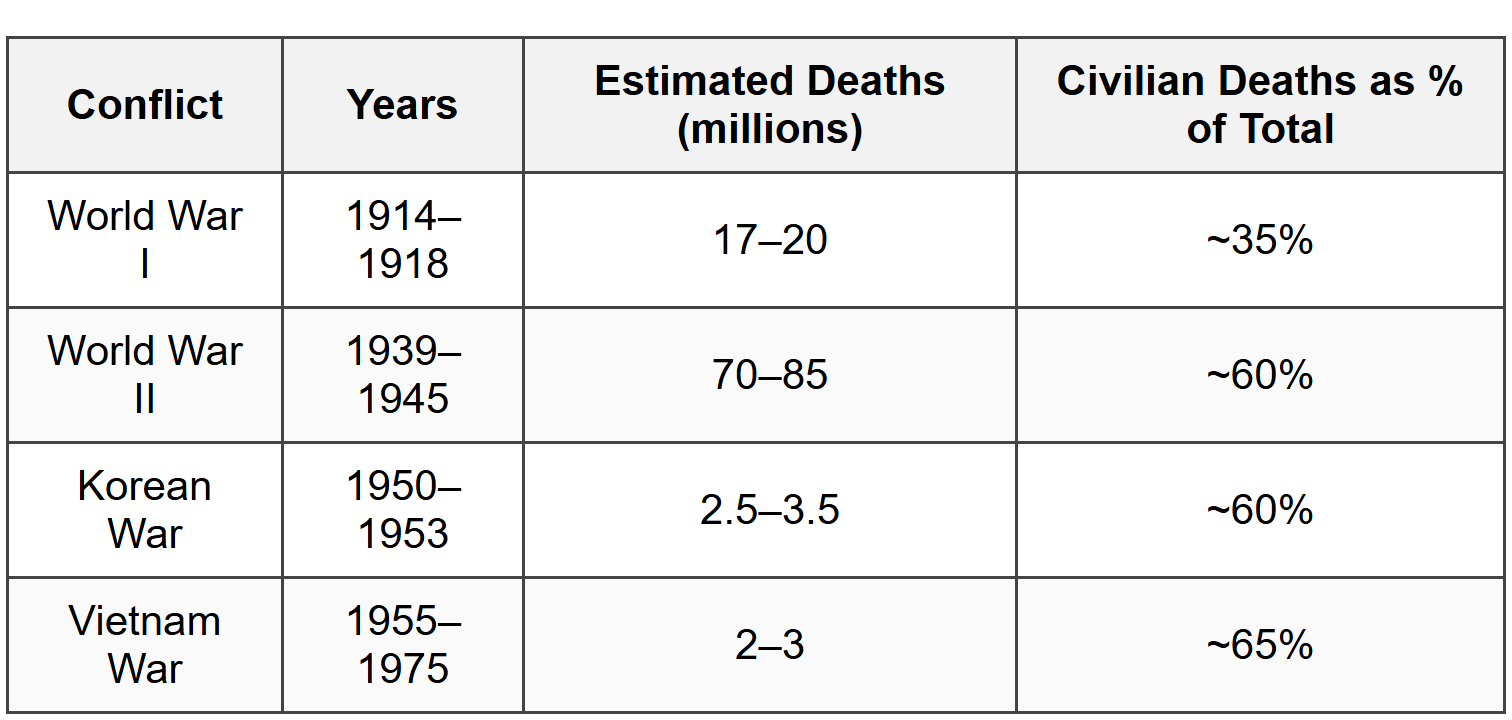
19. Which of the following conclusions about 20th-century warfare is best supported by the data in the table?
- The total number of casualties decreased steadily throughout the 20th century
- The proportion of civilian deaths increased significantly between World War I and later 20th-century conflicts
- Asian conflicts consistently produced fewer total casualties than European conflicts
- Wars became shorter in duration as military technology advanced
20. The increase in civilian deaths as a percentage of total casualties between World War I and World War II most directly resulted from:
- The development of more accurate weapons that could distinguish combatants from non-combatants
- The adoption of strategic bombing campaigns, genocide, and deliberate targeting of civilian populations as military tactics
- International laws that prohibited attacks on military installations
- The decline in the size of professional armies in favor of smaller special forces units
SECTION II: FREE RESPONSE
Directions
This section contains 2 free-response questions. Answer all parts of each question. You should plan to spend approximately 40 minutes on the Short Answer Question (SAQ) and 40 minutes on the Long Essay Question (LEQ). Support your answers with specific historical evidence and clearly explain your reasoning.
Question 1: Short Answer Question (SAQ)
"We, men and women, who hereby constitute ourselves as the National Organization for Women, believe that the time has come for a new movement toward true equality for all women in America, and toward a fully equal partnership of the sexes... We reject the current assumptions that a man must carry the sole burden of supporting himself, his wife, and family... or that marriage, home, and family are primarily woman's world and responsibility... We believe that a true partnership between the sexes demands a different concept of marriage, an equitable sharing of the responsibilities of home and children and of the economic burdens of their support."
- National Organization for Women (NOW), Statement of Purpose, 1966
A. Identify ONE way in which the feminist movement described in the source challenged traditional gender roles in the mid-20th century.
B. Explain ONE reason why social movements like the feminist movement gained momentum in the 1960s and 1970s.
C. Explain ONE similarity between the feminist movement described in the source and another social movement of the 20th century.
Question 2: Long Essay Question (LEQ)
Historical Reasoning Skill: Causation
Evaluate the extent to which the Treaty of Versailles caused instability in Europe in the period 1919-1939.
In your response, you should do the following:
- Present a thesis that makes a historically defensible claim and responds to all parts of the question
- Provide context relevant to the prompt by describing broader historical developments or processes
- Use specific and relevant historical evidence to support your argument
- Use historical reasoning to explain relationships among the pieces of evidence and how they support your argument
- Demonstrate a complex understanding by explaining connections across time periods, regions, or themes
Choose to answer for ONE of the following time-period options:
Option 1: Focus on the immediate aftermath (1919-1923)
Option 2: Focus on the period of relative stability (1924-1929)
Option 3: Focus on the period of crisis and collapse (1929-1939)
ANSWER KEY
Part A: Multiple-Choice Answer Table
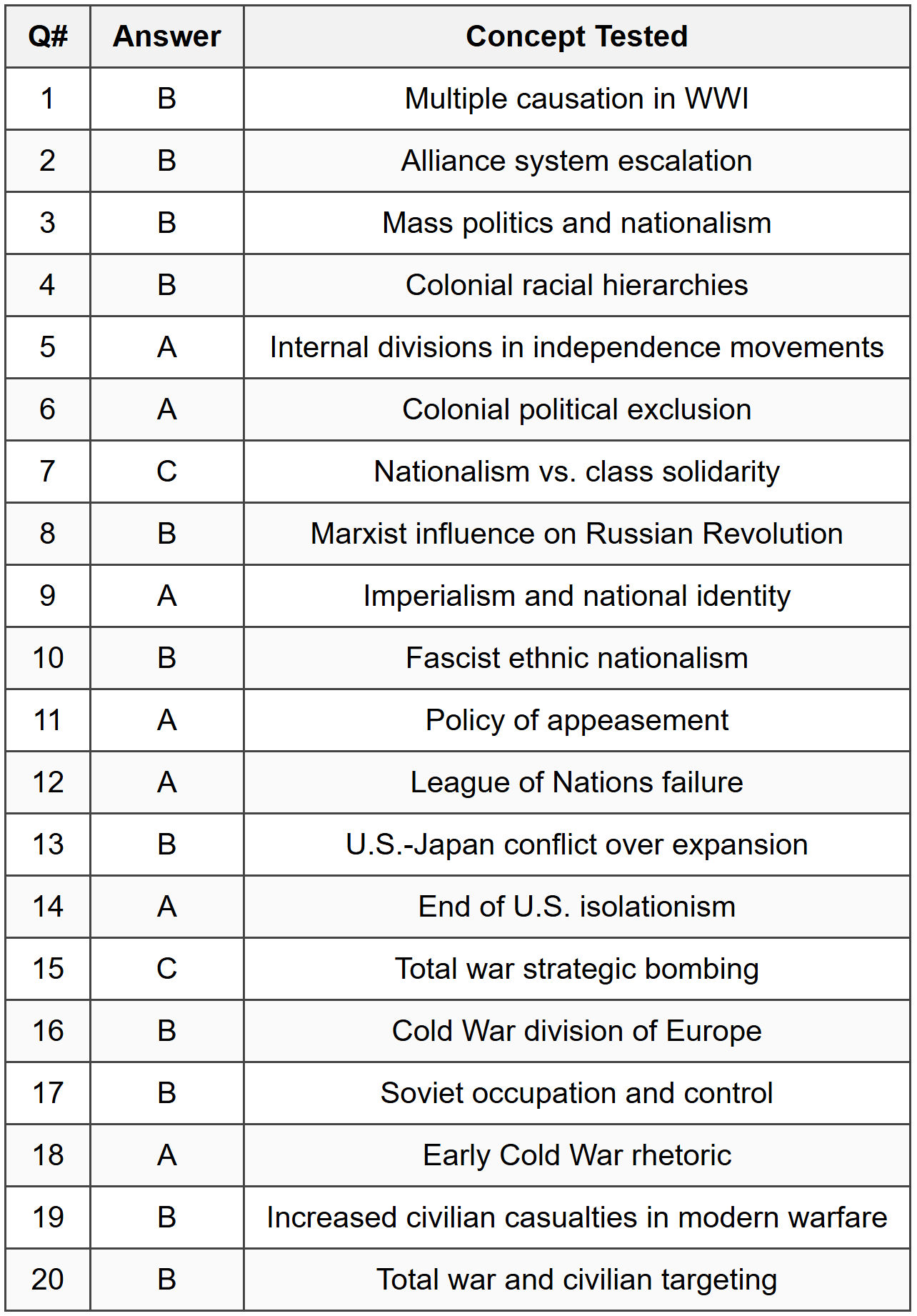
Part B: Free-Response Question Detailed Answers
FRQ 1 - Answer Key (Short Answer Question)
Part A: Identify ONE way in which the feminist movement described in the source challenged traditional gender roles in the mid-20th century.
The feminist movement challenged the traditional assumption that women's primary responsibility was the home and family by arguing for equal participation in economic and professional life. The NOW statement explicitly rejects the idea that "marriage, home, and family are primarily woman's world and responsibility," advocating instead for an equitable sharing of domestic duties and economic support between men and women. This directly confronted the post-World War II ideology of separate spheres that confined women to domestic roles while men dominated public and economic life.
Part B: Explain ONE reason why social movements like the feminist movement gained momentum in the 1960s and 1970s.
Social movements gained momentum in the 1960s and 1970s due to the expansion of higher education and increased participation of women in the workforce during and after World War II. By the 1960s, more women had college degrees and work experience outside the home, creating a growing awareness of wage discrimination, limited career opportunities, and legal inequalities. This educated, politically conscious demographic provided both leadership and grassroots support for organized movements demanding systemic change. Additionally, the success of the Civil Rights Movement provided a model for collective action and demonstrated that organized protest could achieve legal and social reforms.
Part C: Explain ONE similarity between the feminist movement described in the source and another social movement of the 20th century.
The feminist movement shared significant similarities with the Civil Rights Movement in its demands for legal equality and an end to systemic discrimination. Both movements challenged deeply entrenched social hierarchies-racial segregation in the case of the Civil Rights Movement and gender-based inequality in the case of the feminist movement. Both utilized similar tactics including public demonstrations, legal challenges, and legislative advocacy to achieve their goals. Just as the Civil Rights Act of 1964 prohibited racial discrimination, Title VII of the same act prohibited sex discrimination in employment, demonstrating how both movements sought federal legislation to guarantee equal rights and opportunities for marginalized groups.
FRQ 2 - Answer Key (Long Essay Question)
Model Thesis Statement
Thesis: While the Treaty of Versailles created significant conditions for instability in Europe through its harsh reparations demands, territorial revisions, and perceived injustices, it was not the sole cause of instability in the interwar period; rather, the treaty's provisions combined with the Great Depression, the failure of international diplomacy, and the rise of totalitarian ideologies to create the conditions that led to World War II.
Contextualization
A strong response would provide context by describing the end of World War I, the scale of destruction and loss of life that created demands for punishment of Germany, and the competing visions for the postwar order represented by Woodrow Wilson's Fourteen Points, French security concerns, and British imperial interests. The response should note that the treaty was negotiated at a time when traditional European balance-of-power diplomacy was giving way to new principles of national self-determination and collective security.
Historical Evidence - Key Examples That Would Earn Points
Evidence supporting the treaty as a cause of instability:
- War guilt clause (Article 231): Required Germany to accept sole responsibility for the war, creating widespread resentment among Germans and providing fuel for nationalist movements that claimed Germany had been unjustly blamed.
- Reparations payments: The demand that Germany pay 132 billion gold marks in reparations contributed to hyperinflation in the early 1920s, wiping out middle-class savings and creating economic chaos that undermined faith in the Weimar Republic.
- Territorial losses: Germany lost approximately 13% of its territory and 10% of its population, including the resource-rich regions of Alsace-Lorraine and the Saar, as well as all overseas colonies. The creation of the Polish Corridor separated East Prussia from the rest of Germany, creating a geographic and political grievance.
- Military restrictions: The treaty limited the German army to 100,000 men, prohibited conscription, banned tanks and military aircraft, and limited the navy. These restrictions were seen as humiliating and left Germany vulnerable, while also creating a sense that revision of the treaty was necessary and justified.
Evidence of other contributing factors to instability:
- The Great Depression (1929): The global economic collapse created mass unemployment in Germany (reaching 6 million by 1932), which radicalized politics and enabled Hitler's rise to power. Economic crisis undermined moderate parties and made extremist promises appealing.
- Failure of the League of Nations: The League lacked enforcement mechanisms and was weakened by the absence of the United States. Its inability to prevent Japanese expansion in Manchuria (1931) and Italian invasion of Ethiopia (1935) demonstrated that collective security had failed.
- Rise of totalitarian ideologies: Fascism in Italy (from 1922), Nazism in Germany (from 1933), and militarism in Japan represented new forms of aggressive nationalism that rejected liberal democracy and international cooperation.
Historical Reasoning - Causation
A strong response demonstrates the causation reasoning skill by:
- Distinguishing between immediate/short-term causes (such as the treaty's economic burdens in the 1920s) and long-term causes (such as the cultivation of resentment that Nazi propaganda exploited in the 1930s)
- Explaining the relative importance of the treaty compared to other factors-for example, noting that while the treaty created grievances, it was the Depression that made those grievances politically explosive
- Identifying chains of causation-for example: Treaty reparations → French occupation of the Ruhr (1923) → German hyperinflation → destruction of middle-class wealth → increased support for extremist parties
- Recognizing that the treaty's impact varied over time-Germany was relatively stable during the mid-1920s (Locarno era) when reparations were renegotiated and the economy recovered, suggesting the treaty alone was not determinative
Complexity
A response demonstrates complexity by:
- Explaining how the treaty both caused instability and reflected deeper continuities, such as the persistence of militarism and nationalism that had contributed to World War I itself
- Making connections to other regions or time periods-for example, comparing the punitive nature of Versailles with the more lenient treatment of Germany after World War II (Marshall Plan, integration into NATO), which produced different outcomes
- Analyzing multiple perspectives-for example, explaining how French insistence on security led to harsh treaty terms, but these same terms undermined French security by creating German resentment and desire for revision
- Recognizing irony or unintended consequences-for example, the principle of self-determination created new nation-states in Eastern Europe that contained dissatisfied minorities and unstable borders, contributing to the very instability the treaty sought to prevent