Practice Questions :Cold War and Decolonization

SECTION I: MULTIPLE CHOICE
Directions
Each of the questions or incomplete statements below is followed by four suggested answers or completions. Select the one that is best in each case. You will have approximately 40 minutes to complete this section.
Note: All multiple-choice questions in this section are stimulus-based. Read each source excerpt carefully before answering the associated question(s).
Questions 1-2 refer to the following excerpt.
Source 1: Speech by Jawaharlal Nehru, Prime Minister of India, at the Bandung Conference, Indonesia, April 1955.
"We have sworn to free ourselves from the domination of any country, from the domination of any group, and we propose to live our own lives in our own way, consistent only with the principles and purposes of the United Nations Charter. We propose, as far as possible, not to come in the way of the great powers in their conflicts. But we also propose to avoid becoming a field of those conflicts. We have had enough of being dragged into wars and conflicts which were not of our making. We want to be friends with both sides and not be aligned with either."
Question 1
Which of the following best describes the primary purpose of Nehru's statement at the Bandung Conference?
- To establish military alliances with Western European powers to counter Soviet expansion in Asia
- To articulate a policy of non-alignment that would allow newly independent nations to avoid superpower conflicts
- To advocate for immediate economic integration of Asian and African nations into the Soviet economic bloc
- To call for the dissolution of the United Nations due to its perceived Western bias
Question 2
Nehru's speech at Bandung most directly reflected which of the following developments in the post-1945 international order?
- The emergence of newly independent nations seeking to assert their sovereignty and avoid Cold War polarization
- The establishment of formal military alliances between Asian nations and the United States
- The decline of nationalist movements in colonized territories due to superpower intervention
- The complete withdrawal of European powers from all colonial possessions by 1955
Questions 3-4 refer to the following excerpt.
Source 2: From Winston Churchill's "Iron Curtain" speech, delivered at Westminster College in Fulton, Missouri, March 5, 1946.
"From Stettin in the Baltic to Trieste in the Adriatic an iron curtain has descended across the Continent. Behind that line lie all the capitals of the ancient states of Central and Eastern Europe. Warsaw, Berlin, Prague, Vienna, Budapest, Belgrade, Bucharest and Sofia; all these famous cities and the populations around them lie in what I must call the Soviet sphere, and all are subject, in one form or another, not only to Soviet influence but to a very high and in some cases increasing measure of control from Moscow."
Question 3
Churchill's characterization of the "iron curtain" most directly contributed to which of the following developments in the early Cold War period?
- The implementation of policies designed to contain Soviet expansion and influence in Europe
- The immediate reunification of Germany under a democratic government
- The establishment of free trade agreements between Eastern and Western European nations
- The withdrawal of all American military forces from Europe by 1950
Question 4
The division of Europe described by Churchill was most similar to which of the following earlier historical developments?
- The division of Africa among European colonial powers at the Berlin Conference of 1884-1885
- The creation of separate spheres of influence in China by foreign powers in the late nineteenth century
- The partition of the Indian subcontinent into Hindu and Muslim majority states in 1947
- The establishment of colonial mandates in the Middle East following World War I
Questions 5-6 refer to the following excerpt.
Source 3: From Frantz Fanon's The Wretched of the Earth, published in 1961.
"National liberation, national renaissance, the restoration of nationhood to the people, commonwealth: whatever may be the headings used or the new formulas introduced, decolonization is always a violent phenomenon. At whatever level we study it-relationships between individuals, new names for sports clubs, the human admixture at cocktail parties, in the police, on the directing boards of national or private banks-decolonization is quite simply the replacing of a certain 'species' of men by another 'species' of men. Without any period of transition, there is a total, complete, and absolute substitution."
Question 5
Fanon's argument that decolonization is "always a violent phenomenon" is best supported by which of the following examples from the mid-twentieth century?
- The negotiated transfer of power from Britain to India in 1947, which occurred without armed conflict between Indian nationalists and British forces
- The Algerian War of Independence (1954-1962), in which armed struggle was central to ending French colonial rule
- The peaceful dissolution of the British mandate in Palestine following United Nations mediation
- The voluntary withdrawal of Belgian forces from the Congo without any resistance from Congolese independence movements
Question 6
Fanon's emphasis on the "complete and absolute substitution" of one group by another most directly reflects which of the following aspects of twentieth-century decolonization movements?
- The desire of independence leaders to maintain existing colonial administrative structures to ensure continuity
- The radical transformation of political, economic, and social systems that accompanied the end of colonial rule
- The willingness of European colonial powers to grant gradual autonomy while retaining economic control
- The preference of most colonized peoples for hybrid governments that combined indigenous and European institutions
Questions 7-8 refer to the following data.
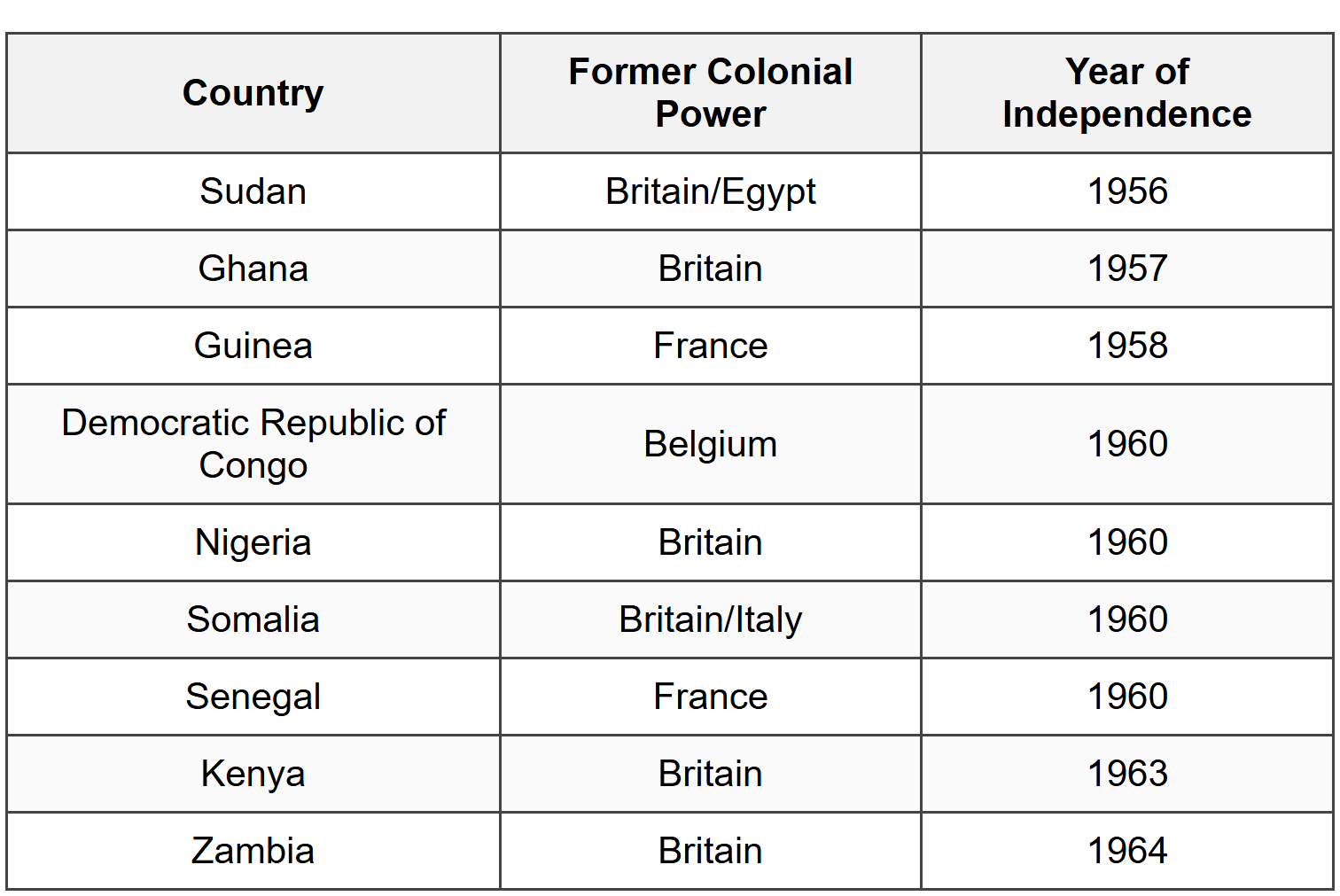
Table 1: Selected African Nations Achieving Independence, 1956-1965
Question 7
The data in the table best support which of the following conclusions about African decolonization?
- European powers withdrew from Africa primarily in response to military defeats by African independence movements
- The year 1960 marked a significant acceleration in the pace of African independence, often called the "Year of Africa"
- Belgium controlled more African territory than any other European power prior to decolonization
- All African nations achieved independence through peaceful negotiation without violent resistance
Question 8
The pattern of decolonization shown in the table was most directly influenced by which of the following Cold War developments?
- Superpower competition for influence in the developing world, which made maintaining expensive colonial empires less strategically valuable
- A formal agreement between the United States and Soviet Union to jointly administer former European colonies
- The United Nations' military intervention to forcibly remove European colonial administrators from Africa
- The economic prosperity of European nations, which eliminated their need for colonial resources
Questions 9-10 refer to the following excerpt.
Source 4: From the Truman Doctrine speech, delivered to a joint session of Congress, March 12, 1947.
"I believe that it must be the policy of the United States to support free peoples who are resisting attempted subjugation by armed minorities or by outside pressures. I believe that we must assist free peoples to work out their own destinies in their own way. I believe that our help should be primarily through economic and financial aid which is essential to economic stability and orderly political processes. The seeds of totalitarian regimes are nurtured by misery and want. They spread and grow in the evil soil of poverty and strife. They reach their full growth when the hope of a people for a better life has died. We must keep that hope alive."
Question 9
The Truman Doctrine represented a significant shift in United States foreign policy because it
- committed the United States to a policy of isolationism and non-intervention in European affairs
- established the principle of providing economic and military support to nations resisting communist influence
- called for immediate military invasion of all communist countries to establish democratic governments
- proposed the division of Europe into permanent American and Soviet occupation zones
Question 10
Truman's assertion that "totalitarian regimes are nurtured by misery and want" most directly led to which of the following United States policies?
- The Marshall Plan, which provided economic assistance to rebuild Western European economies
- The dissolution of the League of Nations and its replacement with the United Nations
- The immediate recognition of the People's Republic of China as the legitimate government of China
- The withdrawal of American economic aid from all nations that had been Axis powers during World War II
Questions 11-12 refer to the following excerpt.
Source 5: From a speech by Patrice Lumumba, Prime Minister of the Democratic Republic of Congo, at independence ceremonies, June 30, 1960.
"We have known harassing work, exacted in exchange for salaries which did not permit us to eat enough to drive away hunger, or to clothe ourselves, or to house ourselves decently, or to raise our children as creatures dear to us. We have known ironies, insults, blows that we endured morning, noon, and evening, because we are Negroes. We have seen our lands seized in the name of allegedly legal laws which in fact recognized only that might is right. We have not forgotten that the law was not the same for a white and for a black, accommodating for the first, cruel and inhuman for the other."
Question 11
Lumumba's description of colonial rule in the Congo is most similar to critiques of imperialism made by which of the following groups?
- European industrialists who argued that colonies were economically unprofitable
- Indigenous intellectuals and activists across colonized regions who documented the exploitative nature of colonial systems
- Colonial administrators who advocated for the expansion of European territorial control
- American isolationists who opposed any foreign entanglements during the 1930s
Question 12
The conditions Lumumba described in the Belgian Congo were most directly a result of which of the following colonial policies?
- The implementation of economic systems designed to extract resources and labor from colonized peoples for the benefit of the colonizing power
- The establishment of representative governments that granted colonized peoples equal voting rights with European settlers
- The creation of extensive educational systems that provided universal literacy for all colonial subjects
- The prohibition of racial discrimination through legally enforced civil rights protections
Questions 13-14 refer to the following excerpt.
Source 6: From Nikita Khrushchev's speech to the 20th Congress of the Communist Party of the Soviet Union, February 1956 (known as the "Secret Speech").
"Stalin acted not through persuasion, explanation, and patient cooperation with people, but by imposing his concepts and demanding absolute submission to his opinion. Whoever opposed this concept or tried to prove his viewpoint and the correctness of his position was doomed to removal from the leading collective and to subsequent moral and physical annihilation. Mass arrests and deportations of many thousands of people, execution without trial and without normal investigation created conditions of insecurity, fear, and even desperation."
Question 13
Khrushchev's denunciation of Stalin's methods in this speech most directly contributed to which of the following developments in the Cold War?
- The immediate reunification of East and West Germany under Soviet control
- A period of "de-Stalinization" within the Soviet Union and increased tensions within the communist bloc as satellite states sought greater autonomy
- The complete abandonment of communist ideology by all Eastern European nations
- The formation of a military alliance between the Soviet Union and the United States
Question 14
The conditions described in Khrushchev's speech were most similar to those created by which of the following twentieth-century regimes?
- The democratic government of the Weimar Republic in Germany during the 1920s
- The totalitarian state established by the Nazi regime in Germany under Adolf Hitler
- The constitutional monarchy of Great Britain during the reign of George VI
- The democratic government of France during the Third Republic
Questions 15-16 refer to the following excerpt.
Source 7: From a declaration by the Organization of African Unity (OAU), Addis Ababa, Ethiopia, May 1963.
"We, the Heads of African States and Governments assembled in the City of Addis Ababa, Ethiopia; convinced that it is the inalienable right of all people to control their own destiny; conscious of the fact that freedom, equality, justice and dignity are essential objectives for the achievement of the legitimate aspirations of the African peoples; determined to safeguard and consolidate the hard-won independence as well as the sovereignty and territorial integrity of our States, and to fight against neo-colonialism in all its forms."
Question 15
The OAU's reference to fighting "neo-colonialism in all its forms" most directly reflected African leaders' concerns about which of the following post-independence challenges?
- The potential for former colonial powers to maintain economic and political influence over newly independent nations through indirect means
- The immediate recolonization of African territories by European military forces
- The desire of African nations to rejoin their former colonial empires voluntarily
- The complete isolation of African nations from participation in the global economy
Question 16
The formation of the Organization of African Unity in 1963 represented a continuation of which of the following twentieth-century trends?
- The establishment of regional organizations aimed at promoting solidarity and cooperation among newly independent nations
- The rejection of all forms of international cooperation in favor of complete national isolation
- The formal incorporation of African nations into either NATO or the Warsaw Pact
- The voluntary return of political sovereignty to former colonial powers
Questions 17-18 refer to the following excerpt.
Source 8: From President John F. Kennedy's speech at Rice University, September 12, 1962.
"We choose to go to the moon. We choose to go to the moon in this decade and do the other things, not because they are easy, but because they are hard, because that goal will serve to organize and measure the best of our energies and skills, because that challenge is one that we are willing to accept, one we are unwilling to postpone, and one which we intend to win, and the others, too. For space science, like nuclear science and all technology, has no conscience of its own. Whether it will become a force for good or ill depends on man."
Question 17
Kennedy's commitment to landing on the moon "in this decade" was most directly motivated by which of the following Cold War considerations?
- The desire to demonstrate American technological and ideological superiority over the Soviet Union in the context of superpower competition
- The need to establish permanent military bases on the moon to launch nuclear weapons at the Soviet Union
- A joint Soviet-American agreement to share all space exploration costs and achievements equally
- The requirement to fulfill treaty obligations under the United Nations Charter
Question 18
The space race between the United States and the Soviet Union described in Kennedy's speech was most similar to which of the following earlier forms of international competition?
- The naval arms race between Britain and Germany prior to World War I, in which military buildups reflected broader geopolitical rivalries
- The cooperative scientific expeditions of the International Geophysical Year in 1957-1958
- The cultural exchange programs established between the United States and Soviet Union in the 1950s
- The joint British-French administration of colonial territories under the mandate system
Questions 19-20 refer to the following excerpt.
Source 9: From Ho Chi Minh's "Declaration of Independence of the Democratic Republic of Vietnam," September 2, 1945.
"All men are created equal. They are endowed by their Creator with certain inalienable rights, among them are Life, Liberty, and the pursuit of Happiness. This immortal statement was made in the Declaration of Independence of the United States of America in 1776. In a broader sense, this means: All the peoples on the earth are equal from birth, all the peoples have a right to live, to be happy and free. The Declaration of the French Revolution made in 1791 on the Rights of Man and the Citizen also states: 'All men are born free and with equal rights, and must always remain free and have equal rights.' Nevertheless, for more than eighty years, the French imperialists have violated our Fatherland and oppressed our fellow-citizens."
Question 19
Ho Chi Minh's use of quotations from the American Declaration of Independence and the French Declaration of the Rights of Man and Citizen was most likely intended to
- demonstrate Vietnamese rejection of all Western political ideas and values
- appeal to Western democratic ideals to justify Vietnamese independence and expose the hypocrisy of colonial rule
- propose the immediate incorporation of Vietnam into the French Republic as an equal province
- advocate for the restoration of the Vietnamese monarchy under French protection
Question 20
The strategy employed by Ho Chi Minh in this declaration was most similar to that used by which of the following independence movements?
- The Indian National Congress, which used British liberal political principles to argue for Indian self-determination
- The Meiji Restoration in Japan, which sought to preserve traditional feudal social structures
- The Taiping Rebellion in China, which rejected all foreign influences in favor of indigenous religious beliefs
- The Zulu resistance to British colonization, which relied exclusively on military confrontation
SECTION II: FREE RESPONSE
Directions
Section II of this examination contains two free-response questions. You should spend approximately 40 minutes on Question 1 (Short Answer Question) and approximately 40 minutes on Question 2 (Long Essay Question). Write your responses in the spaces provided, or on separate sheets of paper if necessary. Use specific historical evidence to support your arguments.
Question 1: Short Answer Question (SAQ)
Recommended Time: 40 minutes
Source: Photograph description - A black-and-white photograph taken in August 1961 shows East German construction workers, supervised by armed soldiers, building a concrete barrier topped with barbed wire through the center of Berlin. On the western side of the barrier, a crowd of West Berliners watches the construction. The barrier would eventually become known as the Berlin Wall, dividing the city until 1989.
Using the photograph description and your knowledge of world history, answer all parts of the question that follows.
- Identify ONE specific historical development that led to the construction of the Berlin Wall in 1961.
- Explain ONE way in which the Berlin Wall represented the broader ideological divisions of the Cold War.
- Explain ONE significant consequence of the division of Berlin for Cold War international relations between 1961 and 1989.
Question 2: Long Essay Question (LEQ)
Recommended Time: 40 minutes
Directions: Answer the following question. In your response, you should do the following:
- Respond to the prompt with a historically defensible thesis or claim that establishes a line of reasoning.
- Describe a broader historical context relevant to the prompt.
- Support an argument in response to the prompt using specific and relevant examples of historical evidence.
- Use historical reasoning (e.g., comparison, causation, or continuity and change) to frame or structure an argument that addresses the prompt.
- Use evidence to corroborate, qualify, or modify an argument that addresses the prompt.
Historical Reasoning Skill: Causation
Prompt: Evaluate the extent to which Cold War tensions influenced the process and outcomes of decolonization in Asia and Africa in the period 1945-1975.
In your response, consider the following:
- How superpower rivalry shaped the strategies and ideologies of independence movements
- The role of Cold War competition in accelerating or complicating the decolonization process
- The impact of Cold War alignments on post-independence political stability and development
Note: Choose examples from at least TWO different regions (e.g., Southeast Asia, South Asia, Sub-Saharan Africa, North Africa, or the Middle East).
ANSWER KEY
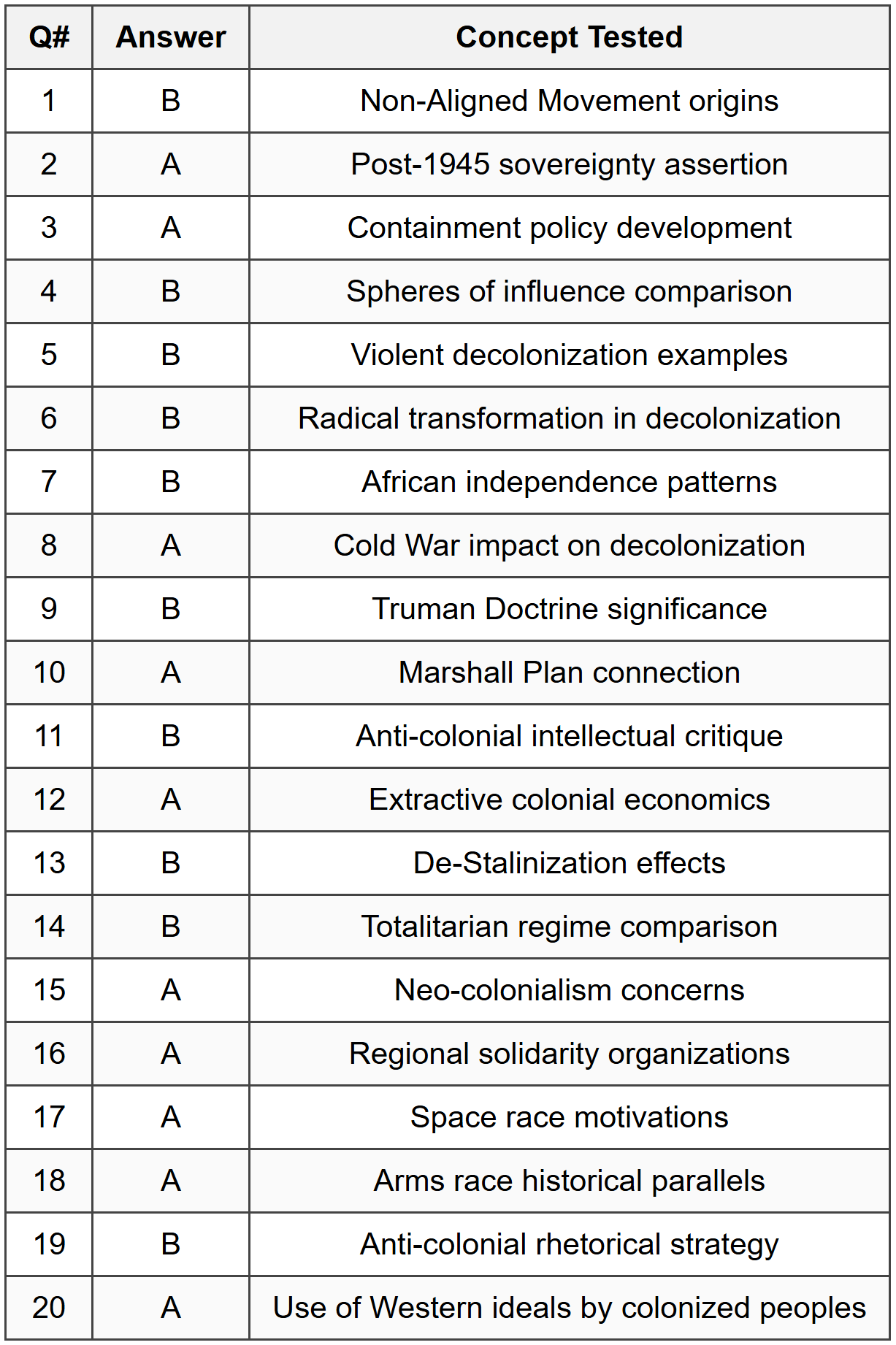
Part A - Multiple-Choice Answer Table
Part B - Free-Response Question Detailed Answers
FRQ 1 - Answer Key (Short Answer Question)
Part A: Identify ONE specific historical development that led to the construction of the Berlin Wall in 1961
An acceptable answer would identify the mass migration of East Germans to West Berlin as a key development. Between 1949 and 1961, approximately 2.7 million East Germans fled to West Germany through West Berlin, which remained accessible despite being surrounded by communist East Germany. This "brain drain" of skilled workers and professionals threatened the economic and political stability of the East German state, prompting the construction of the Wall to prevent further emigration.
Alternative acceptable answers:
- The division of Germany into occupation zones following World War II, which created separate capitalist and communist German states by 1949
- The Berlin Crisis of 1958-1961, during which Khrushchev demanded Western withdrawal from West Berlin
- The economic disparity between prosperous West Berlin and struggling East Berlin under communist economic planning
Part B: Explain ONE way in which the Berlin Wall represented the broader ideological divisions of the Cold War
The Berlin Wall physically embodied the ideological division between capitalism and communism that characterized the Cold War. The Wall separated democratic, market-oriented West Berlin (supported by the United States and Western Allies) from communist, centrally-planned East Berlin (controlled by the Soviet Union). This concrete barrier symbolized the "Iron Curtain" that divided Europe into two competing political, economic, and social systems. The fact that East Germany had to physically imprison its citizens to prevent them from choosing the Western system became a powerful propaganda symbol for the West, demonstrating the appeal of liberal democracy and capitalism over Soviet-style communism.
Key elements that strengthen this answer:
- Specific reference to the ideological contrast (capitalism vs. communism)
- Explanation of what this division meant in practical terms (different political and economic systems)
- Connection to broader Cold War symbolism and propaganda value
Part C: Explain ONE significant consequence of the division of Berlin for Cold War international relations between 1961 and 1989
The Berlin Wall became a focal point for Cold War tensions and near-confrontations that threatened to escalate into armed conflict. The most immediate consequence was the tank standoff at Checkpoint Charlie in October 1961, when American and Soviet tanks faced each other directly for 16 hours over access rights, bringing the superpowers to the brink of military engagement. Throughout the Wall's existence, incidents such as shootings of those attempting to escape and disputes over access rights kept Berlin as a "pressure point" in Cold War relations, while also serving as a rallying symbol for Western resistance to communism, exemplified by President Kennedy's 1963 "Ich bin ein Berliner" speech and President Reagan's 1987 "Tear down this wall" speech.
Alternative acceptable consequences:
- The Wall's construction solidified the permanent division of Germany and formalized the bipolar division of Europe, reducing the likelihood of German reunification and reinforcing NATO-Warsaw Pact divisions
- The successful construction of the Wall without Western military intervention established implicit rules of Cold War engagement, suggesting both superpowers would accept existing spheres of influence to avoid direct military confrontation
- The Wall became a powerful symbol in Western propaganda that undermined Soviet claims about the superiority of communism, as it demonstrated that the communist system required force to prevent citizens from fleeing
FRQ 2 - Answer Key (Long Essay Question)
Model Thesis Statement
While decolonization in Asia and Africa between 1945 and 1975 was primarily driven by long-standing nationalist movements and the weakening of European colonial powers after World War II, Cold War tensions significantly influenced both the process and outcomes of independence by providing ideological frameworks and material support for independence movements, accelerating the timeline of European withdrawal as colonial conflicts became proxy wars, and shaping post-independence political instability as newly independent nations became battlegrounds for superpower competition.
Why this thesis works:
- It is historically defensible and takes a clear position on "the extent" (acknowledges Cold War influence while recognizing other factors)
- It establishes a clear line of reasoning with three distinct areas of Cold War influence: ideological/material support, acceleration of decolonization, and post-independence effects
- It addresses the causation reasoning skill by explaining how Cold War tensions influenced outcomes
- It is sophisticated, acknowledging complexity rather than making an absolute claim
Contextualization
A strong contextualization paragraph would establish:
- The weakening of European colonial powers after World War II due to economic devastation and loss of prestige
- The emergence of the United States and Soviet Union as superpowers with competing ideological systems (capitalism/liberal democracy vs. communism/central planning)
- The existence of nationalist movements in colonized territories that predated the Cold War, often emerging in the early twentieth century
- The role of the Atlantic Charter (1941) and the United Nations Charter (1945) in promoting self-determination
- The broader global context of 1945-1975, including technological change, global economic restructuring, and the nuclear arms race
Evidence and Analysis - Specific Examples
Example 1: Vietnam - Cold War Ideological Support Shaping Independence Movements
Ho Chi Minh's Vietnamese independence movement initially adopted democratic rhetoric (as seen in the 1945 Declaration of Independence), but increasing U.S. support for French colonial reconquest after 1950 pushed the Viet Minh toward closer alignment with communist China and the Soviet Union. After the French defeat at Dien Bien Phu (1954), Cold War considerations led to the Geneva Conference partition of Vietnam, rather than the unified independent Vietnam nationalists sought. This demonstrates how Cold War tensions directly shaped both the ideology and territorial outcomes of decolonization.
Example 2: Congo - Cold War Intervention Destabilizing Post-Independence States
The Congo Crisis (1960-1965) illustrates how Cold War competition destabilized newly independent nations. When Prime Minister Patrice Lumumba sought Soviet assistance after Belgian and Western interference in Congolese internal affairs, the United States and Belgium supported the secession of mineral-rich Katanga province and backed the coup that brought Mobutu to power. Cold War fears of communist expansion led Western powers to undermine a democratically elected leader, resulting in decades of authoritarian rule. This shows how superpower rivalry directly shaped post-independence political development.
Example 3: Indonesia - Non-Alignment as Response to Cold War Pressures
Indonesia's Sukarno hosted the 1955 Bandung Conference, bringing together 29 Asian and African nations to articulate an alternative to Cold War alignment. This demonstrates how Cold War tensions actually accelerated certain aspects of decolonization by creating opportunities for colonized peoples to leverage superpower competition, while also inspiring the creation of new international frameworks (the Non-Aligned Movement) that reshaped post-colonial international relations.
Example 4: Algeria - Cold War Accelerating French Withdrawal
The Algerian War of Independence (1954-1962) became increasingly costly as France sought to maintain its prestige in Cold War competition with the Soviet Union. However, the war's brutality damaged France's international reputation and diverted resources from European economic integration and NATO commitments. The Cold War context made maintaining colonial control more costly in terms of international standing, ultimately accelerating French willingness to negotiate Algerian independence in 1962.
Example 5: India - Decolonization Preceding Intensive Cold War Competition
Indian independence in 1947 preceded the most intense period of Cold War competition in Asia and was primarily the result of decades of Indian nationalist organizing and British economic exhaustion after World War II. While India later became a founder of the Non-Aligned Movement, its independence process itself was largely autonomous from direct Cold War influence, illustrating the limits of Cold War impact on decolonization.
Example 6: Ghana - Cold War Providing Alternative Development Models
Kwame Nkrumah's Ghana (independent 1957) initially pursued a socialist development path influenced by Soviet economic models, accepting aid from both Western and Eastern bloc nations. The availability of Soviet support as an alternative to Western assistance gave newly independent African nations greater leverage in negotiating aid relationships, though it also contributed to Cold War interventions when leaders like Nkrumah were perceived as tilting too far toward the communist bloc (he was overthrown in a 1966 coup during a visit to Beijing).
Historical Reasoning Application - Causation
To earn full credit for the causation reasoning skill, the essay must:
- Identify and explain multiple causes: Distinguish between long-term causes of decolonization (rise of nationalism, World War II weakening of Europe, Enlightenment ideals of self-determination) and the specific additional influence of Cold War tensions
- Establish causal relationships: Explain HOW Cold War competition led to specific outcomes - for example, how superpower rivalry created incentives for European powers to withdraw rather than fight costly colonial wars that diverted resources from Cold War competition in Europe
- Evaluate relative significance: Assess whether Cold War tensions were a primary cause, contributing cause, or relatively minor factor compared to indigenous nationalism and European weakness - the answer may vary by region and specific case
- Consider contingency: Acknowledge that decolonization outcomes were not predetermined - different levels of Cold War involvement produced different results (compare peaceful British withdrawal from India vs. violent conflicts in Vietnam or Algeria where Cold War proxy elements were stronger)
Complexity and Sophistication
Essays can demonstrate complexity by:
- Recognizing that Cold War influence varied significantly by region and time period (stronger in Southeast Asia and Congo, weaker in West African French colonies)
- Acknowledging counterevidence (cases like India where decolonization proceeded largely independently of Cold War dynamics)
- Analyzing both intended and unintended consequences (European powers didn't intend Cold War competition to undermine their empires, but it did)
- Explaining how multiple factors interacted (nationalism + European weakness + Cold War competition together produced the specific timing and character of decolonization)
- Considering different perspectives (how independence looked different from the perspective of colonized peoples vs. European powers vs. Cold War superpowers)
END OF EXAMINATION