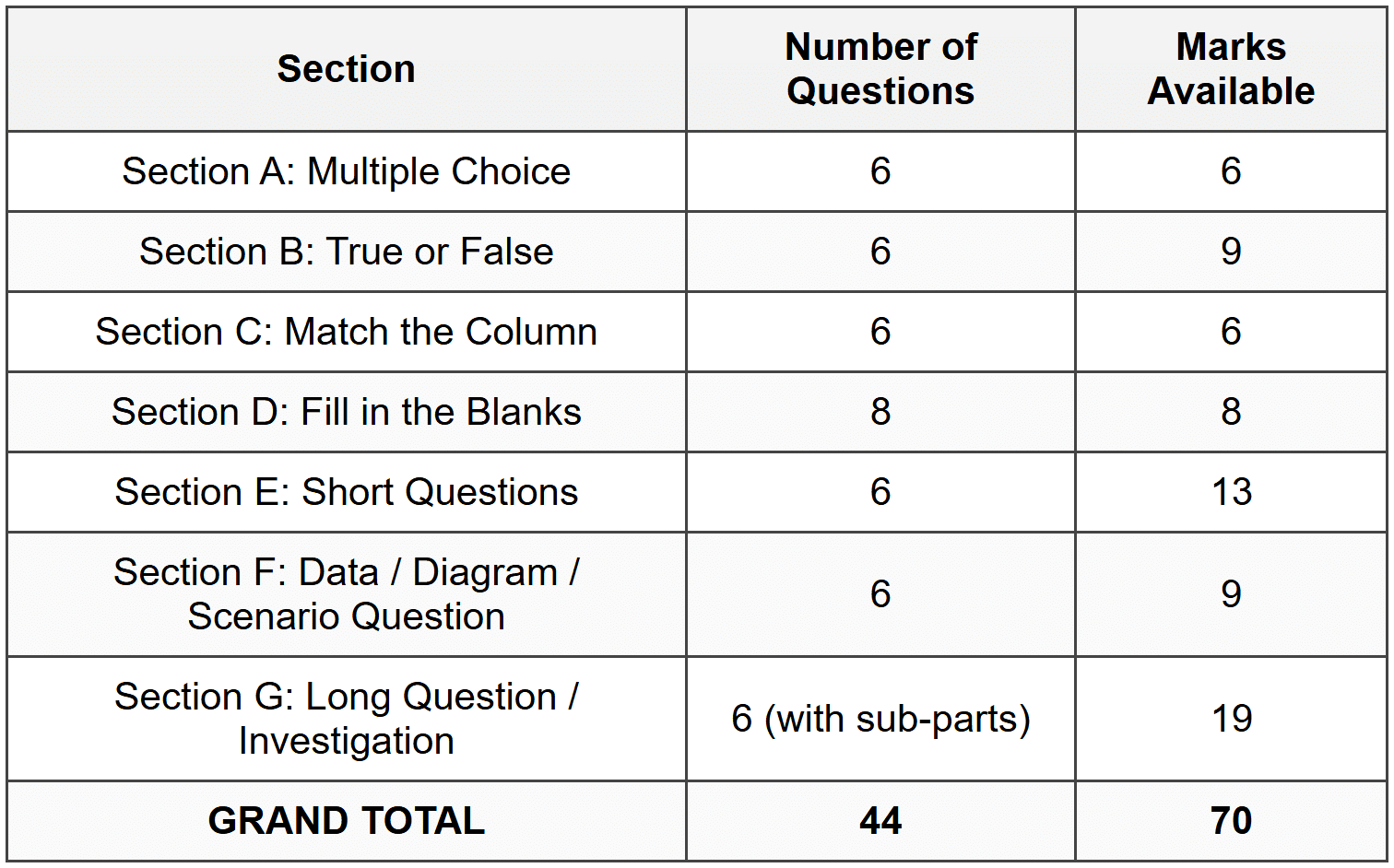
Worksheet -- Photosynthesis


Instructions to the Learner
- Read all questions carefully before answering.
- Answer all questions in the spaces provided on your answer sheet.
- Write neatly and clearly.
- Pay attention to the mark allocation for each question.
- Use the word bank provided where applicable.
- Show all working for calculations.
- The total marks for this worksheet is 80.
Section A: Multiple Choice
Choose the correct answer from the options provided. Write only the letter (A-D) next to the question number.
- Photosynthesis is the process by which plants make their own food. Which gas do plants take in during photosynthesis? [1]
- Oxygen
- Carbon dioxide
- Nitrogen
- Hydrogen
- Thandi is investigating photosynthesis. Which part of the plant cell contains chlorophyll? [1]
- Cell wall
- Nucleus
- Chloroplast
- Vacuole
- What is the main source of energy that plants use during photosynthesis? [1]
- Wind
- Sunlight
- Soil
- Water
- Sipho places a plant in a dark cupboard for three days. What will happen to the rate of photosynthesis? [1]
- It will increase
- It will stop or decrease significantly
- It will stay the same
- It will double
- During photosynthesis, plants produce oxygen. Where is this oxygen released? [1]
- Through the roots
- Through the stomata in the leaves
- Through the stem
- Through the flowers
- Which of the following is a product of photosynthesis? [1]
- Carbon dioxide
- Water
- Glucose (sugar)
- Soil nutrients
Section A Total: [6 marks]
Section B: True or False
Write TRUE or FALSE next to each statement. If the statement is FALSE, rewrite it to make it correct.
- Plants can make their own food through photosynthesis. [1]
- Photosynthesis takes place in the roots of the plant. [2]
- Chlorophyll is the green pigment that traps light energy in plants. [1]
- Plants release carbon dioxide during photosynthesis. [2]
- Water is one of the raw materials needed for photosynthesis. [1]
- Photosynthesis can occur in complete darkness. [2]
Section B Total: [9 marks]
Section C: Match the Column
Match the items in Column A with the correct description in Column B. Write only the letter of the correct answer next to the question number.
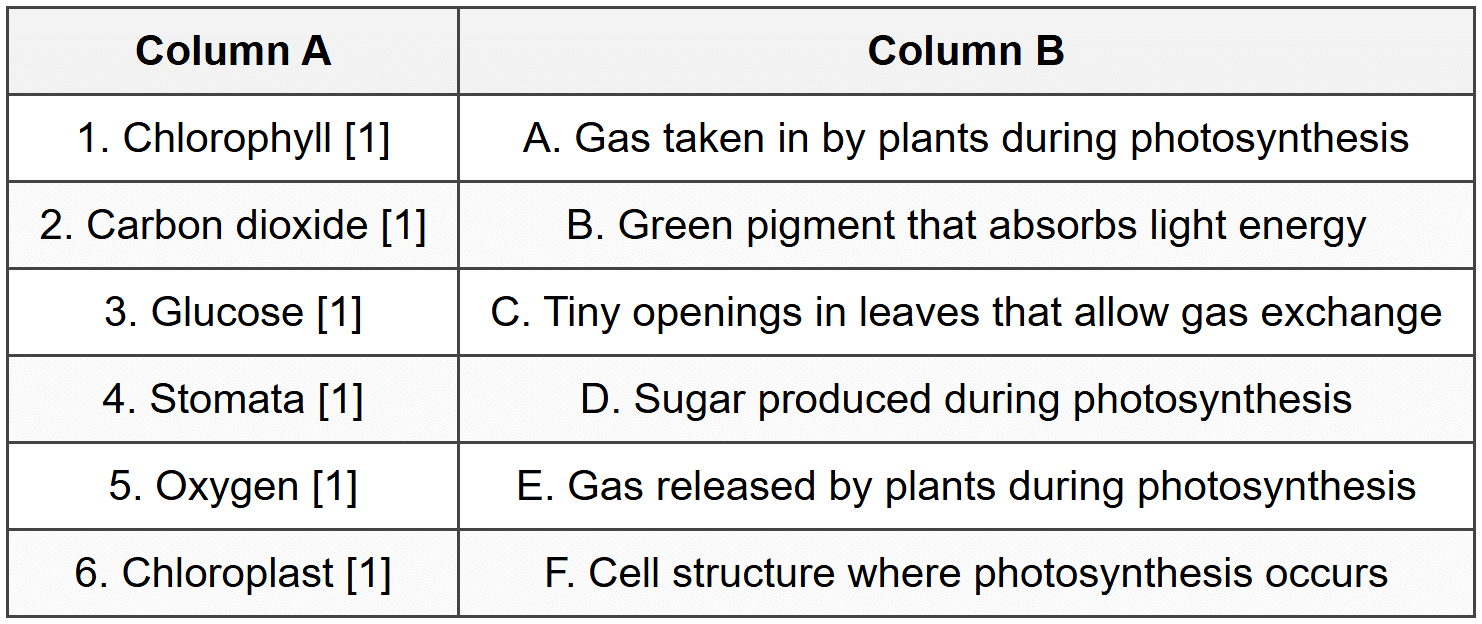
Section C Total: [6 marks]
Section D: Fill in the Blanks
Use the words from the word bank below to complete the sentences. Each word may be used only once.
Word Bank: sunlight, glucose, oxygen, chlorophyll, carbon dioxide, water, chloroplasts, stomata
- Photosynthesis takes place in the __________ of plant cells. [1]
- The green pigment called __________ traps light energy for photosynthesis. [1]
- Plants take in __________ from the air through their leaves. [1]
- During photosynthesis, plants produce __________ which is a type of sugar. [1]
- Plants absorb __________ from the soil through their roots. [1]
- The gas __________ is released into the air as a by-product of photosynthesis. [1]
- __________ provides the energy needed for photosynthesis to occur. [1]
- Gases enter and leave the leaf through tiny pores called __________. [1]
Section D Total: [8 marks]
Section E: Short Questions
Answer the following questions in one to three complete sentences.
- Why is photosynthesis important for life on Earth? [2]
- Name the three raw materials needed for photosynthesis. [3]
- Explain why most leaves are green. [2]
- What happens to the glucose that plants produce during photosynthesis? [2]
- Why do plants need sunlight for photosynthesis? [2]
- Describe one way you could test if a plant has been photosynthesizing. [2]
Section E Total: [13 marks]
Section F: Data / Diagram / Scenario Question
Lerato conducted an experiment to investigate photosynthesis. She took two identical healthy plants and placed them in different conditions for one week:
- Plant A: Placed on a sunny windowsill with regular watering
- Plant B: Placed in a dark cupboard with regular watering
After one week, Lerato observed the following:
- Plant A: Leaves remained green and healthy, plant showed new growth
- Plant B: Leaves turned yellow and pale, plant showed no new growth
Answer the following questions based on Lerato's experiment:
- What was the independent variable (the factor that was changed) in Lerato's experiment? [1]
- What was the dependent variable (the factor that was measured or observed) in this experiment? [1]
- Name one factor that Lerato kept the same (controlled variable) in this experiment. [1]
- Explain why Plant B's leaves turned yellow and pale. [2]
- Why did Plant A remain healthy and show new growth? [2]
- What can Lerato conclude about the importance of light for photosynthesis based on her results? [2]
Section F Total: [9 marks]
Section G: Long Question / Investigation
Bongani wants to understand the process of photosynthesis better. He learns that photosynthesis is a chemical process that can be represented by a word equation.
- Write the word equation for photosynthesis, showing the raw materials on the left and the products on the right. [3]
For each of the following, explain its role in photosynthesis:
- Chlorophyll [2]
- Sunlight [2]
- Stomata [2]
- Bongani reads that photosynthesis is essential for all life on Earth, not just for plants. Explain how animals, including humans, depend on photosynthesis for survival. [3]
- Describe what would happen to a plant if it did not receive enough water, even if it had plenty of sunlight. Explain your answer with reference to the photosynthesis process. [3]
- In some areas, air pollution increases the amount of dust and particles in the air, which can settle on leaves. Predict and explain how this might affect a plant's ability to photosynthesize. [3]
- Farmers sometimes grow plants in greenhouses where they can control the temperature, light, and water. Suggest two ways a farmer could increase the rate of photosynthesis in greenhouse plants and explain why each method would work. [4]
Section G Total: [19 marks]
OVERALL TOTAL: [70 marks]
Answer Key
MEMO - FOR EDUCATOR USE ONLY
Section A: Multiple Choice
Section A - Question 1
Answer: B - Carbon dioxide
- Why B is correct: Plants absorb carbon dioxide from the air through their stomata during photosynthesis; it is one of the essential raw materials used to make glucose.
- Why A is wrong: Oxygen is produced and released by plants during photosynthesis, not taken in.
- Why C is wrong: Nitrogen is not directly used in the photosynthesis process, although it is important for plant growth.
- Why D is wrong: Hydrogen is part of water molecules used in photosynthesis, but hydrogen gas itself is not taken in by plants.
Section A - Question 2
Answer: C - Chloroplast
- Why C is correct: Chloroplasts are the specialized organelles in plant cells that contain chlorophyll and are the sites where photosynthesis occurs.
- Why A is wrong: The cell wall provides structure and support to plant cells but does not contain chlorophyll or perform photosynthesis.
- Why B is wrong: The nucleus controls cell activities and contains genetic material, but does not contain chlorophyll.
- Why D is wrong: The vacuole stores water and nutrients but is not the site of photosynthesis.
Section A - Question 3
Answer: B - Sunlight
- Why B is correct: Sunlight provides the light energy that is absorbed by chlorophyll and converted into chemical energy during photosynthesis.
- Why A is wrong: Wind may help with pollination and seed dispersal but does not provide energy for photosynthesis.
- Why C is wrong: Soil provides minerals and anchors plants but is not an energy source for photosynthesis.
- Why D is wrong: Water is a raw material in photosynthesis but not the energy source; energy comes from sunlight.
Section A - Question 4
Answer: B - It will stop or decrease significantly
- Why B is correct: Without light, plants cannot carry out photosynthesis because light energy is essential to power the process; therefore, the rate will drop to zero or near zero.
- Why A is wrong: Darkness prevents photosynthesis; it cannot increase the rate.
- Why C is wrong: Photosynthesis is light-dependent, so removing light will stop or greatly reduce it, not keep it the same.
- Why D is wrong: The absence of light stops photosynthesis entirely; it cannot double.
Section A - Question 5
Answer: B - Through the stomata in the leaves
- Why B is correct: Stomata are tiny pores on the surface of leaves that allow gas exchange; oxygen produced during photosynthesis exits through these openings.
- Why A is wrong: Roots absorb water and minerals but do not release oxygen from photosynthesis.
- Why C is wrong: The stem transports substances but is not the primary site for oxygen release.
- Why D is wrong: Flowers are reproductive structures and do not play a major role in gas exchange during photosynthesis.
Section A - Question 6
Answer: C - Glucose (sugar)
- Why C is correct: Glucose is the sugar produced during photosynthesis and serves as food for the plant.
- Why A is wrong: Carbon dioxide is a raw material (reactant) used in photosynthesis, not a product.
- Why B is wrong: Water is also a raw material needed for photosynthesis, not a product.
- Why D is wrong: Soil nutrients are absorbed by roots but are not products of photosynthesis.
Section A Total: [6 marks]
Section B: True or False
Section B - Question 1
Answer: TRUE
Plants are autotrophs and produce their own food through the process of photosynthesis using light energy, carbon dioxide, and water.
Section B - Question 2
Answer: FALSE
Corrected statement: Photosynthesis takes place in the leaves of the plant (specifically in the chloroplasts).
Explanation: The leaves contain chloroplasts with chlorophyll that trap light energy; roots absorb water and minerals but do not perform photosynthesis because they lack chlorophyll and are underground away from light.
Section B - Question 3
Answer: TRUE
Chlorophyll is the green pigment found in chloroplasts that absorbs light energy, which is essential for photosynthesis to occur.
Section B - Question 4
Answer: FALSE
Corrected statement: Plants release oxygen during photosynthesis.
Explanation: During photosynthesis, plants take in carbon dioxide and release oxygen as a by-product; oxygen is produced when water molecules are split using light energy.
Section B - Question 5
Answer: TRUE
Water is absorbed by the roots and transported to the leaves where it is used as one of the raw materials in the photosynthesis reaction.
Section B - Question 6
Answer: FALSE
Corrected statement: Photosynthesis cannot occur in complete darkness (or requires light to occur).
Explanation: Light energy is essential for photosynthesis because it powers the chemical reactions that convert carbon dioxide and water into glucose; without light, the process stops.
Section B Total: [9 marks]
Section C: Match the Column
Section C - Question 1
Answer: B
Chlorophyll is the green pigment found in chloroplasts that absorbs light energy from the sun, making it essential for photosynthesis.
Section C - Question 2
Answer: A
Carbon dioxide is the gas absorbed from the atmosphere through stomata and is used as a raw material in photosynthesis to produce glucose.
Section C - Question 3
Answer: D
Glucose is the sugar (carbohydrate) produced during photosynthesis and serves as food and energy storage for the plant.
Section C - Question 4
Answer: C
Stomata are tiny pores mainly on the underside of leaves that open and close to allow gases like carbon dioxide and oxygen to enter and exit.
Section C - Question 5
Answer: E
Oxygen is released as a by-product of photosynthesis when water molecules are split, and it exits the leaf through the stomata.
Section C - Question 6
Answer: F
Chloroplasts are the cell organelles where photosynthesis takes place, containing the chlorophyll needed to capture light energy.
Section C Total: [6 marks]
Section D: Fill in the Blanks
Section D - Question 1
Answer: chloroplasts
Chloroplasts are the specialized organelles in plant cells that contain chlorophyll and are the sites where the photosynthesis reactions occur.
Section D - Question 2
Answer: chlorophyll
Chlorophyll is the green pigment that absorbs light energy, which is necessary to drive the chemical reactions of photosynthesis.
Section D - Question 3
Answer: carbon dioxide
Carbon dioxide is taken in from the air through stomata and is one of the two main raw materials needed to produce glucose during photosynthesis.
Section D - Question 4
Answer: glucose
Glucose is the sugar molecule produced during photosynthesis that provides energy and building material for plant growth.
Section D - Question 5
Answer: water
Water is absorbed by the roots and transported to the leaves where it is split during photosynthesis to release oxygen and provide hydrogen for glucose formation.
Section D - Question 6
Answer: oxygen
Oxygen is released as a waste product during photosynthesis and is essential for the respiration of most living organisms.
Section D - Question 7
Answer: sunlight
Sunlight provides the light energy that is captured by chlorophyll and converted into chemical energy stored in glucose.
Section D - Question 8
Answer: stomata
Stomata are tiny openings that regulate gas exchange, allowing carbon dioxide in and oxygen out during photosynthesis.
Section D Total: [8 marks]
Section E: Short Questions
Section E - Question 1
Model Answer: Photosynthesis is important because it produces oxygen that most living organisms need for respiration. It also produces glucose, which is the basis of food chains, providing energy for plants and the animals that eat them.
Mark breakdown:
- Produces oxygen for respiration (1)
- Produces glucose/food for organisms (1)
Section E - Question 2
Model Answer: The three raw materials needed for photosynthesis are carbon dioxide, water, and sunlight (light energy).
Mark breakdown:
- Carbon dioxide (1)
- Water (1)
- Sunlight/light energy (1)
Section E - Question 3
Model Answer: Most leaves are green because they contain chlorophyll, which is a green pigment. Chlorophyll absorbs red and blue light for photosynthesis but reflects green light, which is why we see leaves as green.
Mark breakdown:
- Contain chlorophyll which is green (1)
- Chlorophyll reflects green light (1)
Section E - Question 4
Model Answer: The glucose produced during photosynthesis is used by the plant for energy through respiration. Some glucose is also converted into starch for storage, and some is used to make cellulose for cell walls and other plant structures.
Mark breakdown:
- Used for energy/respiration (1)
- Stored as starch or used to build plant structures (1)
Section E - Question 5
Model Answer: Plants need sunlight because it provides the energy required to power the chemical reactions of photosynthesis. The light energy is absorbed by chlorophyll and used to convert carbon dioxide and water into glucose.
Mark breakdown:
- Sunlight provides energy for photosynthesis (1)
- Energy is used to make glucose from carbon dioxide and water (1)
Section E - Question 6
Model Answer: One way to test if a plant has been photosynthesizing is to test a leaf for starch using iodine solution. If the leaf turns blue-black when iodine is added, it shows that starch (produced from glucose during photosynthesis) is present.
Mark breakdown:
- Test for starch using iodine (1)
- Blue-black color indicates starch/photosynthesis has occurred (1)
Section E Total: [13 marks]
Section F: Data / Diagram / Scenario Question
Section F - Question 1
Answer: The independent variable was the amount of light / presence or absence of light (or whether the plant was placed in light or darkness).
The independent variable is what the experimenter deliberately changes to observe its effect.
Section F - Question 2
Answer: The dependent variable was the health of the plant / color of the leaves / growth of the plant.
The dependent variable is what is measured or observed as a result of changing the independent variable.
Section F - Question 3
Answer: Lerato kept the watering (amount of water) the same, or she used identical plants, or the same type of pot/container.
Controlled variables ensure that only the independent variable affects the results.
Section F - Question 4
Model Answer: Plant B's leaves turned yellow and pale because it was kept in darkness and could not photosynthesize. Without light, the plant could not produce chlorophyll or maintain the chlorophyll it had, causing the green color to fade.
Mark breakdown:
- No light meant no photosynthesis (1)
- Chlorophyll was not produced/maintained, causing yellow color (1)
Section F - Question 5
Model Answer: Plant A remained healthy because it received sunlight, which allowed it to photosynthesize. Through photosynthesis, it produced glucose for energy and growth, and maintained its chlorophyll, keeping the leaves green.
Mark breakdown:
- Received sunlight so could photosynthesize (1)
- Produced glucose for energy and growth (1)
Section F - Question 6
Model Answer: Lerato can conclude that light is essential for photosynthesis. Without light, plants cannot photosynthesize, which leads to loss of chlorophyll, yellowing of leaves, and no growth, while plants with light remain healthy and grow.
Mark breakdown:
- Light is essential/necessary for photosynthesis (1)
- Reference to evidence from both plants showing difference (1)
Section F Total: [9 marks]
Section G: Long Question / Investigation
Section G - Question 1
Model Answer:
Carbon dioxide + Water → Glucose + Oxygen
(Alternative acceptable format: Carbon dioxide + Water + Light energy → Glucose + Oxygen)
Mark breakdown:
- Carbon dioxide and water on left side as reactants (1)
- Glucose and oxygen on right side as products (1)
- Correct use of arrow showing direction of reaction (1)
Section G - Question 2a
Model Answer: Chlorophyll is the green pigment found in chloroplasts that absorbs light energy from the sun. This light energy is then used to power the chemical reactions that convert carbon dioxide and water into glucose during photosynthesis.
Mark breakdown:
- Chlorophyll absorbs/traps light energy (1)
- This energy powers the photosynthesis reactions (1)
Section G - Question 2b
Model Answer: Sunlight provides the energy needed for photosynthesis. The light energy is absorbed by chlorophyll and converted into chemical energy, which is then stored in the glucose molecules that are produced.
Mark breakdown:
- Sunlight provides energy for the process (1)
- Energy is converted to chemical energy in glucose (1)
Section G - Question 2c
Model Answer: Stomata are tiny pores mainly found on the underside of leaves that control gas exchange. They allow carbon dioxide to enter the leaf for photosynthesis and oxygen to exit as a waste product.
Mark breakdown:
- Stomata are pores that allow gas exchange (1)
- Allow CO₂ in and O₂ out (1)
Section G - Question 3
Model Answer: Animals depend on photosynthesis because they cannot make their own food and must eat plants or other animals that have eaten plants. Photosynthesis produces the glucose that forms the base of all food chains. Additionally, animals need oxygen for respiration, and this oxygen is released by plants during photosynthesis.
Mark breakdown:
- Animals eat plants or plant-eating animals for food/energy (1)
- Photosynthesis produces glucose that forms base of food chains (1)
- Photosynthesis produces oxygen needed for animal respiration (1)
Section G - Question 4
Model Answer: If a plant did not receive enough water, photosynthesis would slow down or stop because water is one of the essential raw materials needed for the process. Even with plenty of sunlight, the plant cannot produce glucose without sufficient water. The plant would wilt, and its leaves may turn brown and dry out because cells lose turgor pressure without water.
Mark breakdown:
- Water is a raw material needed for photosynthesis (1)
- Without water, photosynthesis slows/stops even with light (1)
- Plant wilts or dies due to lack of water in cells (1)
Section G - Question 5
Model Answer: If dust and particles settle on leaves, they block sunlight from reaching the chlorophyll in the chloroplasts. Since light energy is essential for photosynthesis, less light absorption means the rate of photosynthesis will decrease. The dust may also block stomata, preventing carbon dioxide from entering the leaf, which would further reduce photosynthesis.
Mark breakdown:
- Dust blocks sunlight from reaching chlorophyll (1)
- Less light means reduced photosynthesis (1)
- Dust may block stomata, reducing CO₂ intake (1)
Section G - Question 6
Model Answer: First, the farmer could increase the light intensity by using artificial lights or increasing natural light exposure. This would provide more light energy for chlorophyll to absorb, increasing the rate of photosynthesis. Second, the farmer could increase the carbon dioxide concentration in the greenhouse by adding CO₂ from tanks or other sources. Since carbon dioxide is a raw material for photosynthesis, more of it available means more glucose can be produced, increasing the rate of photosynthesis.
Mark breakdown:
- Increase light intensity/provide more light (1)
- Explanation: more light energy increases photosynthesis rate (1)
- Increase carbon dioxide concentration (1)
- Explanation: more CO₂ as raw material increases photosynthesis rate (1)
Acceptable alternatives: increase temperature (within optimal range), ensure adequate water supply - with appropriate explanations
Section G Total: [19 marks]
Mark Allocation Summary Table