Worksheet -- Safety with electricity


Section A: Multiple Choice
Question 1
Which of the following materials is the best insulator to use when handling electrical wires?
- A. Copper wire
- B. Aluminium foil
- C. Rubber gloves
- D. Steel rod
[2]
Question 2
Thandi notices that an electrical plug feels very hot after being used for a long time. What is the most likely cause of this heating?
- A. The plug is drawing too much current
- B. The plug is made of plastic
- C. The socket is too cold
- D. The appliance is switched off
[2]
Question 3
Which safety device is designed to break the circuit automatically when there is an overload of current?
- A. Switch
- B. Fuse
- C. Resistor
- D. Transformer
[2]
Question 4
Why should you never use electrical appliances with wet hands?
- A. Water is a good conductor of electricity and increases the risk of electric shock
- B. Water will damage the appliance permanently
- C. Wet hands make it difficult to hold the appliance
- D. Water reduces the voltage in the circuit
[2]
Section B: True or False
Question 1
An earth wire provides a safe path for excess electrical current to flow into the ground.
[1]
Question 2
It is safe to overload a multi-plug adapter as long as all appliances are switched off.
[1]
Question 3
A circuit breaker can be reset after it trips, but a fuse must be replaced.
[1]
Question 4
Frayed or damaged electrical cords should be repaired immediately with tape and can continue to be used safely.
[1]
Section C: Match the Column
Match the electrical safety term in Column A with the correct description in Column B. Write only the letter of the correct answer next to the question number.
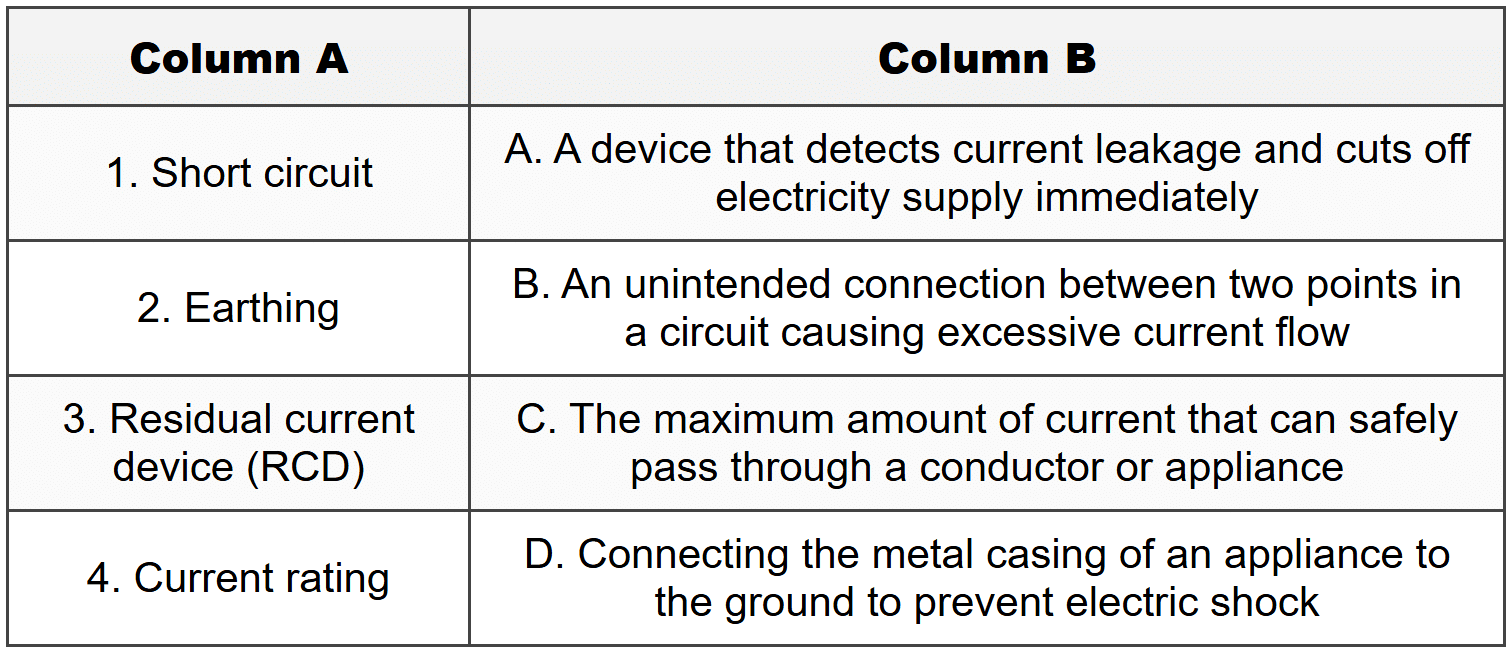
[4]
Section D: Fill in the Blanks
Use the words from the word bank below to complete the following sentences. Each word may be used only once.
Word Bank: conductor, insulator, electrocution, surge, grounded
Question 1
A material that does not allow electric current to pass through it easily is called an ________.
[1]
Question 2
________ is the term used to describe a fatal injury caused by electric shock.
[1]
Question 3
An appliance is properly ________ when its metal parts are connected to the earth wire.
[1]
Question 4
A sudden increase in voltage in an electrical circuit is called a power ________.
[1]
Section E: Short Questions
Question 1
Explain why electrical appliances with metal casings must have a three-pin plug with an earth connection.
[3]
Question 2
State two reasons why it is dangerous to use damaged electrical cords.
[2]
Question 3
Describe what you should do immediately if you see someone receiving an electric shock.
[3]
Question 4
Why is it important to switch off appliances at the wall socket and not just on the appliance itself?
[2]
Section F: Scenario Question
Sipho is helping his mother install a new electric kettle in their kitchen. He notices that the kettle has a three-pin plug with a thick green-and-yellow wire visible through a transparent section of the cord. His mother mentions that their old kettle only had a two-pin plug. Sipho is curious about why the new kettle is different and what the extra wire is for.
Question 1
What is the name and function of the green-and-yellow wire that Sipho observed?
[2]
Question 2
Explain why the new kettle with a metal casing requires a three-pin plug, while the old plastic kettle only needed a two-pin plug.
[3]
Question 3
If the live wire inside the kettle accidentally touches the metal casing, describe what will happen if the earth wire is properly connected.
[3]
Question 4
Sipho's mother warns him never to touch the kettle with wet hands. Analyse why this warning is important using your knowledge of conductors and human safety.
[4]
Section G: Long Question
Lerato's family has experienced several electrical problems at home recently. The lights flicker often, one of the wall sockets feels warm to the touch, and last week a fuse blew when too many appliances were plugged into a single multi-plug adapter. Lerato's father decides to call an electrician to inspect the house wiring.
Question 1
Identify and explain three potential electrical hazards present in Lerato's home based on the information given.
[6]
Question 2
The electrician tests the earth connections in the house and finds that several sockets do not have proper earthing. Explain in detail why proper earthing is a critical safety feature in household electrical systems.
[4]
Question 3
The electrician recommends installing a residual current device (RCD) in the main distribution board. Describe how an RCD works and explain why it provides better protection than a standard fuse alone.
[5]
Question 4
After the repairs, the electrician gives Lerato's family a list of electrical safety rules to follow at home. Evaluate the importance of the following rule: "Never use extension cords as permanent wiring solutions." Provide at least two reasons to support your evaluation.
[3]
Grand Total: [60]
---Answer Key
Well done for completing the worksheet! Before you check your answers, make sure you have attempted every question to the best of your ability. Use this answer key to mark your work carefully and to learn from any mistakes. Remember, making mistakes is part of learning!
Section A - Multiple Choice
Section A - Question 1
C. Rubber gloves
Rubber gloves are the correct answer because rubber is an excellent insulator, meaning it does not conduct electricity and will protect you from electric shock when handling wires. Copper, aluminium, and steel are all conductors and would allow electricity to pass through, putting you at risk.
Section A - Question 2
A. The plug is drawing too much current
When a plug draws too much current (more than it is designed to handle), resistance in the connections causes heating. This is a warning sign of overloading or a faulty connection, which can lead to electrical fires. The plug being made of plastic or the appliance being off would not cause heating.
Section A - Question 3
B. Fuse
A fuse is a safety device containing a thin wire that melts and breaks the circuit when too much current flows through it, preventing damage to appliances and reducing fire risk. A switch is manually operated, a resistor controls current flow, and a transformer changes voltage levels.
Section A - Question 4
A. Water is a good conductor of electricity and increases the risk of electric shock
Water, especially tap water containing dissolved minerals, conducts electricity well. When your hands are wet, electricity can easily flow through the water and into your body, causing a potentially fatal electric shock. This is why electrical safety always emphasizes keeping water away from electricity.
Section B - True or False
Section B - Question 1
TRUE
The earth wire is connected to the ground and provides a low-resistance path for fault currents to flow safely away from the user and into the earth, preventing electric shock.
Section B - Question 2
FALSE
Corrected statement: It is dangerous to overload a multi-plug adapter even when appliances are switched off, because the wiring can still overheat and cause a fire.
Even when appliances are off, plugging too many devices into one adapter creates too much resistance and can cause the wiring inside the adapter to overheat, potentially causing an electrical fire. The current rating of the adapter must never be exceeded.
Section B - Question 3
TRUE
A circuit breaker is a reusable switch-like device that trips (opens) when there is too much current and can be reset by flipping it back. A fuse, however, contains a wire that melts permanently and must be replaced with a new fuse of the correct rating.
Section B - Question 4
FALSE
Corrected statement: Frayed or damaged electrical cords must be replaced immediately and should never be repaired with tape, as they pose a serious shock and fire hazard.
Tape is not a safe insulator for damaged cords. Exposed wires can still cause electric shock, short circuits, or fires. The only safe solution is to replace the damaged cord completely or have it professionally repaired.
Section C - Match the Column
1. B - Short circuit: An unintended connection between two points in a circuit causing excessive current flow. A short circuit bypasses the normal load and allows huge amounts of current to flow, which causes overheating and can lead to fires or damaged components.
2. D - Earthing: Connecting the metal casing of an appliance to the ground to prevent electric shock. This ensures that if a live wire touches the casing, the current flows safely to earth instead of through a person's body.
3. A - Residual current device (RCD): A device that detects current leakage and cuts off electricity supply immediately. RCDs are very sensitive and can detect even tiny imbalances in current, switching off power in milliseconds to protect against electrocution.
4. C - Current rating: The maximum amount of current that can safely pass through a conductor or appliance. Exceeding the current rating causes overheating and potential fire hazards, which is why appliances and plugs have specific ratings marked on them.
Section D - Fill in the Blanks
Question 1: insulator
An insulator is a material that resists the flow of electric current, such as rubber, plastic, or glass. Insulators are used to cover wires and protect users from electric shock.
Question 2: Electrocution
Electrocution refers specifically to death caused by electric shock. The term comes from "electric execution" and is used when an electric shock is fatal.
Question 3: grounded
When an appliance is grounded, its metal parts are connected to the earth wire, ensuring that any fault current flows safely into the ground rather than through a person touching the appliance.
Question 4: surge
A power surge is a sudden, brief increase in voltage that can damage sensitive electronic equipment. Surges can be caused by lightning strikes, power outages, or large appliances switching on.
Section E - Short Questions
Section E - Question 1
Electrical appliances with metal casings need an earth connection because if a live wire accidentally touches the metal casing, the casing could become live and give someone an electric shock [1]. The earth wire provides a low-resistance path for the fault current to flow safely into the ground [1], and this surge of current will cause the fuse or circuit breaker to trip, cutting off the electricity supply and protecting the user [1].
Mark breakdown: explanation of risk [1] • function of earth wire [1] • protection mechanism [1]
Section E - Question 2
Two reasons why damaged electrical cords are dangerous:
• Exposed wires can cause electric shock if touched by a person [1]
• Exposed wires can create a short circuit, leading to sparks, overheating, and electrical fires [1]
Mark breakdown: one valid reason [1] • second valid reason [1]
Section E - Question 3
If you see someone receiving an electric shock, you must never touch them directly because the electricity can pass through their body into yours [1]. First, switch off the electricity supply at the mains or unplug the appliance if it is safe to do so [1]. If you cannot switch off the power, use a non-conducting object like a dry wooden broom handle to push the person away from the electrical source, then call for emergency medical help immediately [1].
Mark breakdown: do not touch [1] • switch off power [1] • use non-conductor or call for help [1]
Section E - Question 4
Switching off appliances at the wall socket completely disconnects them from the electrical supply [1], which prevents standby power consumption and eliminates the risk of electrical faults occurring in the appliance when it is not in use, reducing fire risk [1].
Mark breakdown: complete disconnection [1] • safety or energy reason [1]
Section F - Scenario Question
Section F - Question 1
The green-and-yellow wire is called the earth wire (or ground wire) [1]. Its function is to provide a safe path for fault current to flow into the ground, protecting the user from electric shock if a fault occurs inside the appliance [1].
Mark breakdown: correct name [1] • correct function [1]
Section F - Question 2
The new kettle has a metal casing, which can conduct electricity [1]. If a live wire inside the kettle breaks or touches the metal casing, the casing could become live and give someone a dangerous electric shock [1]. The earth wire in the three-pin plug connects the metal casing to the ground, so any fault current flows safely away and trips the fuse, protecting the user [1]. The old plastic kettle did not need earthing because plastic is an insulator and cannot conduct electricity, so there was no risk of the casing becoming live.
Mark breakdown: metal casing conducts [1] • risk of shock [1] • earth wire provides safety [1]
Section F - Question 3
If the live wire touches the metal casing and the earth wire is properly connected, the fault current will flow through the earth wire to the ground [1]. This creates a large surge of current in the circuit [1], which will cause the fuse to blow or the circuit breaker to trip, immediately cutting off the electricity supply and making the kettle safe [1].
Mark breakdown: current flows to earth [1] • large current surge [1] • fuse/breaker trips [1]
Section F - Question 4
Water is a good conductor of electricity, especially tap water which contains dissolved minerals and salts [1]. When Sipho's hands are wet, electricity can easily flow through the water on his skin into his body [1]. The human body also conducts electricity, and even a small current passing through the body can cause the heart to stop or muscles to contract uncontrollably [1]. Therefore, touching any electrical appliance with wet hands greatly increases the risk of a fatal electric shock, which is why this safety rule is critical [1].
Mark breakdown: water is a conductor [1] • electricity flows through water to body [1] • human body conducts electricity [1] • risk of fatal shock [1]
Section G - Long Question
Section G - Question 1
Three potential electrical hazards in Lerato's home:
1. Flickering lights: This suggests loose connections in the wiring or circuit, which can cause sparking and overheating, potentially leading to electrical fires [2].
2. Warm wall socket: A socket that feels warm indicates excessive current flow or poor connections, which means resistance is causing heat buildup. This is a serious fire hazard and suggests the socket or wiring is faulty or overloaded [2].
3. Blown fuse from overloading: Plugging too many appliances into one multi-plug adapter causes the total current to exceed the safe rating, which overheats the wiring and blew the fuse. Continued overloading could cause fires if the fuse does not blow in time [2].
Mark breakdown: hazard 1 identified and explained [2] • hazard 2 identified and explained [2] • hazard 3 identified and explained [2]
Section G - Question 2
Proper earthing is a critical safety feature because it protects people from electric shock [1]. If a fault occurs inside an appliance and a live wire touches the metal casing, the casing becomes live and dangerous [1]. When earthing is present, the fault current flows through the earth wire to the ground instead of through a person who touches the appliance [1]. This large current also causes the fuse or circuit breaker to trip immediately, cutting off the electricity supply and preventing injury or death [1].
Mark breakdown: protects from shock [1] • describes fault scenario [1] • current flows to earth [1] • fuse trips/power cut [1]
Section G - Question 3
A residual current device (RCD) continuously monitors the current flowing in the live wire and the current returning in the neutral wire [1]. In a normal circuit, these currents are equal [1]. If there is a current leakage (for example, through a person receiving a shock or through faulty insulation), the RCD detects the difference between the live and neutral currents [1]. The RCD responds extremely quickly (within milliseconds) and automatically cuts off the electricity supply [1]. An RCD provides better protection than a fuse alone because a fuse only responds to overcurrent or short circuits, not to small leakage currents that can still be fatal to humans, whereas an RCD can detect and respond to very small current imbalances [1].
Mark breakdown: monitors current balance [1] • currents normally equal [1] • detects leakage/difference [1] • cuts power quickly [1] • comparison with fuse [1]
Section G - Question 4
The rule "Never use extension cords as permanent wiring solutions" is very important for safety. First reason: Extension cords are designed for temporary use only and are not built to handle continuous current flow over long periods. Permanent use causes the cord to overheat, which degrades the insulation and increases the risk of short circuits and electrical fires [1.5]. Second reason: Extension cords often run across floors or under carpets, where they can be damaged by foot traffic, furniture, or heat buildup. Damaged cords expose live wires, creating serious shock and fire hazards. Permanent installations should always use proper fixed wiring that is safely enclosed and rated for continuous use [1.5].
Mark breakdown: first reason with explanation [1.5] • second reason with explanation [1.5]
Mark Allocation Summary
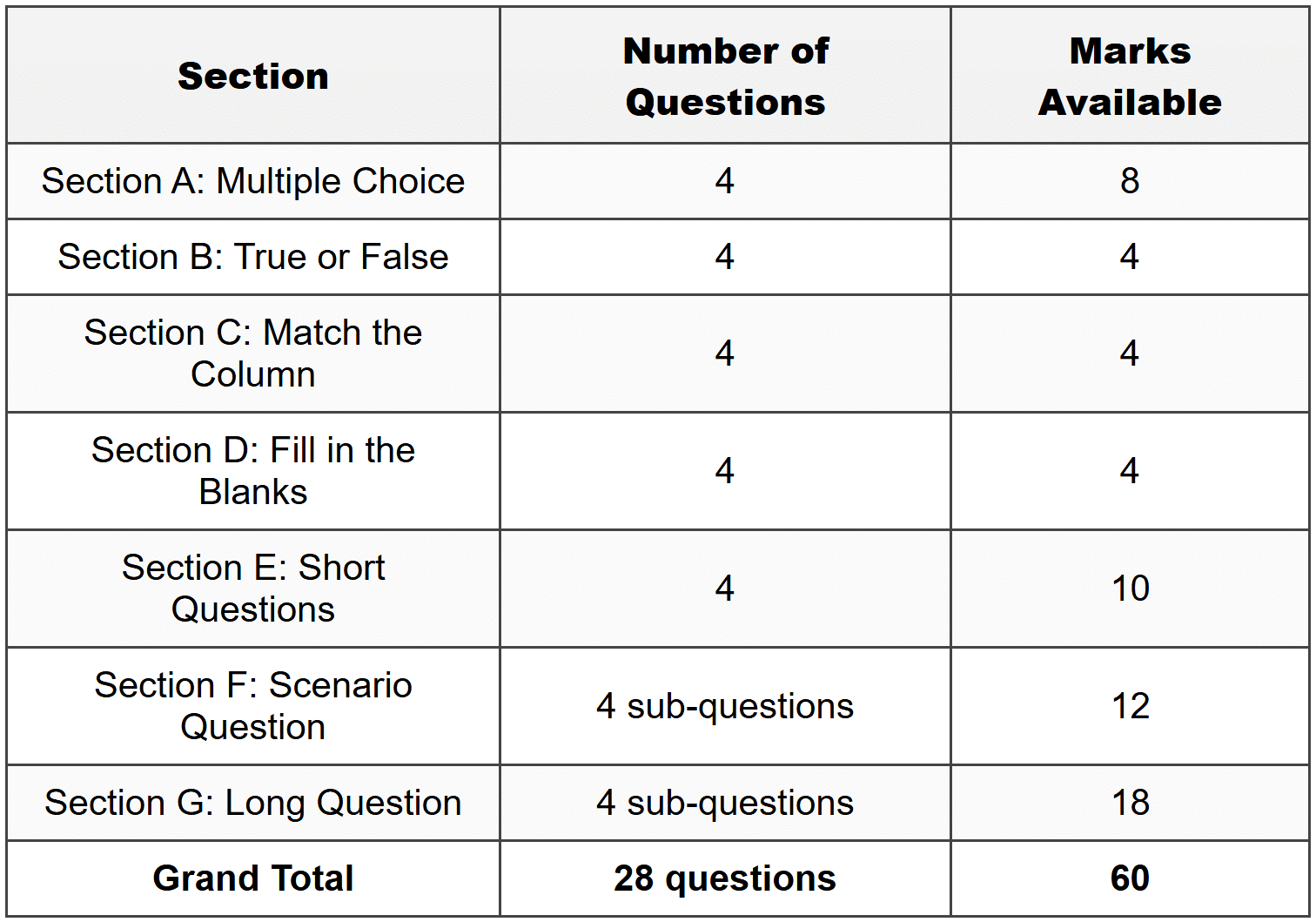
Remember to review any questions you got wrong and make sure you understand the correct answers. Electrical safety is not just about passing tests - it's about keeping yourself and others safe every day!




