Kurukshetra Summary: February 2026 - 2


Rural Sports For Community Well-Being
Overview
Sports are integral to India's vision of Viksit Bharat 2047, contributing to physical and mental well-being, youth empowerment, and social cohesion in rural areas. Beyond physical fitness, sports contribute significantly to mental well-being, discipline, teamwork, leadership, resilience, and social cohesion.
Infrastructure as the Foundation of Rural Sports
The development of rural stadiums and modern sports complexes is crucial to provide safe, standardised, and motivating spaces for training and competition. Such facilities should be designed as multi-sport complexes capable of supporting athletics, football, kabaddi, volleyball, wrestling, and other popular rural sports. A cluster-based and decentralised infrastructure model offers particular advantages-one well-equipped facility serves a group of neighbouring villages, supported by adequate transport connectivity.
Community-Based Sports and Drug De-Addiction
Community-based sports have emerged as an effective tool for addressing substance abuse among rural youth. In many regions, unemployment, seasonal migration, and limited recreational avenues create conditions that make young people vulnerable to drug and substance abuse. Organised sports offer a structured, healthy, and discipline-oriented alternative. Local sports clubs, village leagues, and mentorship initiatives involving trained coaches and respected role models further strengthen the impact.
Gender Inclusion and Girls' Participation
Ensuring gender inclusion is fundamental to equitable rural sports development. Girls in rural areas often face multiple barriers: restrictive social norms, safety concerns, domestic responsibilities, and absence of gender-sensitive facilities. Focused programmes should include girls-only training sessions, appointment of female coaches, and the creation of safe and accessible sports spaces. Flexible training schedules that accommodate educational and household responsibilities can further encourage participation.
Governance and Policy Initiatives
The Government of India has launched flagship programmes such as Khelo India, PYKKA, and the Nehru Yuva Kendra Sangathan to provide village- and block-level facilities, competitions, and youth engagement opportunities. In his Mann Ki Baat address on the Khelo Bharat Niti 2025, the Prime Minister underscored that 'villages, the poor, and daughters are the priority of the policy,' highlighting an integrated approach to grassroots sports, youth empowerment, and community well-being.
Integrating Sports with MNREGA
Integrating sports infrastructure development with schemes such as the Mahatma Gandhi National Rural Employment Guarantee Act (MNREGA) can generate employment while creating durable community assets. Activities like land levelling, drainage, boundary construction, and basic lighting can be supported under rural employment programmes. This approach embeds sports spaces within village planning processes and enhances cost-effectiveness.
Sports, Rural Youth, And Economic Development
Overview
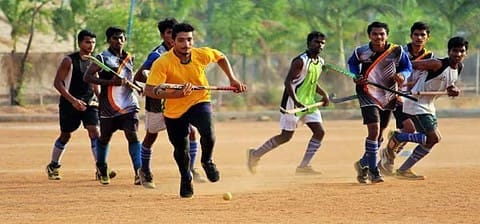
An integrated approach to rural sports development is essential to address persistent challenges such as poor infrastructure, limited coaching, uneven participation, and gender barriers, while positioning sport as a tool for public health and community development. In rural India, girls' participation in sport is still viewed as an exception rather than a norm.
Rural Girls, Employment Stress, and Policy Gaps
Rural India is home to nearly two-thirds of the country's adolescent girls, yet it records some of the lowest female labour force participation rates in the world. Survey data consistently show a sharp decline in women's participation after adolescence, particularly in rural areas where early marriage, unpaid domestic responsibilities, and health constraints limit economic engagement. National analyses suggest that persistently low levels of physical activity among women and girls could add more than INR 55 trillion in annual healthcare costs by 2047 if current trends continue.
Sports as an Economic Intervention
Reframing girls' participation in sport as an economic intervention rather than purely a social initiative allows its full developmental potential to be recognised. The economic effects operate through multiple pathways-delaying early marriage, improving health outcomes, building employable skills, and generating local livelihoods. Well-designed sports programmes can delay early marriage, improve health outcomes, build employable skills, and generate local livelihoods.
Women Coaches as Local Economic Anchors
Rural sport creates employment opportunities for women as coaches, trainers, referees, and physical education instructors. Female coaches play a critical role in enabling girls' participation by addressing safety concerns and negotiating social norms. Certified women coaches at block or district levels contribute to the sustainability of local sports ecosystems-earning regular incomes, gaining social recognition, and exercising leadership without needing to migrate to urban centres.
Global Perspectives
International evidence reinforces these findings. In sub-Saharan Africa, structured sport programmes for adolescent girls have been linked to reductions in teenage pregnancy and improvements in school retention. Kenya's Iten is widely recognised as the world's most prominent 'sports village.' Ethiopia's Bekoji has produced world-class long-distance runners including Tirunesh Dibaba, Genzebe Dibaba, and Kenenisa Bekele. These examples demonstrate how rural sporting ecosystems can generate sustained participation and economic opportunity when conditions are right.
Rural Olympics In India
Overview
India's rural landscape is rich with traditional sports and community games that have been played for centuries. Among the most iconic gatherings celebrating these games is the Rural Olympics-an annual festival of indigenous sports, strength competitions, and cultural performances. Unlike the international Olympics, India's Rural Olympics focus on sustaining rural sporting traditions, village pride, and heritage games deeply embedded in local life.
The Qila Raipur Sports Festival
The most famous Rural Olympics is held in Qila Raipur, a village near Ludhiana, Punjab. Known as the Qila Raipur Sports Festival, it is often referred to as India's Rural Olympics due to its scale, variety of events, and historical significance. The festival began in 1933 and has grown into one of India's largest rural sporting festivals, attracting thousands of participants and spectators. Held every year in late January or early February at the Grewal Sports Association grounds, the festival spans several days. Traditional events include bullock cart racing, camel races, tug-of-war, kabaddi, and tractor pulling, alongside feats of strength such as heavy tire lifting and rope climbing. Modern athletic competitions like track races, cycling, hockey, and kabaddi are also part of the festival.
Other Rural Sports Festivals
- Chhattisgarhi Olympics (Chhattisgarh): Statewide rural sports event featuring kabaddi, kho-kho, and traditional races, attracting millions of participants
- Local Festivals in Gujarat: Host rural Olympic-style competitions with rope pulling, running races, and indigenous games
- Isha Gramotsavam: Further encourages participation across multiple states, including women and youth, fostering rural talent and preserving traditional sports culture
Cultural Significance
The Rural Olympics is more than a sports event. It is a celebration of India's grassroots sporting heritage, a platform for showcasing rural strength, community spirit, and cultural pride. Qila Raipur's Rural Olympics is notable not only for competition but also for its celebration of rural identity and physical skill, while also preserving cultural traditions through folk music, dance, and local cuisine.
Rural Games On The Global Stage
Overview
India's rural games, once confined to village commons and seasonal gatherings, have evolved into globally recognised sports. Traditional rural games today are emerging as instruments of cultural diplomacy, grassroots talent development, and inclusive growth.
Kabaddi: From Village Strength Test to Global Sport
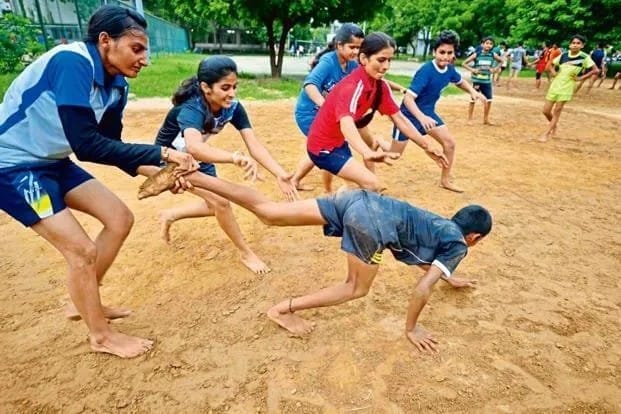
Kabaddi is perhaps the most prominent example of a rural Indian game achieving global stature. Its origins are widely traced to ancient India, with references in Sanskrit literature and associations drawn to the Vedic period (1500-500 BCE). A decisive moment in Kabaddi's globalisation came with the launch of the Pro Kabaddi League (PKL) in 2014, which transformed Kabaddi into a major televised sport. Today, Kabaddi is played in more than 50 countries across Asia, Africa, Europe, and the Americas. The Global Indian Pravasi Kabaddi League, launched in 2025, features teams with players from countries including Egypt, Germany, and Argentina, reflecting the role of diaspora communities in internationalising the sport.
Kho-Kho: A Traditional Chase Game Goes Worldwide
Kho-Kho originated as a simple chase-and-dodge game played in rural India, particularly in Maharashtra. Its formal journey began in 1914, when the Deccan Gymkhana Club in Pune standardised rules. A significant milestone was the inaugural Kho-Kho World Cup 2025 held in New Delhi, which saw participation from 23 countries across six continents. Kho-Kho is now played in over 60 countries across multiple continents.
Carrom: From Local Parlours to International Competition
Carrom represents a different but equally significant journey from local leisure activity to global competitive sport. Believed to have originated in the Indian subcontinent in the late nineteenth century. The spread of Carrom beyond India was significantly influenced by Indian diaspora communities, who carried the game to South Asia, the Middle East, Europe, and the United States. India hosted the World Carrom Championships in 1991 and 2000.
Other Indigenous Games Gaining Recognition
- Lagori (Seven Stones/Sitoliya Pitto): Ancient South Asian game with 5,000+ years of origins. Modernised through Indian Lagori Premiere League and World Cup events.
- Atya Patya: Indigenous tag sport traditionally played in rural areas during harvest seasons. Recognised by Government of India under indigenous sports categories.
Government & Institutional Support
The Khelo India Programme plays a central role in encouraging participation in indigenous games such as Kabaddi and Kho-Kho. Under the National Education Policy 2020, the Bharatiya Khel (Indian Games) initiative seeks to introduce traditional games into school curricula across the country. Seventy-five heritage games, including Kabaddi, Kho-Kho, and Seven Stones, have been incorporated into structured school programmes.
Mallakhamb: India's Enduring Tradition Of Strength
Overview
Mallakhamb is one of India's most distinctive traditional sports, representing a refined system of physical training rooted in indigenous knowledge and rural life. More than a display of strength or acrobatics, Mallakhamb reflects a long-standing tradition of disciplined body training that developed in India long before the advent of modern fitness systems.
Origins and History
The term Mallakhamb is derived from two Sanskrit words: Malla, meaning wrestler, and Khamb, meaning pole. The organised form of Mallakhamb took shape in the early eighteenth century in Maharashtra. It is commonly attributed to Balambhatta Deodhar, a physical trainer during the reign of Peshwa Bajirao II, who systematised the practice for structured training. Traditionally, Mallakhamb was practised in rural akharas, which served as centres for physical training and discipline.
Three Forms of Mallakhamb
- Pole Mallakhamb - most traditional and widely practised form
- Rope Mallakhamb - using a suspended rope
- Hanging Mallakhamb - combining aerial and static elements
Contemporary Significance
In contemporary times, Mallakhamb has evolved into an organised sport with formal rules, judging systems, and competitions at school, state, and national levels. The Mallakhamb Federation of India oversees its development and promotion. Mallakhamb is not merely a sport; it is a living heritage of India's traditional methods of physical training. Preserving and promoting it is essential to safeguarding indigenous knowledge systems.
Kalaripayattu: Traditional Rural Sports Heritage Of Kerala
Overview
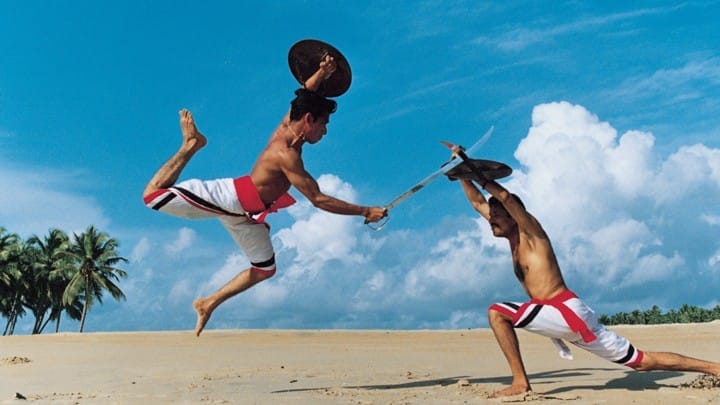
Kalaripayattu, the traditional martial art of Kerala, occupies a unique and respected position among India's indigenous rural sports practices. It originated and evolved in the rural landscape of Kerala where a kalari (training arena) was an earthen space constructed near villages or temples. These arenas were centres of learning where local masters known as Gurukkals trained village youth.
Characteristics and Values
One of the defining characteristics of Kalaripayattu is its practice with minimal resources-an earthen arena, simple wooden or metal weapons, and indigenous knowledge formed the foundation of training. There was no dependence on modern infrastructure or expensive equipment. This simplicity made the art accessible to rural communities and allowed it to flourish within village life. The training develops flexibility, balance, coordination, courage, and self-control-qualities that align with the philosophy of traditional rural sports.
Cultural Connection
Kalaripayattu is also deeply connected to Kerala's folk culture. The Vadakkan Pattukal, popular folk ballads of northern Kerala, narrate the heroic deeds of Kalaripayattu warriors. These stories were passed down orally through generations in rural communities and reflect the cultural and social importance of the art. Through these narratives, Kalaripayattu became an integral part of village identity and collective memory.
Modern Recognition
In the modern era, Kalaripayattu has been systematised and recognised as a traditional and indigenous sport. Formal rules, competitions, and scoring systems have been introduced, enabling its inclusion in organised sporting events at state, national, and international levels. Despite this transformation, the rural essence of Kalaripayattu remains intact-it is a living representation of India's rural sports heritage.
Viksit Bharat-G Ram G Act 2025: Reforming Rural Employment
Overview
The Viksit Bharat-Guarantee for Rozgar and Ajeevika Mission (Gramin) Act, 2025 marks a comprehensive statutory reform of MGNREGA, aligning rural employment with the vision of Viksit Bharat 2047. The VB-G RAM G Act, 2025 represents a comprehensive statutory overhaul of MGNREGA, aligning rural employment policy with the long-term vision of Viksit Bharat 2047, while strengthening accountability, infrastructure outcomes, and income security.
Key Features
- Enhanced Employment Guarantee: Expanded from 100 to 125 days of wage employment per rural household per financial year
- Agricultural Support: 60-day aggregate no-work period during peak sowing and harvesting seasons, ensuring adequate labour availability for farmers
- Focused Nature of Works: Four priority verticals: (i) Water security through water-related works, (ii) Core rural infrastructure, (iii) Livelihood-related infrastructure, (iv) Special works to mitigate extreme weather events
- Financial Architecture: Total estimated annual requirement of ₹1,51,282 crore; Central share of ₹95,692.31 crore; cost-sharing: 60:40 (Centre:States); 90:10 for NE & Himalayan States; 100% for UTs
- Digital Governance: AI-based monitoring, real-time MIS dashboards, weekly public disclosures, mandatory social audits every six months
- Decentralised Planning: Viksit Gram Panchayat Plans linked with national spatial platforms such as PM Gati Shakti
MGNREGA: Evolution and Structural Constraints
MGNREGA guaranteed at least 100 days of wage employment per rural household annually for unskilled manual work. Over time, several administrative and technological reforms strengthened its implementation. Women's participation rose steadily from 48% in FY 2013-14 to 58.15% in FY 2025-26. However, deeper structural issues persisted-monitoring across states revealed instances of works not found on the ground, mismatches between expenditure and physical progress, and bypassing of digital attendance systems.
Administrative & Accountability Reforms
The Act increases the administrative expenditure ceiling from 6% to 9%, enabling better staffing, remuneration, training, and technical capacity. A 5-level robust institutional structure ensures coordinated, accountable, and transparent implementation: Central and State Gramin Rozgar Guarantee Councils → National and State Steering Committees → Panchayati Raj Institutions → District Programme Coordinators → Gram Sabhas. The Government of India is empowered to investigate complaints, suspend fund releases in cases of serious irregularities, and direct corrective measures.
Social Protection
The Act establishes a comprehensive transparency framework across all stages of implementation. Social protection is strengthened through a mandatory unemployment allowance. If work is not provided within 15 days, a daily unemployment allowance becomes payable, with liability resting on the States.
Benefits for Rural Economy, Farmers and Labourers
By linking employment with productive asset creation, the Act strengthens the rural economy, raises household incomes, and enhances resilience. Priority to water-related works supports agriculture and groundwater recharge. Investments in roads and connectivity improve market access. Farmers benefit from assured labour availability during peak seasons, prevention of wage inflation, and improved irrigation, storage, and connectivity. Labourers gain from higher potential earnings through 125 days of guaranteed work and secure digital wage payments.
Comprehensive Policy Snapshot
Key Government Schemes Covered in This Issue
Scheme / Initiative | Key Purpose / Impact |
Khelo Bharat Niti 2025 (NSP 2025) | Comprehensive sports policy replacing NSP 2001; five pillars: global excellence, economic development, social inclusion, mass participation, education integration |
KIRTI | Khelo India Rising Talent Identification - scientific talent scouting for children aged 9-18 in rural, tribal, remote areas |
ASMITA | Achieving Sports Milestone by Inspiring Women Through Action - India's largest women-only sports league, 27 disciplines, 34 states |
TOPS | Target Olympic Podium Scheme - monthly stipend of ₹50,000 + foreign training + equipment for elite Olympic/Paralympic prospects |
PYKKA | Panchayat Yuva Krida aur Khel Abhiyan - village and block-level sports infrastructure and annual competitions |
Sansad Khel Mahotsav | MP-led initiative promoting fitness and sports from village to parliamentary constituency level |
Khelo India Centres (KICs) | 1,000+ centres across 750 districts converting schools, panchayat grounds, SAI extensions into training hubs |
VB-G RAM G Act, 2025 | Replaces MGNREGA; expands employment guarantee from 100 to 125 days; four priority work verticals; AI-based monitoring |
SAG Scheme | Special Area Games - SAI coaches identify and train talent from remote villages (wrestling, archery, cycling, boxing) |
Pro Kabaddi League (PKL) | Launched 2014; transformed Kabaddi into a major televised sport; hundreds of millions of viewers; global reach in 50+ countries |
FAQs on Kurukshetra Summary: February 2026 - 2
| 1. How do rural sports contribute to community well-being? |  |
| 2. What role do rural sports play in economic development? | |
| 3. What is the significance of rural Olympics in India? | |
| 4. Can you explain the traditional sport of Mallakhamb? | |
| 5. What is Kalaripayattu and its relevance to rural sports heritage in Kerala? | |




