Acids, bases and neutral substances


Section A: Multiple Choice
- Which part of the plant cell is responsible for photosynthesis? [1]
- Nucleus
- Chloroplast
- Mitochondria
- Cell membrane
- What is the primary function of the root system in plants? [1]
- Photosynthesis
- Reproduction
- Anchoring and absorbing water and nutrients
- Gas exchange
- Which tissue in plants is responsible for transporting water from the roots to the leaves? [1]
- Phloem
- Epidermis
- Xylem
- Cambium
- What type of plant reproduction involves seeds? [1]
- Vegetative propagation
- Budding
- Sexual reproduction
- Binary fission
Section B: True or False
- All plant cells have a cell wall made of cellulose. [1]
- Stomata are small openings found on the underside of leaves that allow for gas exchange. [1]
- The stem of a plant only provides support and has no role in transporting substances. [1]
- Pollination is the transfer of pollen from the anther to the stigma of a flower. [1]
Section C: Match the Column
Match each structure in Column A with its correct function in Column B. Write only the letter of the correct answer next to the number.
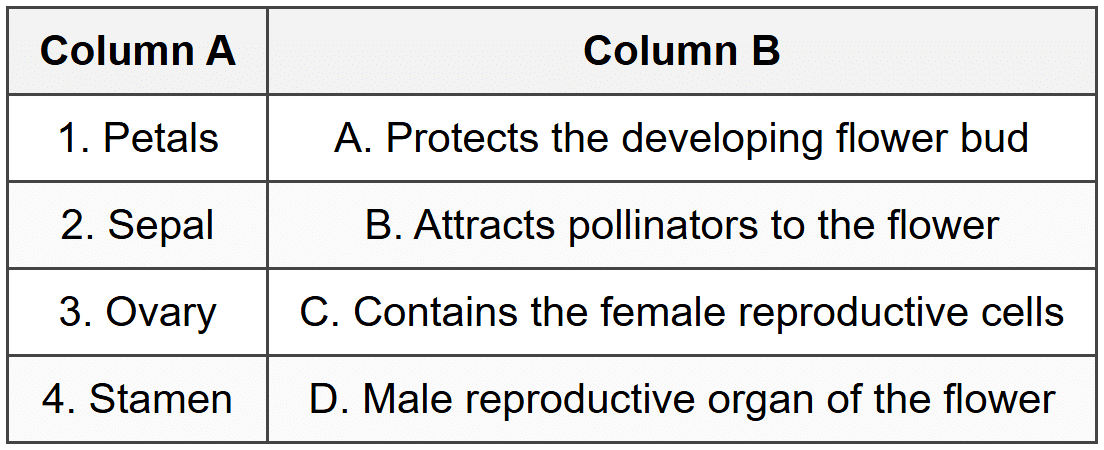
[4]
Section D: Fill in the Blanks
Word Bank: photosynthesis, chlorophyll, carbon dioxide, glucose
- The green pigment called ________ absorbs light energy during photosynthesis. [1]
- Plants use ________ from the air as a raw material to make food. [1]
- The process by which plants make their own food using sunlight is called ________. [1]
- During photosynthesis, plants produce a sugar called ________ which they use for energy. [1]
Section E: Short Questions
- Name two differences between xylem and phloem tissue in plants. [2]
- Explain why leaves are usually broad and flat in shape. [2]
- Describe one way in which seeds can be dispersed from the parent plant. [2]
- What is the role of the vacuole in a plant cell? [2]
Section F: Scenario Question
Thabo is investigating how plants respond to light. He places a potted plant near a window and observes it for one week. He notices that the plant stem begins to bend towards the window where sunlight enters the room.
- What is the name of the plant response that Thabo observed? [1]
- Explain why the plant stem bends towards the light source. [2]
- Predict what would happen if Thabo rotated the plant so that the bent stem faced away from the window. [2]
- Suggest why this response is important for the survival of plants. [2]
Section G: Long Question
Lerato wants to investigate which conditions are necessary for germination. She sets up four experiments using bean seeds:
- Set A: Seeds placed in a moist environment with warmth and air
- Set B: Seeds placed in a dry environment with warmth and air
- Set C: Seeds placed underwater with warmth
- Set D: Seeds placed in a moist environment in the refrigerator
After five days, only the seeds in Set A germinated successfully.
- Identify the three conditions necessary for germination based on Lerato's investigation. [3]
- Explain why the seeds in Set B did not germinate. [2]
- Explain why the seeds in Set C did not germinate even though water and warmth were present. [2]
- Evaluate Lerato's investigation. Was it a fair test? Justify your answer by referring to the control of variables. [3]
Grand Total: [50]
Answer Key
Well done for completing the worksheet! Before you check these answers, make sure you have attempted every question on your own. Use this answer key to check your understanding and learn from any mistakes. Remember, making mistakes is an important part of learning science!
Section A - Multiple Choice
Section A - Question 1
B. Chloroplast
Chloroplasts are the special structures inside plant cells that contain chlorophyll and carry out photosynthesis, converting light energy into chemical energy in the form of food.
Section A - Question 2
C. Anchoring and absorbing water and nutrients
The root system has two main jobs: it anchors the plant firmly in the soil so it doesn't fall over, and it absorbs water and dissolved minerals from the soil that the plant needs to survive and grow.
Section A - Question 3
C. Xylem
Xylem tissue is made up of long, hollow tubes that transport water and dissolved minerals upwards from the roots through the stem to all parts of the plant, including the leaves.
Section A - Question 4
C. Sexual reproduction
Sexual reproduction in plants involves the fusion of male and female reproductive cells, which leads to the formation of seeds that contain the embryo of a new plant.
Section B - True or False
Section B - Question 1
TRUE
Plant cells have a rigid cell wall made of cellulose that surrounds the cell membrane, giving the cell structure, support, and protection.
Section B - Question 2
TRUE
Stomata are tiny pores mostly found on the lower surface of leaves that open and close to allow carbon dioxide to enter for photosynthesis and oxygen and water vapour to exit.
Section B - Question 3
FALSE
Corrected statement: The stem of a plant provides support and also transports water, minerals, and food throughout the plant.
The original statement is incorrect because stems contain xylem and phloem tissues that transport substances between roots and leaves, so they have a very important transport function in addition to providing support.
Section B - Question 4
TRUE
Pollination is the process where pollen grains from the male part of the flower (anther) are transferred to the female part (stigma), which is necessary for fertilisation and seed formation.
Section C - Match the Column
1 - B
Petals are often brightly coloured and scented to attract insects, birds, and other pollinators to the flower.
2 - A
Sepals are usually green leaf-like structures that protect the delicate flower bud before it opens.
3 - C
The ovary is the swollen base of the female part of the flower that contains ovules, which hold the female reproductive cells (egg cells).
4 - D
The stamen consists of the anther and filament and is the male reproductive organ that produces pollen.
Section D - Fill in the Blanks
Section D - Question 1
chlorophyll
Chlorophyll is the green pigment found in chloroplasts that captures light energy needed for photosynthesis.
Section D - Question 2
carbon dioxide
Carbon dioxide is a gas that enters the leaf through stomata and is used as a raw material in the photosynthesis process.
Section D - Question 3
photosynthesis
Photosynthesis is the chemical process in which plants use sunlight, water, and carbon dioxide to produce glucose and oxygen.
Section D - Question 4
glucose
Glucose is a simple sugar produced during photosynthesis that provides energy for the plant's life processes and can be stored as starch.
Section E - Short Questions
Section E - Question 1
Two differences between xylem and phloem are:
• Xylem transports water and minerals upwards from roots to leaves, while phloem transports dissolved food (sugars) from leaves to all parts of the plant. (1 mark)
• Xylem cells are dead at maturity and have thick walls, while phloem cells are living and have thinner walls. (1 mark)
Section E - Question 2
Leaves are usually broad and flat to provide a large surface area for absorbing sunlight, which is needed for photosynthesis. (1 mark) The flat shape also allows carbon dioxide to reach all cells easily and helps with efficient gas exchange. (1 mark)
Section E - Question 3
Seeds can be dispersed by wind. (1 mark) For example, dandelion seeds have light, feathery structures that allow them to be carried away from the parent plant by the wind, reducing competition for resources. (1 mark)
(Other acceptable answers: animal dispersal, water dispersal, or explosive mechanism - with appropriate example and explanation.)
Section E - Question 4
The vacuole is a large fluid-filled sac in plant cells that stores water, dissolved sugars, salts, and waste products. (1 mark) It also helps to keep the cell firm and rigid by pushing against the cell wall, which provides support to the plant. (1 mark)
Section F - Scenario Question
Section F - Question 1
The plant response that Thabo observed is called phototropism. (1 mark)
Section F - Question 2
The plant stem bends towards the light because of a growth hormone called auxin that accumulates on the shaded side of the stem. (1 mark) This causes the cells on the shaded side to grow longer than those on the lit side, making the stem bend towards the light source. (1 mark)
Section F - Question 3
If Thabo rotated the plant so the bent stem faced away from the window, the plant would gradually bend back towards the light again. (1 mark) This is because the auxin would redistribute to the new shaded side, causing that side to grow more and turning the stem back towards the light source. (1 mark)
Section F - Question 4
This response is important for survival because plants need sunlight for photosynthesis to make food. (1 mark) By growing towards light, plants can maximize the amount of light their leaves receive, ensuring they produce enough glucose for energy and growth. (1 mark)
Section G - Long Question
Section G - Question 1
The three conditions necessary for germination are:
• Water/moisture (1 mark)
• Warmth/suitable temperature (1 mark)
• Oxygen/air (1 mark)
Section G - Question 2
The seeds in Set B did not germinate because they lacked water. (1 mark) Seeds need water to soften the seed coat, activate enzymes, and allow the embryo to begin growing and breaking through the seed. (1 mark)
Section G - Question 3
The seeds in Set C did not germinate because they were completely underwater and could not access oxygen. (1 mark) Seeds need oxygen for respiration, which provides the energy needed for the germination process and early growth. (1 mark)
Section G - Question 4
Lerato's investigation was a fair test because she changed only one variable at a time while keeping the others constant. (1 mark) For example, Set A and Set B differed only in moisture, Set A and Set C differed only in air availability, and Set A and Set D differed only in temperature. (1 mark) This allowed her to identify which specific condition was responsible for preventing germination in each case. (1 mark)
Mark Allocation Summary
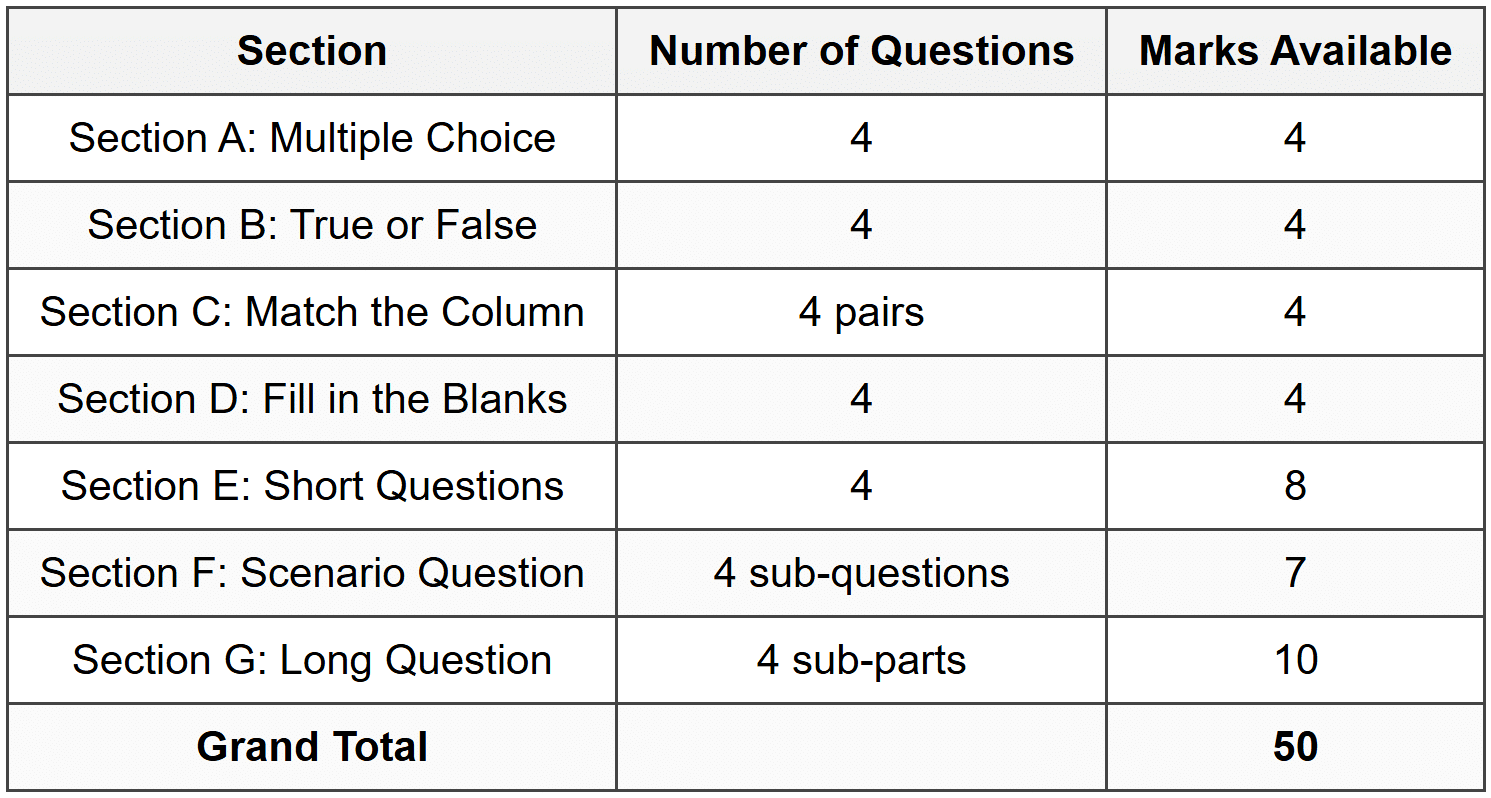
Remember: science is about understanding how the natural world works. If you didn't get full marks, use this answer key to see where you can improve. Keep asking questions and stay curious!




