Photosyntheses


Section A: Multiple Choice
Choose the correct answer for each question. Write only the letter (A-D) of your choice.
1. Which organ in the human body is responsible for pumping blood throughout the body? [1]
- A. Lungs
- B. Heart
- C. Stomach
- D. Liver
2. What type of blood vessel carries blood away from the heart? [1]
- A. Veins
- B. Capillaries
- C. Arteries
- D. Lymph vessels
3. Which component of blood is responsible for carrying oxygen to all parts of the body? [1]
- A. White blood cells
- B. Platelets
- C. Plasma
- D. Red blood cells
4. What is the function of valves in the heart? [1]
- A. To produce blood cells
- B. To prevent blood from flowing backwards
- C. To pump blood faster
- D. To filter waste from the blood
Section B: True or False
Write TRUE or FALSE for each statement.
1. The pulse you feel at your wrist is caused by blood flowing through veins. [1]
2. White blood cells help the body fight infections and diseases. [1]
3. The heart has two chambers called the left and right ventricles only. [1]
4. Capillaries are tiny blood vessels where oxygen and nutrients pass into body cells. [1]
Section C: Match the Column
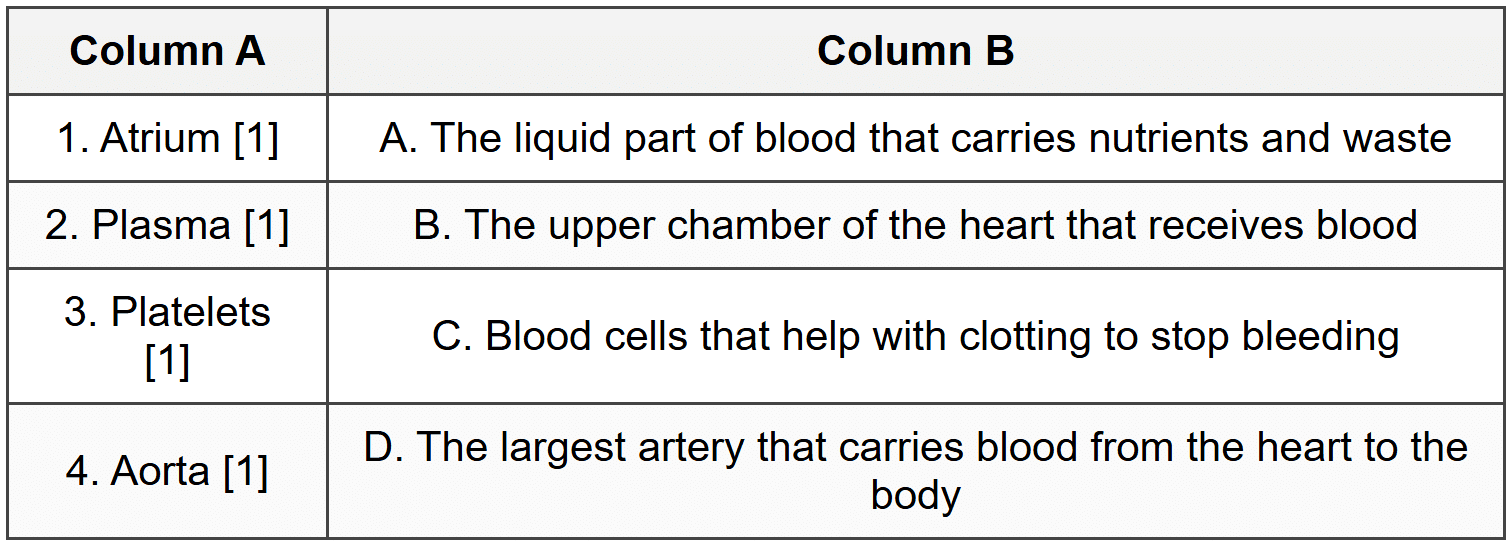
Match each item in Column A with the correct description in Column B. Write only the letter of your choice next to the number.
Section D: Fill in the Blanks
Use the words from the word bank below to complete the sentences. Each word may be used only once.
Word Bank: circulatory, ventricle, deoxygenated, stethoscope
1. The ________ system transports blood, oxygen, and nutrients throughout the body. [1]
2. The lower chamber of the heart that pumps blood out is called the ________. [1]
3. Blood that has delivered its oxygen to the cells and is returning to the heart is called ________ blood. [1]
4. A doctor uses a ________ to listen to the heartbeat. [1]
Section E: Short Questions
1. Name two waste products that the circulatory system helps remove from the body. [2]
2. Explain why the heart is described as a double pump. [2]
3. Describe one way a person can keep their circulatory system healthy. [2]
4. What happens to the heart rate when a person exercises? Explain why. [3]
Section F: Scenario Question
Thabo is a Grade 6 learner who enjoys playing soccer every afternoon. During a science lesson, his teacher explained how the circulatory system works and how it responds to physical activity. After soccer practice one day, Thabo noticed that his heart was beating much faster than when he was resting.
1. Name the instrument Thabo's teacher could use to measure his heartbeat. [1]
2. Explain why Thabo's heart rate increased during soccer practice. [2]
3. Identify which type of blood vessel delivers oxygen-rich blood to Thabo's leg muscles while he is playing soccer. [1]
4. After resting for 10 minutes, Thabo's heart rate returned to normal. Suggest why the body reduces heart rate after exercise stops. [3]
Section G: Long Question
The human circulatory system is essential for survival. It works continuously to deliver oxygen and nutrients to every cell in the body and to remove waste products.
1. Draw a simple labelled diagram of the human heart showing the four chambers. [4]
2. Describe the journey of a red blood cell from the moment it picks up oxygen in the lungs until it delivers that oxygen to a muscle cell in the arm. [5]
3. Evaluate why a blockage in a coronary artery (an artery that supplies blood to the heart muscle itself) is dangerous to a person's health. [3]
4. Conclude by explaining how regular exercise benefits the heart and circulatory system in the long term. [3]
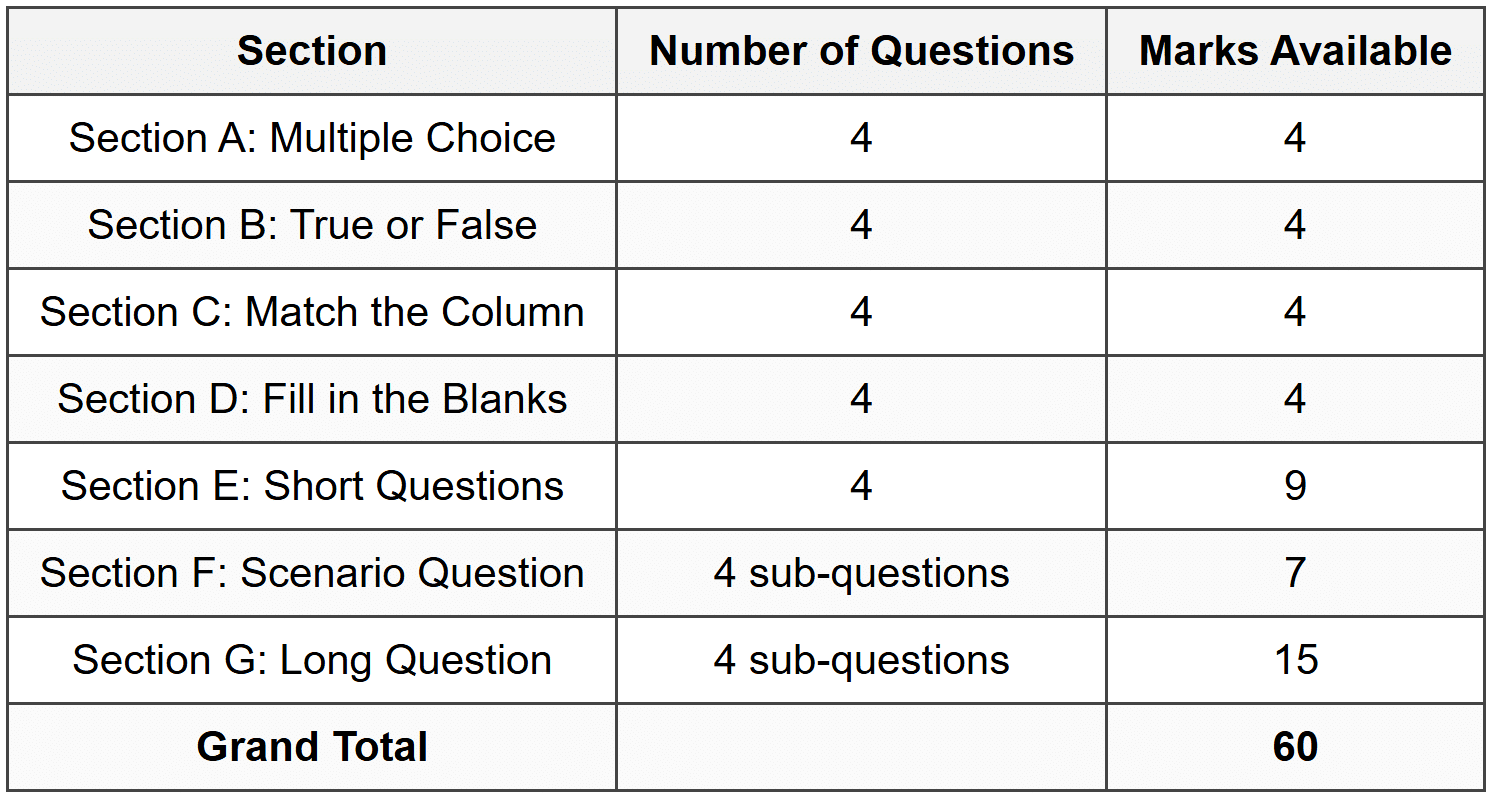
Grand Total: [60]
Answer Key
Well done for completing the worksheet! Before you check your answers, make sure you have attempted every question to the best of your ability. Use this answer key to mark your work carefully and learn from any mistakes. Remember, making mistakes is part of learning!
Section A - Multiple Choice
Section A - Question 1
Answer: B. Heart
The heart is a muscular organ that pumps blood throughout your entire body, delivering oxygen and nutrients to all your cells.
Section A - Question 2
Answer: C. Arteries
Arteries are strong, thick-walled blood vessels that carry blood away from the heart to the rest of the body under high pressure.
Section A - Question 3
Answer: D. Red blood cells
Red blood cells contain a special protein called haemoglobin which binds to oxygen in the lungs and carries it to every part of your body.
Section A - Question 4
Answer: B. To prevent blood from flowing backwards
Valves in the heart act like one-way doors, making sure that blood flows in the correct direction and does not flow back into the chamber it just left.
Section B - True or False
Section B - Question 1
Answer: FALSE
Correction: The pulse you feel at your wrist is caused by blood flowing through arteries, not veins.
The pulse is the wave of pressure that travels through the arteries each time the heart beats and pushes blood out. Veins carry blood back to the heart at lower pressure, so you do not feel a pulse in them.
Section B - Question 2
Answer: TRUE
White blood cells are part of your immune system. They defend your body against germs, bacteria, and viruses that can make you sick.
Section B - Question 3
Answer: FALSE
Correction: The heart has four chambers: two atria (upper chambers) and two ventricles (lower chambers).
The left and right ventricles are the lower chambers that pump blood out of the heart, but the heart also has two upper chambers called atria that receive blood coming into the heart.
Section B - Question 4
Answer: TRUE
Capillaries are the smallest blood vessels with very thin walls. This allows oxygen, nutrients, and waste products to pass between the blood and the body cells easily.
Section C - Match the Column
Section C - Question 1
Answer: B - Atrium: The upper chamber of the heart that receives blood.
The atria (plural of atrium) collect blood returning to the heart before it is pumped into the ventricles.
Section C - Question 2
Answer: A - Plasma: The liquid part of blood that carries nutrients and waste.
Plasma is the yellowish liquid in which blood cells float. It transports dissolved nutrients, hormones, and waste products like carbon dioxide.
Section C - Question 3
Answer: C - Platelets: Blood cells that help with clotting to stop bleeding.
When you get a cut, platelets rush to the site and stick together to form a clot that seals the wound and stops blood loss.
Section C - Question 4
Answer: D - Aorta: The largest artery that carries blood from the heart to the body.
The aorta is the main artery that leaves the left ventricle and branches out to supply oxygenated blood to all parts of the body.
Section D - Fill in the Blanks
Section D - Question 1
Answer: circulatory
The circulatory system is the body system made up of the heart, blood vessels, and blood that works together to transport substances around the body.
Section D - Question 2
Answer: ventricle
The ventricles are the lower chambers of the heart with thick muscular walls designed to pump blood out to the lungs and the rest of the body.
Section D - Question 3
Answer: deoxygenated
Deoxygenated blood is blood that has released its oxygen to the cells and is now carrying carbon dioxide back to the heart and lungs to be refreshed.
Section D - Question 4
Answer: stethoscope
A stethoscope is a medical instrument that doctors and nurses use to listen to the sounds made by your heart and lungs.
Section E - Short Questions
Section E - Question 1
Model Answer: Two waste products the circulatory system helps remove are carbon dioxide (1 mark) and urea (1 mark). Carbon dioxide is carried in the blood to the lungs where it is breathed out, and urea is carried to the kidneys to be removed in urine.
Section E - Question 2
Model Answer: The heart is called a double pump because it pumps blood to two different places (1 mark). The right side pumps deoxygenated blood to the lungs, and the left side pumps oxygenated blood to the rest of the body (1 mark).
Section E - Question 3
Model Answer: A person can keep their circulatory system healthy by doing regular physical exercise such as running, swimming, or cycling (1 mark). Exercise strengthens the heart muscle and improves blood flow (1 mark). (Other acceptable answers include eating a balanced diet low in fat and salt, not smoking, or drinking enough water.)
Section E - Question 4
Model Answer: When a person exercises, their heart rate increases (1 mark). This happens because the muscles are working harder and need more oxygen and glucose for energy (1 mark). The heart pumps faster to deliver more oxygenated blood to the muscles and to remove carbon dioxide and other wastes more quickly (1 mark).
Section F - Scenario Question
Section F - Question 1
Model Answer: Thabo's teacher could use a stethoscope to measure his heartbeat (1 mark). Alternatively, measuring the pulse at the wrist or neck can also be used to count heart rate.
Section F - Question 2
Model Answer: Thabo's heart rate increased during soccer practice because his muscles needed more oxygen and energy to keep moving and playing (1 mark). His heart pumped faster to deliver more oxygenated blood to his muscles and to remove waste products like carbon dioxide more quickly (1 mark).
Section F - Question 3
Model Answer: Arteries deliver oxygen-rich blood to Thabo's leg muscles while he is playing soccer (1 mark). Arteries carry blood away from the heart under high pressure to all parts of the body.
Section F - Question 4
Model Answer: After exercise stops, the body no longer needs as much oxygen and energy as it did during activity (1 mark). The muscles are resting and producing less carbon dioxide, so the heart does not need to pump as fast (1 mark). The body naturally slows the heart rate back to normal to conserve energy and return to a resting state (1 mark).
Section G - Long Question
Section G - Question 1
Model Answer: Your diagram should show a simple heart with four chambers clearly labelled (1 mark each for correct labels):
• Right atrium (upper right chamber)
• Left atrium (upper left chamber)
• Right ventricle (lower right chamber)
• Left ventricle (lower left chamber)
The diagram should be neat and the labels should point clearly to the correct chambers.
Section G - Question 2
Model Answer (5 marks total):
The red blood cell picks up oxygen in the lungs at the tiny capillaries surrounding the air sacs (1 mark). It then travels through the pulmonary vein back to the left atrium of the heart (1 mark). From the left atrium, it moves into the left ventricle, which pumps it out through the aorta (1 mark). The aorta branches into smaller arteries that carry the blood toward the arm (1 mark). Finally, the red blood cell enters tiny capillaries in the arm muscle, where oxygen is released into the muscle cells (1 mark).
Section G - Question 3
Model Answer (3 marks total):
A blockage in a coronary artery is very dangerous because the heart muscle itself needs a constant supply of oxygen and nutrients to keep beating (1 mark). If the coronary artery is blocked, part of the heart muscle does not get enough blood and oxygen, and those cells can die (1 mark). This is called a heart attack, and it can cause the heart to stop working properly or even stop completely, which is life-threatening (1 mark).
Section G - Question 4
Model Answer (3 marks total):
Regular exercise benefits the heart and circulatory system in the long term because it makes the heart muscle stronger (1 mark). A stronger heart can pump more blood with each beat, so it does not have to beat as often, which means it works more efficiently (1 mark). Exercise also helps keep blood vessels healthy and flexible, reduces the risk of blockages, and improves overall fitness and stamina (1 mark).
Mark Allocation Summary Table