Electric Circuits


Section A: Multiple Choice
Choose the correct answer for each question. Write only the letter (A-D) of your answer.
What is the main function of chlorophyll in a plant? [1]
- A) To transport water from roots to leaves
- B) To absorb light energy for photosynthesis
- C) To store food for the plant
- D) To protect the plant from insects
Which gas do plants release during photosynthesis? [1]
- A) Carbon dioxide
- B) Nitrogen
- C) Oxygen
- D) Hydrogen
Where does photosynthesis mainly take place in a plant? [1]
- A) In the roots
- B) In the stem
- C) In the leaves
- D) In the flowers
Which of the following is a product of photosynthesis? [1]
- A) Water
- B) Glucose
- C) Carbon dioxide
- D) Soil minerals
Section B: True or False
Read each statement carefully. Write TRUE if the statement is correct or FALSE if it is incorrect.
- Plants need sunlight, water, and carbon dioxide to make their own food. [1]
- Photosynthesis can happen at night without any light. [1]
- The green colour of leaves is caused by a substance called chlorophyll. [1]
- During photosynthesis, plants take in oxygen from the air. [1]
Section C: Match the Column
Match each term in Column A with the correct description in Column B. Write only the letter of your answer next to the number.
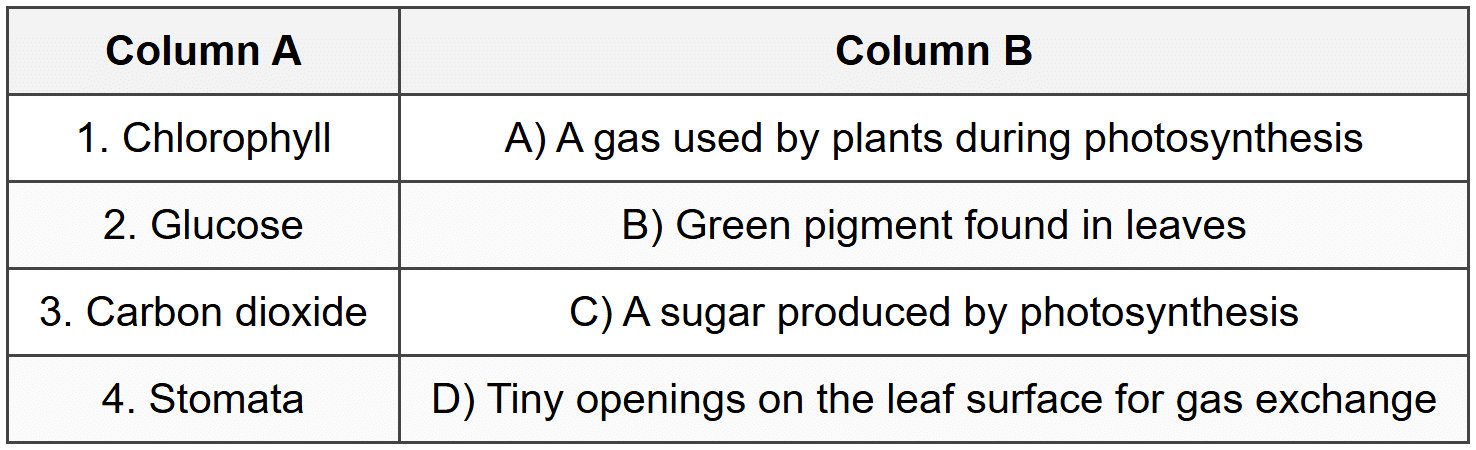
[4]
Section D: Fill in the Blanks
Complete each sentence by filling in the missing word from the word bank below.
Word Bank: energy, photosynthesis, oxygen, leaves
- The process by which plants make their own food is called ________. [1]
- Plants absorb light ________ from the sun to make food. [1]
- Most photosynthesis happens in the ________ of a plant. [1]
- Plants give off ________ gas during photosynthesis, which animals need to breathe. [1]
Section E: Short Questions
Answer each question in one to three sentences.
- Name three raw materials that plants need for photosynthesis. [3]
- Explain why plants are called producers in a food chain. [2]
- What would happen to a plant if it did not receive any sunlight for several weeks? [2]
- Why do most leaves appear green in colour? [2]
Section F: Scenario Question
Thabo is conducting an experiment in his school garden. He places one potted plant in a dark cupboard and another identical plant on the windowsill where it receives plenty of sunlight. Both plants are watered equally every day. After two weeks, Thabo observes that the plant in the cupboard has pale, yellow leaves and looks weak, while the plant on the windowsill has healthy, green leaves.
- What process was the plant in the cupboard unable to carry out properly? [1]
- Explain why the leaves of the plant in the cupboard turned pale and yellow. [2]
- What does this experiment show about the importance of light for plants? [2]
- Predict what would happen if Thabo moved the plant from the cupboard back into the sunlight and continued to water it. [2]
Section G: Long Question
Amahle wants to investigate how the amount of light affects the rate of photosynthesis in a water plant called Elodea. She places sprigs of the plant in three beakers of water and puts them at different distances from a lamp. She counts the number of oxygen bubbles released by each plant in five minutes.
- Identify the independent variable and the dependent variable in Amahle's investigation. [2]
- Why is it important for Amahle to use the same type of plant and the same amount of water in each beaker? [2]
- Amahle observes that the plant closest to the lamp produces the most bubbles. Explain why this result supports the idea that light is necessary for photosynthesis. [3]
- Suggest one way Amahle could improve her investigation to make her results more reliable. [2]
Grand Total: [50]
Answer Key
Well done for completing the worksheet! Before you check your answers, make sure you have attempted every question. Use this answer key to mark your work carefully and learn from any mistakes. Remember, making mistakes is an important part of learning!
Section A - Multiple Choice
Section A - Question 1
Answer: B - To absorb light energy for photosynthesis
Chlorophyll is the green pigment in leaves that captures light energy from the sun, which the plant uses to make food during photosynthesis.
Section A - Question 2
Answer: C - Oxygen
During photosynthesis, plants take in carbon dioxide and release oxygen as a waste product. This oxygen is what we breathe in.
Section A - Question 3
Answer: C - In the leaves
Leaves contain chlorophyll and have a large surface area to absorb sunlight, making them the main site of photosynthesis in most plants.
Section A - Question 4
Answer: B - Glucose
Glucose is a type of sugar that plants produce during photosynthesis. It is used as food to provide energy for growth and other life processes.
Section B - True or False
Section B - Question 1
TRUE
This statement is correct because sunlight provides energy, water supplies hydrogen, and carbon dioxide provides carbon for the plant to make glucose.
Section B - Question 2
FALSE
Corrected statement: Photosynthesis cannot happen at night without light, because plants need light energy to carry out the process.
Photosynthesis requires light energy to convert carbon dioxide and water into glucose and oxygen, so it cannot occur in complete darkness.
Section B - Question 3
TRUE
Chlorophyll is the green pigment found in the chloroplasts of plant cells, and it gives leaves their green colour.
Section B - Question 4
FALSE
Corrected statement: During photosynthesis, plants take in carbon dioxide from the air, not oxygen.
Plants absorb carbon dioxide through tiny pores called stomata and release oxygen as a by-product of photosynthesis.
Section C - Match the Column
Section C
- 1 - B: Chlorophyll is the green pigment found in leaves that absorbs light energy for photosynthesis.
- 2 - C: Glucose is a sugar produced during photosynthesis and serves as food for the plant.
- 3 - A: Carbon dioxide is a gas that plants absorb from the air and use as a raw material in photosynthesis.
- 4 - D: Stomata are tiny openings, mainly on the underside of leaves, that allow gases like carbon dioxide and oxygen to move in and out of the plant.
Section D - Fill in the Blanks
Section D - Question 1
Answer: photosynthesis
Photosynthesis is the name of the process by which green plants make their own food using sunlight, water, and carbon dioxide.
Section D - Question 2
Answer: energy
Light energy from the sun is absorbed by chlorophyll and is used to power the chemical reactions in photosynthesis.
Section D - Question 3
Answer: leaves
Leaves are specially adapted with a large surface area and contain chloroplasts where photosynthesis takes place.
Section D - Question 4
Answer: oxygen
Oxygen is released by plants during photosynthesis and is essential for animals and humans to breathe.
Section E - Short Questions
Section E - Question 1
Model Answer: The three raw materials that plants need for photosynthesis are sunlight, water, and carbon dioxide.
Mark breakdown:
- Sunlight [1]
- Water [1]
- Carbon dioxide [1]
Section E - Question 2
Model Answer: Plants are called producers because they can make their own food through photosynthesis. They do not need to eat other organisms, and they provide food for other living things in the food chain.
Mark breakdown:
- Explanation that plants make their own food [1]
- Reference to them being the source of food for others or start of the food chain [1]
Section E - Question 3
Model Answer: If a plant did not receive any sunlight for several weeks, it would not be able to carry out photosynthesis. This means it could not make food, so it would become weak, stop growing, and eventually die.
Mark breakdown:
- Cannot carry out photosynthesis / cannot make food [1]
- Would weaken, stop growing, or die [1]
Section E - Question 4
Model Answer: Most leaves appear green because they contain a pigment called chlorophyll, which absorbs red and blue light but reflects green light.
Mark breakdown:
- Mention of chlorophyll [1]
- Explanation that it reflects green light or absorbs other colours [1]
Section F - Scenario Question
Section F - Question 1
Answer: The plant in the cupboard was unable to carry out photosynthesis properly.
Without light, the plant cannot produce the energy needed to make food.
Section F - Question 2
Model Answer: The leaves turned pale and yellow because chlorophyll needs light to function and remain green. Without light, the chlorophyll breaks down and is not replaced, so the leaves lose their green colour and cannot photosynthesise.
Mark breakdown:
- Chlorophyll breaks down or is not produced without light [1]
- This causes leaves to lose green colour / turn yellow [1]
Section F - Question 3
Model Answer: This experiment shows that light is essential for photosynthesis. Without light, plants cannot make food and their health declines, as shown by the weak, yellow leaves of the plant kept in darkness.
Mark breakdown:
- Light is necessary/essential for photosynthesis [1]
- Reference to evidence from the experiment (weak plant in dark vs healthy in light) [1]
Section F - Question 4
Model Answer: If Thabo moved the plant back into the sunlight and watered it, the plant would likely recover. It would begin to produce chlorophyll again, the leaves would turn green, and the plant would start photosynthesising and growing normally.
Mark breakdown:
- Plant would recover / improve [1]
- Leaves would turn green again / plant would photosynthesise [1]
Section G - Long Question
Section G - Question 1
Model Answer:
- Independent variable: The distance of the plant from the lamp (or the amount/intensity of light).
- Dependent variable: The number of oxygen bubbles produced (or the rate of photosynthesis).
Mark breakdown:
- Correct independent variable [1]
- Correct dependent variable [1]
Section G - Question 2
Model Answer: It is important to use the same type of plant and the same amount of water in each beaker to ensure a fair test. This means that the only thing changing is the amount of light, so any difference in results is due to light and not other factors.
Mark breakdown:
- To make the test fair / control variables [1]
- So that only light varies and affects the results [1]
Section G - Question 3
Model Answer: The plant closest to the lamp receives the most light energy, which allows it to carry out photosynthesis faster. This produces more oxygen bubbles. This result supports the idea that light is necessary for photosynthesis because when more light is available, the rate of photosynthesis increases.
Mark breakdown:
- More light = more photosynthesis / faster rate [1]
- More oxygen is produced as a result [1]
- Shows light is essential for photosynthesis [1]
Section G - Question 4
Model Answer: Amahle could repeat the experiment several times and calculate an average number of bubbles for each distance. This would make her results more reliable by reducing the effect of any unusual results or errors.
Alternative improvements include: using a larger sample of plants, measuring light intensity with a meter, or keeping temperature constant.
Mark breakdown:
- Suggestion of repeating/averaging or increasing sample size [1]
- Explanation of why this improves reliability [1]
Mark Allocation Summary
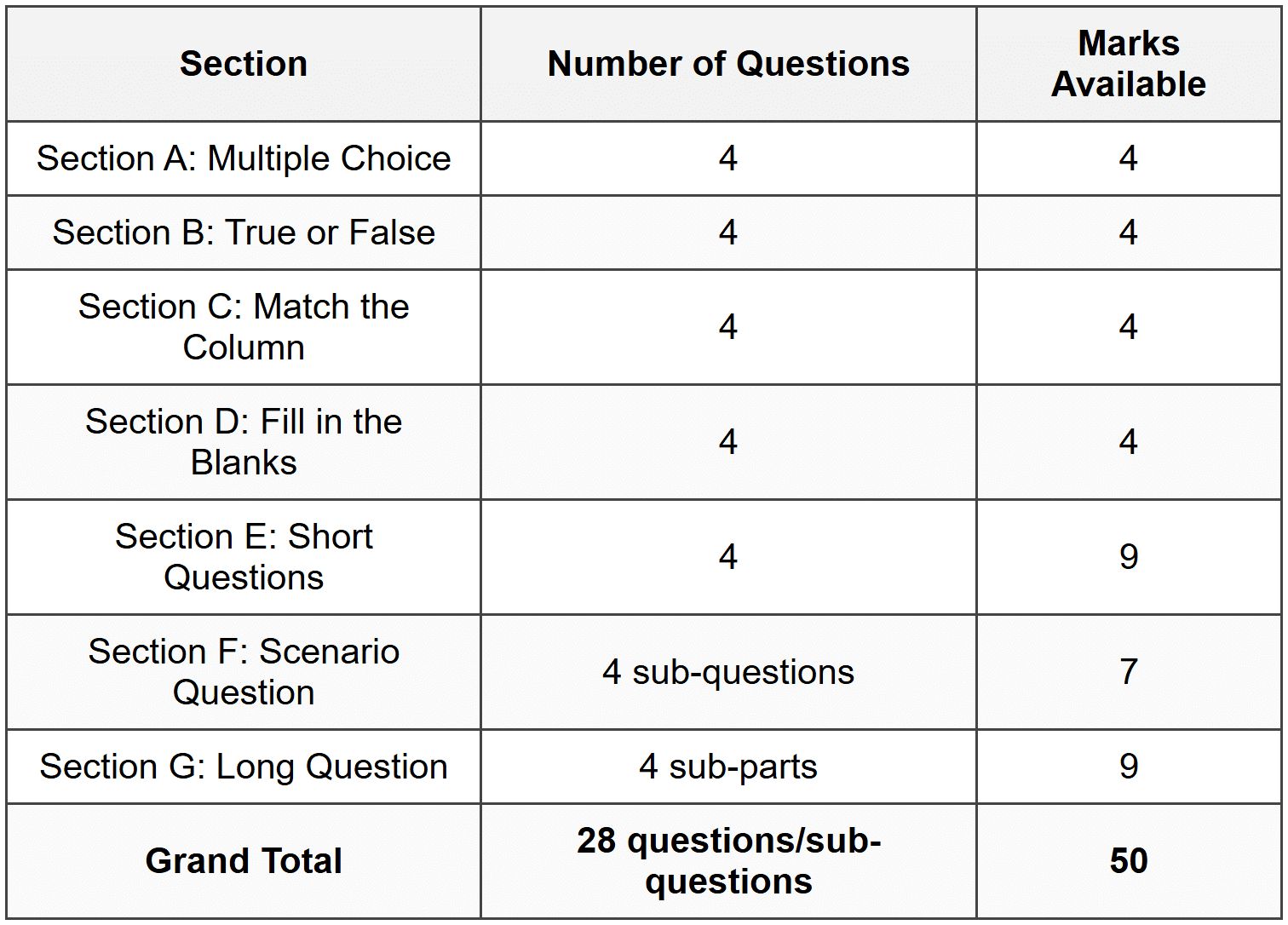
Remember to review any questions you got wrong and make sure you understand the correct answers. Keep up the great work!