Acids, bases and neutral substances


Section A: Multiple Choice
Choose the correct answer from the options provided. Write only the letter of your choice.
1. What is the main function of the lungs in the human body? [1]
- A. To pump blood around the body
- B. To exchange oxygen and carbon dioxide
- C. To digest food
- D. To remove solid waste
2. Which part of the respiratory system contains tiny air sacs where gas exchange takes place? [1]
- A. Trachea
- B. Bronchi
- C. Alveoli
- D. Diaphragm
3. What happens to the diaphragm when you breathe in? [1]
- A. It moves upwards and relaxes
- B. It moves downwards and contracts
- C. It stays in the same position
- D. It stops working temporarily
4. Which gas do humans breathe out as a waste product? [1]
- A. Oxygen
- B. Nitrogen
- C. Carbon dioxide
- D. Hydrogen
Section B: True or False
Read each statement carefully and decide whether it is TRUE or FALSE.
1. The trachea is also known as the windpipe. [1]
2. When you exhale, your rib cage moves outwards. [1]
3. The bronchi are two tubes that branch off from the trachea into each lung. [1]
4. Smoking damages the cilia in the respiratory system. [1]
Section C: Match the Column
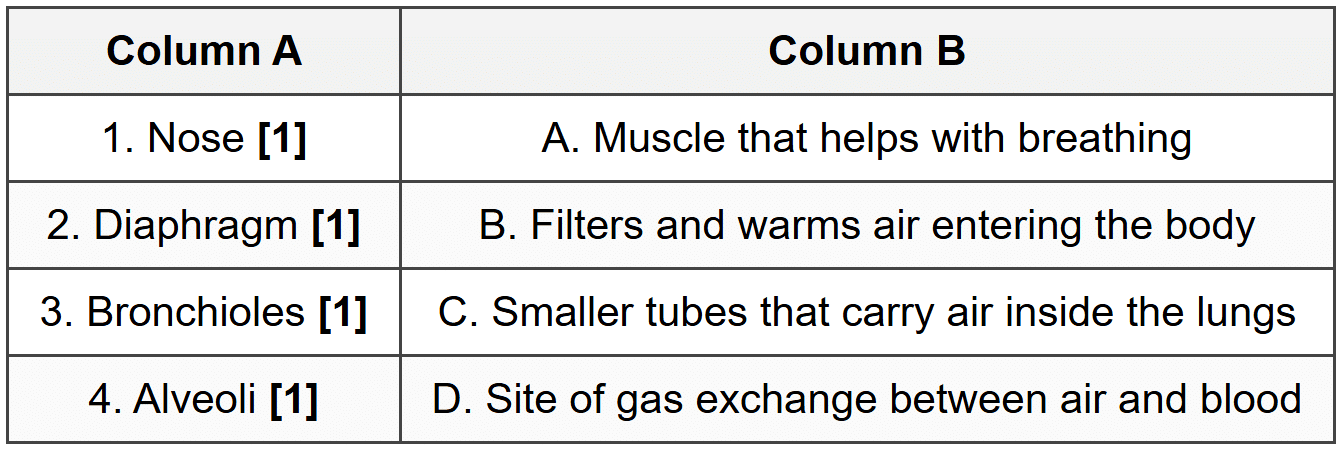
Match each part of the respiratory system in Column A with its correct function in Column B. Write only the letter of the correct match.
Section D: Fill in the Blanks
Complete each sentence by filling in the missing word from the word bank below.
Word Bank: respiration, intercostal, mucus, oxygen
1. The process of breathing in and out is called ________. [1]
2. ________ is the gas that is absorbed into the blood from the air in the lungs. [1]
3. The ________ muscles are found between the ribs and help move the rib cage during breathing. [1]
4. ________ traps dust and germs in the airways to protect the lungs. [1]
Section E: Short Questions
Answer each question in one to three sentences.
1. Describe the path air takes from the nose to the lungs. [3]
2. Explain why it is important for the body to remove carbon dioxide. [2]
3. Why do people breathe faster during exercise? [2]
4. Name two ways the respiratory system protects itself from harmful particles. [2]
Section F: Scenario Question
Thandi is a Grade 6 learner who enjoys playing netball. During a match, she notices that her breathing becomes much faster and deeper than when she is sitting in class.
1. What are the two main gases involved in breathing? [2]
2. Explain why Thandi's breathing rate increases during the netball match. [3]
3. What happens to the size of Thandi's chest cavity when she breathes in deeply? [2]
4. Suggest one reason why Thandi should not play netball if she has a serious chest infection. [2]
Section G: Long Question
Sipho conducted an investigation to measure how exercise affects breathing rate. He counted the number of breaths he took per minute while resting, and then again immediately after running for 3 minutes.
Results:
- Breathing rate at rest: 16 breaths per minute
- Breathing rate after exercise: 32 breaths per minute
1. Calculate by how much Sipho's breathing rate increased after exercise. [2]
2. Explain why the body needs more oxygen during exercise. [3]
3. Describe what happens inside the alveoli that allows oxygen to enter the blood. [3]
4. Evaluate whether Sipho's investigation was fair. Suggest one way he could improve his investigation. [3]
Grand Total: [50]
Answer Key
Well done for completing the worksheet! Before you check your answers, make sure you have attempted every question. Use this answer key to mark your work carefully and learn from any mistakes. Remember, making mistakes is part of learning!
Section A - Multiple Choice
Section A - Question 1
Answer: B. To exchange oxygen and carbon dioxide
The lungs are responsible for taking in oxygen from the air we breathe and removing carbon dioxide from the blood. This process is called gas exchange and it happens in tiny air sacs called alveoli.
Section A - Question 2
Answer: C. Alveoli
The alveoli are tiny air sacs found at the end of the smallest airways in the lungs. They have very thin walls and are surrounded by blood vessels, which allows oxygen to pass into the blood and carbon dioxide to leave the blood.
Section A - Question 3
Answer: B. It moves downwards and contracts
When you breathe in, the diaphragm muscle contracts and moves downwards. This increases the space inside your chest cavity, allowing air to flow into your lungs.
Section A - Question 4
Answer: C. Carbon dioxide
Carbon dioxide is produced by cells in the body as a waste product. It is carried by the blood to the lungs, where it is removed from the body when we breathe out.
Section B - True or False
Section B - Question 1
Answer: TRUE
The trachea is commonly called the windpipe because it is the tube that carries air from the throat down into the lungs.
Section B - Question 2
Answer: FALSE
Corrected statement: When you exhale, your rib cage moves inwards (or downwards).
When you breathe out, the rib cage moves inwards and downwards, making the chest cavity smaller and pushing air out of the lungs.
Section B - Question 3
Answer: TRUE
The trachea divides into two bronchi, one leading to the left lung and one to the right lung. These tubes continue to branch into smaller tubes inside the lungs.
Section B - Question 4
Answer: TRUE
Smoking damages the cilia, which are tiny hair-like structures that line the airways and help to sweep mucus and dirt out of the lungs. When cilia are damaged, the lungs cannot clean themselves properly.
Section C - Match the Column
Section C - Question 1
Answer: 1 - B
The nose filters and warms the air before it enters the lungs, removing dust and germs.
Section C - Question 2
Answer: 2 - A
The diaphragm is a muscle below the lungs that contracts and relaxes to help with breathing.
Section C - Question 3
Answer: 3 - C
Bronchioles are the smaller tubes that branch from the bronchi and carry air deeper into the lungs.
Section C - Question 4
Answer: 4 - D
Alveoli are tiny air sacs where oxygen passes into the blood and carbon dioxide is removed from the blood.
Section D - Fill in the Blanks
Section D - Question 1
Answer: respiration
Respiration refers to the process of breathing in and out, which brings oxygen into the body and removes carbon dioxide.
Section D - Question 2
Answer: oxygen
Oxygen is the gas we need from the air to help our cells release energy from food.
Section D - Question 3
Answer: intercostal
The intercostal muscles are found between the ribs and help move the rib cage up and down during breathing.
Section D - Question 4
Answer: mucus
Mucus is a sticky substance produced in the airways that traps dust, germs, and other harmful particles to keep the lungs clean.
Section E - Short Questions
Section E - Question 1
Model Answer:
Air enters through the nose where it is filtered and warmed. It then travels down the trachea (windpipe), which divides into two bronchi, one for each lung. Inside the lungs, the bronchi branch into smaller bronchioles that end in tiny air sacs called alveoli.
Mark breakdown:
- Nose/nasal cavity mentioned [1]
- Trachea and bronchi mentioned [1]
- Bronchioles or alveoli mentioned [1]
Section E - Question 2
Model Answer:
Carbon dioxide is a waste product produced by cells when they release energy. If it builds up in the body, it can become toxic and harm the body, so it must be removed through the lungs when we breathe out.
Mark breakdown:
- Carbon dioxide is a waste product [1]
- It is harmful/toxic if it builds up [1]
Section E - Question 3
Model Answer:
During exercise, the muscles are working harder and need more energy. To release more energy, the body needs more oxygen, so the breathing rate increases to bring in more oxygen and remove more carbon dioxide.
Mark breakdown:
- Muscles need more energy/oxygen [1]
- Breathing rate increases to supply more oxygen [1]
Section E - Question 4
Model Answer:
The respiratory system produces mucus that traps dust and germs. It also has tiny hairs called cilia that sweep the mucus and trapped particles up and out of the airways.
Mark breakdown:
- Mucus traps particles [1]
- Cilia sweep particles out [1]
Section F - Scenario Question
Section F - Question 1
Model Answer:
The two main gases involved in breathing are oxygen and carbon dioxide.
Mark breakdown:
- Oxygen [1]
- Carbon dioxide [1]
Section F - Question 2
Model Answer:
During the netball match, Thandi's muscles are working very hard and using a lot of energy. To release this energy, her cells need more oxygen. Her breathing rate increases so that more oxygen can be brought into her body and more carbon dioxide can be removed quickly.
Mark breakdown:
- Muscles need more energy/oxygen [1]
- Breathing rate increases to supply more oxygen [1]
- Carbon dioxide must be removed faster [1]
Section F - Question 3
Model Answer:
When Thandi breathes in deeply, her diaphragm contracts and moves downwards, and her rib cage moves upwards and outwards. This makes the size of her chest cavity increase, allowing more air to fill her lungs.
Mark breakdown:
- Chest cavity increases in size [1]
- Diaphragm moves down or rib cage moves up/out [1]
Section F - Question 4
Model Answer:
If Thandi has a serious chest infection, her airways may be swollen or blocked with mucus, making it difficult to breathe properly. Playing netball would make her breathing even harder because her body would need more oxygen, which could worsen her condition or make her feel very unwell.
Mark breakdown:
- Airways blocked or breathing is difficult [1]
- Exercise increases demand for oxygen / worsens condition [1]
Section G - Long Question
Section G - Question 1
Model Answer:
Increase in breathing rate = 32 - 16
= 16 breaths per minute
Mark breakdown:
- Correct subtraction shown [1]
- Correct answer with unit [1]
Section G - Question 2
Model Answer:
During exercise, the muscles work much harder than when the body is at rest. Muscles need energy to contract, and this energy is released from food using oxygen. The more the muscles work, the more oxygen they need, so the body has to breathe faster and deeper to bring in enough oxygen.
Mark breakdown:
- Muscles need more energy [1]
- Energy is released using oxygen [1]
- More oxygen is needed during exercise [1]
Section G - Question 3
Model Answer:
The alveoli are surrounded by tiny blood vessels called capillaries. Oxygen from the air inside the alveoli passes through the thin walls of the alveoli and into the blood by a process called diffusion. At the same time, carbon dioxide moves from the blood into the alveoli to be breathed out.
Mark breakdown:
- Alveoli are surrounded by blood vessels/capillaries [1]
- Oxygen passes through thin walls into blood [1]
- Mention of diffusion or carbon dioxide moving out [1]
Section G - Question 4
Model Answer:
Sipho's investigation was fairly simple but could be improved. A fair test requires that he keeps everything the same except for the one thing he is testing (the amount of exercise). He could improve his investigation by repeating the measurements several times and calculating an average, which would make his results more reliable. He could also measure his breathing rate after different amounts of exercise to see if there is a pattern.
Mark breakdown:
- Evaluation of fairness or reliability mentioned [1]
- Suggestion to repeat the test or take more measurements [1]
- Clear explanation of the improvement [1]
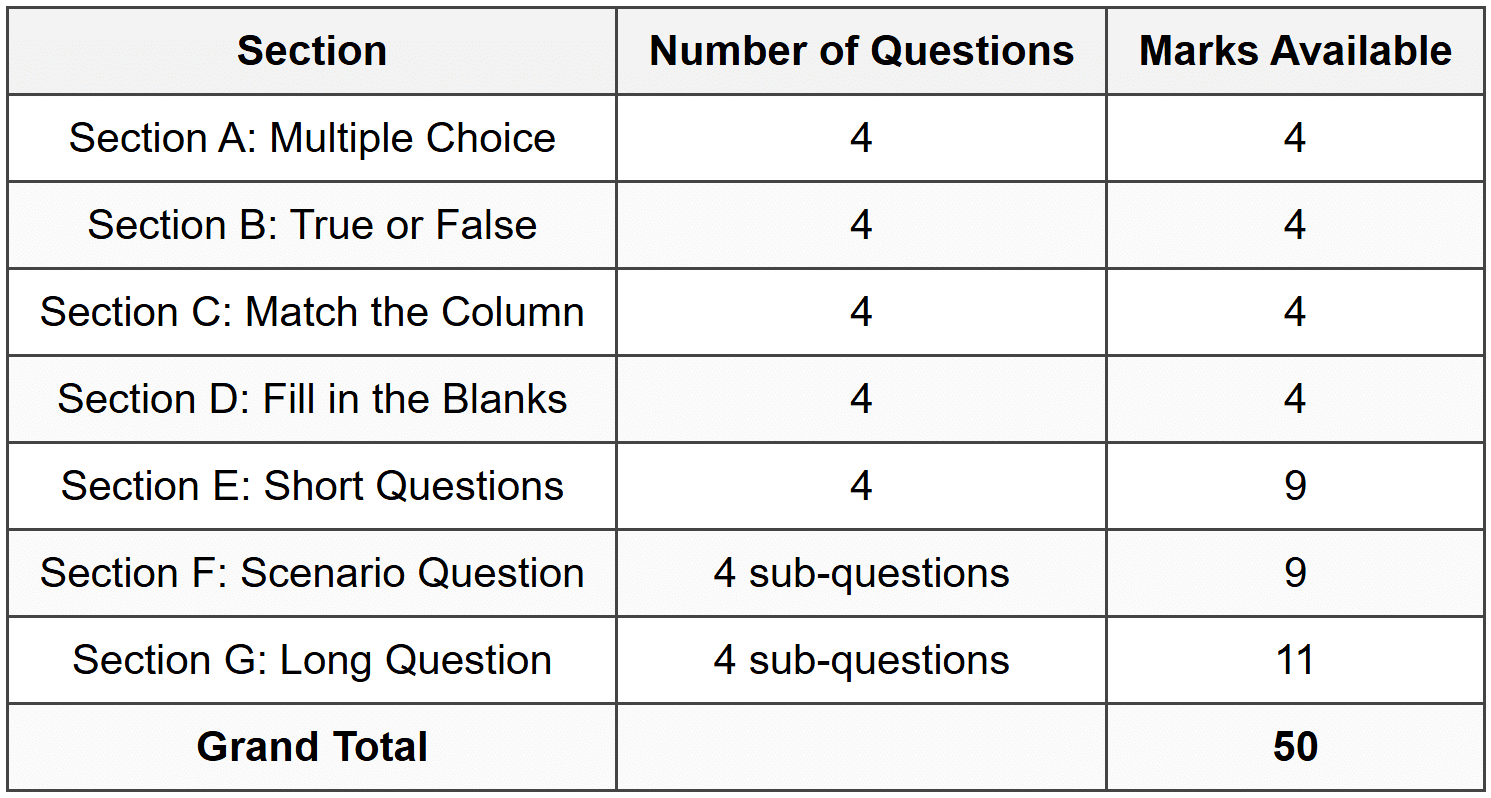
Mark Allocation Summary
Remember to review any questions you got wrong and make sure you understand the correct answers. Keep up the excellent work!




