Electric Circuits


Section A: Multiple Choice
Choose the correct answer for each question. Write only the letter (A-D) of your choice.
1. Which of the following materials allows electricity to flow through it easily? [1]
- A. Plastic
- B. Copper wire
- C. Rubber
- D. Wood
2. What is the function of a switch in an electric circuit? [1]
- A. To produce electricity
- B. To store electricity
- C. To open or close the circuit
- D. To increase the brightness of a bulb
3. In which type of circuit do all components share the same path for electricity to flow? [1]
- A. Parallel circuit
- B. Series circuit
- C. Complex circuit
- D. Open circuit
4. What happens to the other bulbs in a series circuit if one bulb is removed? [1]
- A. They shine brighter
- B. They continue to shine at the same brightness
- C. They go out
- D. They flicker on and off
Section B: True or False
Read each statement carefully. Write TRUE if the statement is correct or FALSE if the statement is incorrect.
1. A cell is a source of electrical energy in a circuit. [1]
2. Insulators are materials that allow electricity to flow through them easily. [1]
3. In a parallel circuit, if one component stops working, the other components will continue to work. [1]
4. A closed circuit allows electricity to flow through all the components. [1]
Section C: Match the Column
Match each item in Column A with the correct description in Column B. Write only the letter of your answer.
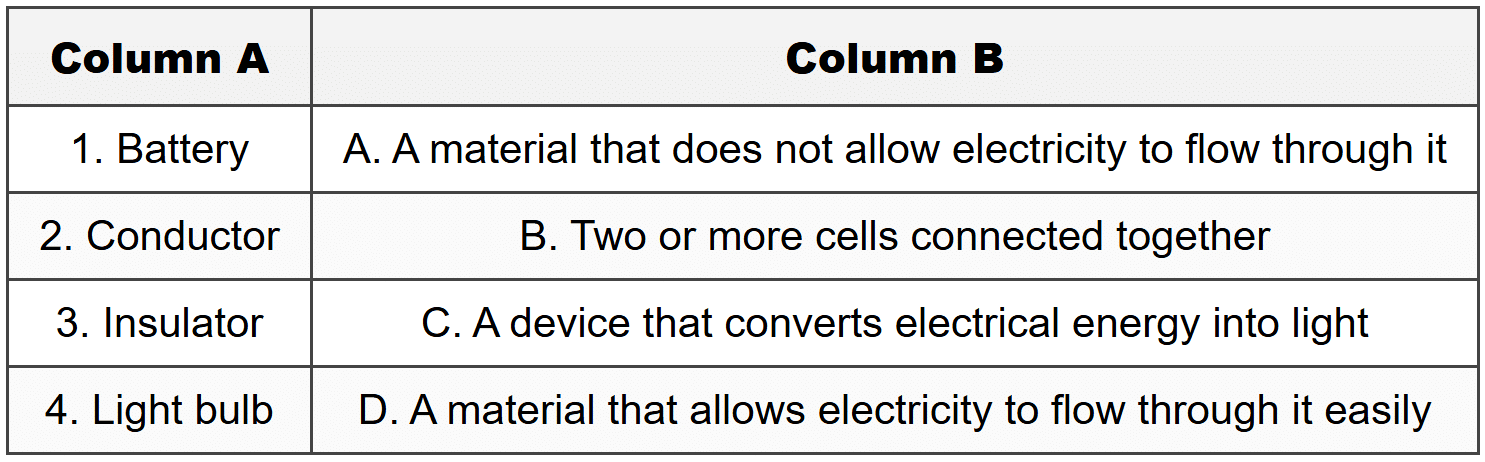
[4]
Section D: Fill in the Blanks
Complete each sentence by filling in the blank spaces using words from the word bank below.
Word Bank: circuit diagram, energy, open, symbols
1. A ________ is a drawing that uses ________ to represent the components of an electric circuit. [2]
2. When a switch is in the off position, it creates an ________ circuit and electricity cannot flow. [1]
3. Cells and batteries provide electrical ________ to make components in a circuit work. [1]
Section E: Short Questions
Answer the following questions in one to three sentences.
1. Name two components that are needed to make a complete electric circuit. [2]
2. Explain why it is dangerous to touch electrical wires with wet hands. [2]
3. What is the difference between a cell and a battery? [2]
4. Draw the circuit symbol for a cell. [1]
Section F: Scenario Question
Thandi is doing an investigation in her Natural Science class. She builds a circuit using one cell, two connecting wires, a switch, and one light bulb. When she closes the switch, the bulb lights up. She then adds a second bulb to her circuit by connecting it in the same path as the first bulb.
1. What type of circuit has Thandi created after adding the second bulb? [1]
2. What will happen to the brightness of the bulbs when the second bulb is added compared to when there was only one bulb? [2]
3. Thandi notices that when she unscrews one of the bulbs, the other bulb also goes out. Explain why this happens. [2]
4. Suggest how Thandi could change her circuit so that if one bulb goes out, the other bulb will remain lit. [2]
Section G: Long Question
Sipho wants to install lights in two different rooms of his house. He is thinking about how to connect the bulbs so that he can control each room's light independently.
1. Which type of circuit should Sipho use so that he can switch off the light in one room without affecting the light in the other room? [1]
2. Draw a labelled circuit diagram showing two bulbs connected in the type of circuit you identified in question 1, including a cell and a switch for each bulb. [4]
3. Explain one advantage and one disadvantage of connecting bulbs in a series circuit for household lighting. [4]
4. Evaluate why most homes use the type of circuit you identified in question 1 rather than a series circuit. Give at least two reasons. [3]
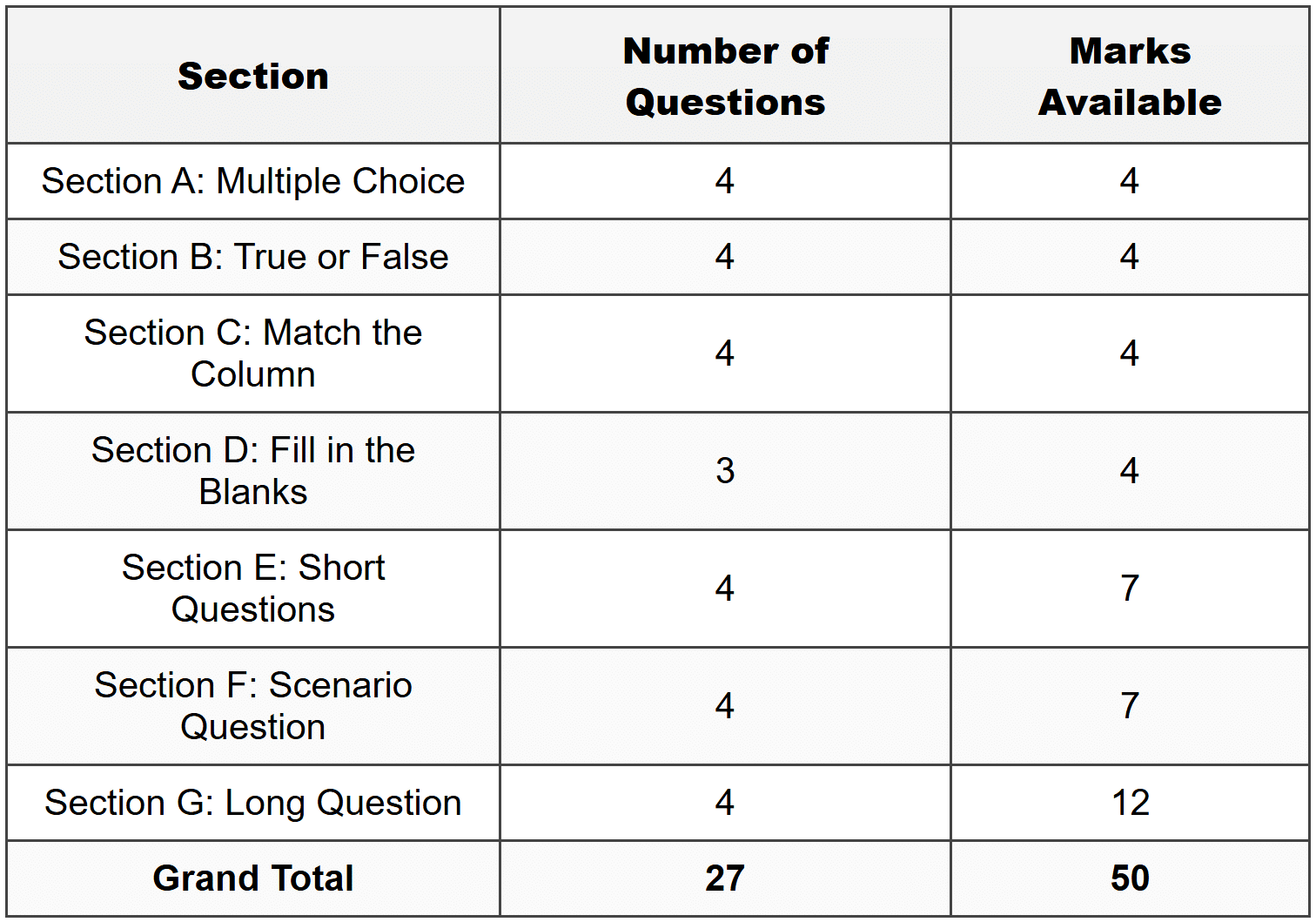
Grand Total: [50]
Answer Key
Well done for completing your worksheet! Remember, it's important to try all the questions yourself first before checking the answers. This will help you learn and remember the concepts better. Use this answer key to check your work and understand where you can improve. Keep up the great effort!
Section A - Multiple Choice
Section A - Question 1
Answer: B. Copper wire
Copper wire is a conductor, which means it allows electricity to flow through it easily. Materials like plastic, rubber, and wood are insulators and do not allow electricity to pass through them easily.
Section A - Question 2
Answer: C. To open or close the circuit
A switch is used to control the flow of electricity in a circuit. When the switch is closed, it completes the circuit and allows electricity to flow. When it is open, it breaks the circuit and stops the flow of electricity.
Section A - Question 3
Answer: B. Series circuit
In a series circuit, all the components are connected one after another in a single path. This means electricity flows through each component in turn along the same pathway.
Section A - Question 4
Answer: C. They go out
In a series circuit, there is only one path for electricity to flow. If one bulb is removed, the circuit is broken and electricity cannot flow through any of the other components, so all the bulbs go out.
Section B - True or False
Section B - Question 1
Answer: TRUE
A cell provides electrical energy by converting chemical energy into electrical energy. This energy allows the components in the circuit to work.
Section B - Question 2
Answer: FALSE
Corrected statement: Conductors are materials that allow electricity to flow through them easily.
Insulators are materials that do not allow electricity to flow through them easily. They are used to cover wires and prevent electric shocks. Examples include plastic, rubber, and wood.
Section B - Question 3
Answer: TRUE
In a parallel circuit, each component has its own separate path to the power source. If one component stops working, electricity can still flow through the other paths, so the other components continue to work.
Section B - Question 4
Answer: TRUE
A closed circuit is a complete circuit with no breaks. This allows electricity to flow from the power source, through all the components, and back to the power source.
Section C - Match the Column
Section C - Question 1
Answer: 1 - B
A battery is made up of two or more cells connected together to provide more electrical energy.
Section C - Question 2
Answer: 2 - D
A conductor is a material that allows electricity to flow through it easily, such as copper, aluminum, and other metals.
Section C - Question 3
Answer: 3 - A
An insulator is a material that does not allow electricity to flow through it, which makes it useful for covering wires to keep us safe from electric shocks.
Section C - Question 4
Answer: 4 - C
A light bulb is a device that converts electrical energy into light energy when electricity flows through it.
Section D - Fill in the Blanks
Section D - Question 1
Answer: circuit diagram, symbols
A circuit diagram uses standard symbols to represent different components like cells, switches, and bulbs, making it easier to understand and communicate how a circuit is connected.
Section D - Question 2
Answer: open
An open circuit has a break in the path, which stops electricity from flowing through the circuit. This happens when a switch is in the off position.
Section D - Question 3
Answer: energy
Cells and batteries are sources of electrical energy that power the components in a circuit, allowing devices like bulbs to light up and motors to turn.
Section E - Short Questions
Section E - Question 1
Model Answer:
A complete electric circuit needs a power source (such as a cell or battery) [1] and connecting wires to form a closed path for electricity to flow [1]. Other components like bulbs or switches can also be included to perform specific functions.
Section E - Question 2
Model Answer:
Water is a conductor of electricity [1]. When your hands are wet and you touch electrical wires, electricity can flow through the water and into your body, which can cause a dangerous electric shock or even death [1].
Section E - Question 3
Model Answer:
A cell is a single unit that produces electrical energy from chemical reactions [1]. A battery is made up of two or more cells connected together to provide more electrical energy [1].
Section E - Question 4
Model Answer:
The circuit symbol for a cell consists of one long line (positive terminal) and one short line (negative terminal) placed parallel to each other [1]. (Award the mark if the drawing clearly shows the correct symbol with unequal lines.)
Section F - Scenario Question
Section F - Question 1
Model Answer:
Thandi has created a series circuit [1], because both bulbs are connected one after the other in the same path.
Section F - Question 2
Model Answer:
When the second bulb is added in series, the brightness of both bulbs will decrease [1]. This is because the electrical energy from the cell is now shared between two bulbs instead of one, so each bulb receives less energy [1].
Section F - Question 3
Model Answer:
In a series circuit, there is only one path for electricity to flow [1]. When Thandi unscrews one bulb, the circuit is broken and electricity can no longer flow, so the other bulb also goes out [1].
Section F - Question 4
Model Answer:
Thandi should connect the bulbs in a parallel circuit [1]. In a parallel circuit, each bulb has its own separate path to the power source, so if one bulb goes out, electricity can still flow through the other path and the other bulb will remain lit [1].
Section G - Long Question
Section G - Question 1
Model Answer:
Sipho should use a parallel circuit [1], because in a parallel circuit each component can be controlled independently.
Section G - Question 2
Model Answer:
The circuit diagram should show [4 marks total]:
- A cell or battery correctly drawn with long and short lines [1]
- Two bulbs drawn with the correct circuit symbol (circle with an X or cross inside) [1]
- The two bulbs connected in parallel, meaning each bulb is on a separate branch from the cell [1]
- A switch on each branch or one main switch, with all components correctly connected and clearly labelled [1]
(Award marks based on the accuracy of symbols, correct parallel connection, and clear labelling.)
Section G - Question 3
Model Answer:
Advantage: A series circuit is simple and uses fewer wires, which makes it cheaper and easier to build [2].
Disadvantage: In a series circuit, if one bulb breaks or is switched off, all the other bulbs in the circuit will also go out because there is only one path for electricity to flow [2]. This makes series circuits impractical for household lighting where you want to control lights in different rooms independently.
Section G - Question 4
Model Answer:
Most homes use parallel circuits for the following reasons [3 marks total]:
Reason 1: In a parallel circuit, each light or appliance can be switched on or off independently without affecting the others [1.5]. This is very important in a home where you may want the kitchen light on but the bedroom light off.
Reason 2: If one bulb or appliance stops working in a parallel circuit, the others will continue to work [1.5]. This is much more practical and convenient for everyday use compared to a series circuit where one fault would affect all the lights.
(Award full marks for two clear, well-explained reasons. Award partial marks for correct but incomplete explanations.)
Mark Allocation Summary