Support Systems in Animals

Section A: Multiple Choice
Choose the correct answer from the options provided. Write only the letter (A-D) of your choice.
Question 1 [1]
The hydrostatic skeleton in earthworms functions by:
- A. rigid calcium deposits in the body wall
- B. fluid-filled compartments that provide support through pressure
- C. cartilage rods running along the length of the body
- D. interlocking bony plates on the surface
Question 2 [1]
Which of the following animals possesses an endoskeleton?
- A. Grasshopper
- B. Snail
- C. Frog
- D. Crab
Question 3 [1]
The exoskeleton of arthropods is primarily composed of:
- A. cellulose
- B. chitin
- C. keratin
- D. collagen
Question 4 [1]
An earthworm's body is divided into segments filled with coelomic fluid. If the pressure in one segment is measured as 12 kPa and in an adjacent segment as 8 kPa during contraction, what is the pressure difference between these two segments?
- A. 20 kPa
- B. 4 kPa
- C. 10 kPa
- D. 96 kPa
Question 5 [1]
The main advantage of an exoskeleton over a hydrostatic skeleton is that it:
- A. allows unlimited growth without moulting
- B. provides rigid protection and attachment points for muscles
- C. requires less energy to maintain
- D. is found only in aquatic environments
Question 6 [1]
A beetle has a body mass of 0.0024 kg and its exoskeleton has a mass of 0.0006 kg. What percentage of the beetle's body mass is its exoskeleton?
- A. 4%
- B. 25%
- C. 40%
- D. 250%
Question 7 [1]
Which statement correctly describes the process of moulting (ecdysis) in arthropods?
- A. The old exoskeleton expands to accommodate growth
- B. The animal sheds its exoskeleton and secretes a new, larger one
- C. New layers are continuously added beneath the existing exoskeleton
- D. The exoskeleton dissolves and reforms every day
Question 8 [1]
A snail's shell grows as the animal grows. If a young snail's shell has a mass of 1.2 g and after three months the shell mass is 3.6 g, by what factor has the shell mass increased?
- A. 2.4
- B. 3
- C. 4.8
- D. 2
Question 9 [1]
In vertebrates, the axial skeleton includes:
- A. limbs and limb girdles
- B. skull, vertebral column, and rib cage
- C. only the bones of the legs
- D. external protective covering
Question 10 [1]
Thandi observes that during movement, an earthworm's circular muscles contract in some segments while longitudinal muscles contract in others. If circular muscle contraction reduces segment diameter from 6 mm to 4 mm, what is the reduction in diameter?
- A. 10 mm
- B. 1.5 mm
- C. 2 mm
- D. 24 mm
Section B: Structured Questions
Question 1: Hydrostatic Skeletons
(a) Explain how a hydrostatic skeleton provides support in animals such as earthworms. [3]
(b) Kagiso investigates the movement of an earthworm and notices that when longitudinal muscles contract, the segment becomes shorter and wider. Calculate the percentage decrease in length if a segment contracts from 8.0 mm to 6.0 mm in length. [4]
(c) An earthworm moves through soil by alternating the contraction of circular and longitudinal muscles. A student measures the force exerted by the coelomic fluid against the body wall during circular muscle contraction. The force measured is 0.015 N over an area of 5.0 × 10⁻⁶ m2. Calculate the pressure exerted by the coelomic fluid. [5]
(d) Evaluate why a hydrostatic skeleton is well-suited for burrowing animals but would be ineffective for large terrestrial animals that need to support significant body weight against gravity. [4]
Question 2: Exoskeletons and Endoskeletons
(a) Distinguish between an exoskeleton and an endoskeleton by describing the location and composition of each. [4]
(b) A grasshopper moults its exoskeleton to allow for growth. Before moulting, the grasshopper has a body length of 22 mm. After moulting and expansion, its body length increases to 28 mm. Calculate the percentage increase in body length. [4]
(c) Sipho reads that the exoskeleton of a crab must be thick enough to provide protection, but if it becomes too thick, the crab cannot move efficiently. The table below shows data collected on three crabs of different sizes:
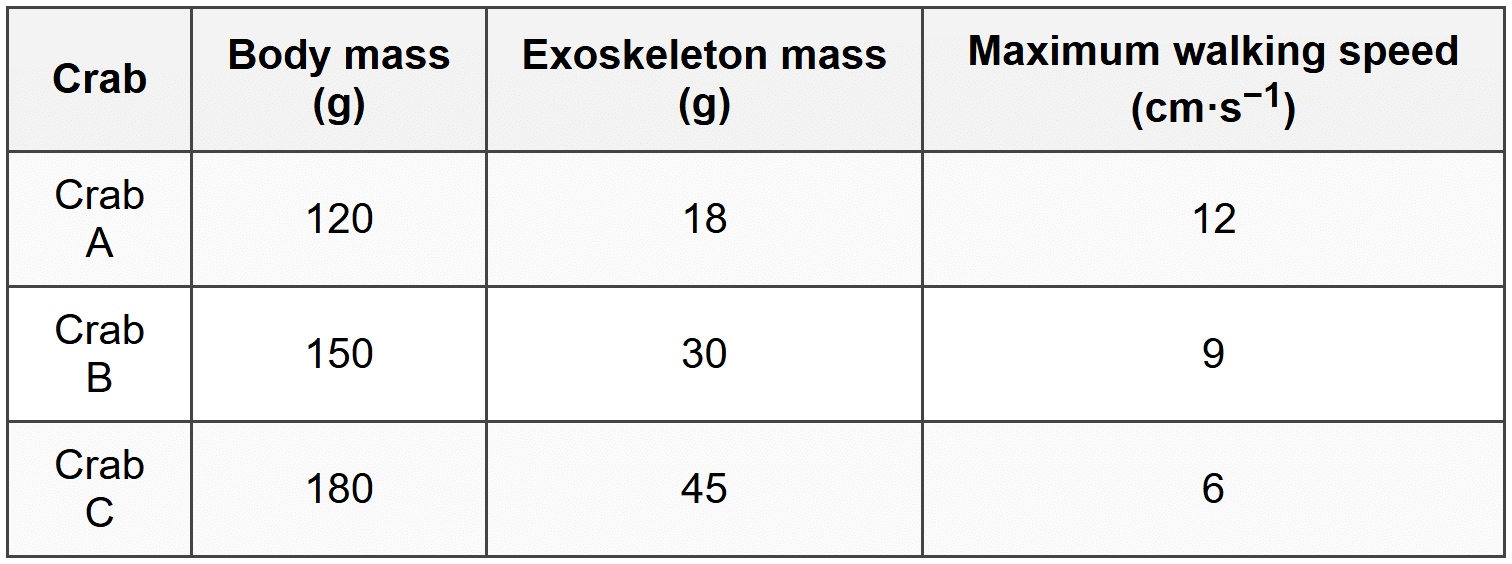
Calculate the exoskeleton mass as a percentage of body mass for Crab B. [3]
(d) Using the data in the table, explain the relationship between exoskeleton mass (as a proportion of body mass) and walking speed. Suggest a reason for this trend. [4]
Section C: Data Analysis and Graphing
Question 1: Growth and Shell Mass in Snails
Lerato conducts an investigation on the growth of snail shells over a 10-week period. She measures the mass of the shell weekly and records the following data:
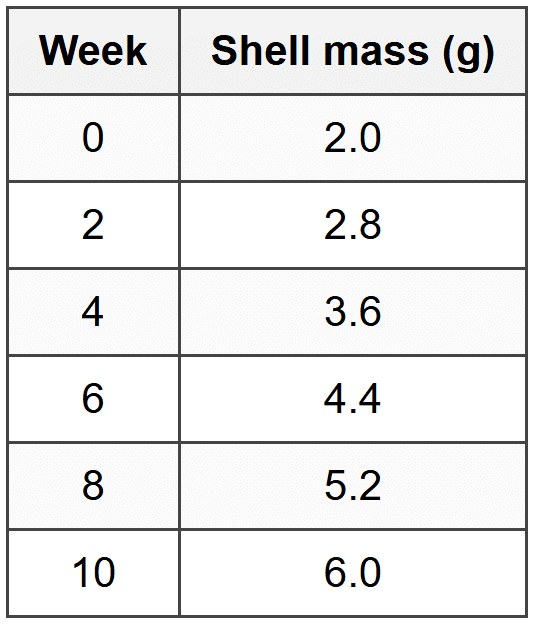
(a) What was the shell mass at week 6? [1]
(b) Calculate the average increase in shell mass per week over the entire 10-week period. [4]
(c) Describe the trend shown in the data and explain what this suggests about the growth pattern of the snail's shell. [3]
(d) Lerato hypothesizes that the rate of shell growth would slow down if the snail's calcium intake decreased. Evaluate whether the data collected supports or refutes this hypothesis, and suggest what additional data would be needed to test this hypothesis fully. [4]
Section D: Scientific Investigation
Question 1: Effect of Temperature on Moulting Rate in Mealworms
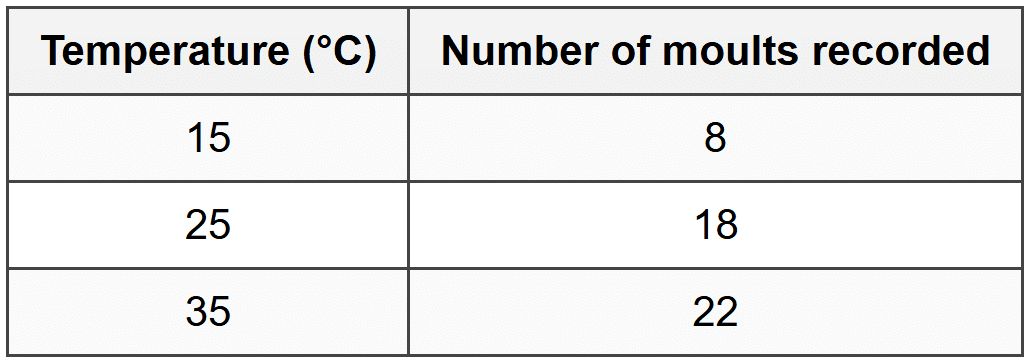
Amahle investigates how temperature affects the rate of moulting in mealworm larvae (an insect with an exoskeleton). She sets up three identical containers, each with 10 mealworms of the same age and size. She places one container at 15°C, one at 25°C, and one at 35°C. All other conditions (food, light, humidity) are kept constant. After 14 days, she counts the number of exoskeletons (exuviae) shed in each container as an indicator of moulting events. Her results are as follows:
(a) Identify the independent variable in this investigation. [1]
(b) Identify the dependent variable in this investigation. [1]
(c) Name one controlled variable in this investigation and explain why it must be kept constant. [3]
(d) Write a hypothesis for Amahle's investigation using the format: If [condition], then [expected result], because [scientific reason]. [3]
(e) Based on the results in the table, draw a conclusion about the effect of temperature on moulting rate in mealworms. State whether the hypothesis you wrote in (d) is supported by the data, and provide scientific justification for your conclusion. [5]
Grand Total: [75]
Answer Key
Well done for completing the worksheet! Before you check your answers, make sure you have attempted every question and shown all your working for calculations. Use this answer key to mark your own work carefully, and take note of where you can improve. Remember, making mistakes is part of learning!
Section A: Multiple Choice
Section A - Question 1
B. fluid-filled compartments that provide support through pressure
This is correct because a hydrostatic skeleton works by maintaining pressure in fluid-filled body compartments, allowing the animal to maintain shape and move by changing the pressure in different segments. It is not simply rigid structures, but the dynamic pressure of fluid that provides support.
Section A - Question 2
C. Frog
Frogs are vertebrates and possess an endoskeleton made of bone and cartilage located inside the body. This requires you to apply your knowledge of animal classification and skeletal types rather than just recalling a definition.
Section A - Question 3
B. chitin
Chitin is the main structural component of arthropod exoskeletons. This is a factual recall question testing knowledge of exoskeleton composition.
Section A - Question 4
B. 4 kPa
Pressure difference = 12 kPa - 8 kPa = 4 kPa. This requires you to perform a simple calculation using subtraction of pressures to find the difference, not just recall a fact.
Section A - Question 5
B. provides rigid protection and attachment points for muscles
An exoskeleton offers firm surfaces for muscle attachment and better protection compared to the flexible hydrostatic skeleton. This tests understanding of the functional advantages rather than simple recall.
Section A - Question 6
B. 25%
Percentage = (0.0006 kg ÷ 0.0024 kg) × 100% = 25%. This question requires calculation and application of percentage formula, not just recall.
Section A - Question 7
B. The animal sheds its exoskeleton and secretes a new, larger one
Moulting (ecdysis) involves the shedding of the old exoskeleton and formation of a new one to allow growth. This tests comprehension of a biological process.
Section A - Question 8
B. 3
Factor of increase = 3.6 g ÷ 1.2 g = 3. This requires calculation of a ratio to determine the factor of increase.
Section A - Question 9
B. skull, vertebral column, and rib cage
The axial skeleton forms the central axis of the body and includes the skull, vertebral column, and rib cage. This tests knowledge of skeletal organization.
Section A - Question 10
C. 2 mm
Reduction in diameter = 6 mm - 4 mm = 2 mm. This is a straightforward subtraction requiring application of arithmetic to a biological scenario.
Section B: Structured Questions
Section B - Question 1(a)
A hydrostatic skeleton provides support through fluid-filled compartments within the body. The coelomic fluid is incompressible and exerts pressure against the body wall, maintaining the shape of the animal. Muscles in the body wall contract against this fluid, allowing the animal to change shape and move while the fluid provides the necessary support.
Key points for full marks: fluid-filled compartments, pressure against body wall, muscle contraction against incompressible fluid.
Section B - Question 1(b)
Step 1: Formula for percentage decrease:
Percentage decrease = [(initial length - final length) ÷ initial length] × 100%
Step 2: Substitute values:
Percentage decrease = [(8.0 mm - 6.0 mm) ÷ 8.0 mm] × 100%
Step 3: Calculate:
= [2.0 mm ÷ 8.0 mm] × 100%
= 0.25 × 100%
= 25%
Step 4: Final answer:
The percentage decrease in length is 25%.
Note: The answer is a percentage (unitless in this context, but the % symbol is required for full marks).
Section B - Question 1(c)
Step 1: Formula for pressure:
\( P = \frac{F}{A} \)
where \( P \) = pressure (Pa), \( F \) = force (N), \( A \) = area (m2)
Step 2: Substitute the given values:
\( P = \frac{0.015 \text{ N}}{5.0 \times 10^{-6} \text{ m}^2} \)
Step 3: Calculate:
\( P = \frac{0.015}{5.0 \times 10^{-6}} \)
\( P = 0.015 \times \frac{1}{5.0 \times 10^{-6}} \)
\( P = 0.015 \times 2.0 \times 10^{5} \)
\( P = 0.003 \times 10^{6} \)
\( P = 3.0 \times 10^{3} \text{ Pa} \)
or \( P = 3000 \text{ Pa} \) or \( 3.0 \text{ kPa} \)
Step 4: Final answer:
The pressure exerted by the coelomic fluid is 3.0 × 10³ Pa (or 3.0 kPa).
Unit is essential: Pa or kPa must be stated for full marks.
Section B - Question 1(d)
A hydrostatic skeleton is well-suited for burrowing animals because the fluid pressure can be redistributed throughout the body, allowing the animal to push through soil and change shape efficiently in a confined space. However, for large terrestrial animals, a hydrostatic skeleton would be ineffective because it cannot provide the rigid structural support needed to hold the body upright against gravity. Large animals require a rigid skeleton (endo- or exoskeleton) to support their mass, as fluid alone would collapse under the weight.
Full marks require: explanation of suitability for burrowing (fluid redistribution, flexibility), and clear reasoning why it fails for large terrestrial animals (lack of rigid support, gravity).
Section B - Question 2(a)
An exoskeleton is an external skeleton found on the outside of the animal's body, typically made of chitin (in arthropods) or calcium carbonate (in molluscs). It provides protection and muscle attachment but must be moulted for growth. An endoskeleton is an internal skeleton located inside the body, made of bone and cartilage in vertebrates. It grows with the animal and provides support and protection of internal organs.
Key points: location (external vs internal), composition (chitin/calcium carbonate vs bone/cartilage), and function.
Section B - Question 2(b)
Step 1: Formula for percentage increase:
Percentage increase = [(final length - initial length) ÷ initial length] × 100%
Step 2: Substitute values:
Percentage increase = [(28 mm - 22 mm) ÷ 22 mm] × 100%
Step 3: Calculate:
= [6 mm ÷ 22 mm] × 100%
= 0.2727... × 100%
= 27.27%
≈ 27% (or 27.3% to one decimal place)
Step 4: Final answer:
The percentage increase in body length is approximately 27% (or 27.3%).
Note: The % symbol is required for full marks.
Section B - Question 2(c)
Step 1: Formula for percentage:
Percentage = (exoskeleton mass ÷ body mass) × 100%
Step 2: Substitute values for Crab B:
Percentage = (30 g ÷ 150 g) × 100%
Step 3: Calculate:
= 0.2 × 100%
= 20%
Step 4: Final answer:
The exoskeleton mass as a percentage of body mass for Crab B is 20%.
The % symbol must be included.
Section B - Question 2(d)
The data shows that as the exoskeleton mass increases as a proportion of body mass, the walking speed decreases. Crab A has an exoskeleton that is 15% of body mass (18 g ÷ 120 g) and walks at 12 cm·s-1, while Crab C has an exoskeleton that is 25% of body mass (45 g ÷ 180 g) and walks at only 6 cm·s-1. This trend suggests that a heavier exoskeleton relative to body mass increases the burden on the crab, making movement more difficult and reducing speed. The thicker exoskeleton, while providing more protection, adds mass that the muscles must move, reducing efficiency.
Full marks require: clear description of inverse relationship, reference to data, and a scientific explanation linking exoskeleton mass to movement efficiency.
Section C: Data Analysis and Graphing
Section C - Question 1(a)
The shell mass at week 6 was 4.4 g.
Section C - Question 1(b)
Step 1: Formula for average increase per week:
Average increase per week = (final mass - initial mass) ÷ total time
Step 2: Substitute values:
Average increase per week = (6.0 g - 2.0 g) ÷ 10 weeks
Step 3: Calculate:
= 4.0 g ÷ 10 weeks
= 0.4 g·week-1
Step 4: Final answer:
The average increase in shell mass per week is 0.4 g·week-1.
Unit is essential: g·week-1 (or g per week or g/week) must be stated for full marks.
Section C - Question 1(c)
The data shows a steady, linear increase in shell mass over the 10-week period. The shell mass increases by approximately 0.4 g every week, indicating a constant rate of growth. This suggests that the snail is growing at a consistent rate under stable environmental conditions, and that the snail is continuously secreting calcium carbonate to add to the shell as it grows.
Full marks: identification of linear/constant trend, reference to data, and explanation linking to shell growth process.
Section C - Question 1(d)
The data collected shows a constant rate of growth, but does not directly test the effect of calcium intake on shell growth rate, as calcium intake was not varied or measured in this investigation. To fully support or refute Lerato's hypothesis, she would need to conduct an experiment where calcium intake is the independent variable - for example, by providing different groups of snails with diets containing varying amounts of calcium and then measuring shell growth rate over time. The current data alone cannot support or refute the hypothesis because all conditions, including diet, were presumably constant.
Full marks require: statement that current data does not test the hypothesis, clear explanation of why, and specific suggestion for additional data (varying calcium intake and measuring shell growth).
Section D: Scientific Investigation
Section D - Question 1(a)
The independent variable is temperature (measured in °C).
Explanation: This is the variable that Amahle deliberately changes or manipulates in the investigation.
Section D - Question 1(b)
The dependent variable is the number of moults recorded (or moulting rate).
Explanation: This is the variable that Amahle measures in response to changes in temperature.
Section D - Question 1(c)
One controlled variable is food supply (accept also: light, humidity, age of mealworms, size of mealworms, or number of mealworms).
Explanation: Food supply must be kept constant because differences in nutrition could affect the growth rate and moulting frequency of the mealworms independently of temperature. If food varied between containers, it would be impossible to determine whether changes in moulting rate were due to temperature or differences in food availability.
Full marks: name the variable and provide a clear explanation linking it to the dependent variable.
Section D - Question 1(d)
Model hypothesis:
If the temperature is increased, then the number of moults in mealworms will increase, because higher temperatures increase the rate of metabolic processes, including growth and the production of hormones that trigger moulting.
(Accept any hypothesis in correct format that predicts increased moulting with increased temperature and provides a scientifically valid reason related to metabolism, enzyme activity, or growth rate.)
Section D - Question 1(e)
Conclusion:
The results show that as temperature increased from 15°C to 35°C, the number of moults recorded increased from 8 to 22. This indicates a positive relationship between temperature and moulting rate. The hypothesis is supported by the data, as higher temperatures (25°C and 35°C) resulted in significantly more moulting events compared to the lower temperature (15°C). This can be explained by the fact that higher temperatures increase metabolic rate and enzyme activity, which speeds up growth and the biochemical processes involved in moulting. The data clearly demonstrates that temperature has a strong effect on the rate at which mealworms moult their exoskeletons.
Full marks require: clear statement of conclusion supported by data, explicit statement that hypothesis is supported, reference to the data values, and scientific reasoning linking temperature to metabolic rate or enzyme activity.
Mark Allocation Summary
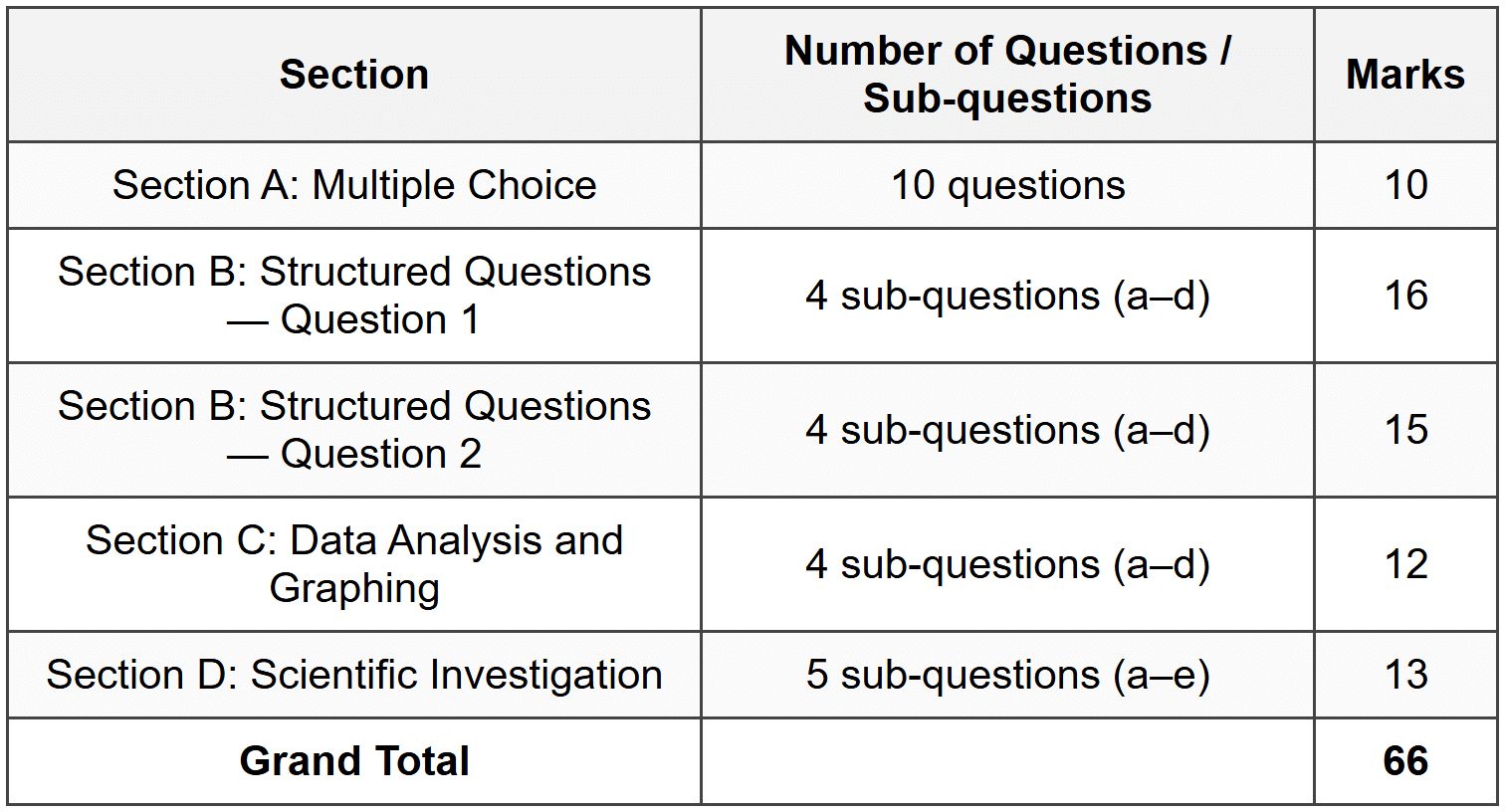
Note: Please verify your own addition of marks. The grand total listed after Section D was [75], but the detailed mark allocation totals to 66 marks. Please use the table above as the correct mark allocation based on each question's individual marks.




