Support Systems in Animals

Section A: Multiple Choice
Choose the correct answer from the options provided. Write only the letter (A-D) of your choice.
1. Which type of skeleton is found in earthworms? [1]
- A. Endoskeleton
- B. Exoskeleton
- C. Hydrostatic skeleton
- D. Cartilaginous skeleton
2. The human skull is an example of which function of the skeletal system? [1]
- A. Movement
- B. Protection
- C. Blood cell production
- D. Mineral storage
3. Amahle examines a bone under a microscope and observes Haversian canals. Which type of bone tissue is she observing? [1]
- A. Spongy bone
- B. Cartilage
- C. Compact bone
- D. Bone marrow
4. In which animals would you find chitin as the main component of their support system? [1]
- A. Birds and mammals
- B. Insects and crustaceans
- C. Fish and amphibians
- D. Reptiles and mammals
5. A hinge joint allows movement in how many planes? [1]
- A. No movement
- B. One plane only
- C. Two planes
- D. All directions
6. Sipho measures the length of his femur as 45 cm. If the average human femur represents approximately 26% of total body height, what is Sipho's approximate height? [1]
- A. 117 cm
- B. 145 cm
- C. 173 cm
- D. 192 cm
7. Red bone marrow is primarily responsible for which function? [1]
- A. Storing fat
- B. Producing blood cells
- C. Storing minerals
- D. Protecting organs
8. A snail's shell is classified as which type of skeletal structure? [1]
- A. Endoskeleton
- B. Exoskeleton
- C. Hydrostatic skeleton
- D. Axial skeleton
9. Thandi conducts an experiment and finds that a sample of bone contains 65% mineral content by mass. If the bone sample has a mass of 80 g, what is the mass of the organic components in the bone? [1]
- A. 12 g
- B. 28 g
- C. 52 g
- D. 65 g
10. Which of the following statements best explains why birds have hollow bones? [1]
- A. To store more calcium
- B. To reduce body mass for flight while maintaining strength
- C. To produce more red blood cells
- D. To protect internal organs more effectively
Section B: Structured Questions
Question 1: Skeletal Types and Functions
(a) Explain why a hydrostatic skeleton is well-suited for burrowing animals such as earthworms. [3]
(b) Compare the advantages and disadvantages of an exoskeleton compared to an endoskeleton in terms of growth and protection. [4]
(c) Kagiso investigates the mineral content of different bones. He finds that the femur of an adult contains 200 g of calcium. If calcium represents 35% of the total mineral content, and minerals make up 65% of the total bone mass, calculate the total mass of the femur. Show all working. [4]
(d) A marine biologist discovers a new species of deep-sea creature with an unusual skeletal structure that combines features of both exoskeletons and hydrostatic support. Evaluate why such a combination might be advantageous in a deep-sea environment where pressure is extremely high. [4]
Question 2: Joints and Movement
(a) Name the type of joint found at the elbow and describe the type of movement it allows. [2]
(b) Explain the role of synovial fluid in synovial joints and state what would happen if this fluid was reduced. [3]
(c) Nomsa conducts a flexibility test and finds that when she bends her knee, the angle between her thigh and lower leg decreases from 180° to 45°. Calculate the angular displacement of her knee joint during this movement. Show all working and include the unit. [3]
(d) Lerato compares the structure of joints in three different animals: a human shoulder (ball-and-socket), a chicken wing (hinge), and a turtle's neck (pivot). She notices that animals with different lifestyles have different predominant joint types. Analyse the relationship between joint type and the lifestyle or movement requirements of each animal, providing specific examples from the three animals mentioned. [5]
Section C: Data Analysis and Graphing
Question 1: Bone Density Investigation
Bongani investigates how bone density changes with age in humans. He collects the following data from medical records showing average bone density measured in g·cm-3:
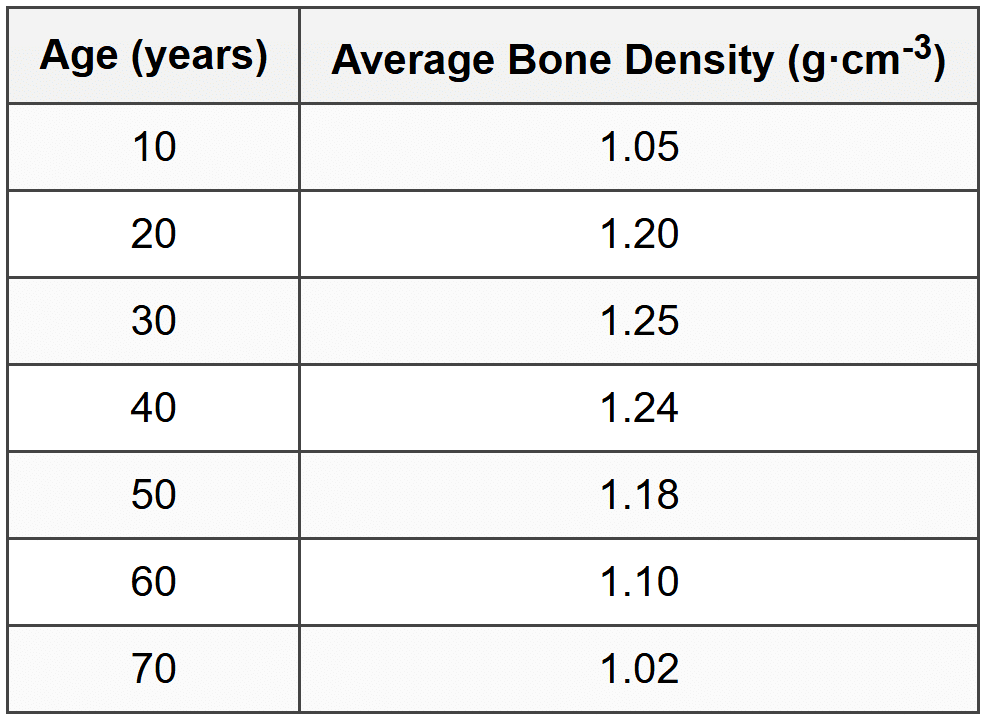
(a) Identify the age at which bone density reaches its maximum value according to the data. [1]
(b) Calculate the percentage decrease in bone density from age 30 to age 70. Show all working. [3]
(c) Describe the trend in bone density between ages 10 and 30, and suggest a biological reason for this trend. [3]
(d) Bongani notices that bone density decreases more rapidly after age 50. Evaluate possible reasons for this accelerated decline, considering both biological and lifestyle factors. What recommendations would you make to a 45-year-old person to maintain healthy bone density? [5]
Section D: Scientific Investigation
Question 1: Effect of Calcium Intake on Bone Strength
Zanele designs an investigation to determine whether calcium intake affects bone strength in young rats. She divides 20 rats of the same age, mass, and breed into two groups. Group A receives a diet containing high calcium content (1.2% calcium by mass), while Group B receives a normal diet containing 0.6% calcium by mass. After 8 weeks, she measures the force required to fracture the femur bone of each rat using a specialised device. All other conditions, including protein intake, vitamin D levels, exercise, and lighting, are kept identical for both groups.
(a) Identify the independent variable in this investigation. [1]
(b) Identify the dependent variable in this investigation. [1]
(c) Name one controlled variable in this investigation and explain why it must be kept constant. [2]
(d) Write a hypothesis for this investigation using the correct format: If [condition], then [expected result], because [scientific reason]. [3]
(e) Zanele's results showed that Group A rats required an average force of 95 N to fracture the femur, while Group B rats required an average force of 68 N. One rat in Group A showed an unusually low fracture force of 52 N. Draw a conclusion from these results, evaluate whether the hypothesis is supported, and suggest a possible explanation for the anomalous result in Group A. [5]
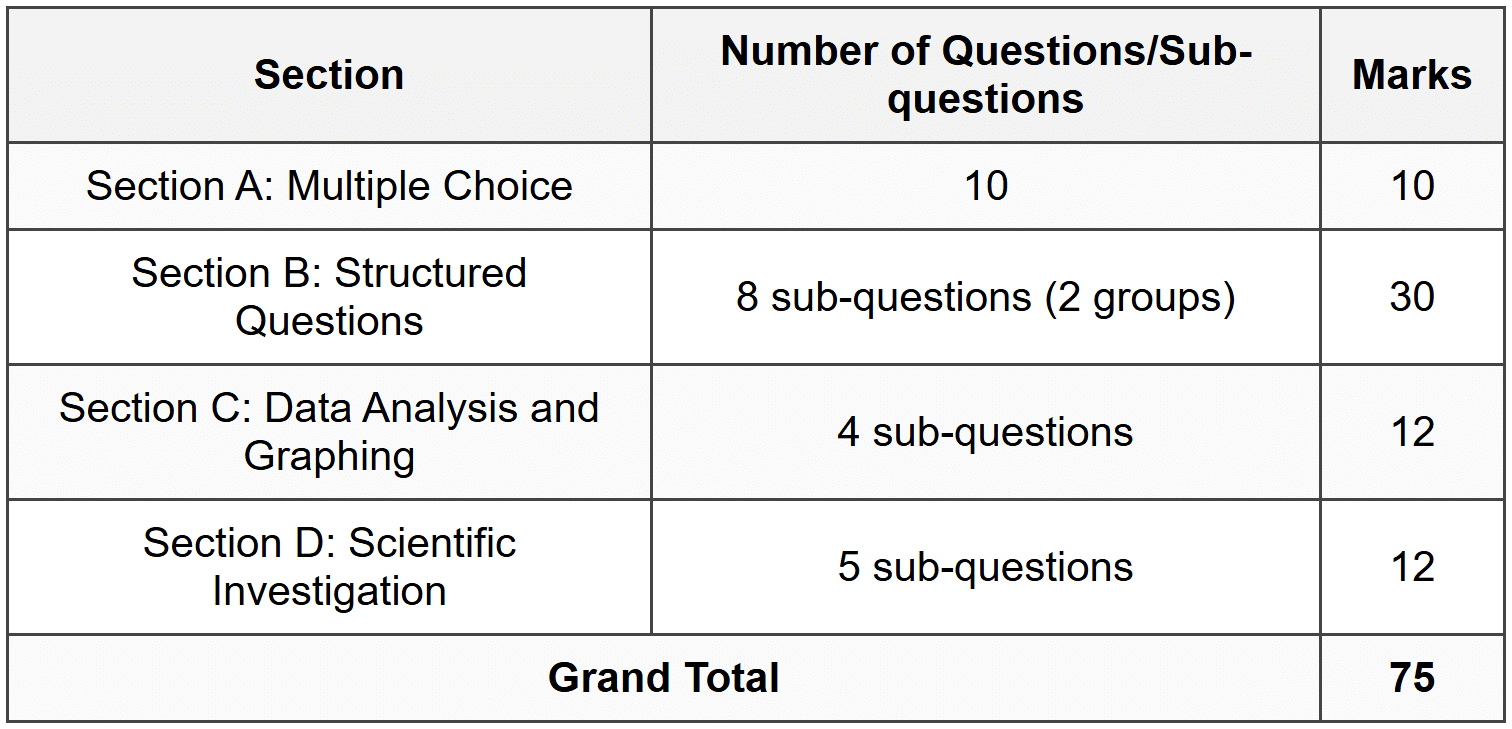
Grand Total: [75]
Answer Key
Well done on completing the worksheet! Before you check your answers, make sure you have attempted every question and shown all your working for calculations. Use this answer key to identify areas where you did well and topics you may need to revise. Remember, understanding your mistakes is an important part of learning.
Section A - Question 1
Answer: C. Hydrostatic skeleton
Earthworms use a hydrostatic skeleton, which consists of fluid-filled compartments surrounded by muscles. This allows them to change shape by contracting muscles and moving the fluid, which is perfect for burrowing. This is not just recall-you needed to connect the animal type to the correct skeletal system.
Section A - Question 2
Answer: B. Protection
The skull's primary function is to protect the delicate brain tissue inside. While bones have multiple functions, you needed to apply your knowledge of the skull's structure to identify its main role rather than just listing functions.
Section A - Question 3
Answer: C. Compact bone
Haversian canals are characteristic structures found only in compact bone tissue, where they contain blood vessels and nerves. You needed to recall the microscopic structure of bone types and match the feature to the correct tissue.
Section A - Question 4
Answer: B. Insects and crustaceans
Chitin is the tough, nitrogen-containing polysaccharide that forms the exoskeleton of arthropods, including insects (like beetles) and crustaceans (like crabs). This required you to link a chemical component to the correct animal groups.
Section A - Question 5
Answer: B. One plane only
A hinge joint, such as the elbow or knee, allows movement in only one plane-like a door hinge. You needed to visualise the movement and understand the structural limitation of this joint type.
Section A - Question 6
Answer: C. 173 cm
This required a calculation: If 45 cm = 26% of height, then height = 45 ÷ 0.26 = 173.08 cm ≈ 173 cm. You needed to set up a percentage relationship and solve for the unknown, not just recall a fact.
Section A - Question 7
Answer: B. Producing blood cells
Red bone marrow is the site of hematopoiesis (blood cell production), making red blood cells, white blood cells, and platelets. This tests your understanding of bone function beyond just structural support.
Section A - Question 8
Answer: B. Exoskeleton
A snail's shell is an external, rigid structure that provides support and protection, making it an exoskeleton. You needed to classify the skeletal type based on its position relative to the body.
Section A - Question 9
Answer: B. 28 g
If 65% is mineral, then 35% is organic. Organic mass = 80 g × 0.35 = 28 g. This required you to understand complementary percentages and perform a calculation, not just identify a term.
Section A - Question 10
Answer: B. To reduce body mass for flight while maintaining strength
Hollow bones reduce the overall mass of the bird without significantly compromising strength, making flight more energy-efficient. This required you to analyse the relationship between structure and function, not simply recall that bird bones are hollow.
Section B - Question 1(a)
A hydrostatic skeleton consists of fluid-filled compartments surrounded by circular and longitudinal muscles. When earthworms contract these muscles, the fluid is incompressible and transmits force, allowing the body to elongate or shorten. This creates the peristaltic movement ideal for pushing through soil, and the fluid provides the necessary rigidity for burrowing without a hard skeleton.
Key points for full marks: mention fluid-filled compartments, muscle contraction transmitting force, and suitability for burrowing movement.
Section B - Question 1(b)
Exoskeleton advantages: Provides excellent protection from predators and physical damage, prevents water loss in terrestrial environments. Exoskeleton disadvantages: Must be shed during moulting for growth, leaving the animal temporarily vulnerable; limits maximum body size due to weight.
Endoskeleton advantages: Grows continuously with the animal without moulting, allows for larger body sizes, provides attachment points for muscles inside the body. Endoskeleton disadvantages: Offers less direct external protection, requires other protective structures like skin or scales.
For full marks: compare at least two advantages and two disadvantages, with specific reference to growth and protection as asked.
Section B - Question 1(c)
Step 1: Calculate total mineral content
If calcium = 35% of minerals, and calcium mass = 200 g
Total mineral mass = 200 g ÷ 0.35 = 571.43 g
Step 2: Calculate total bone mass
If minerals = 65% of total bone mass
Total bone mass = 571.43 g ÷ 0.65
Total bone mass = 878.97 g
Total bone mass ≈ 879 g
Final answer: 879 g (unit required for full marks)
Section B - Question 1(d)
In a deep-sea environment, external pressure is extremely high, which could collapse a purely hydrostatic skeleton. An exoskeleton component would provide rigid structural support to resist compression from the outside. However, a purely rigid exoskeleton might crack under pressure changes. The hydrostatic component would allow the organism to adjust its internal pressure to match external conditions, preventing crushing or bursting. This combination allows flexibility to cope with pressure variations while maintaining structural integrity. Additionally, the hydrostatic portion enables movement in an environment where rigid appendages might be less efficient.
For full marks: must evaluate both advantages of the combination, reference the high-pressure environment, and explain why each component addresses a specific challenge. Partial marks (2) for listing advantages without linking to deep-sea conditions.
Section B - Question 2(a)
The elbow contains a hinge joint. This joint allows movement in one plane only, specifically flexion (bending) and extension (straightening) of the arm.
Section B - Question 2(b)
Synovial fluid acts as a lubricant between the articulating surfaces of bones in synovial joints, reducing friction during movement. It also provides nutrients to the cartilage and removes waste products. If synovial fluid was reduced, there would be increased friction between bones, leading to pain, inflammation, reduced range of motion, and eventually damage to the articular cartilage, potentially causing conditions like arthritis.
For full marks: explain at least two functions of synovial fluid and at least two consequences of reduced fluid.
Section B - Question 2(c)
Step 1: Identify the formula
Angular displacement = initial angle - final angle
Step 2: Substitute values
Angular displacement = 180° - 45°
Step 3: Calculate
Angular displacement = 135°
Final answer: 135° (unit required for full marks)
Section B - Question 2(d)
The human shoulder has a ball-and-socket joint that allows movement in multiple planes (rotation, flexion, extension, abduction, adduction), which is essential for humans' manipulative abilities and tool use-requiring a wide range of arm positions. The chicken wing has predominantly hinge joints, allowing movement in one plane, which suits the flapping motion needed for flight where strength and stability in a single plane are more important than multi-directional flexibility. The turtle's neck has pivot joints that allow rotational movement, enabling the turtle to retract its head into its shell for protection and to look around while keeping its body still-crucial for an animal with limited mobility. This demonstrates that joint structure is closely adapted to functional demands: versatility for manipulation, power for flight, and defensive rotation for protection.
For full marks: must analyse all three joint types with specific reference to the lifestyle/movement of each animal. Partial marks (3) for describing joints without clear functional analysis; (2) for only two animals analysed correctly.
Section C - Question 1(a)
Answer: 30 years
The maximum bone density value in the table is 1.25 g·cm-3, which occurs at age 30.
Section C - Question 1(b)
Step 1: Identify values
Bone density at age 30 = 1.25 g·cm-3
Bone density at age 70 = 1.02 g·cm-3
Step 2: Calculate the decrease
Decrease = 1.25 - 1.02 = 0.23 g·cm-3
Step 3: Calculate percentage decrease
Percentage decrease = (0.23 ÷ 1.25) × 100%
Percentage decrease = 0.184 × 100%
Percentage decrease = 18.4%
Final answer: 18.4% (unit required for full marks)
Section C - Question 1(c)
Between ages 10 and 30, bone density shows a steady increase from 1.05 g·cm-3 to 1.25 g·cm-3. This occurs because during childhood and adolescence, the body is in a growth phase where bone formation (by osteoblasts) exceeds bone resorption (by osteoclasts). The body deposits minerals, especially calcium and phosphate, into the bone matrix, increasing density. Peak bone mass is typically reached in the late 20s to early 30s when skeletal maturity is achieved.
For full marks: must describe the trend (increase) and provide a biological explanation referencing growth, bone formation/resorption, or mineral deposition. Partial marks (2) for correct trend only; (1) for vague explanation.
Section C - Question 1(d)
The accelerated decline in bone density after age 50 can be attributed to several factors. Hormonal changes, particularly the decrease in oestrogen levels during menopause in women and lower testosterone in men, reduce bone formation and increase bone resorption. Reduced physical activity in older adults decreases mechanical stress on bones, which is necessary to stimulate bone maintenance. Decreased calcium absorption and vitamin D synthesis also contribute to weaker bones. Additionally, age-related reduction in osteoblast activity means new bone is formed more slowly.
Recommendations for a 45-year-old: Engage in regular weight-bearing exercise (walking, jogging, resistance training) to maintain mechanical stress on bones; ensure adequate calcium intake (dairy products, leafy greens, supplements if needed); maintain sufficient vitamin D levels through sunlight exposure or supplements; avoid excessive alcohol and smoking, which impair bone health; consider regular bone density screening to detect early changes.
For full marks: must evaluate at least three biological/lifestyle factors causing decline AND provide at least three specific, scientifically justified recommendations. Partial marks (3) for factors only or recommendations only; (2) for superficial explanations; (1) for listing without evaluation.
Section D - Question 1(a)
Answer: Calcium intake (or calcium content of the diet)
This is the independent variable because it is the factor that Zanele deliberately changes or manipulates between the two groups-one group receives high calcium and the other receives normal calcium.
Section D - Question 1(b)
Answer: Bone strength (or force required to fracture the femur)
This is the dependent variable because it is the factor that Zanele measures as an outcome, and it depends on the calcium intake level.
Section D - Question 1(c)
Answer: Age of rats (or mass, breed, protein intake, vitamin D levels, exercise level, lighting) - any one is acceptable.
Explanation: Age (or the chosen variable) must be kept constant because if the rats were of different ages, older or younger rats might naturally have different bone development levels, which would confuse the results. We would not know if differences in bone strength were due to calcium intake or age differences.
For full marks: must name a specific variable and explain why variation in it would affect the results or create confusion.
Section D - Question 1(d)
Hypothesis: If rats are fed a high calcium diet (1.2% calcium), then their bones will require a greater force to fracture compared to rats fed a normal calcium diet (0.6% calcium), because calcium is a major mineral component of bone and increases bone density and structural strength.
For full marks: must follow the format exactly with condition, expected result, and scientific reason. Partial marks (2) for correct format but weak scientific reason; (1) for missing one component.
Section D - Question 1(e)
Conclusion: The results show that Group A (high calcium diet) had significantly stronger bones (average 95 N) compared to Group B (normal calcium diet, average 68 N). This represents an increase of approximately 40% in fracture force. The hypothesis is supported because increased calcium intake did result in greater bone strength, consistent with the scientific understanding that calcium contributes to bone mineral density and structural integrity.
The anomalous result in Group A (52 N) is considerably lower than the group average and even lower than the Group B average. Possible explanations include: the individual rat may have had a genetic defect affecting bone formation; it may have suffered an injury or disease affecting that specific bone; there may have been a measurement error or the bone was not positioned correctly during testing; or the rat may not have actually consumed the high-calcium food due to individual feeding behaviour. This anomaly should be investigated further or excluded as an outlier if there is evidence of experimental error.
For full marks: must state a clear conclusion, explicitly state whether hypothesis is supported with reference to data, and provide at least two plausible scientific explanations for the anomaly. Partial marks (3) for conclusion and support statement only; (2) for weak data reference; (1) for no anomaly explanation.
Mark Allocation Summary