Support Systems in Animals

SECTION A: SHORT QUESTIONS
(Total: 38 marks)A1: Give the correct biological term
(Total: 8 marks) 1. The type of skeleton found in arthropods where the rigid outer covering provides support and protection. 2. The process by which bone tissue is formed from cartilage during the development of the vertebrate skeleton. 3. The fluid-filled body cavity in annelids that maintains body shape through hydrostatic pressure and acts as a support system. 4. The type of connective tissue that connects bone to bone at joints in the vertebrate skeletal system. 5. The mineral compound deposited in bone matrix that gives bones their hardness and strength. 6. The type of joint found in the human skull where bones are immovable and fused together. 7. The cells responsible for the breakdown and reabsorption of bone tissue during bone remodelling. 8. The outer layer of compact bone tissue that surrounds the marrow cavity in long bones.A2: True or False
(Total: 8 marks) 9. The endoskeleton of vertebrates grows with the animal, whereas the endoskeleton of arthropods must be shed periodically through moulting. 10. Cartilage is a flexible connective tissue that contains blood vessels and heals rapidly when damaged. 11. The axial skeleton in humans includes the skull, vertebral column, and limbs. 12. Osteocytes are mature bone cells located in small spaces called lacunae within the bone matrix.A3: Match Column A to Column B
(Total: 10 marks)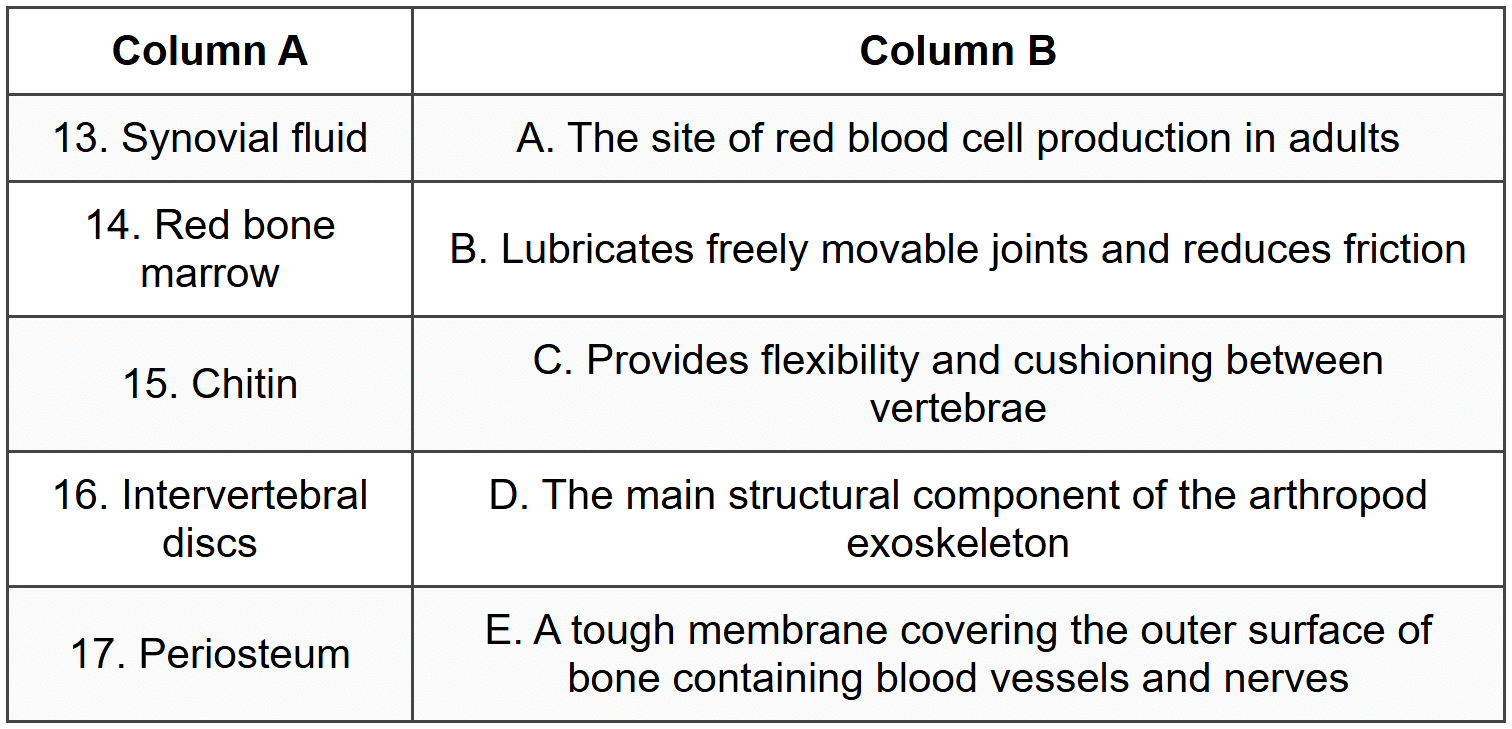
A4: Multiple Choice
(Total: 12 marks) 18. Thabo observes an earthworm moving across moist soil. The earthworm's body remains firm and cylindrical during movement. Which statement best explains how the earthworm maintains its body shape during locomotion?A. The exoskeleton provides rigid support that cannot change shape.
B. The hydrostatic skeleton uses fluid pressure in the coelom to maintain body shape while allowing flexibility.
C. The endoskeleton of bones provides a framework for muscle attachment.
D. The cartilaginous skeleton remains flexible but maintains a constant shape. 19. A scientist compares the skeletal systems of a grasshopper and a mouse. Which advantage does the mouse's endoskeleton have over the grasshopper's exoskeleton?
A. The endoskeleton provides better protection against predators.
B. The endoskeleton allows continuous growth without the need for moulting.
C. The endoskeleton is lighter and allows for faster movement.
D. The endoskeleton prevents water loss more effectively. 20. During a rugby match, Sipho fractures his femur. After six weeks in a cast, X-rays show that new bone tissue has formed at the fracture site. Which cells are primarily responsible for the formation of this new bone tissue?
A. Osteoclasts, which break down old bone and deposit new bone matrix.
B. Chondrocytes, which produce cartilage that later becomes bone.
C. Osteoblasts, which synthesise and secrete new bone matrix.
D. Osteocytes, which maintain the bone matrix and repair damage. 21. A veterinarian examines an elderly dog with arthritis in its hip joint. The cartilage covering the bone surfaces at the joint has worn away. Which consequence would most likely result from this cartilage loss?
A. Increased flexibility and range of movement at the joint.
B. Increased friction between bones causing pain and reduced movement.
C. Decreased production of synovial fluid in the joint cavity.
D. Fusion of the bones at the joint creating an immovable joint. 22. Researchers studying bone density find that astronauts who spend several months in space experience significant bone loss. Which explanation best accounts for this observation?
A. The absence of gravity reduces the stress on bones, decreasing osteoblast activity and increasing osteoclast activity.
B. The lack of oxygen in space prevents bone cells from carrying out cellular respiration.
C. Exposure to radiation in space destroys the periosteum covering the bones.
D. Muscles become stronger in space, placing too much stress on bones and causing them to break down.
SECTION B: DIAGRAM AND LABELLING QUESTIONS
(Total: 22 marks)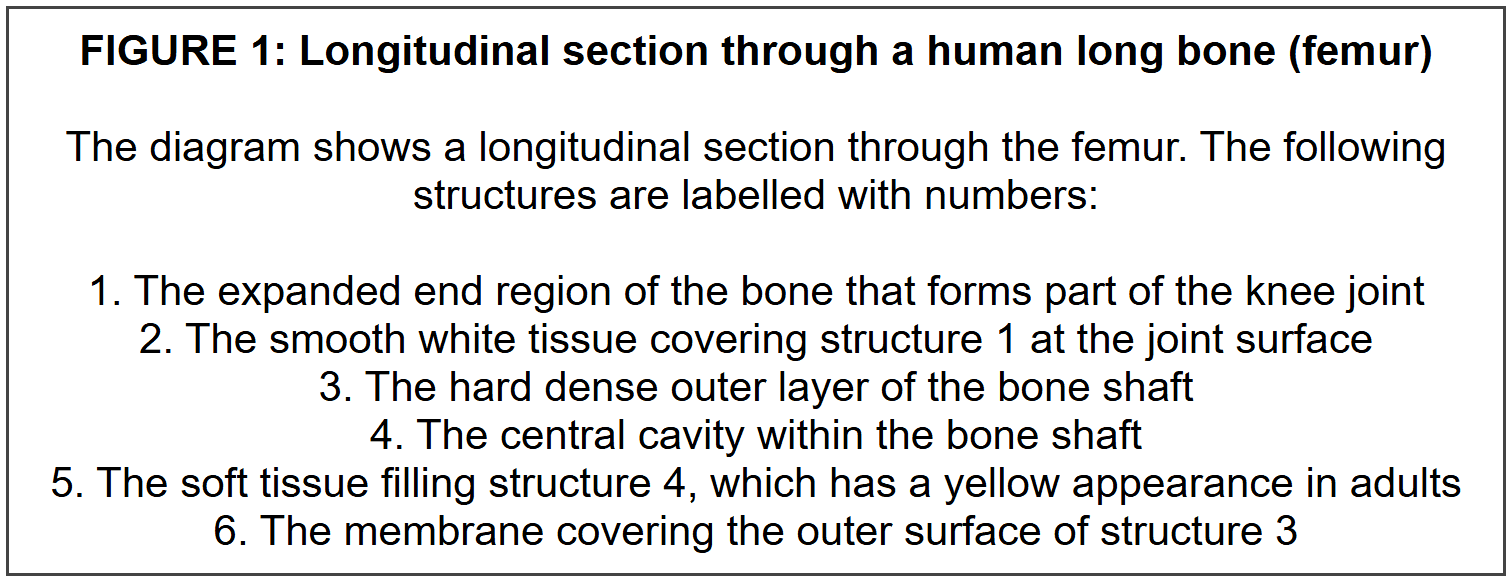 23. Identify the structures labelled 1 to 6 using the correct biological terms. 24. State the function of the structure labelled 2. 25. State the function of the structure labelled 3. 26. Explain what would happen to the bone if structure 6 was completely removed due to severe infection. Refer to at least two consequences in your answer. 27. The soft tissue at structure 5 changes in composition from red to yellow as a person ages. Explain the biological significance of this change and how it affects the function of the bone.
SECTION C: STRUCTURED QUESTIONS
(Total: 40 marks)Question 28: Bone Growth and Development
Lindiwe is a Grade 10 learner who wants to understand why children have more bones than adults. She learns that a human baby is born with approximately 270 bones, but an adult has only 206 bones. She also discovers that many bones in a newborn baby are made of cartilage rather than bone tissue. 28. (a) Name the process by which cartilage is converted into bone tissue during development. (b) Explain why newborn babies have many bones made of cartilage rather than fully formed bone tissue. (c) Explain how the number of bones decreases from 270 in a baby to 206 in an adult, even though no bones are lost or destroyed. (d) A child suffers from a genetic disorder that prevents osteoblasts from functioning properly. Predict and explain two effects this disorder would have on the child's skeletal development.Question 29: Comparison of Skeletal Systems
A biology class visits an aquarium and observes three different animals: a crayfish (Jasus lalandii), a shark, and a bony fish. The teacher explains that these animals have three different types of skeletal support systems. 29. (a) Identify the type of skeleton found in the crayfish and name one other animal phylum that has this type of skeleton. (b) The shark's skeleton is made entirely of cartilage, whereas the bony fish has a skeleton made of bone tissue. Compare these two types of skeletal material by stating one advantage and one disadvantage of a cartilaginous skeleton compared to a bony skeleton. (c) The crayfish must undergo a process called ecdysis (moulting) in order to grow. Explain why this process is necessary for growth in animals with this type of skeleton, and describe what happens to the animal immediately after moulting. (d) A student suggests that an exoskeleton is superior to an endoskeleton because it provides better protection. Evaluate this statement by discussing one advantage and one disadvantage of an exoskeleton compared to an endoskeleton, and reach a conclusion about which type of skeleton is more beneficial overall.SECTION D: SCIENTIFIC ESSAY
(Total: 20 marks) 30. Write a structured essay on the structure and function of a synovial joint in the human skeletal system. Your essay must include the following: 1. A description of the main structural components of a synovial joint, including the names of at least four structures and their arrangement. 2. An explanation of how each structural component you have named contributes to the function of the joint. 3. An explanation of how synovial joints allow movement while maintaining stability and preventing damage to bones. 4. A discussion of what happens when a synovial joint is damaged or diseased, using osteoarthritis as an example. 5. One example of a specific synovial joint in the human body, naming the bones that articulate at that joint. Mark allocation guide:Description of structural components with correct terminology (6 marks)
Explanation of how each structure contributes to joint function (6 marks)
Explanation of movement, stability, and protection (4 marks)
Discussion of joint damage or disease (2 marks)
Example of a specific synovial joint with correct bone names (2 marks) GRAND TOTAL: 120 marks
ANSWER KEY
Dear Student,
Well done for completing this worksheet on Support Systems in Animals. Before you check your answers, make sure you have attempted every question to the best of your ability. Use this answer key to mark your work honestly, and take note of where you need to improve your understanding. Pay special attention to the correct biological terminology, as using precise scientific language is essential for success in Life Sciences. Good luck!
SECTION A1 - Give the correct biological term
Question 1: ExoskeletonAn exoskeleton is an external skeleton found in arthropods such as insects and crustaceans, made of a hard material called chitin that provides support and protection from the outside of the body. Question 2: Ossification (or osteogenesis)
Ossification is the process during which cartilage tissue is gradually replaced by bone tissue as an animal grows and develops, resulting in a hard, mineralised skeleton. Question 3: Coelom (or hydrostatic skeleton is also acceptable)
The coelom is a fluid-filled body cavity that acts as a hydrostatic skeleton in soft-bodied animals like earthworms, providing support through fluid pressure while allowing flexibility. Question 4: Ligament
A ligament is a tough band of fibrous connective tissue that connects one bone to another at a joint, providing stability and limiting excessive movement. Question 5: Calcium phosphate (or hydroxyapatite)
Calcium phosphate is the main mineral compound deposited in the bone matrix, giving bones their characteristic hardness and strength. Question 6: Fibrous joint (or fixed joint or immovable joint or suture)
A fibrous joint is an immovable joint where bones are held tightly together by fibrous connective tissue, such as the joints between the skull bones. Question 7: Osteoclasts
Osteoclasts are specialised bone cells that break down and reabsorb old or damaged bone tissue, playing a key role in bone remodelling and calcium regulation. Question 8: Compact bone (or cortical bone)
Compact bone is the dense, hard outer layer of bone tissue that provides strength and protection to the bone and surrounds the inner spongy bone and marrow cavity.
SECTION A2 - True or False
Question 9: FALSEThe corrected word is exoskeleton.
The statement should read: "The endoskeleton of vertebrates grows with the animal, whereas the exoskeleton of arthropods must be shed periodically through moulting." An exoskeleton is rigid and cannot grow, so arthropods must moult (shed) their exoskeleton to increase in size. An endoskeleton, by contrast, grows continuously with the animal. Question 10: FALSE
The corrected phrase is no blood vessels (or lacks blood vessels).
The statement should read: "Cartilage is a flexible connective tissue that contains no blood vessels and heals slowly when damaged." Because cartilage is avascular (lacks blood vessels), nutrients and oxygen must diffuse through the matrix, which makes healing very slow compared to other tissues. Question 11: FALSE
The corrected word is ribs (or ribcage or sternum).
The statement should read: "The axial skeleton in humans includes the skull, vertebral column, and ribs." The axial skeleton forms the central axis of the body and includes the skull, vertebral column, ribs, and sternum. The limbs are part of the appendicular skeleton, not the axial skeleton. Question 12: TRUE
This statement is correct. Osteocytes are mature bone cells that are embedded in the bone matrix within small spaces called lacunae, where they maintain the bone tissue.
SECTION A3 - Match Column A to Column B
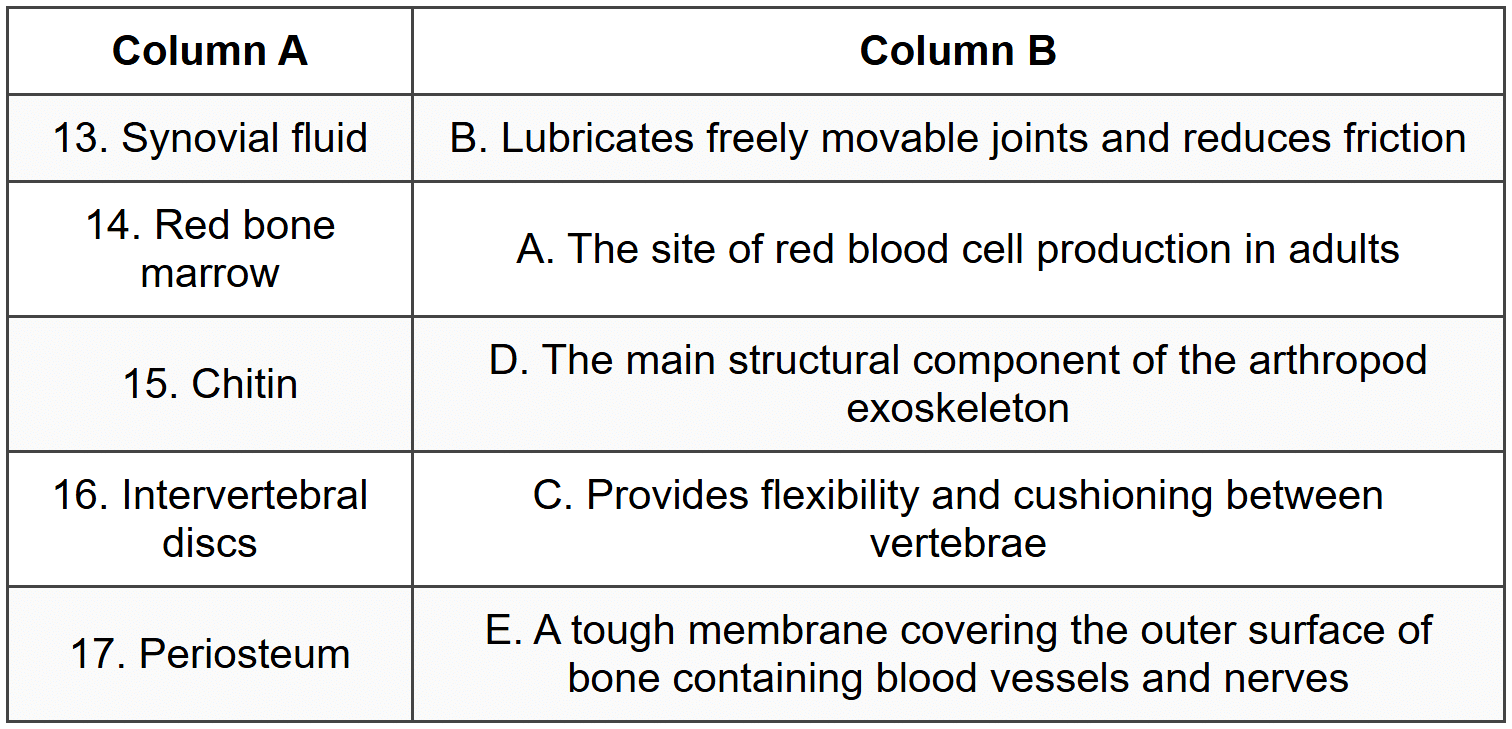 Question 13: 13 - B
Synovial fluid is a viscous liquid found in synovial joints that lubricates the joint surfaces, reduces friction during movement, and nourishes the cartilage. Question 14: 14 - A
Red bone marrow is the soft tissue found inside certain bones where haematopoiesis (the production of red blood cells, white blood cells, and platelets) occurs. Question 15: 15 - D
Chitin is a tough, nitrogen-containing polysaccharide that forms the main structural material of the arthropod exoskeleton, providing strength and protection. Question 16: 16 - C
Intervertebral discs are pads of cartilage located between the vertebrae in the spine that absorb shock, provide cushioning, and allow flexibility of the vertebral column. Question 17: 17 - E
The periosteum is a dense fibrous membrane that covers the outer surface of bones, containing blood vessels that supply nutrients and nerves that sense pain.
SECTION A4 - Multiple Choice
Question 18: B - The hydrostatic skeleton uses fluid pressure in the coelom to maintain body shape while allowing flexibility.Earthworms are annelids that lack a hard skeleton. Instead, they have a hydrostatic skeleton in which fluid in the coelom is held under pressure by muscles in the body wall. This provides support and maintains body shape while still allowing the flexibility needed for movement through soil. Option A is incorrect because earthworms do not have an exoskeleton. Options C and D are incorrect because earthworms do not possess an endoskeleton or a cartilaginous skeleton. Question 19: B - The endoskeleton allows continuous growth without the need for moulting.
The mouse has an endoskeleton (internal skeleton) made of bone, which grows continuously as the animal grows, because living bone tissue is remodelled throughout life. In contrast, the grasshopper's exoskeleton is rigid and non-living, so it must be shed periodically through moulting to allow the animal to increase in size. Option A is incorrect because exoskeletons generally provide better protection than endoskeletons. Option C is incorrect because exoskeletons are often lighter. Option D is incorrect because exoskeletons, not endoskeletons, are better at preventing water loss. Question 20: C - Osteoblasts, which synthesise and secrete new bone matrix.
Osteoblasts are the bone cells responsible for producing and secreting new bone matrix during bone growth and repair. When a fracture occurs, osteoblasts become active at the fracture site and lay down new bone tissue to heal the break. Option A is incorrect because osteoclasts break down bone, they do not build it. Option B is partially correct in that cartilage may form initially, but it is the osteoblasts that produce the final bone tissue. Option D is incorrect because osteocytes are mature bone cells that maintain bone, but they do not actively produce large amounts of new bone matrix. Question 21: B - Increased friction between bones causing pain and reduced movement.
Articular cartilage covers the ends of bones at synovial joints and provides a smooth, slippery surface that reduces friction during movement. When this cartilage wears away, the bone surfaces rub directly against each other, causing increased friction, pain, inflammation, and reduced movement. This is characteristic of osteoarthritis. Option A is incorrect because loss of cartilage decreases, not increases, flexibility. Option C may occur secondarily but is not the primary consequence. Option D is incorrect because bone fusion is not a direct result of cartilage loss. Question 22: A - The absence of gravity reduces the stress on bones, decreasing osteoblast activity and increasing osteoclast activity.
Bone tissue is constantly being remodelled in response to mechanical stress. Weight-bearing activity stimulates osteoblasts to build bone. In the microgravity environment of space, bones experience much less mechanical stress, so osteoblast activity decreases and osteoclast activity (bone breakdown) may increase or remain constant, leading to a net loss of bone density. Option B is incorrect because astronauts have oxygen supplied in the spacecraft. Option C is incorrect because radiation does not specifically destroy the periosteum. Option D is incorrect because muscles actually become weaker in space, not stronger.
SECTION B - Diagram and Labelling Questions
Question 23: Identification of structures 1 to 61. Epiphysis (or head of the bone)
2. Articular cartilage (or hyaline cartilage)
3. Compact bone (or cortical bone)
4. Medullary cavity (or marrow cavity)
5. Yellow bone marrow (or yellow marrow)
6. Periosteum Each correct identification earns 1 mark. The use of the exact biological term is essential; general descriptions such as "end of bone" or "covering" will not earn full marks. Question 24: Function of structure 2 (articular cartilage)
Model answer: Articular cartilage covers the ends of bones at the joint surface and provides a smooth, slippery surface that reduces friction during movement. It also absorbs shock and prevents damage to the underlying bone during weight-bearing activities.
Marking note: The answer must mention reduction of friction and/or shock absorption to earn full marks (2 marks). General statements like "helps movement" earn only 1 mark. Question 25: Function of structure 3 (compact bone)
Model answer: Compact bone forms the hard, dense outer layer of the bone that provides structural strength and support to the bone. It protects the inner structures of the bone and resists the stresses produced during movement and weight-bearing.
Marking note: The answer must mention strength, support, or protection to earn full marks (2 marks). The term compact bone must be used. Question 26: Consequences if structure 6 (periosteum) is removed
Model answer: If the periosteum is completely removed, the bone would lose its blood supply because the periosteum contains blood vessels that deliver oxygen and nutrients to bone tissue. This would result in death of osteocytes and impaired bone repair and growth. Additionally, the bone would lose its source of new osteoblasts, which are produced by the periosteum, so the bone would be unable to heal fractures or remodel itself in response to stress.
Marking note: A full-mark answer (4 marks) must mention at least two consequences: (1) loss of blood supply leading to bone cell death, and (2) loss of osteoblast production leading to impaired healing/growth. Key terms required: periosteum, blood vessels, osteoblasts, osteocytes. A partial answer mentioning only one consequence earns 2 marks. Question 27: Significance of red to yellow marrow change
Model answer: In children, red bone marrow is found in many bones and is the site of haematopoiesis (production of blood cells). As a person ages, much of the red marrow in long bones is replaced by yellow bone marrow, which consists mainly of adipose tissue (fat) and serves as an energy store rather than producing blood cells. This change reflects the decreased demand for blood cell production as growth slows, and red marrow becomes concentrated in fewer bones such as the pelvis, sternum, and vertebrae where blood cell production continues throughout life.
Marking note: A full-mark answer (4 marks) must explain (1) the function of red marrow (haematopoiesis), (2) the composition and function of yellow marrow (adipose tissue for energy storage), and (3) the biological reason for the change (reduced need for blood cell production with age). Key terms required: red bone marrow, yellow bone marrow, haematopoiesis, adipose tissue.
SECTION C - Structured Questions
Question 28(a): Name the process of cartilage to bone conversionAnswer: Ossification (or endochondral ossification)
Marking note: The term ossification is essential for the mark. "Bone formation" alone is too vague and will not earn the mark. (2 marks) Question 28(b): Why newborns have cartilage rather than bone
Model answer: Newborn babies have many bones made of cartilage rather than bone because cartilage is more flexible and can compress, which is essential during childbirth to allow the baby to pass through the birth canal without injury. Cartilage is also lighter and allows for rapid growth during early development. As the baby grows, the cartilage is gradually replaced by bone through ossification.
Marking note: A full-mark answer (3 marks) must mention (1) flexibility for childbirth, (2) allowance for growth, and (3) the term ossification. An answer mentioning only one reason earns 1 mark; two reasons earn 2 marks. Question 28(c): How bone number decreases from 270 to 206
Model answer: The number of bones decreases from 270 to 206 because many separate bones in babies gradually fuse together as the child grows and matures. For example, the skull of a newborn consists of several separate bone plates separated by fontanelles (soft spots) that allow for brain growth and flexibility during birth. As the child develops, these bones fuse together at sutures to form a single, solid skull. Similarly, some bones in the spine and pelvis fuse during growth.
Marking note: A full-mark answer (4 marks) must explain that bones fuse together (not disappear), provide at least one example (skull or pelvis), and use correct terminology such as fontanelles or sutures. The term fusion is essential. Question 28(d): Effects of non-functioning osteoblasts
Model answer: If osteoblasts do not function properly, the child's bones would not form correctly or grow properly because osteoblasts are responsible for producing and secreting new bone matrix. One effect would be that ossification would not occur, so the skeleton would remain largely cartilaginous, weak, and unable to support the body's weight. A second effect would be that bones would be unable to increase in thickness or repair fractures, leading to frequent breaks and deformities. The child would suffer from a condition similar to osteogenesis imperfecta or rickets, with severe skeletal abnormalities.
Marking note: A full-mark answer (4 marks) must predict and explain two distinct effects with correct biological reasoning. Key terms required: osteoblasts, bone matrix, ossification. Each effect with explanation earns 2 marks. Question 29(a): Type of skeleton in crayfish and another example
Answer: The crayfish has an exoskeleton. Another animal phylum with an exoskeleton is Insecta (or Arthropoda as a broader answer, or any specific insect such as beetles, or crustaceans).
Marking note: 1 mark for exoskeleton, 1 mark for a correct example. (2 marks total) Question 29(b): Compare cartilaginous and bony skeletons
Model answer: One advantage of a cartilaginous skeleton is that cartilage is lighter than bone, which makes the shark more buoyant and reduces the energy needed for swimming. One disadvantage is that cartilage is more flexible and less rigid than bone, so it provides less structural support and protection, and cannot support the weight of a large body on land.
Marking note: A full-mark answer (4 marks) must state one clear advantage and one clear disadvantage, each with a brief explanation. Key terms: cartilage, bone, buoyancy or lighter, flexibility, support. Each advantage and disadvantage is worth 2 marks. Question 29(c): Why moulting is necessary and what happens after
Model answer: Moulting (or ecdysis) is necessary because the exoskeleton is rigid and non-living, so it cannot expand or grow as the animal inside grows. To increase in size, the crayfish must shed its old exoskeleton and secrete a new, larger one. Immediately after moulting, the animal's body is soft and vulnerable to predators because the new exoskeleton has not yet hardened. During this time, the animal absorbs water to expand its body to a larger size before the new exoskeleton hardens through the deposition of chitin and minerals.
Marking note: A full-mark answer (5 marks) must explain (1) why moulting is necessary (rigid exoskeleton cannot grow), (2) what happens immediately after (soft body, vulnerable), and (3) how the new skeleton forms (expansion and hardening). Key terms: moulting, exoskeleton, chitin. Explanation of necessity: 2 marks; description of post-moult state: 3 marks. Question 29(d): Evaluate exoskeleton vs endoskeleton
Model answer: One advantage of an exoskeleton is that it provides excellent protection from predators, physical injury, and water loss because it forms a hard outer covering over the entire body. One disadvantage is that the exoskeleton limits growth and requires moulting, during which the animal is vulnerable and cannot feed or move effectively. An endoskeleton, by contrast, allows continuous growth without moulting, supports larger body size, and permits greater flexibility and range of movement. However, it provides less protection to internal organs. Overall, an endoskeleton is more beneficial for large, active animals such as vertebrates because it supports greater body mass and allows more efficient movement, while an exoskeleton is more beneficial for small animals like arthropods that require protection and can tolerate the constraints of moulting.
Marking note: A full-mark answer (6 marks) must include (1) one advantage of exoskeleton with explanation (2 marks), (2) one disadvantage of exoskeleton with explanation (2 marks), and (3) a reasoned conclusion comparing the two and stating which is more beneficial in a particular context (2 marks). Key terms: exoskeleton, endoskeleton, moulting, protection, growth. Answers that simply list points without evaluation or conclusion earn a maximum of 4 marks.
SECTION D - Scientific Essay
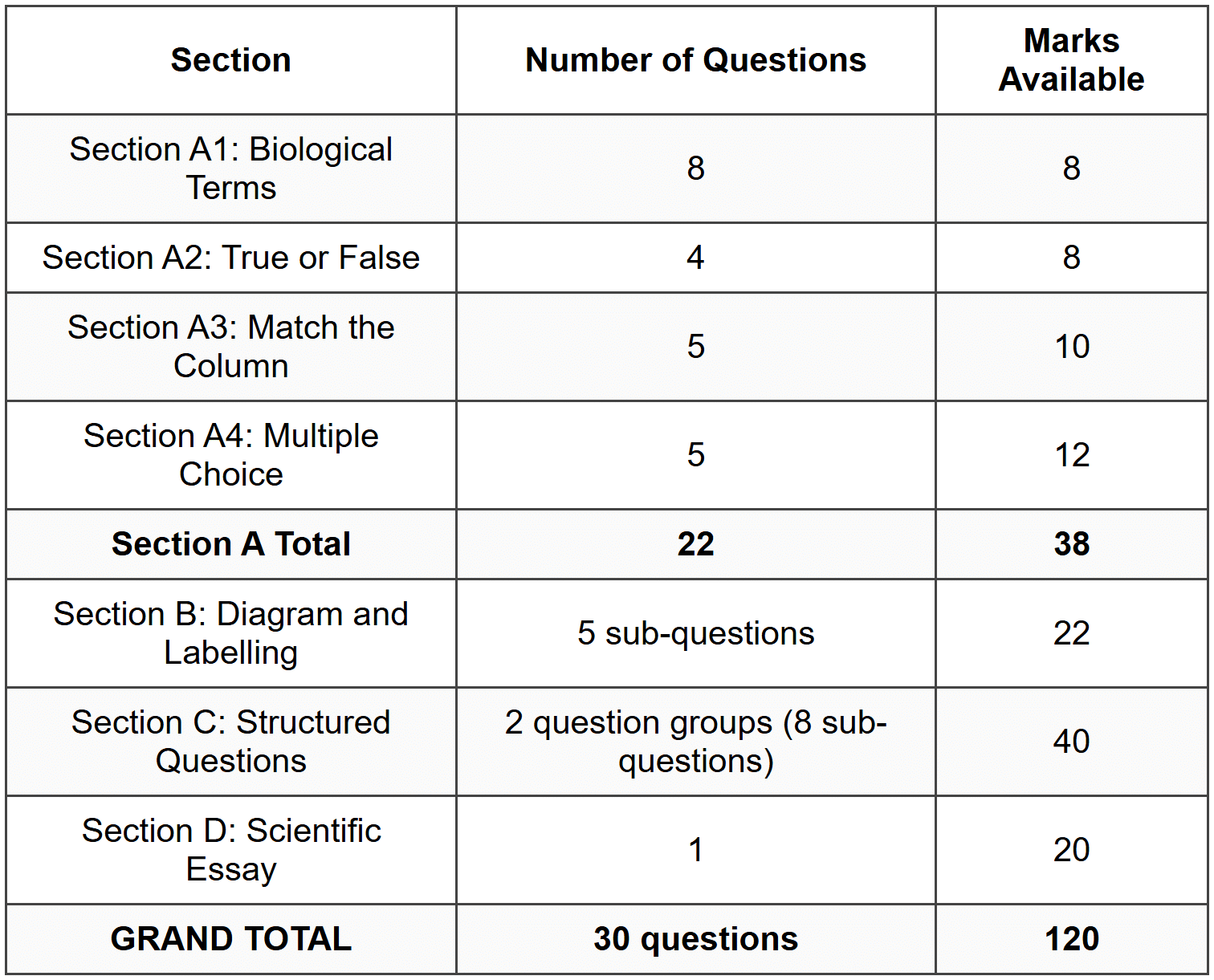
Question 30: Structure and function of a synovial joint Model Essay Answer: A synovial joint is a freely movable joint found in the human skeletal system, such as the knee, elbow, shoulder, and hip. These joints have a complex structure that allows a wide range of movement while maintaining stability and protecting the bones from damage. 1. Structural components of a synovial joint: A synovial joint consists of several key structures. The ends of the two bones that meet at the joint are called the articulating surfaces. Each articulating surface is covered by a layer of smooth, white articular cartilage (also called hyaline cartilage). Surrounding the joint is a tough, fibrous joint capsule (or articular capsule) that encloses the joint cavity and holds the bones together. The inner lining of the joint capsule is called the synovial membrane, which secretes a viscous fluid called synovial fluid into the joint cavity (or synovial cavity). The bones are held together at the joint by strong bands of connective tissue called ligaments, which are attached to the bones on either side of the joint. 2. How each component contributes to joint function: The articular cartilage provides a smooth, slippery surface that reduces friction between the bones during movement and absorbs shock during weight-bearing activities such as walking or running. The synovial fluid lubricates the joint, further reducing friction, and also provides nutrients and oxygen to the cartilage, which lacks its own blood supply. The joint capsule encloses and stabilises the joint, preventing dislocation. The synovial membrane produces synovial fluid and removes waste products from the joint cavity. The ligaments hold the bones in the correct position and prevent excessive or abnormal movement that could damage the joint. 3. How synovial joints allow movement while maintaining stability: Synovial joints allow a wide range of movement because the articular cartilage and synovial fluid reduce friction to almost zero, permitting bones to glide smoothly over one another. At the same time, the ligaments and joint capsule limit the range of movement and prevent dislocation, maintaining stability. Muscles attached to the bones via tendons contract to produce movement, while the structure of the joint and the ligaments ensure that movement occurs only in the appropriate directions. This balance between mobility and stability is essential for coordinated, controlled movement. 4. What happens when a synovial joint is damaged (osteoarthritis): When a synovial joint is damaged or diseased, such as in osteoarthritis, the articular cartilage gradually wears away due to aging, overuse, or injury. As the cartilage thins, the bones begin to rub directly against each other, causing pain, inflammation, and reduced movement. The synovial membrane may become inflamed and produce excess fluid, causing swelling. Over time, the joint may become deformed and lose its function. 5. Example of a specific synovial joint: An example of a synovial joint is the knee joint, where the femur (thigh bone) articulates with the tibia (shin bone). This is a hinge joint that allows flexion and extension of the lower leg. Marker's note on common errors: Students often lose marks in essay questions on synovial joints by: - Using general terms like "cushioning" or "padding" instead of articular cartilage - Failing to mention synovial fluid or its function in lubrication and nutrition - Confusing ligaments (bone to bone) with tendons (muscle to bone) - Describing movement without explaining the role of cartilage and fluid in reducing friction - Not providing a specific example of a joint or naming the bones incorrectly - Writing about joints in general rather than specifically about synovial joints - Not using the term articulating surfaces or articular cartilage To earn full marks, students must use precise biological terminology throughout, structure the essay according to the numbered requirements, and demonstrate understanding of both structure and function with clear cause-and-effect reasoning. Mark breakdown: - Description of structural components (articular cartilage, synovial fluid, joint capsule, synovial membrane, ligaments) with correct terminology: 6 marks (awarded for naming at least 4 structures and describing their arrangement) - Explanation of how each structure contributes to function (friction reduction, lubrication, stability, shock absorption): 6 marks (awarded for linking each named structure to a specific function) - Explanation of movement, stability, and protection (balance between mobility and stability, role of ligaments and capsule): 4 marks - Discussion of osteoarthritis (cartilage wear, bone-on-bone friction, pain, inflammation, loss of function): 2 marks - Example of specific joint with correct bone names (e.g., knee joint: femur and tibia): 2 marksMark Allocation Summary Table
Remember to review any questions you got wrong and make sure you understand the correct biological terminology. Pay special attention to the difference between similar terms like osteoblasts and osteoclasts, or ligaments and tendons. Well done on completing this assessment, and keep up the excellent work in Life Sciences!