Grade 10 Exam > Grade 10 Notes > Life Sciences > Cells: the Basic Units of Life
Cells: the Basic Units of Life

# Grade 10 Life Sciences Worksheet ## SECTION A: SHORT QUESTIONS (Total: 28 marks) ### A1: Biological Terms (Total: 4 marks) **1.** The process by which a cell divides to produce two genetically identical daughter cells, each containing the same number of chromosomes as the parent cell. **2.** The semi-permeable membrane that controls the movement of substances into and out of the cell. **3.** The organelle responsible for aerobic cellular respiration, often described as the powerhouse of the cell. **4.** The shrinking of the cytoplasm away from the cell wall in a plant cell due to the loss of water by osmosis. ### A2: True or False (Total: 8 marks) **5.** Prokaryotic cells contain a well-defined nucleus surrounded by a nuclear membrane. **6.** The rough endoplasmic reticulum is studded with ribosomes and is responsible for lipid synthesis. **7.** Mitosis is the process by which gametes are produced with half the number of chromosomes of the parent cell. **8.** Lysosomes contain digestive enzymes that break down worn-out organelles and foreign material. ### A3: Match the Column (Total: 5 marks) 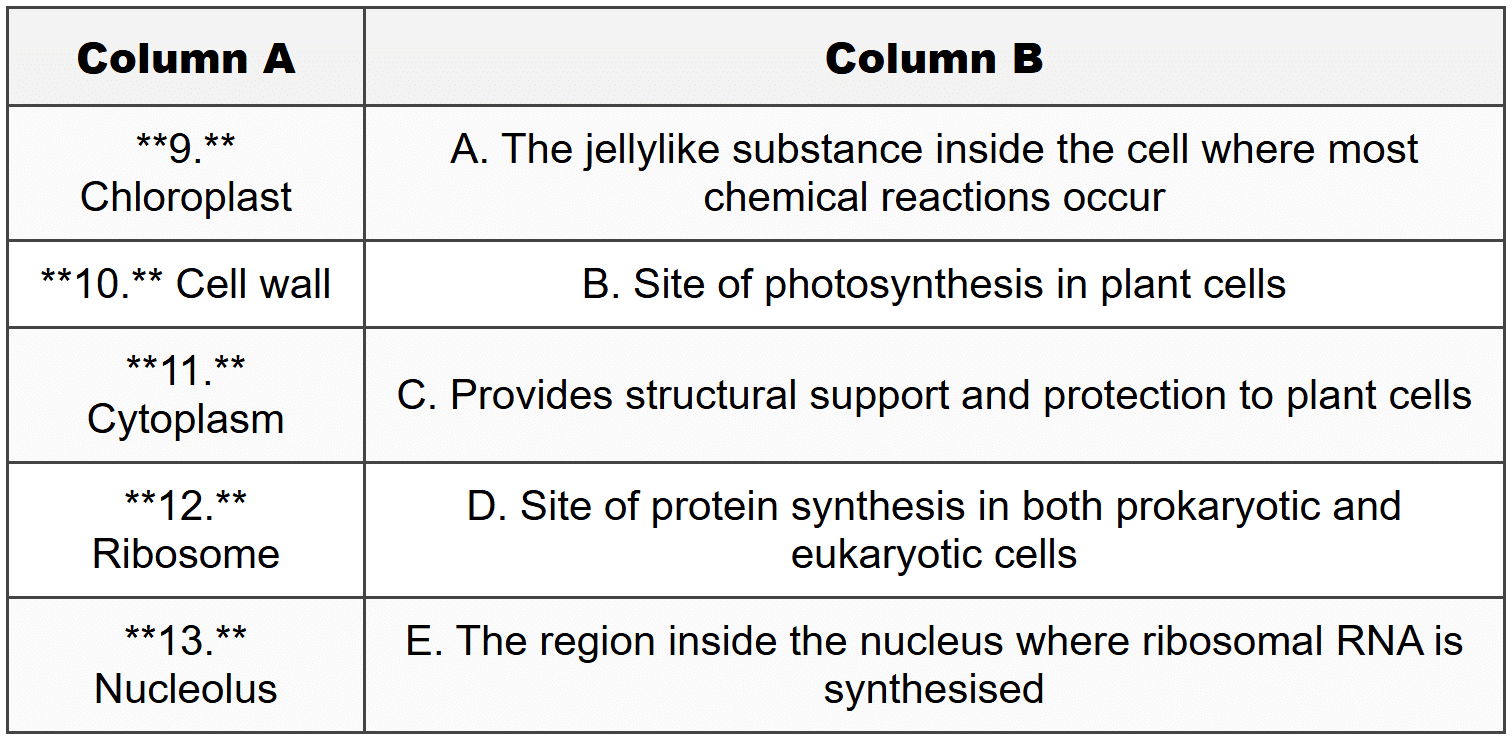 ### A4: Multiple Choice (Total: 11 marks) **14.** Thando examines a cell under a microscope and observes that it contains a cell wall, chloroplasts, and a large central vacuole. The cell lacks centrioles. Which of the following organisms is Thando most likely observing? A. Paramecium caudatum
B. Escherichia coli
C. Spirogyra species
D. Human epithelial tissue **15.** During an investigation, Naledi places plant cells in a solution with a higher water concentration than the cell sap. After 30 minutes, she observes that the cells have become swollen and firm. Which of the following best explains this observation? A. Water moved out of the cells by osmosis, causing the cells to become plasmolysed
B. Water moved into the cells by active transport, increasing turgor pressure
C. Water moved into the cells by osmosis, causing the cells to become turgid
D. Solutes moved out of the cells by diffusion, reducing osmotic pressure **16.** A scientist treats cells with a chemical that destroys all mitochondria. Which cellular process would be most immediately and severely affected? A. Protein synthesis at the ribosomes
B. Photosynthesis in the chloroplasts
C. Aerobic respiration and ATP production
D. DNA replication in the nucleus **17.** Sipho compares a prokaryotic cell with a eukaryotic cell. Which of the following structures would be present in the eukaryotic cell but absent in the prokaryotic cell? A. Cell membrane
B. Ribosomes
C. Genetic material
D. Membrane-bound organelles **18.** A plant cell is placed in a hypertonic solution. Which of the following sequences correctly describes the resulting process? A. Water moves into the cell → cell becomes turgid → turgor pressure increases
B. Water moves out of the cell → cytoplasm shrinks → cell becomes plasmolysed
C. Solutes move into the cell → osmotic pressure decreases → cell becomes flaccid
D. Solutes move out of the cell → water follows by active transport → cell wall collapses ## SECTION B: DIAGRAM AND LABELLING QUESTIONS (Total: 17 marks)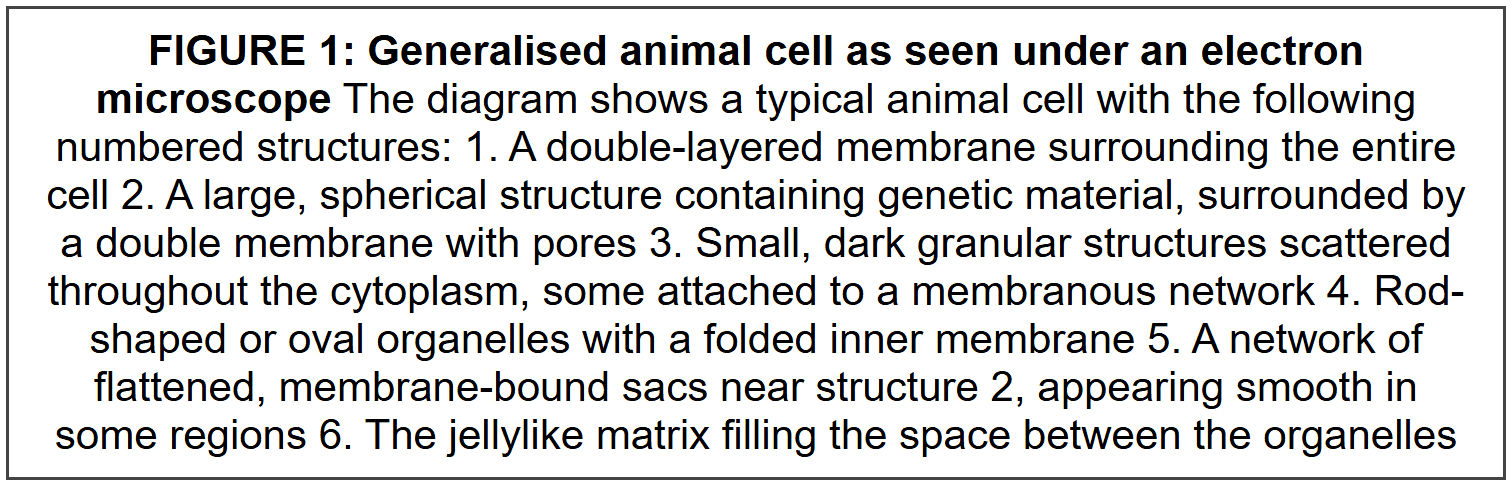 **19.** (a) Identify each of the numbered structures (1 to 6) shown in FIGURE 1 by stating the correct biological term. (b) State the function of structure 4 and structure 5. (c) Explain what would happen to the cell's ability to synthesise proteins if structure 3 was completely absent from the cell. (d) A student observes FIGURE 1 and concludes that this cannot be a plant cell. Provide two structural features visible in FIGURE 1 that support this conclusion. ## SECTION C: STRUCTURED QUESTIONS (Total: 30 marks) ### C1: Osmosis and Cell Turgidity (Total: 15 marks) Lerato conducts an experiment by placing pieces of potato tissue in three different solutions for two hours. She measures the mass of each piece before and after immersion. Solution A is distilled water, Solution B is a dilute salt solution, and Solution C is a concentrated salt solution. After two hours, the potato piece in Solution A has increased in mass, the piece in Solution B shows no change in mass, and the piece in Solution C has decreased in mass. **20.** (a) Define the biological term osmosis. (b) Explain why the potato piece in Solution A increased in mass, using correct biological terminology. (c) The potato piece in Solution B showed no change in mass. What does this indicate about the water concentration of Solution B relative to the cell sap of the potato cells? (d) Predict and explain what would happen to the appearance and texture of the cells in the potato piece placed in Solution C when viewed under a microscope. (e) Explain why plant cells do not burst when placed in a hypotonic solution, whereas animal cells may undergo lysis under the same conditions. ### C2: Cell Division and Growth (Total: 15 marks) Bongi is studying the process by which multicellular organisms grow and repair damaged tissues. She learns that a specific type of nuclear division ensures that each new cell receives an identical set of genetic instructions. She observes prepared slides showing cells at different stages of this division process. **21.** (a) Name the type of nuclear division Bongi is studying. (b) State the biological importance of this type of cell division in living organisms. (c) During one stage of this division process, the chromatin condenses into visible chromosomes, and the nuclear membrane disintegrates. Name this stage. (d) Bongi observes a cell where the chromosomes are aligned along the equator of the cell, attached to spindle fibres. Explain what will happen immediately after this stage and why this is essential for producing genetically identical daughter cells. (e) A certain chemical disrupts the formation of spindle fibres during cell division. Predict the effect this chemical would have on the distribution of chromosomes to the daughter cells, and explain your reasoning. ## SECTION D: SCIENTIFIC ESSAY (Total: 20 marks) **22.** Write a structured essay on the structure and function of the cell membrane and the processes of diffusion and osmosis in maintaining cellular homeostasis. Your essay must include the following: 1. A description of the structure of the cell membrane, including the arrangement of phospholipids and proteins. 2. An explanation of the function of the cell membrane as a selectively permeable barrier. 3. A detailed explanation of the process of diffusion, including reference to concentration gradient and molecular movement. 4. A detailed explanation of the process of osmosis, including the movement of water molecules across a semi-permeable membrane. 5. An explanation of how diffusion and osmosis contribute to maintaining homeostasis in cells. 6. At least one relevant example from a named organism (using correct binomial nomenclature) to illustrate the importance of these processes. Mark allocation guide:
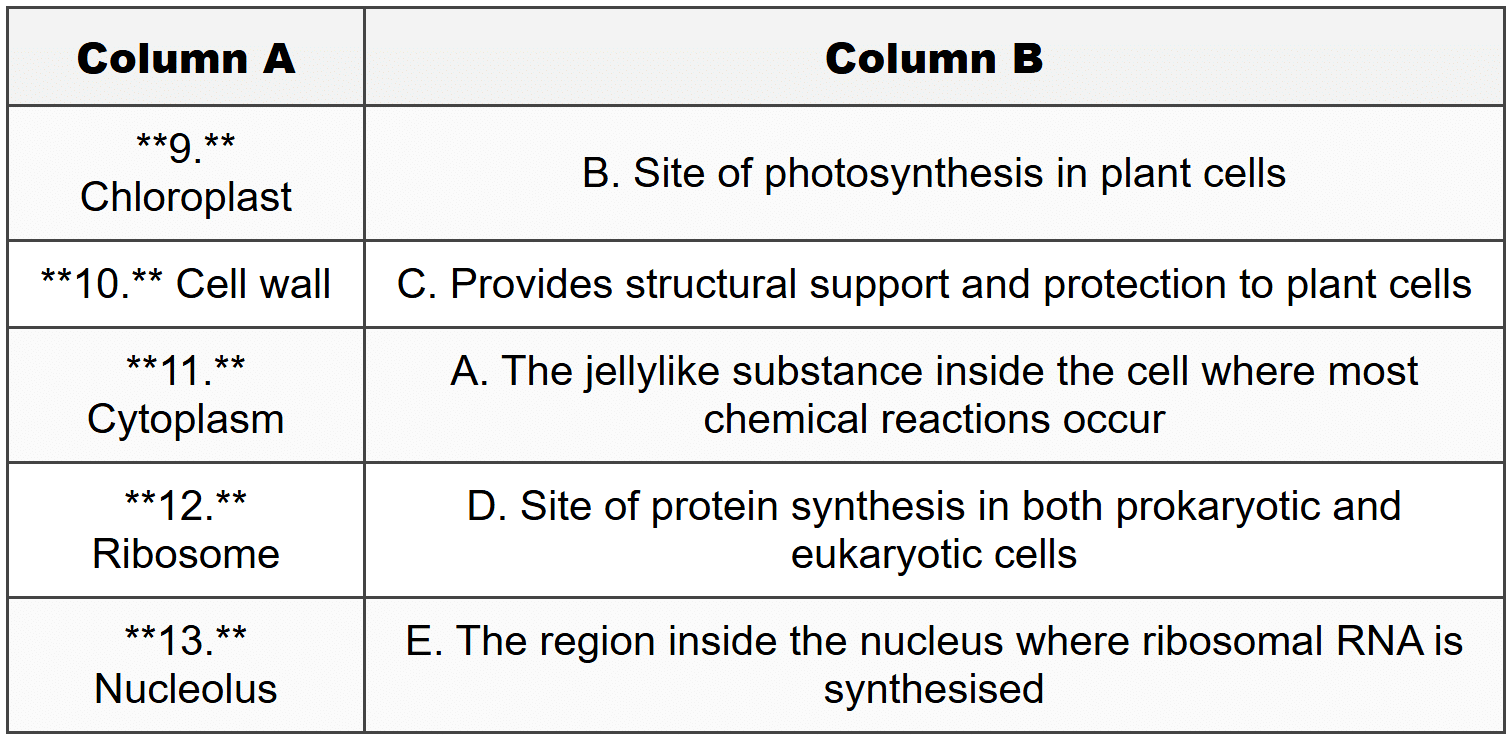 **9.** Chloroplasts contain the green pigment chlorophyll and are the sites where light energy is converted into chemical energy during photosynthesis. **10.** The cell wall is made of cellulose in plant cells and provides rigidity, structural support, and protection against mechanical damage and pathogens. **11.** The cytoplasm is the site where many metabolic reactions occur, including glycolysis, and it suspends the organelles within the cell. **12.** Ribosomes are composed of ribosomal RNA and proteins, and they translate messenger RNA into polypeptide chains during protein synthesis. **13.** The nucleolus is located inside the nucleus and is responsible for assembling ribosomal RNA with ribosomal proteins to form ribosome subunits. --- ### SECTION A4 - Question 14 C. Spirogyra species Spirogyra is a filamentous green alga (a plant-like organism) that possesses a cell wall, chloroplasts for photosynthesis, and a large central vacuole. Plant cells lack centrioles, which are found in animal cells. Paramecium is a unicellular animal-like protist, Escherichia coli is a prokaryotic bacterium, and human epithelial tissue consists of animal cells, all of which would not have all the features Thando observed. (2 marks for correct answer; 1 mark deducted if reasoning is unclear) ### SECTION A4 - Question 15 C. Water moved into the cells by osmosis, causing the cells to become turgid When plant cells are placed in a hypotonic solution (higher water concentration outside the cell), water moves into the cells by osmosis down the concentration gradient. This causes the vacuole to swell, pushing the cytoplasm against the cell wall, creating turgor pressure and making the cells turgid (firm). Active transport requires energy and is not the mechanism for water movement; plasmolysis occurs when cells are placed in hypertonic solutions. (3 marks for correct answer and explanation) ### SECTION A4 - Question 16 C. Aerobic respiration and ATP production Mitochondria are the sites of aerobic cellular respiration, where glucose is oxidised in the presence of oxygen to produce ATP (adenosine triphosphate), the energy currency of the cell. Without mitochondria, the cell cannot efficiently produce ATP through aerobic respiration, severely limiting energy availability for cellular processes. Protein synthesis occurs at ribosomes, photosynthesis in chloroplasts, and DNA replication in the nucleus, none of which directly depend on mitochondria. (2 marks) ### SECTION A4 - Question 17 D. Membrane-bound organelles Eukaryotic cells contain membrane-bound organelles such as the nucleus, mitochondria, endoplasmic reticulum, Golgi apparatus, and lysosomes. Prokaryotic cells lack these membrane-bound organelles. Both prokaryotic and eukaryotic cells possess a cell membrane, ribosomes, and genetic material (DNA), although the organisation of these structures differs between the two cell types. (2 marks) ### SECTION A4 - Question 18 B. Water moves out of the cell → cytoplasm shrinks → cell becomes plasmolysed A hypertonic solution has a lower water concentration (higher solute concentration) than the cell sap. Water therefore moves out of the plant cell by osmosis down the concentration gradient. As water leaves, the cytoplasm shrinks and pulls away from the cell wall, a process called plasmolysis. The cell becomes flaccid first, then plasmolysed if water loss continues. Option A describes a hypotonic solution; options C and D incorrectly describe solute movement and mechanisms. (2 marks) --- ### SECTION B - Question 19(a) **Identification of structures 1 to 6:** 1. Cell membrane (also acceptable: plasma membrane) 2. Nucleus 3. Ribosomes 4. Mitochondrion (plural: mitochondria) 5. Endoplasmic reticulum (accept smooth endoplasmic reticulum or ER) 6. Cytoplasm Each correct biological term earns 1 mark. Students must use the exact term, not a description. (6 marks) ### SECTION B - Question 19(b) Function of structure 4 (Mitochondrion): The mitochondrion is the site of aerobic cellular respiration, where glucose is broken down in the presence of oxygen to release energy in the form of ATP (adenosine triphosphate). This energy is used for all energy-requiring processes in the cell. Function of structure 5 (Endoplasmic reticulum): The endoplasmic reticulum is involved in the synthesis, processing, and transport of proteins (rough ER) and lipids (smooth ER). It also serves as a transport system, moving substances from one part of the cell to another. For full marks, students must mention the specific process (aerobic respiration for mitochondrion; synthesis/processing/transport for ER) and use correct biological terminology. (4 marks: 2 marks per structure) ### SECTION B - Question 19(c) Model answer: If ribosomes (structure 3) were completely absent, the cell would be unable to synthesise proteins. Ribosomes are the sites of protein synthesis, where messenger RNA is translated into polypeptide chains. Without proteins, the cell could not produce enzymes, which are essential for controlling metabolic reactions, nor could it produce structural proteins needed for cell growth, repair, and function. The cell would eventually die because proteins are essential for virtually all cellular processes. Full-mark answer must include: inability to synthesise proteins, reference to ribosomes as sites of protein synthesis, and at least one consequence (e.g., no enzymes, no cell structure, cell death). A partial-mark answer might only state "no protein synthesis" without explaining the biological consequence. (4 marks) ### SECTION B - Question 19(d) Model answer: **Two structural features that indicate this is not a plant cell:** 1. The cell lacks a cell wall surrounding the cell membrane. Plant cells have a rigid cellulose cell wall outside the cell membrane that provides structural support and protection. 2. The cell lacks chloroplasts, which are present in photosynthetic plant cells and contain the green pigment chlorophyll needed for photosynthesis. (Alternative acceptable answer: The cell lacks a large permanent central vacuole, which is a prominent feature of mature plant cells and stores cell sap.) For full marks, students must name two structures absent from the diagram that are characteristic of plant cells, using correct biological terminology. (3 marks: 1.5 marks per feature, or 1 mark for naming the structure and 0.5 marks for explaining its significance) --- ### SECTION C1 - Question 20(a) Osmosis is the net movement of water molecules from a region of higher water concentration (or lower solute concentration) to a region of lower water concentration (or higher solute concentration) through a semi-permeable membrane. The definition must include: water molecules, concentration gradient (or water potential gradient), and semi-permeable membrane. (3 marks) ### SECTION C1 - Question 20(b) Model answer: The potato piece in Solution A (distilled water) increased in mass because water moved into the potato cells by osmosis. Distilled water has a higher water concentration than the cell sap inside the potato cells (distilled water is a hypotonic solution). Water molecules move down the concentration gradient through the semi-permeable cell membrane into the cells, causing the cells to become turgid and increasing the mass of the potato piece. Essential biological terms for full marks: osmosis, hypotonic solution (or higher water concentration), concentration gradient, semi-permeable membrane, and turgid. General language such as "water went in" will not earn full marks. (4 marks) ### SECTION C1 - Question 20(c) Model answer: If the potato piece in Solution B showed no change in mass, this indicates that Solution B has the same water concentration (or same solute concentration) as the cell sap of the potato cells. The solution is isotonic to the cell sap. There is no net movement of water into or out of the cells because there is no concentration gradient, so the cells remain in a state of dynamic equilibrium. The answer must state that the solution is isotonic or has the same water/solute concentration as the cell sap. (2 marks) ### SECTION C1 - Question 20(d) Model answer: The cells in the potato piece placed in Solution C (concentrated salt solution) would undergo plasmolysis. Solution C is hypertonic to the cell sap (lower water concentration outside the cell). Water moves out of the cells by osmosis down the concentration gradient. The vacuole shrinks, and the cytoplasm pulls away from the cell wall. Under the microscope, the cells would appear shrunken, with a visible gap between the cytoplasm and the cell wall. The potato tissue would feel soft and flaccid because turgor pressure has been lost. Essential terms for full marks: plasmolysis, hypertonic, osmosis, cytoplasm shrinks/pulls away from cell wall, loss of turgor pressure. (4 marks) ### SECTION C1 - Question 20(e) Model answer: Plant cells do not burst when placed in a hypotonic solution because they have a strong, rigid cell wall made of cellulose that surrounds the cell membrane. When water enters the cell by osmosis, the cell becomes turgid and turgor pressure builds up as the cytoplasm pushes against the cell wall. The cell wall resists further expansion and prevents the cell from bursting. Animal cells lack a cell wall and are surrounded only by a flexible cell membrane. When water enters an animal cell in a hypotonic solution, the cell swells and the membrane cannot withstand the increasing pressure, causing the cell to undergo lysis (burst). Essential terms for full marks: cell wall, cellulose, turgor pressure, osmosis, lysis (for animal cells), and the contrasting lack of a cell wall in animal cells. (2 marks) --- ### SECTION C2 - Question 21(a) Mitosis Mitosis is the type of nuclear division that produces two genetically identical daughter nuclei, each containing the same number of chromosomes as the parent nucleus. (2 marks) ### SECTION C2 - Question 21(b) Model answer: The biological importance of mitosis includes: 1. Growth: Mitosis increases the number of cells in an organism, allowing multicellular organisms to grow in size from a single fertilised egg. 2. Repair and regeneration: Mitosis replaces damaged, worn-out, or dead cells with new, genetically identical cells, enabling tissues to heal and regenerate. 3. Asexual reproduction: In some organisms, mitosis is used to produce genetically identical offspring (clones) without the need for gametes or fertilisation. 4. Genetic continuity: Mitosis ensures that each daughter cell receives an identical set of genetic information, maintaining the chromosome number and genetic makeup of the parent cell. Students must provide at least two valid points using correct biological terminology. (3 marks: award marks for any valid and well-explained importance, up to maximum) ### SECTION C2 - Question 21(c) Prophase During prophase, the chromatin fibres condense and coil to form visible chromosomes, each consisting of two sister chromatids joined at the centromere. The nuclear membrane (nuclear envelope) disintegrates, and the centrioles (in animal cells) move to opposite poles of the cell, beginning to form the spindle apparatus. (2 marks) ### SECTION C2 - Question 21(d) Model answer: The stage Bongi observes is metaphase, where chromosomes are aligned along the equatorial plane (or metaphase plate) of the cell, attached to spindle fibres at their centromeres. Immediately after metaphase, during anaphase, the centromeres divide, and the sister chromatids are pulled apart by the shortening of the spindle fibres. Each chromatid (now called a chromosome) moves to opposite poles of the cell. This separation is essential for producing genetically identical daughter cells because it ensures that each daughter cell receives exactly the same number and type of chromosomes. Each daughter cell will have one copy of every chromosome that was present in the parent cell, maintaining genetic continuity. Essential terms for full marks: anaphase, sister chromatids separate, centromere divides, spindle fibres, opposite poles, genetic continuity. (4 marks) ### SECTION C2 - Question 21(e) Model answer: If spindle fibres cannot form, the chromosomes will not be able to move to opposite poles of the cell during anaphase. The sister chromatids will remain attached at the centromere and will not be separated and distributed to the daughter cells. As a result, when the cell divides during cytokinesis, the chromosomes will not be evenly distributed. One or both daughter cells may receive an incorrect number of chromosomes (a condition called aneuploidy), or the chromosomes may remain clustered in the middle of the cell and not move at all. This would result in daughter cells that are not genetically identical to the parent cell and may not be viable (able to survive). Reasoning: Spindle fibres are responsible for attaching to chromosomes at the centromere and physically pulling sister chromatids apart. Without this mechanism, there is no force to separate and move the chromosomes. Essential terms for full marks: chromosomes cannot move/separate, anaphase disrupted, unequal distribution of chromosomes, aneuploidy, non-viable daughter cells. (4 marks) --- ### SECTION D - Question 22 Model Essay Answer **1. Description of cell membrane structure (4 marks)** The cell membrane (also called the plasma membrane) is composed of a phospholipid bilayer with embedded proteins. Each phospholipid molecule has a hydrophilic (water-loving) phosphate head and two hydrophobic (water-fearing) fatty acid tails. The phospholipids are arranged in two layers with the hydrophilic heads facing outward toward the aqueous environment inside and outside the cell, and the hydrophobic tails facing inward, away from water. Proteins are embedded in the phospholipid bilayer; some span the entire membrane (integral proteins or transmembrane proteins), while others are attached to the surface (peripheral proteins). Some proteins and lipids have attached carbohydrate chains (forming glycoproteins and glycolipids), which play a role in cell recognition and communication. This arrangement is known as the fluid mosaic model because the membrane is flexible and the proteins move within the lipid bilayer like a mosaic. For full 4 marks, student must mention: phospholipid bilayer, arrangement of hydrophilic heads and hydrophobic tails, proteins (integral and/or peripheral), and fluid mosaic model. Partial marks awarded for incomplete descriptions. --- **2. Explanation of cell membrane function (3 marks)** The cell membrane functions as a selectively permeable barrier, controlling the movement of substances into and out of the cell. It allows certain molecules, such as small non-polar molecules (e.g., oxygen, carbon dioxide) and water, to pass through freely, while restricting the passage of large polar molecules and ions. This selective permeability is essential for maintaining the cell's internal environment (homeostasis), regulating the concentration of substances inside the cell, and protecting the cell from harmful substances. The membrane also contains receptor proteins that allow the cell to respond to external signals, and transport proteins that facilitate the movement of specific substances across the membrane. For full 3 marks, student must mention: selectively permeable, controls movement of substances, and maintaining homeostasis. Mention of receptor proteins or transport proteins adds depth. --- **3. Explanation of diffusion (4 marks)** Diffusion is the net movement of molecules or ions from a region of higher concentration to a region of lower concentration, down a concentration gradient, until equilibrium is reached. Diffusion occurs as a result of the random, constant movement of particles (kinetic energy). No energy input from the cell is required, so diffusion is a form of passive transport. Diffusion continues until the concentration of the substance is equal throughout the space, at which point the molecules continue to move randomly but there is no net movement in any direction (dynamic equilibrium). Examples of substances that move by diffusion across the cell membrane include oxygen, carbon dioxide, and other small lipid-soluble molecules. The rate of diffusion is affected by factors such as the concentration gradient, temperature, surface area, and the size of the molecules. For full 4 marks, student must mention: net movement from high to low concentration, concentration gradient, passive transport (no energy required), and dynamic equilibrium. Factors affecting diffusion rate can add depth. --- **4. Explanation of osmosis (4 marks)** Osmosis is the net movement of water molecules from a region of higher water concentration (or lower solute concentration) to a region of lower water concentration (or higher solute concentration), through a semi-permeable membrane. Osmosis is a special type of diffusion that involves only water molecules. Like diffusion, osmosis is a form of passive transport and does not require energy from the cell. The movement of water continues until the water concentration is equal on both sides of the membrane, or until another force (such as turgor pressure in plant cells) stops further net movement. Osmosis is critically important for maintaining water balance in cells and is influenced by the solute concentration of the solutions inside and outside the cell. A solution with a higher solute concentration than the cell is hypertonic, a solution with a lower solute concentration is hypotonic, and a solution with the same solute concentration is isotonic. For full 4 marks, student must mention: net movement of water, concentration gradient (or water potential), semi-permeable membrane, and passive transport. Mention of hypertonic/hypotonic/isotonic solutions adds depth. --- **5. Explanation of contribution to homeostasis (3 marks)** Diffusion and osmosis are essential for maintaining homeostasis, which is the regulation of the internal environment of the cell to keep conditions stable and optimal for cellular processes. Through diffusion, cells obtain necessary substances such as oxygen for aerobic respiration and remove waste products such as carbon dioxide, maintaining the correct concentrations of gases needed for metabolism. Through osmosis, cells regulate their water content and prevent excessive water gain or loss, which could damage the cell. In plant cells, osmosis maintains turgor pressure, which keeps the cells firm and supports the plant structure. In animal cells, osmosis helps maintain cell shape and prevents lysis (bursting) or crenation (shrivelling). Without these processes, cells would not be able to maintain the stable internal conditions necessary for enzymes to function and for metabolic reactions to occur efficiently. For full 3 marks, student must mention: homeostasis, regulation of substance concentration (e.g., gases, water), and at least one consequence of失调 (e.g., enzyme function, cell damage, turgor pressure). --- **6. Relevant example with correct binomial nomenclature (2 marks)** An example of the importance of diffusion and osmosis can be seen in Elodea canadensis (Canadian pondweed), an aquatic plant. The cells of Elodea canadensis are surrounded by fresh water, which is hypotonic to the cell sap. Water continuously enters the cells by osmosis, but the cells do not burst because of the strong cell wall that resists the turgor pressure. At the same time, carbon dioxide needed for photosynthesis diffuses into the cells from the surrounding water, and oxygen produced during photosynthesis diffuses out of the cells into the water. This continuous exchange by diffusion and the regulation of water content by osmosis allow Elodea canadensis to maintain homeostasis and carry out essential life processes in its aquatic environment. For full 2 marks, student must: Name an organism using correct binomial nomenclature (italicised, genus capitalised, species lowercase), and clearly link the example to either diffusion or osmosis or both in a biologically accurate way. --- Marker's Note: Common errors students make in this type of essay include: - Using general language instead of precise biological terms (e.g., "substances move in and out" instead of "diffusion" or "osmosis"; "cell covering" instead of "cell membrane") - Confusing diffusion and osmosis (osmosis is specific to water; diffusion refers to any substance) - Forgetting to mention that osmosis occurs through a semi-permeable membrane - Incorrectly stating that diffusion or osmosis require energy (they are passive processes) - Failing to use binomial nomenclature correctly (not italicising, incorrect capitalisation, or omitting the species name) - Not explaining the link between the processes and homeostasis clearly - Providing an example that is not scientifically accurate or relevant Students should structure their essay according to the numbered requirements in the question, use subheadings if helpful, and ensure every biological process is explained using correct terminology. Quality of explanation and accuracy are more important than length. --- ## Mark Allocation Summary Table
  --- **Well done! Keep revising, stay curious, and remember that understanding biological processes deeply will help you succeed not only in exams but also in understanding the living world around you. All the best in your studies!**
### A4: Multiple Choice (Total: 11 marks) **14.** Thando examines a cell under a microscope and observes that it contains a cell wall, chloroplasts, and a large central vacuole. The cell lacks centrioles. Which of the following organisms is Thando most likely observing? A. Paramecium caudatumB. Escherichia coli
C. Spirogyra species
D. Human epithelial tissue **15.** During an investigation, Naledi places plant cells in a solution with a higher water concentration than the cell sap. After 30 minutes, she observes that the cells have become swollen and firm. Which of the following best explains this observation? A. Water moved out of the cells by osmosis, causing the cells to become plasmolysed
B. Water moved into the cells by active transport, increasing turgor pressure
C. Water moved into the cells by osmosis, causing the cells to become turgid
D. Solutes moved out of the cells by diffusion, reducing osmotic pressure **16.** A scientist treats cells with a chemical that destroys all mitochondria. Which cellular process would be most immediately and severely affected? A. Protein synthesis at the ribosomes
B. Photosynthesis in the chloroplasts
C. Aerobic respiration and ATP production
D. DNA replication in the nucleus **17.** Sipho compares a prokaryotic cell with a eukaryotic cell. Which of the following structures would be present in the eukaryotic cell but absent in the prokaryotic cell? A. Cell membrane
B. Ribosomes
C. Genetic material
D. Membrane-bound organelles **18.** A plant cell is placed in a hypertonic solution. Which of the following sequences correctly describes the resulting process? A. Water moves into the cell → cell becomes turgid → turgor pressure increases
B. Water moves out of the cell → cytoplasm shrinks → cell becomes plasmolysed
C. Solutes move into the cell → osmotic pressure decreases → cell becomes flaccid
D. Solutes move out of the cell → water follows by active transport → cell wall collapses ## SECTION B: DIAGRAM AND LABELLING QUESTIONS (Total: 17 marks)
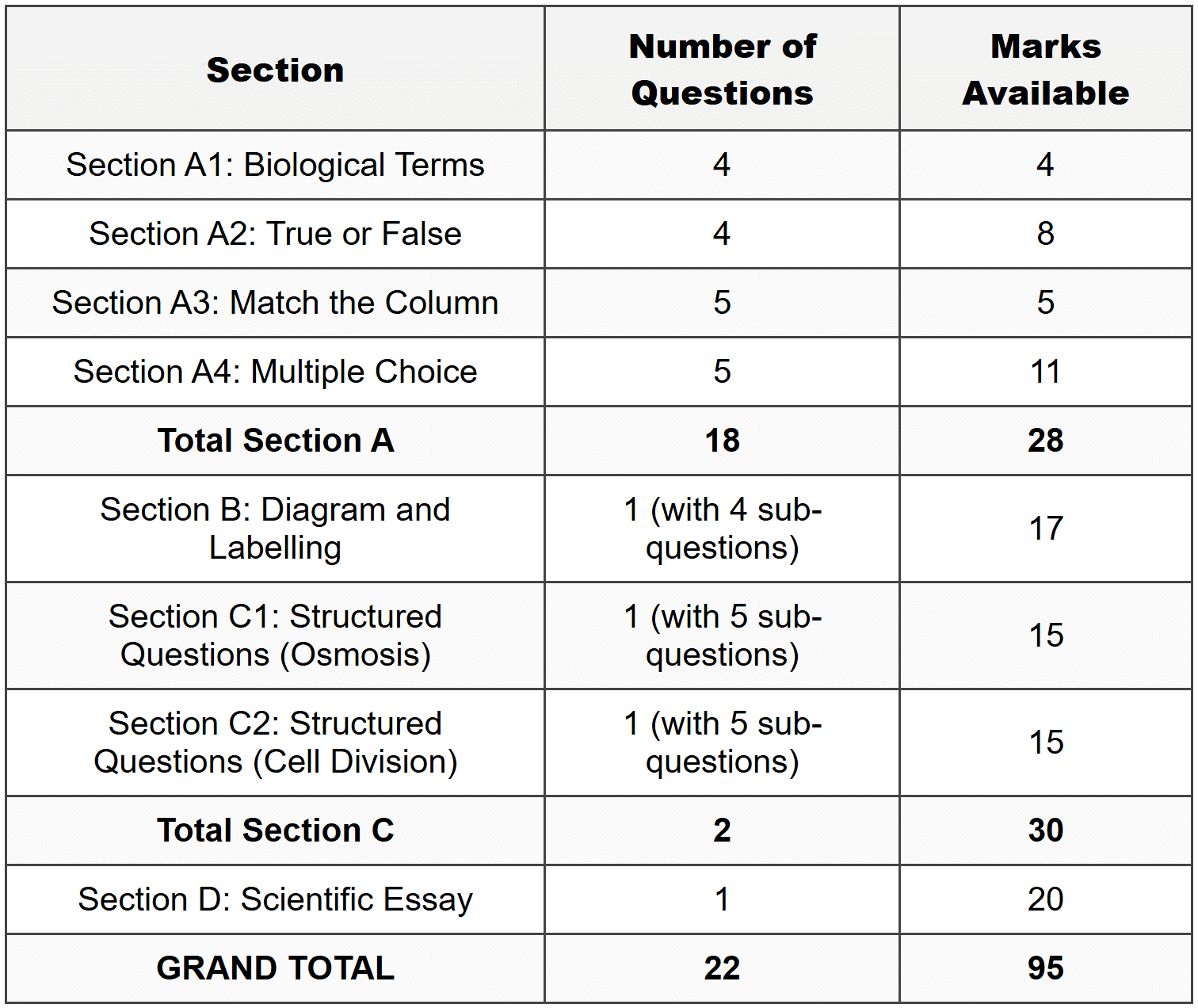
**19.** (a) Identify each of the numbered structures (1 to 6) shown in FIGURE 1 by stating the correct biological term. (b) State the function of structure 4 and structure 5. (c) Explain what would happen to the cell's ability to synthesise proteins if structure 3 was completely absent from the cell. (d) A student observes FIGURE 1 and concludes that this cannot be a plant cell. Provide two structural features visible in FIGURE 1 that support this conclusion. ## SECTION C: STRUCTURED QUESTIONS (Total: 30 marks) ### C1: Osmosis and Cell Turgidity (Total: 15 marks) Lerato conducts an experiment by placing pieces of potato tissue in three different solutions for two hours. She measures the mass of each piece before and after immersion. Solution A is distilled water, Solution B is a dilute salt solution, and Solution C is a concentrated salt solution. After two hours, the potato piece in Solution A has increased in mass, the piece in Solution B shows no change in mass, and the piece in Solution C has decreased in mass. **20.** (a) Define the biological term osmosis. (b) Explain why the potato piece in Solution A increased in mass, using correct biological terminology. (c) The potato piece in Solution B showed no change in mass. What does this indicate about the water concentration of Solution B relative to the cell sap of the potato cells? (d) Predict and explain what would happen to the appearance and texture of the cells in the potato piece placed in Solution C when viewed under a microscope. (e) Explain why plant cells do not burst when placed in a hypotonic solution, whereas animal cells may undergo lysis under the same conditions. ### C2: Cell Division and Growth (Total: 15 marks) Bongi is studying the process by which multicellular organisms grow and repair damaged tissues. She learns that a specific type of nuclear division ensures that each new cell receives an identical set of genetic instructions. She observes prepared slides showing cells at different stages of this division process. **21.** (a) Name the type of nuclear division Bongi is studying. (b) State the biological importance of this type of cell division in living organisms. (c) During one stage of this division process, the chromatin condenses into visible chromosomes, and the nuclear membrane disintegrates. Name this stage. (d) Bongi observes a cell where the chromosomes are aligned along the equator of the cell, attached to spindle fibres. Explain what will happen immediately after this stage and why this is essential for producing genetically identical daughter cells. (e) A certain chemical disrupts the formation of spindle fibres during cell division. Predict the effect this chemical would have on the distribution of chromosomes to the daughter cells, and explain your reasoning. ## SECTION D: SCIENTIFIC ESSAY (Total: 20 marks) **22.** Write a structured essay on the structure and function of the cell membrane and the processes of diffusion and osmosis in maintaining cellular homeostasis. Your essay must include the following: 1. A description of the structure of the cell membrane, including the arrangement of phospholipids and proteins. 2. An explanation of the function of the cell membrane as a selectively permeable barrier. 3. A detailed explanation of the process of diffusion, including reference to concentration gradient and molecular movement. 4. A detailed explanation of the process of osmosis, including the movement of water molecules across a semi-permeable membrane. 5. An explanation of how diffusion and osmosis contribute to maintaining homeostasis in cells. 6. At least one relevant example from a named organism (using correct binomial nomenclature) to illustrate the importance of these processes. Mark allocation guide:- Description of cell membrane structure (4 marks)
- Explanation of cell membrane function (3 marks)
- Explanation of diffusion (4 marks)
- Explanation of osmosis (4 marks)
- Explanation of contribution to homeostasis (3 marks)
- Relevant example with correct binomial nomenclature (2 marks)
**9.** Chloroplasts contain the green pigment chlorophyll and are the sites where light energy is converted into chemical energy during photosynthesis. **10.** The cell wall is made of cellulose in plant cells and provides rigidity, structural support, and protection against mechanical damage and pathogens. **11.** The cytoplasm is the site where many metabolic reactions occur, including glycolysis, and it suspends the organelles within the cell. **12.** Ribosomes are composed of ribosomal RNA and proteins, and they translate messenger RNA into polypeptide chains during protein synthesis. **13.** The nucleolus is located inside the nucleus and is responsible for assembling ribosomal RNA with ribosomal proteins to form ribosome subunits. --- ### SECTION A4 - Question 14 C. Spirogyra species Spirogyra is a filamentous green alga (a plant-like organism) that possesses a cell wall, chloroplasts for photosynthesis, and a large central vacuole. Plant cells lack centrioles, which are found in animal cells. Paramecium is a unicellular animal-like protist, Escherichia coli is a prokaryotic bacterium, and human epithelial tissue consists of animal cells, all of which would not have all the features Thando observed. (2 marks for correct answer; 1 mark deducted if reasoning is unclear) ### SECTION A4 - Question 15 C. Water moved into the cells by osmosis, causing the cells to become turgid When plant cells are placed in a hypotonic solution (higher water concentration outside the cell), water moves into the cells by osmosis down the concentration gradient. This causes the vacuole to swell, pushing the cytoplasm against the cell wall, creating turgor pressure and making the cells turgid (firm). Active transport requires energy and is not the mechanism for water movement; plasmolysis occurs when cells are placed in hypertonic solutions. (3 marks for correct answer and explanation) ### SECTION A4 - Question 16 C. Aerobic respiration and ATP production Mitochondria are the sites of aerobic cellular respiration, where glucose is oxidised in the presence of oxygen to produce ATP (adenosine triphosphate), the energy currency of the cell. Without mitochondria, the cell cannot efficiently produce ATP through aerobic respiration, severely limiting energy availability for cellular processes. Protein synthesis occurs at ribosomes, photosynthesis in chloroplasts, and DNA replication in the nucleus, none of which directly depend on mitochondria. (2 marks) ### SECTION A4 - Question 17 D. Membrane-bound organelles Eukaryotic cells contain membrane-bound organelles such as the nucleus, mitochondria, endoplasmic reticulum, Golgi apparatus, and lysosomes. Prokaryotic cells lack these membrane-bound organelles. Both prokaryotic and eukaryotic cells possess a cell membrane, ribosomes, and genetic material (DNA), although the organisation of these structures differs between the two cell types. (2 marks) ### SECTION A4 - Question 18 B. Water moves out of the cell → cytoplasm shrinks → cell becomes plasmolysed A hypertonic solution has a lower water concentration (higher solute concentration) than the cell sap. Water therefore moves out of the plant cell by osmosis down the concentration gradient. As water leaves, the cytoplasm shrinks and pulls away from the cell wall, a process called plasmolysis. The cell becomes flaccid first, then plasmolysed if water loss continues. Option A describes a hypotonic solution; options C and D incorrectly describe solute movement and mechanisms. (2 marks) --- ### SECTION B - Question 19(a) **Identification of structures 1 to 6:** 1. Cell membrane (also acceptable: plasma membrane) 2. Nucleus 3. Ribosomes 4. Mitochondrion (plural: mitochondria) 5. Endoplasmic reticulum (accept smooth endoplasmic reticulum or ER) 6. Cytoplasm Each correct biological term earns 1 mark. Students must use the exact term, not a description. (6 marks) ### SECTION B - Question 19(b) Function of structure 4 (Mitochondrion): The mitochondrion is the site of aerobic cellular respiration, where glucose is broken down in the presence of oxygen to release energy in the form of ATP (adenosine triphosphate). This energy is used for all energy-requiring processes in the cell. Function of structure 5 (Endoplasmic reticulum): The endoplasmic reticulum is involved in the synthesis, processing, and transport of proteins (rough ER) and lipids (smooth ER). It also serves as a transport system, moving substances from one part of the cell to another. For full marks, students must mention the specific process (aerobic respiration for mitochondrion; synthesis/processing/transport for ER) and use correct biological terminology. (4 marks: 2 marks per structure) ### SECTION B - Question 19(c) Model answer: If ribosomes (structure 3) were completely absent, the cell would be unable to synthesise proteins. Ribosomes are the sites of protein synthesis, where messenger RNA is translated into polypeptide chains. Without proteins, the cell could not produce enzymes, which are essential for controlling metabolic reactions, nor could it produce structural proteins needed for cell growth, repair, and function. The cell would eventually die because proteins are essential for virtually all cellular processes. Full-mark answer must include: inability to synthesise proteins, reference to ribosomes as sites of protein synthesis, and at least one consequence (e.g., no enzymes, no cell structure, cell death). A partial-mark answer might only state "no protein synthesis" without explaining the biological consequence. (4 marks) ### SECTION B - Question 19(d) Model answer: **Two structural features that indicate this is not a plant cell:** 1. The cell lacks a cell wall surrounding the cell membrane. Plant cells have a rigid cellulose cell wall outside the cell membrane that provides structural support and protection. 2. The cell lacks chloroplasts, which are present in photosynthetic plant cells and contain the green pigment chlorophyll needed for photosynthesis. (Alternative acceptable answer: The cell lacks a large permanent central vacuole, which is a prominent feature of mature plant cells and stores cell sap.) For full marks, students must name two structures absent from the diagram that are characteristic of plant cells, using correct biological terminology. (3 marks: 1.5 marks per feature, or 1 mark for naming the structure and 0.5 marks for explaining its significance) --- ### SECTION C1 - Question 20(a) Osmosis is the net movement of water molecules from a region of higher water concentration (or lower solute concentration) to a region of lower water concentration (or higher solute concentration) through a semi-permeable membrane. The definition must include: water molecules, concentration gradient (or water potential gradient), and semi-permeable membrane. (3 marks) ### SECTION C1 - Question 20(b) Model answer: The potato piece in Solution A (distilled water) increased in mass because water moved into the potato cells by osmosis. Distilled water has a higher water concentration than the cell sap inside the potato cells (distilled water is a hypotonic solution). Water molecules move down the concentration gradient through the semi-permeable cell membrane into the cells, causing the cells to become turgid and increasing the mass of the potato piece. Essential biological terms for full marks: osmosis, hypotonic solution (or higher water concentration), concentration gradient, semi-permeable membrane, and turgid. General language such as "water went in" will not earn full marks. (4 marks) ### SECTION C1 - Question 20(c) Model answer: If the potato piece in Solution B showed no change in mass, this indicates that Solution B has the same water concentration (or same solute concentration) as the cell sap of the potato cells. The solution is isotonic to the cell sap. There is no net movement of water into or out of the cells because there is no concentration gradient, so the cells remain in a state of dynamic equilibrium. The answer must state that the solution is isotonic or has the same water/solute concentration as the cell sap. (2 marks) ### SECTION C1 - Question 20(d) Model answer: The cells in the potato piece placed in Solution C (concentrated salt solution) would undergo plasmolysis. Solution C is hypertonic to the cell sap (lower water concentration outside the cell). Water moves out of the cells by osmosis down the concentration gradient. The vacuole shrinks, and the cytoplasm pulls away from the cell wall. Under the microscope, the cells would appear shrunken, with a visible gap between the cytoplasm and the cell wall. The potato tissue would feel soft and flaccid because turgor pressure has been lost. Essential terms for full marks: plasmolysis, hypertonic, osmosis, cytoplasm shrinks/pulls away from cell wall, loss of turgor pressure. (4 marks) ### SECTION C1 - Question 20(e) Model answer: Plant cells do not burst when placed in a hypotonic solution because they have a strong, rigid cell wall made of cellulose that surrounds the cell membrane. When water enters the cell by osmosis, the cell becomes turgid and turgor pressure builds up as the cytoplasm pushes against the cell wall. The cell wall resists further expansion and prevents the cell from bursting. Animal cells lack a cell wall and are surrounded only by a flexible cell membrane. When water enters an animal cell in a hypotonic solution, the cell swells and the membrane cannot withstand the increasing pressure, causing the cell to undergo lysis (burst). Essential terms for full marks: cell wall, cellulose, turgor pressure, osmosis, lysis (for animal cells), and the contrasting lack of a cell wall in animal cells. (2 marks) --- ### SECTION C2 - Question 21(a) Mitosis Mitosis is the type of nuclear division that produces two genetically identical daughter nuclei, each containing the same number of chromosomes as the parent nucleus. (2 marks) ### SECTION C2 - Question 21(b) Model answer: The biological importance of mitosis includes: 1. Growth: Mitosis increases the number of cells in an organism, allowing multicellular organisms to grow in size from a single fertilised egg. 2. Repair and regeneration: Mitosis replaces damaged, worn-out, or dead cells with new, genetically identical cells, enabling tissues to heal and regenerate. 3. Asexual reproduction: In some organisms, mitosis is used to produce genetically identical offspring (clones) without the need for gametes or fertilisation. 4. Genetic continuity: Mitosis ensures that each daughter cell receives an identical set of genetic information, maintaining the chromosome number and genetic makeup of the parent cell. Students must provide at least two valid points using correct biological terminology. (3 marks: award marks for any valid and well-explained importance, up to maximum) ### SECTION C2 - Question 21(c) Prophase During prophase, the chromatin fibres condense and coil to form visible chromosomes, each consisting of two sister chromatids joined at the centromere. The nuclear membrane (nuclear envelope) disintegrates, and the centrioles (in animal cells) move to opposite poles of the cell, beginning to form the spindle apparatus. (2 marks) ### SECTION C2 - Question 21(d) Model answer: The stage Bongi observes is metaphase, where chromosomes are aligned along the equatorial plane (or metaphase plate) of the cell, attached to spindle fibres at their centromeres. Immediately after metaphase, during anaphase, the centromeres divide, and the sister chromatids are pulled apart by the shortening of the spindle fibres. Each chromatid (now called a chromosome) moves to opposite poles of the cell. This separation is essential for producing genetically identical daughter cells because it ensures that each daughter cell receives exactly the same number and type of chromosomes. Each daughter cell will have one copy of every chromosome that was present in the parent cell, maintaining genetic continuity. Essential terms for full marks: anaphase, sister chromatids separate, centromere divides, spindle fibres, opposite poles, genetic continuity. (4 marks) ### SECTION C2 - Question 21(e) Model answer: If spindle fibres cannot form, the chromosomes will not be able to move to opposite poles of the cell during anaphase. The sister chromatids will remain attached at the centromere and will not be separated and distributed to the daughter cells. As a result, when the cell divides during cytokinesis, the chromosomes will not be evenly distributed. One or both daughter cells may receive an incorrect number of chromosomes (a condition called aneuploidy), or the chromosomes may remain clustered in the middle of the cell and not move at all. This would result in daughter cells that are not genetically identical to the parent cell and may not be viable (able to survive). Reasoning: Spindle fibres are responsible for attaching to chromosomes at the centromere and physically pulling sister chromatids apart. Without this mechanism, there is no force to separate and move the chromosomes. Essential terms for full marks: chromosomes cannot move/separate, anaphase disrupted, unequal distribution of chromosomes, aneuploidy, non-viable daughter cells. (4 marks) --- ### SECTION D - Question 22 Model Essay Answer **1. Description of cell membrane structure (4 marks)** The cell membrane (also called the plasma membrane) is composed of a phospholipid bilayer with embedded proteins. Each phospholipid molecule has a hydrophilic (water-loving) phosphate head and two hydrophobic (water-fearing) fatty acid tails. The phospholipids are arranged in two layers with the hydrophilic heads facing outward toward the aqueous environment inside and outside the cell, and the hydrophobic tails facing inward, away from water. Proteins are embedded in the phospholipid bilayer; some span the entire membrane (integral proteins or transmembrane proteins), while others are attached to the surface (peripheral proteins). Some proteins and lipids have attached carbohydrate chains (forming glycoproteins and glycolipids), which play a role in cell recognition and communication. This arrangement is known as the fluid mosaic model because the membrane is flexible and the proteins move within the lipid bilayer like a mosaic. For full 4 marks, student must mention: phospholipid bilayer, arrangement of hydrophilic heads and hydrophobic tails, proteins (integral and/or peripheral), and fluid mosaic model. Partial marks awarded for incomplete descriptions. --- **2. Explanation of cell membrane function (3 marks)** The cell membrane functions as a selectively permeable barrier, controlling the movement of substances into and out of the cell. It allows certain molecules, such as small non-polar molecules (e.g., oxygen, carbon dioxide) and water, to pass through freely, while restricting the passage of large polar molecules and ions. This selective permeability is essential for maintaining the cell's internal environment (homeostasis), regulating the concentration of substances inside the cell, and protecting the cell from harmful substances. The membrane also contains receptor proteins that allow the cell to respond to external signals, and transport proteins that facilitate the movement of specific substances across the membrane. For full 3 marks, student must mention: selectively permeable, controls movement of substances, and maintaining homeostasis. Mention of receptor proteins or transport proteins adds depth. --- **3. Explanation of diffusion (4 marks)** Diffusion is the net movement of molecules or ions from a region of higher concentration to a region of lower concentration, down a concentration gradient, until equilibrium is reached. Diffusion occurs as a result of the random, constant movement of particles (kinetic energy). No energy input from the cell is required, so diffusion is a form of passive transport. Diffusion continues until the concentration of the substance is equal throughout the space, at which point the molecules continue to move randomly but there is no net movement in any direction (dynamic equilibrium). Examples of substances that move by diffusion across the cell membrane include oxygen, carbon dioxide, and other small lipid-soluble molecules. The rate of diffusion is affected by factors such as the concentration gradient, temperature, surface area, and the size of the molecules. For full 4 marks, student must mention: net movement from high to low concentration, concentration gradient, passive transport (no energy required), and dynamic equilibrium. Factors affecting diffusion rate can add depth. --- **4. Explanation of osmosis (4 marks)** Osmosis is the net movement of water molecules from a region of higher water concentration (or lower solute concentration) to a region of lower water concentration (or higher solute concentration), through a semi-permeable membrane. Osmosis is a special type of diffusion that involves only water molecules. Like diffusion, osmosis is a form of passive transport and does not require energy from the cell. The movement of water continues until the water concentration is equal on both sides of the membrane, or until another force (such as turgor pressure in plant cells) stops further net movement. Osmosis is critically important for maintaining water balance in cells and is influenced by the solute concentration of the solutions inside and outside the cell. A solution with a higher solute concentration than the cell is hypertonic, a solution with a lower solute concentration is hypotonic, and a solution with the same solute concentration is isotonic. For full 4 marks, student must mention: net movement of water, concentration gradient (or water potential), semi-permeable membrane, and passive transport. Mention of hypertonic/hypotonic/isotonic solutions adds depth. --- **5. Explanation of contribution to homeostasis (3 marks)** Diffusion and osmosis are essential for maintaining homeostasis, which is the regulation of the internal environment of the cell to keep conditions stable and optimal for cellular processes. Through diffusion, cells obtain necessary substances such as oxygen for aerobic respiration and remove waste products such as carbon dioxide, maintaining the correct concentrations of gases needed for metabolism. Through osmosis, cells regulate their water content and prevent excessive water gain or loss, which could damage the cell. In plant cells, osmosis maintains turgor pressure, which keeps the cells firm and supports the plant structure. In animal cells, osmosis helps maintain cell shape and prevents lysis (bursting) or crenation (shrivelling). Without these processes, cells would not be able to maintain the stable internal conditions necessary for enzymes to function and for metabolic reactions to occur efficiently. For full 3 marks, student must mention: homeostasis, regulation of substance concentration (e.g., gases, water), and at least one consequence of失调 (e.g., enzyme function, cell damage, turgor pressure). --- **6. Relevant example with correct binomial nomenclature (2 marks)** An example of the importance of diffusion and osmosis can be seen in Elodea canadensis (Canadian pondweed), an aquatic plant. The cells of Elodea canadensis are surrounded by fresh water, which is hypotonic to the cell sap. Water continuously enters the cells by osmosis, but the cells do not burst because of the strong cell wall that resists the turgor pressure. At the same time, carbon dioxide needed for photosynthesis diffuses into the cells from the surrounding water, and oxygen produced during photosynthesis diffuses out of the cells into the water. This continuous exchange by diffusion and the regulation of water content by osmosis allow Elodea canadensis to maintain homeostasis and carry out essential life processes in its aquatic environment. For full 2 marks, student must: Name an organism using correct binomial nomenclature (italicised, genus capitalised, species lowercase), and clearly link the example to either diffusion or osmosis or both in a biologically accurate way. --- Marker's Note: Common errors students make in this type of essay include: - Using general language instead of precise biological terms (e.g., "substances move in and out" instead of "diffusion" or "osmosis"; "cell covering" instead of "cell membrane") - Confusing diffusion and osmosis (osmosis is specific to water; diffusion refers to any substance) - Forgetting to mention that osmosis occurs through a semi-permeable membrane - Incorrectly stating that diffusion or osmosis require energy (they are passive processes) - Failing to use binomial nomenclature correctly (not italicising, incorrect capitalisation, or omitting the species name) - Not explaining the link between the processes and homeostasis clearly - Providing an example that is not scientifically accurate or relevant Students should structure their essay according to the numbered requirements in the question, use subheadings if helpful, and ensure every biological process is explained using correct terminology. Quality of explanation and accuracy are more important than length. --- ## Mark Allocation Summary Table --- **Well done! Keep revising, stay curious, and remember that understanding biological processes deeply will help you succeed not only in exams but also in understanding the living world around you. All the best in your studies!**The document Cells: the Basic Units of Life is a part of the Grade 10 Course Life Sciences for Grade 10.
All you need of Grade 10 at this link: Grade 10
About this Document

4.84/5 Rating

Apr 21, 2026 Last updated
Related Exams
Document Description: Cells: the Basic Units of Life for Grade 10 2026 is part of Life Sciences for Grade 10 preparation. The notes and questions for Cells: the Basic Units of Life have been prepared according to the Grade 10 exam syllabus. Information about Cells: the Basic Units of Life covers topics like and Cells: the Basic Units of Life Example, for Grade 10 2026 Exam. Find important definitions, questions, notes, meanings, examples, exercises and tests below for Cells: the Basic Units of Life.
Introduction of Cells: the Basic Units of Life in English is available as part of our Life Sciences for Grade 10 for Grade 10 & Cells: the Basic Units of Life in Hindi for Life Sciences for Grade 10 course. Download more important topics related with notes, lectures and mock test series for Grade 10 Exam by signing up for free. Grade 10: Cells: the Basic Units of Life
Description
Cells: the Basic Units of Life of Life Sciences covers all the important topics, helping you prepare for the Grade 10 exam on EduRev. Start for free!
Information about Cells: the Basic Units of Life
In this doc you can find the meaning of Cells: the Basic Units of Life defined & explained in the simplest way possible. Besides explaining types of Cells: the Basic Units of Life theory, EduRev gives you an ample number of questions to practice Cells: the Basic Units of Life tests, examples and also practice Grade 10 tests



Related Searches
shortcuts and tricks, Cells: the Basic Units of Life, Important questions, Extra Questions, Cells: the Basic Units of Life, Viva Questions, ppt, Cells: the Basic Units of Life, Exam, Summary, mock tests for examination, pdf , study material, Sample Paper, video lectures, Objective type Questions, Free, Semester Notes, Previous Year Questions with Solutions, MCQs, past year papers, practice quizzes;