Biosphere to Ecosystems

SECTION A: SHORT QUESTIONS
(Total: 36 marks)A1: GIVE THE CORRECT BIOLOGICAL TERM
(Total: 8 marks)1. The part of the Earth and its atmosphere where life exists.
2. The variety of all living organisms, including the different species, the genetic differences among them, and the variety of ecosystems in which they occur.
3. The specific role and position a species has in its ecosystem, including all its interactions with the biotic and abiotic factors of its environment.
4. All the populations of different species that live together and interact in a particular area at the same time.
A2: TRUE OR FALSE - IF FALSE, CORRECT THE UNDERLINED WORD OR PHRASE ONLY
(Total: 8 marks)5. A population consists of all the living and non-living components interacting in a particular area.
6. Producers are organisms that obtain their energy by consuming other organisms in an ecosystem.
7. An ecosystem includes both biotic factors and abiotic factors that interact with each other.
8. The lithosphere is the layer of gases that surrounds the Earth and forms part of the biosphere.
A3: MATCH COLUMN A TO COLUMN B
(Total: 10 marks)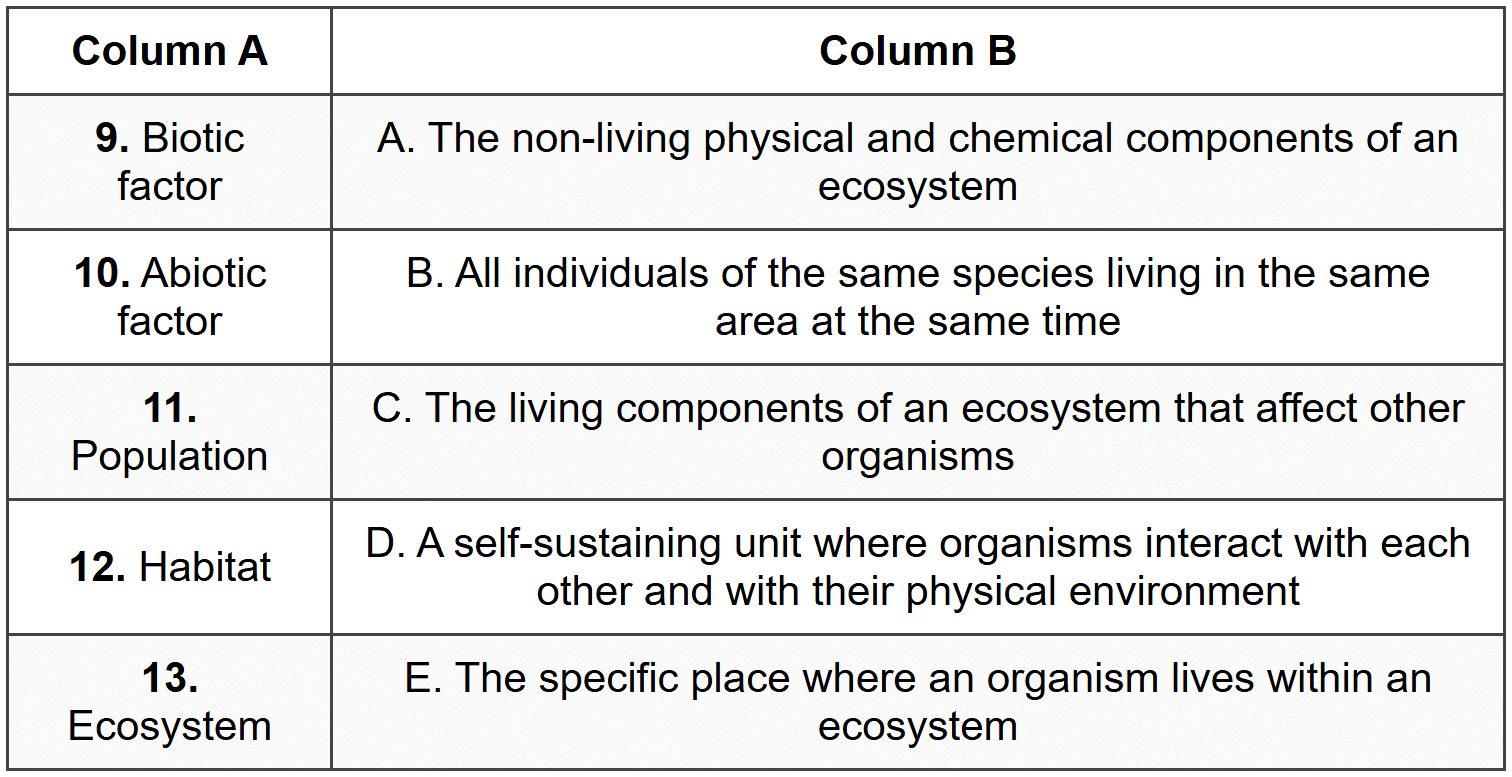
A4: MULTIPLE CHOICE
(Total: 10 marks)14. A group of students is investigating a pond ecosystem. They observe water lilies, algae, dragonfly larvae, fish, and frogs. They also measure water temperature, pH, and oxygen levels. Which statement correctly classifies these observations?
A. Water lilies and algae are biotic factors; dragonfly larvae and fish are abiotic factorsB. Temperature, pH, and oxygen levels are biotic factors; all the organisms are abiotic factors
C. Water lilies, algae, dragonfly larvae, fish, and frogs are biotic factors; temperature, pH, and oxygen levels are abiotic factors
D. All the observations represent abiotic factors because they are all part of the water environment
15. Thabo studies a grassland area and finds three different species of grass, two species of antelope, and one species of lion. He counts 150 individual grass plants of one species, 12 antelope of one species, and 3 lions. Which statement correctly describes the organisation of life in this grassland?
A. The 150 grass plants represent a community, and all the organisms together form a populationB. The 12 antelope of one species represent a population, and all the different species together form a community
C. The grassland represents a population, and the different grass species represent an ecosystem
D. The 3 lions represent a community, and the antelope and grass together form a habitat
16. A scientist compares four different environments: a desert, a coral reef, a tropical rainforest, and a tundra. Which factor best explains why the tropical rainforest has the highest biodiversity?
A. The tropical rainforest has the lowest temperatures, which slow down decompositionB. The tropical rainforest has high rainfall and warm temperatures, providing favourable abiotic conditions for many species
C. The tropical rainforest has low levels of sunlight, which reduces competition among species
D. The tropical rainforest has frozen soil, which preserves nutrients for plant growth
17. In an investigation of a small forest ecosystem, researchers identify the following: soil, sunlight, temperature, rainfall, trees, insects, birds, fungi, and bacteria. If the researchers wanted to study only the biotic interactions in this ecosystem, which combination should they focus on?
A. Soil, sunlight, temperature, and rainfallB. Trees, insects, birds, fungi, and bacteria
C. Soil, trees, and sunlight
D. Temperature, rainfall, and bacteria
18. A conservation team is restoring a degraded wetland ecosystem. They introduce native plant species, remove invasive species, and monitor water quality. After two years, they observe an increase in the number of bird species and insect diversity. Which statement best explains this observation?
A. The increase in plant diversity created new habitats and food sources, supporting more animal speciesB. The removal of invasive species caused the water quality to decrease, attracting more birds
C. The monitoring of water quality directly increased the number of insect species
D. The bird species migrated from other ecosystems because the wetland temperature increased
SECTION B: DIAGRAM AND LABELLING QUESTIONS
(Total: 14 marks)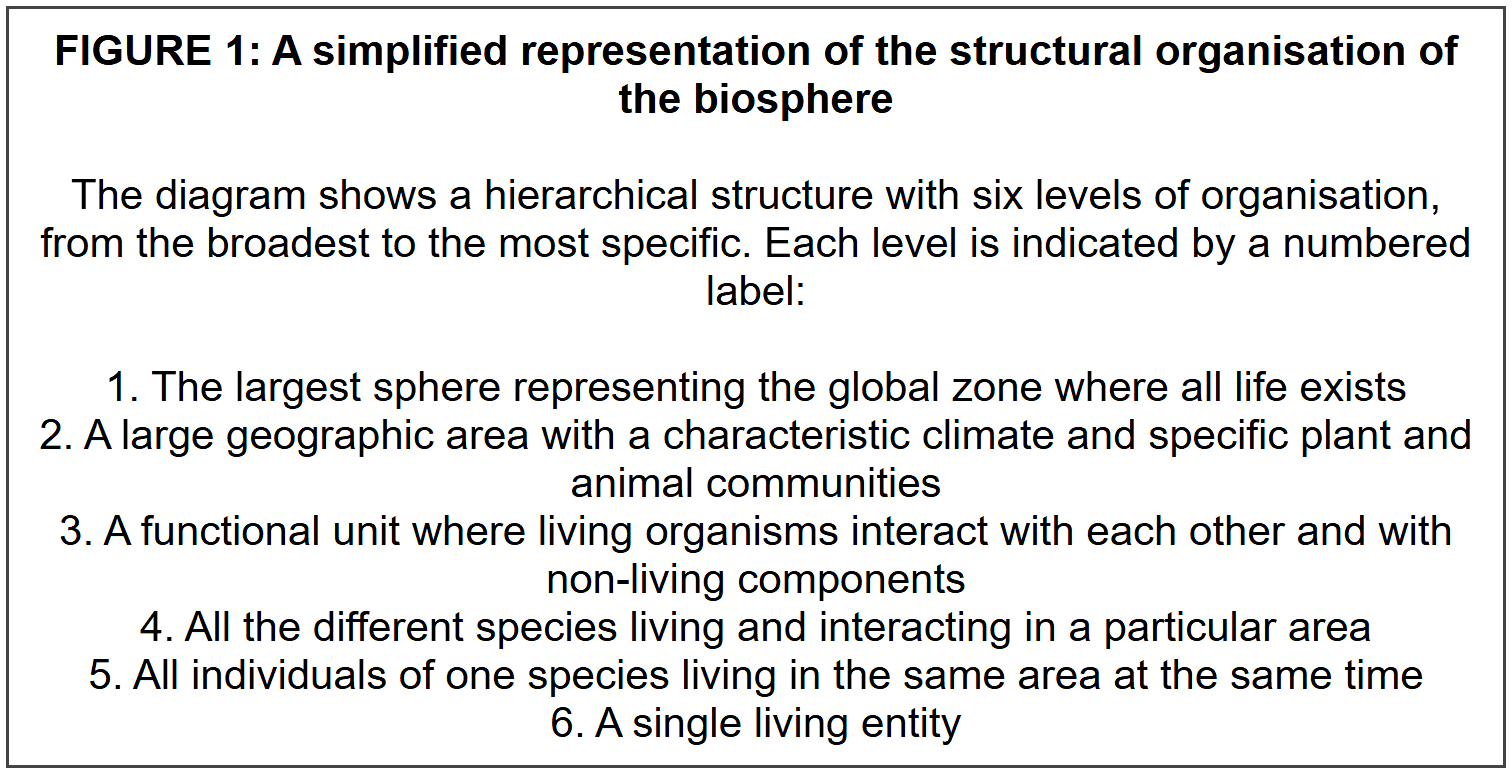
19. Study FIGURE 1 above and answer the following questions:
(a) Identify the level of organisation represented by each of the six numbered labels using the correct biological term.
(b) Describe the relationship between the level represented by label 4 and the level represented by label 5.
(c) Explain why the level represented by label 3 is considered a self-sustaining unit, while the level represented by label 5 is not.
(d) A severe drought affects a grassland area. Predict and explain how this abiotic change would affect the level represented by label 4 compared to the level represented by label 5.
SECTION C: STRUCTURED QUESTIONS
(Total: 30 marks)QUESTION 20: BIOTIC AND ABIOTIC FACTORS IN ECOSYSTEMS
Nomsa investigates a rock pool ecosystem along the coast of KwaZulu-Natal. She records the following observations: water temperature is 24°C, salinity is 35 parts per thousand, several species of algae are attached to rocks, small fish swim in groups, sea anemones are attached to rocks, and crabs move among the rocks.
20. Answer the following questions based on the scenario above:
(a) Distinguish between biotic factors and abiotic factors using examples from Nomsa's investigation.
(b) Explain how the abiotic factor of salinity could affect the distribution of organisms in the rock pool ecosystem.
(c) Nomsa returns to the same rock pool during low tide and notices that the water temperature has increased to 32°C and the water level has dropped significantly. Predict and explain what might happen to the small fish population under these changed conditions.
(d) Evaluate the importance of both biotic and abiotic factors in maintaining the stability of the rock pool ecosystem.
QUESTION 21: LEVELS OF ORGANISATION AND BIODIVERSITY
A research team studies two different forest areas in Mpumalanga. Area A is an indigenous forest with over 80 tree species, numerous bird species, insects, and mammals. Area B is a pine plantation with only one tree species and very few animal species. Both areas receive the same amount of rainfall and have similar soil types.
21. Answer the following questions based on the scenario above:
(a) Compare the biodiversity of Area A and Area B.
(b) Explain why Area A supports a greater variety of animal species than Area B, even though both areas have similar abiotic conditions.
(c) The research team counts 45 individual Podocarpus latifolius trees in a 100 m² section of Area A. Identify the level of biological organisation represented by these 45 trees and justify your answer.
(d) A disease affects only Podocarpus latifolius trees in Area A, killing 30 of the 45 trees. Analyse how this event would affect the community in Area A differently from how a similar disease would affect Area B.
SECTION D: SCIENTIFIC ESSAY
(Total: 20 marks)22. Write a scientific essay on the following topic:
THE BIOSPHERE AND ITS COMPONENTS: FROM GLOBAL SCALE TO LOCAL INTERACTIONS
In your essay, you must:
- Define the biosphere and describe its three main component spheres
- Explain the hierarchical organisation of life within the biosphere, from the broadest level to the individual organism
- Discuss how biotic and abiotic factors interact within an ecosystem to support life
- Explain the concept of biodiversity and its importance for ecosystem stability
- Provide at least two specific examples of organisms using correct binomial nomenclature to illustrate different levels of organisation
Mark allocation guide:
- Definition of biosphere and description of three component spheres: 4 marks
- Explanation of hierarchical organisation from biosphere to organism: 6 marks
- Discussion of interaction between biotic and abiotic factors: 4 marks
- Explanation of biodiversity and its importance: 4 marks
- Use of correct binomial nomenclature and appropriate examples: 2 marks
GRAND TOTAL: 100 marks
ANSWER KEY
Dear Student,
Well done on completing this worksheet on Biosphere to Ecosystems! Before you check your answers, make sure you have attempted all the questions to the best of your ability. Use this answer key to identify areas where you are strong and areas that need more revision. Remember, using the correct biological terminology is essential for earning full marks. Good luck with your studies!
SECTION A1 - GIVE THE CORRECT BIOLOGICAL TERM
Question 1
Answer: Biosphere
The biosphere is the zone of planet Earth where life can exist, including parts of the lithosphere, hydrosphere, and atmosphere.
Question 2
Answer: Biodiversity
Biodiversity refers to the variety of life on Earth at all levels, including species diversity, genetic diversity within species, and ecosystem diversity.
Question 3
Answer: Niche (or ecological niche)
A niche describes not just where an organism lives, but how it lives, what it eats, what eats it, and all its relationships with both living and non-living factors in its environment.
Question 4
Answer: Community
A community is made up of all the different populations of various species that live together and interact in a specific area.
SECTION A2 - TRUE OR FALSE
Question 5
Answer: FALSE
Correction: ecosystem (not population)
A population consists only of individuals of the same species living in the same area. An ecosystem includes both living (biotic) and non-living (abiotic) components that interact with each other.
Question 6
Answer: FALSE
Correction: Consumers or Heterotrophs (not Producers)
Producers (autotrophs) make their own food through photosynthesis or chemosynthesis. Organisms that obtain energy by consuming other organisms are called consumers or heterotrophs.
Question 7
Answer: TRUE
An ecosystem is indeed a functional unit that includes both biotic factors (living organisms) and abiotic factors (non-living components like water, sunlight, temperature, and soil) that interact with one another.
Question 8
Answer: FALSE
Correction: atmosphere (not lithosphere)
The lithosphere is the solid outer layer of the Earth (rocks and soil). The atmosphere is the layer of gases surrounding the Earth, which is part of the biosphere where life exists.
SECTION A3 - MATCH COLUMN A TO COLUMN B
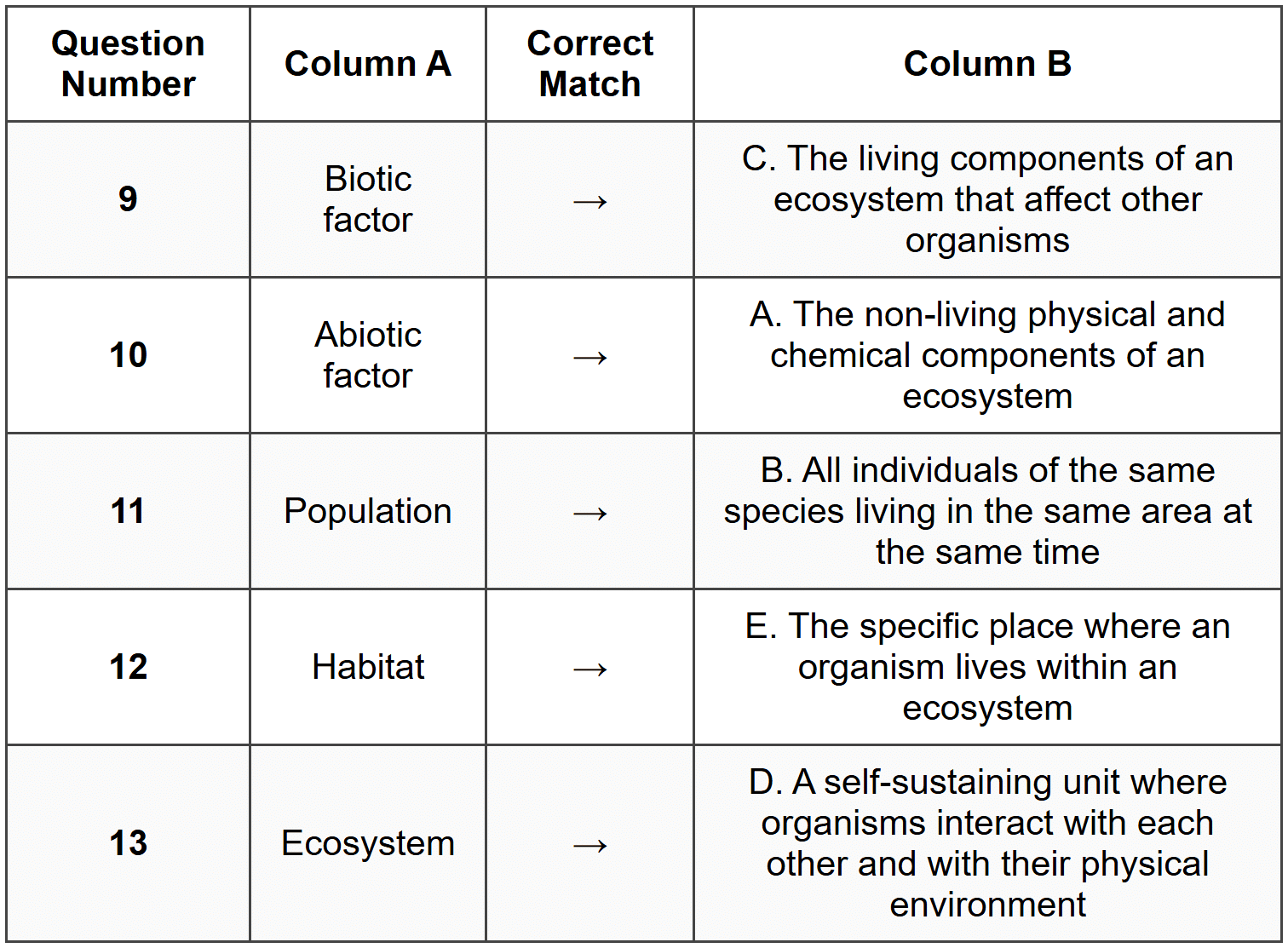
Explanations:
9. Biotic factors are all the living components in an ecosystem, such as plants, animals, fungi, and bacteria, that influence other organisms through interactions like predation, competition, and symbiosis.
10. Abiotic factors include non-living elements such as temperature, light, water, soil, pH, and minerals that affect how organisms live and survive.
11. A population is a group of organisms of the same species that live in the same area at the same time and can potentially interbreed.
12. A habitat is the physical location or type of environment where a particular organism lives, such as a forest, grassland, or coral reef.
13. An ecosystem is a functional unit consisting of all the living organisms (biotic factors) and their physical environment (abiotic factors) interacting together in a particular area.
SECTION A4 - MULTIPLE CHOICE
Question 14
Answer: C. Water lilies, algae, dragonfly larvae, fish, and frogs are biotic factors; temperature, pH, and oxygen levels are abiotic factors
Biotic factors are all living organisms or components derived from living things. Abiotic factors are the non-living physical and chemical components of the environment. In this pond ecosystem, all the organisms listed are biotic factors, while the measurable physical and chemical properties are abiotic factors.
Question 15
Answer: B. The 12 antelope of one species represent a population, and all the different species together form a community
A population consists of all individuals of one species in a particular area, so the 12 antelope of one species form a population. A community consists of all the different species living and interacting in an area, so all the grass species, antelope species, and lion species together form the community.
Question 16
Answer: B. The tropical rainforest has high rainfall and warm temperatures, providing favourable abiotic conditions for many species
Tropical rainforests have high biodiversity because the warm, stable temperatures and abundant rainfall create ideal conditions for a wide variety of species to thrive. These favourable abiotic conditions support complex ecosystems with many ecological niches.
Question 17
Answer: B. Trees, insects, birds, fungi, and bacteria
Biotic interactions occur between living organisms. To study these interactions, researchers must focus on the living components of the ecosystem: trees, insects, birds, fungi, and bacteria. Soil, sunlight, temperature, and rainfall are all abiotic factors.
Question 18
Answer: A. The increase in plant diversity created new habitats and food sources, supporting more animal species
When native plant diversity increases, it creates a greater variety of habitats and food sources for animals. Different plant species support different insect species, which in turn support different bird species. This demonstrates how changes in one component of an ecosystem (plant diversity) can affect other components (animal diversity) through biotic interactions.
SECTION B - DIAGRAM AND LABELLING QUESTIONS
Question 19(a)
Label 1: Biosphere
Label 2: Biome
Label 3: Ecosystem
Label 4: Community
Label 5: Population
Label 6: Organism (or Individual)
Each term must be the exact biological term. The biosphere is the broadest level, followed by biomes (large regions with characteristic climates and organisms), then ecosystems (functional units with biotic and abiotic interactions), communities (all species in an area), populations (one species), and finally individual organisms.
Question 19(b)
Model answer: A community (label 4) is made up of multiple populations (label 5) of different species living together in the same area. Each population consists of all the individuals of one species, and when multiple populations of different species interact, they form a community.
Essential for full marks: Must mention that a community consists of multiple populations, and must use the terms community and population correctly.
Question 19(c)
Model answer: An ecosystem (label 3) is self-sustaining because it includes both biotic factors (living organisms) and abiotic factors (non-living components such as water, sunlight, and nutrients) that interact through energy flow and nutrient cycling. A population (label 5) is not self-sustaining because it consists only of one species and depends on other populations for food, nutrient cycling, and other ecological processes, as well as on abiotic factors for survival.
Essential for full marks: Must explain that an ecosystem contains both biotic and abiotic components and involves energy flow and nutrient cycling. Must explain that a population depends on other populations and abiotic factors. Must use correct biological terminology.
Question 19(d)
Model answer: A severe drought (an abiotic factor) would affect the entire community (label 4) because all the different species depend on water availability. Some plant populations would die first due to lack of water, which would then affect herbivore populations that depend on those plants for food, and subsequently affect predator populations. In contrast, a single population (label 5) of one species might be more severely affected if that species is not drought-tolerant, but drought-tolerant species within the community might survive, maintaining some community structure.
Full marks answer must contain: Recognition that drought is an abiotic factor; explanation that the community (multiple species) would be affected through interdependent relationships and food chains; explanation that a single population's response depends on the species' tolerance; use of correct biological terms such as community, population, abiotic factor, and interdependence.
Partial marks: Mentioning only that drought affects water availability without explaining the cascade effect through the community, or not distinguishing clearly between community-level and population-level effects.
SECTION C - STRUCTURED QUESTIONS
Question 20(a)
Model answer: Biotic factors are the living components of an ecosystem that affect other organisms. In Nomsa's investigation, examples include the species of algae, the small fish, the sea anemones, and the crabs. Abiotic factors are the non-living physical and chemical components of an ecosystem. Examples from the rock pool include water temperature (24°C) and salinity (35 parts per thousand).
Essential terms for full marks: Biotic factors, abiotic factors, and correct examples from the scenario. Students must clearly distinguish living from non-living components.
Question 20(b)
Model answer: Salinity is a measure of the concentration of dissolved salts in water. Organisms in the rock pool have specific tolerance ranges for salinity. If salinity is too high or too low, it affects osmoregulation (the balance of water and salts in the organism's cells). Organisms that cannot tolerate the salinity level will not survive in that area, so salinity determines which species can live in the rock pool and influences their distribution.
Essential terms for full marks: Salinity, tolerance range, osmoregulation or reference to water and salt balance, and distribution. Students must explain the cause-and-effect relationship between salinity and organism survival.
Question 20(c)
Model answer: The increased water temperature to 32°C and decreased water level during low tide would reduce the amount of dissolved oxygen in the water, because warm water holds less oxygen than cool water. The small fish population might experience stress due to hypoxia (low oxygen levels). Some fish may die if the oxygen level becomes too low, or they may move to deeper water or areas with more oxygen if possible. The decreased water level also concentrates the fish in a smaller volume, increasing competition for the limited oxygen available.
Essential terms for full marks: Temperature, dissolved oxygen, population, and explanation of the cause-and-effect relationship between temperature, oxygen availability, and fish survival. Reference to competition or stress adds depth.
Question 20(d)
Model answer: Both biotic and abiotic factors are essential for maintaining ecosystem stability. Abiotic factors such as temperature, salinity, and light provide the physical and chemical conditions necessary for life. These factors determine which species can survive in the ecosystem. Biotic factors such as predators, prey, competitors, and decomposers create relationships like food chains, nutrient cycling, and symbiosis that regulate population sizes and energy flow. Without the interaction between biotic and abiotic factors, the ecosystem would not be self-sustaining. For example, if abiotic factors change dramatically (such as extreme temperature changes), biotic components are affected, potentially leading to ecosystem collapse.
Essential terms for full marks: Biotic factors, abiotic factors, stability, nutrient cycling, energy flow, and explanation of interdependence. Students must evaluate (make a judgment about importance) rather than simply describe.
Question 21(a)
Model answer: Biodiversity refers to the variety of living organisms in an area, including species diversity, genetic diversity, and ecosystem diversity. Area A (indigenous forest) has high biodiversity with over 80 tree species, numerous bird species, insects, and mammals. Area B (pine plantation) has low biodiversity with only one tree species and very few animal species. Therefore, Area A has significantly higher biodiversity than Area B.
Essential terms for full marks: Biodiversity, and clear comparison showing Area A has high biodiversity and Area B has low biodiversity with supporting evidence from the scenario.
Question 21(b)
Model answer: Area A supports a greater variety of animal species because the high diversity of tree species (over 80 species) provides a wide range of habitats and niches. Different tree species produce different types of fruits, seeds, leaves, and flowers, creating diverse food sources for herbivores and insects. This diversity of herbivores and insects in turn supports a greater variety of predators such as birds and mammals. In contrast, Area B has only one tree species, which provides a limited range of habitats and food sources, so fewer animal species can survive there. Even though abiotic conditions are similar, the biotic structure (variety of plants) determines the variety of animals.
Essential terms for full marks: Habitat, niche, food sources, and explanation that plant diversity creates diverse animal niches. Students must explain the causal relationship between plant diversity and animal diversity.
Question 21(c)
Model answer: The 45 individual Podocarpus latifolius trees represent a population. A population is defined as all the individuals of the same species living in the same area at the same time. Since all 45 trees are the same species (Podocarpus latifolius) and they are all found within the same 100 m² section of Area A, they meet the definition of a population.
Essential terms for full marks: Population, and correct justification using the definition (same species, same area, same time). Must use the term population, not "group" or "collection."
Question 21(d)
Model answer: In Area A, the death of 30 out of 45 Podocarpus latifolius trees would reduce that particular population, but the community would likely remain relatively stable because Area A has high biodiversity with over 80 other tree species. Other tree species would continue to provide habitats, food, and other ecological functions, so the overall ecosystem structure and animal diversity would be less severely affected. In Area B, if a similar disease affected the single pine species, the impact would be catastrophic because there is only one tree species. The entire forest structure would collapse, eliminating most habitats and food sources, and the few animal species present would likely disappear. This analysis shows that higher biodiversity provides greater resilience and stability in ecosystems.
Essential terms for full marks: Population, community, biodiversity, ecosystem, resilience or stability, and clear analysis comparing the differential impacts on Area A versus Area B. Students must analyse (break down and compare) the consequences, not just describe what would happen.
SECTION D - SCIENTIFIC ESSAY
Question 22 - Model Essay Answer
1. Definition of the biosphere and description of its three main component spheres (4 marks)
The biosphere is the part of the Earth and its atmosphere where life exists. It is the global sum of all ecosystems and represents the zone of life on Earth. The biosphere is composed of three main component spheres that interact with each other. The lithosphere is the solid outer layer of the Earth, including rocks, soil, and minerals, which provides a substrate for terrestrial life and contains nutrients essential for plant growth. The hydrosphere includes all water on Earth, such as oceans, rivers, lakes, groundwater, and ice, and is essential for all living organisms because water is a fundamental requirement for life processes. The atmosphere is the layer of gases surrounding the Earth, primarily composed of nitrogen, oxygen, carbon dioxide, and water vapour, which provides oxygen for respiration, carbon dioxide for photosynthesis, and protection from harmful ultraviolet radiation.
2. Explanation of hierarchical organisation of life within the biosphere (6 marks)
Life within the biosphere is organised in a hierarchical structure, from the broadest level to the most specific. At the broadest level is the biosphere itself, which encompasses all life on Earth. Within the biosphere are biomes, which are large geographic regions characterised by specific climatic conditions and distinct plant and animal communities, such as tropical rainforests, grasslands, deserts, and tundra. Each biome contains many ecosystems, which are functional units consisting of all the living organisms (biotic factors) and non-living components (abiotic factors) interacting in a particular area. Within each ecosystem are communities, which consist of all the different populations of various species living and interacting in a specific area at the same time. A population is made up of all the individuals of one species living in the same area at the same time and capable of interbreeding. Finally, each population consists of individual organisms, which are single living entities. This hierarchical organisation shows how life is structured from the global scale down to the individual level, with each level interacting with and depending on the others.
3. Discussion of how biotic and abiotic factors interact within an ecosystem (4 marks)
Biotic factors are all the living components of an ecosystem, including plants, animals, fungi, bacteria, and other microorganisms. Abiotic factors are the non-living physical and chemical components, such as temperature, light, water, soil composition, pH, and mineral nutrients. These factors interact in complex ways to support life in ecosystems. For example, plants (producers) use abiotic factors such as sunlight, water, and carbon dioxide to carry out photosynthesis, producing glucose and releasing oxygen. The oxygen produced becomes an abiotic factor that other organisms (consumers) use for aerobic respiration. Animals depend on plants for food and oxygen, while plants depend on animals for carbon dioxide (produced during respiration) and nutrients (from decomposition of dead organisms). Decomposers such as bacteria and fungi break down dead organic matter, returning nutrients to the soil (an abiotic component), which plants then absorb through their roots. Temperature affects the rate of metabolic processes in organisms, while water availability determines which species can survive in an area. These continuous interactions between biotic and abiotic factors create a dynamic, self-sustaining system.
4. Explanation of biodiversity and its importance for ecosystem stability (4 marks)
Biodiversity refers to the variety of all living organisms, including the diversity of species, the genetic variation within species, and the variety of ecosystems in which they occur. High biodiversity is essential for ecosystem stability and resilience. In ecosystems with high biodiversity, there are many different species occupying different niches, which means that if one species is lost due to disease or environmental change, other species can often perform similar ecological roles, maintaining ecosystem function. Biodiversity also ensures complex food webs with multiple feeding relationships, so that the loss of one species does not cause the collapse of the entire system. Greater genetic diversity within species increases the likelihood that some individuals will survive environmental changes, allowing populations to adapt over time. Biodiversity also contributes to important ecosystem services such as nutrient cycling, pollination, water purification, and climate regulation. Without biodiversity, ecosystems become fragile and vulnerable to collapse when faced with disturbances.
5. Examples using correct binomial nomenclature (2 marks)
To illustrate different levels of organisation, consider the following examples: All individual Acacia karroo (sweet thorn trees) growing in a specific grassland area represent a population of that species. These Acacia karroo trees interact with other populations, such as Giraffa camelopardalis (giraffes) that feed on the leaves, Apis mellifera (honey bees) that pollinate the flowers, and various grass species that compete for water and nutrients in the soil. Together, all these different species form a community. This community, along with abiotic factors such as soil, rainfall, temperature, and sunlight, constitutes the grassland ecosystem.
Marker's note on mark distribution:
- Definition of biosphere and three spheres (4 marks): 1 mark for correct definition of biosphere; 1 mark for each of the three spheres (lithosphere, hydrosphere, atmosphere) with a brief description of each. Partial credit if spheres are named but not described.
- Hierarchical organisation (6 marks): 1 mark for each level correctly identified and described in sequence: biosphere, biome, ecosystem, community, population, organism. Must show the hierarchical relationship. Partial credit if some levels are missing or incorrectly described.
- Interaction of biotic and abiotic factors (4 marks): 2 marks for explaining interaction using examples such as photosynthesis or respiration linking living and non-living components; 2 marks for discussing nutrient cycling or decomposition. Must use correct biological terminology such as producers, consumers, decomposers, photosynthesis, respiration.
- Biodiversity and importance (4 marks): 1 mark for defining biodiversity; 3 marks for explaining importance (resilience, ecosystem services, food web complexity, genetic variation). Must link biodiversity to stability.
- Examples with binomial nomenclature (2 marks): 1 mark for each correctly formatted scientific name (genus capitalised, species lowercase, italicised) used appropriately to illustrate a level of organisation. Deduct marks if nomenclature is incorrect or not italicised.
Common errors students make in this type of essay:
- Using general terms like "animals" or "plants" instead of specific biological terms like consumers, producers, herbivores
- Confusing population and community - remember, a population is one species, a community is multiple species
- Incorrectly formatting scientific names - forgetting to italicise, capitalising both words, or capitalising neither
- Describing the levels of organisation without showing the hierarchical relationship or how they are nested within each other
- Discussing biodiversity without linking it to ecosystem stability or resilience
- Not using enough specific examples or using examples that are not relevant to the South African context
- Writing in a casual or colloquial style instead of using formal scientific language
MARK ALLOCATION SUMMARY TABLE
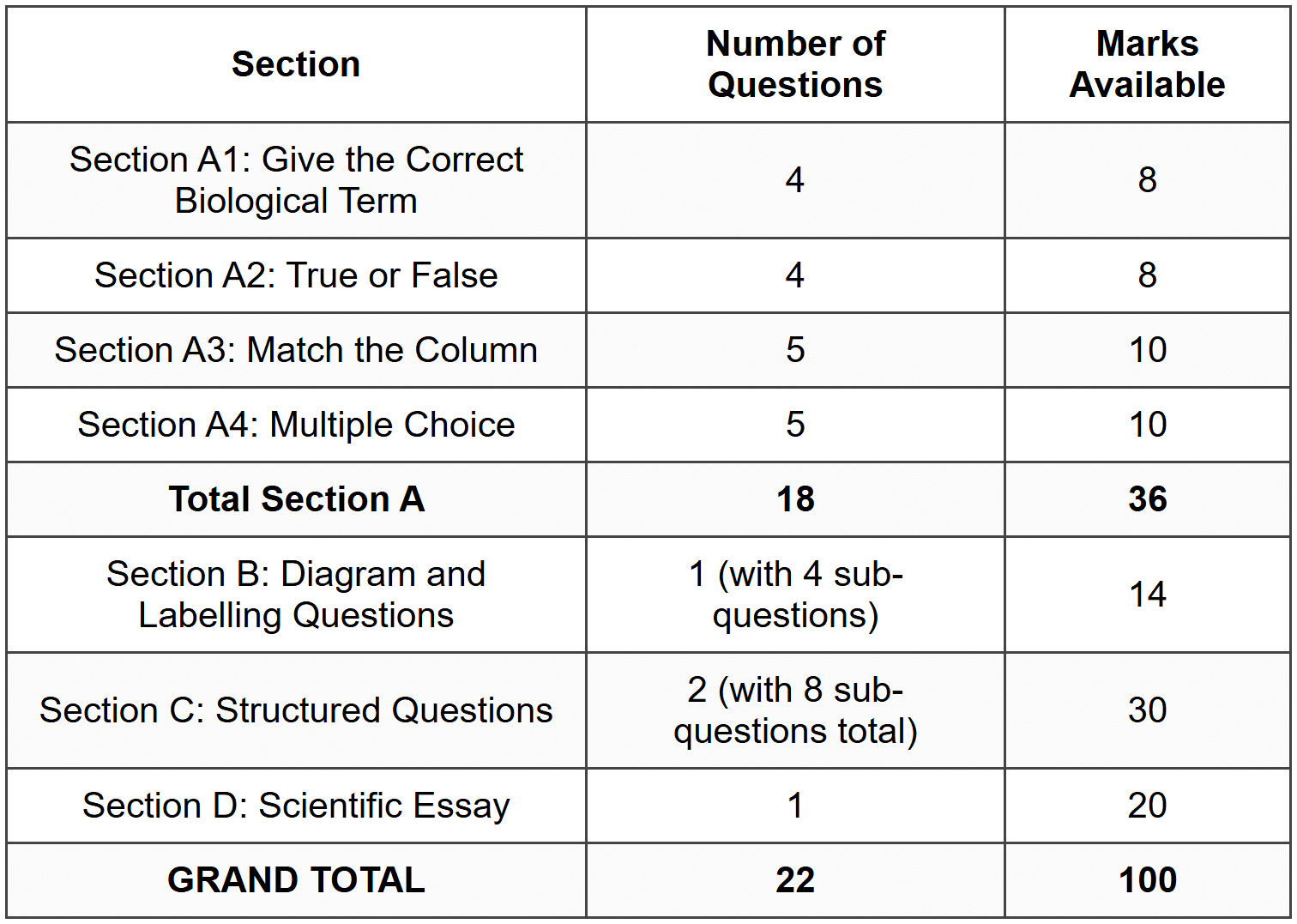
Keep working hard and remember that consistent practice with correct biological terminology will help you achieve excellent results in Life Sciences!




