Final Songwriting Checklist


Final Songwriting Checklist
1. Why You Need a Songwriting Checklist
Picture this: you've just written what feels like your best song yet. The creative rush is still pumping through you, and you're convinced it's ready to share with the world. But here's what experience teaches us-that initial creative high can blind us to problems that listeners will hear immediately.
Think about the songs you love most. Take Bohemian Rhapsody by Queen or God Only Knows by The Beach Boys. These masterpieces weren't first drafts. They were meticulously refined, with every element scrutinized and polished. Brian Wilson famously spent months perfecting vocal arrangements, and Freddie Mercury tested countless variations before settling on the final structure.
A final songwriting checklist is your quality control system. It helps you step back from the emotional attachment to your creation and evaluate it objectively. You're shifting from being the passionate creator to being the critical editor-and both roles are essential.
Here's what happens when you use a systematic checklist: you catch structural weaknesses before they reach listeners, you ensure every section serves a purpose, and you develop a professional standard for your work. Over time, this process becomes internalized, making you a stronger songwriter from the first draft onward.
The best songs feel effortless to the listener precisely because the songwriter worked hard to eliminate everything that felt effortful.
Let's build your comprehensive checklist together, examining every dimension of your song from foundation to finish.
2. Structural Integrity Check
2.1 Overall Architecture
Start by mapping out your song's structure on paper. Write down each section in order: Intro, Verse 1, Chorus, Verse 2, Chorus, Bridge, Chorus, Outro-or whatever form your song takes. Now ask yourself these critical questions:
- Does each section have a clear identity? Your listener should immediately recognize when they've moved from verse to chorus, from chorus to bridge. If sections blur together, you've lost architectural clarity.
- Is there a logical emotional progression? Think about Someone Like You by Adele. The verses build tension with restraint, the pre-chorus escalates anticipation, and the chorus delivers emotional release. Each section prepares the next.
- Do your sections balance repetition and variety? Too much repetition creates boredom; too much variety creates confusion. The standard verse-chorus form endures because it solves this balance elegantly.
Try this exercise: listen to your song while following along with your written structure map. Do the transitions feel natural, or do they jar you? Pay special attention to moments where energy suddenly drops or where you feel the song stalls.
2.2 Section Length and Proportion
Timing matters more than most songwriters realize. Your verse shouldn't ramble on so long that listeners forget what the song is about, but it also needs enough space to establish its narrative or emotional content.
Let's look at proven proportions. In Shake It Off by Taylor Swift, each verse runs about 18 seconds-long enough to deliver a complete thought, short enough to maintain momentum. The chorus hits at 25 seconds, giving it just enough extra weight to feel satisfying without overstaying its welcome.
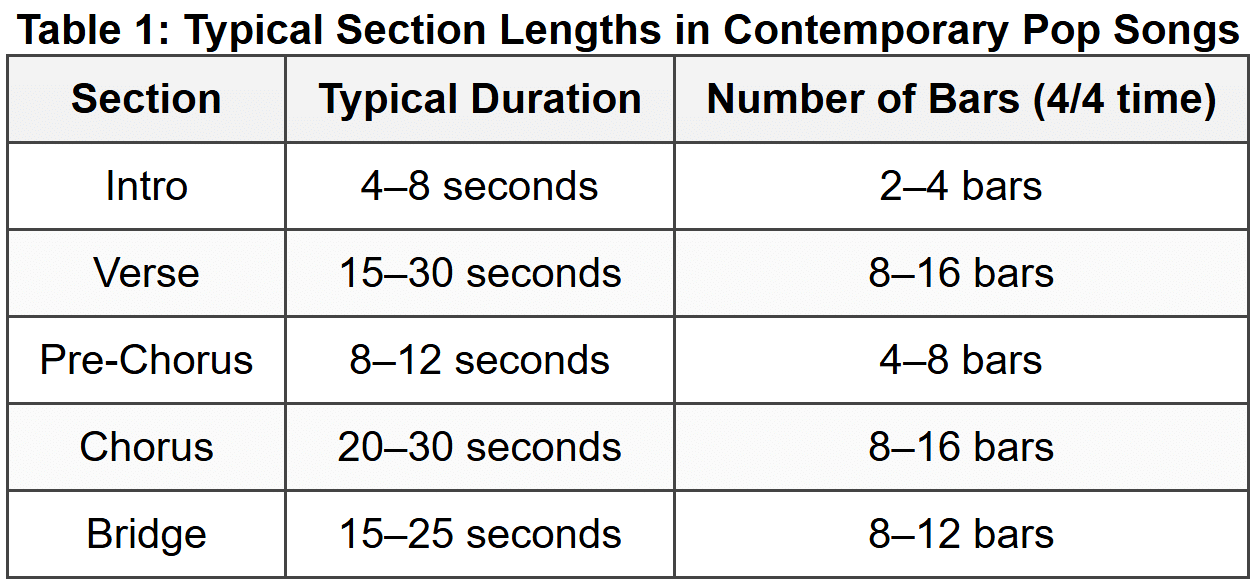
These aren't rigid rules-Stairway to Heaven by Led Zeppelin breaks every convention and remains a masterpiece. But if you're deviating from these proportions, make sure you have a compelling artistic reason. Deviation should be intentional, not accidental.
2.3 The "Does It Need to Be There?" Test
Go through your song section by section and ask ruthlessly: What would happen if I removed this? If the song still works-or works better-you've found excess material that should be cut.
Paul McCartney originally wrote an additional verse for Yesterday, but removed it because the song communicated its message completely in two verses and a bridge. That restraint is part of why the song feels perfect rather than padded.
Ask yourself:
- Does the intro set up the song effectively, or does it delay the real beginning?
- Does the third verse add new information or just repeat what we already know?
- Does the extended outro serve the song, or are you just avoiding the decision to end?
3. Melody Evaluation
3.1 Memorability and Singability
Close your laptop, put down your guitar, and walk away from your song for an hour. Then try to sing your chorus melody from memory. Could you do it? If not, your melody isn't memorable enough yet.
The most enduring melodies share common characteristics. They typically feature:
- A mix of stepwise motion and small leaps-too many steps make melodies bland; too many leaps make them difficult to sing. Listen to Somewhere Over the Rainbow by Harold Arlen. That opening octave leap is dramatic, but the rest of the phrase moves mostly by step, creating a perfect balance.
- A clear high point-your melody should reach toward one or two climactic notes. In Rolling in the Deep by Adele, the chorus builds toward that sustained high note on "deep," creating a satisfying peak.
- Repetition with variation-notice how Let It Be by The Beatles repeats the title phrase with slight melodic variations each time. This creates familiarity while avoiding monotony.
Try this: record yourself singing your melody on a neutral syllable like "la" or "da." Remove the words completely. Does the melody still communicate emotion? Does it still sound interesting? A truly strong melody doesn't depend on lyrics to carry it.
3.2 Range and Tessitura
Your melody might sound great when you sing it, but will other people be able to sing it comfortably? Check your song's range-the distance from lowest to highest note-and its tessitura-where most of the melody sits.
Most successful pop melodies span about an octave to an octave and a fifth. Happy by Pharrell Williams uses a range of about a ninth (just over an octave), with most of the melody sitting in a comfortable mid-range. This makes it singable for most people, which contributed to its massive popularity.
Conversely, Vision of Love by Mariah Carey showcases her extraordinary range, spanning nearly two octaves. That's stunning artistically, but it limits who can perform it. Know your audience and purpose-are you writing for yourself, for a specific artist, or for universal appeal?
If your melody requires advanced vocal technique to sing, you're writing for performers. If it sits comfortably in a conversational range, you're writing for everyone.
3.3 Melodic Contour and Direction
Sketch your melody as a simple line graph, with pitch on the vertical axis and time on the horizontal. What shape do you see? Strong melodies often show clear directional movement-they climb, plateau, and descend with purpose.
Look at your chorus melody specifically. Does it have an arch shape, starting mid-range, climbing to a high point, and then resolving downward? This is one of the most naturally satisfying melodic shapes. Don't Stop Believin' by Journey follows this exact pattern in its famous chorus.
Check for these potential problems:
- Flatlines-melodies that hover around one or two pitches without meaningful movement
- Aimless wandering-melodies that move without apparent direction or goal
- Awkward leaps-particularly large jumps that don't resolve naturally, such as an augmented fourth followed by another leap
4. Lyrical Strength Assessment
4.1 Clarity of Message
Can you summarize your song's central message or story in one sentence? If you struggle to do this, your lyrics probably lack focus. Before worrying about clever wordplay or poetic devices, make sure you're actually saying something clear.
Fast Car by Tracy Chapman tells a specific story with crystal clarity: a person dreams of escaping poverty with their partner, but gradually realizes the relationship won't save them. Every verse develops this narrative. Every image supports this theme.
Read your lyrics as if they were a poem on a page, without music. Ask yourself:
- Would someone understand what this song is about?
- Does each verse contribute to the central idea, or do some verses drift into unrelated territory?
- Is there a clear emotional through-line from beginning to end?
4.2 Cliché Detection
Clichés aren't automatically bad-sometimes a familiar phrase is exactly what you need. But overreliance on clichés makes your song forgettable. You want your lyrics to sound like they could only come from this particular song, not like they were assembled from a generic phrase generator.
Common lyrical clichés to watch for:
- "Heart of gold," "love me true," "forever and always"
- "Standing in the rain" as a metaphor for sadness
- Rhyming "fire" with "desire" or "higher"
- "Baby" used as filler rather than meaning
Now, notice how great songwriters either avoid these entirely or subvert them. In Lose Yourself, Eminem uses "palms are sweaty" as a physical detail that's specific enough to feel fresh, even though it describes a common experience. Bob Dylan rarely uses generic romantic phrases-his lyrics are packed with specific, sometimes surreal imagery that feels uniquely his.
Try this exercise: circle every phrase in your lyrics that you've heard before in other songs. Then challenge yourself to replace at least half of them with more specific, original expressions.
4.3 Prosody: Do Words and Music Match?
Prosody is the marriage between your lyrics and melody-how the natural rhythm and emphasis of your words align with the musical rhythm and melodic contour. Poor prosody makes lyrics feel awkward or forced, even if both elements work well independently.
Say your lyrics out loud conversationally, and notice which syllables you naturally stress. Then sing them with your melody. Do the stressed syllables fall on strong beats or on melodic high points? They should.
Listen to My Shot from Hamilton by Lin-Manuel Miranda. The melody perfectly matches the natural speech rhythm of the lyrics, making even complex, rapid-fire lines feel effortless. Every emphasized word lands on an emphasized beat.
Common prosody problems:
- Important words landing on weak beats or low notes
- Unimportant words (like "the" or "and") forced onto long notes or melodic peaks
- Words stretched or compressed in unnatural ways to fit the melody
- Awkward syllable placement that makes the text unclear
If you find yourself having to explain how lyrics should be sung, that's a red flag that your prosody needs work.
4.4 Rhyme Scheme Consistency
Check whether your rhyme scheme is consistent throughout the song. If your first verse uses an ABAB pattern, does your second verse follow the same pattern? Inconsistency can make a song feel unfinished or careless.
That said, purposeful variation can be effective. The verses might use one rhyme scheme while the chorus uses another, creating contrast. Stan by Eminem features verses with dense internal rhymes, while the choruses (sung by Dido) use a simpler, more open rhyme structure, reflecting the different emotional perspectives.
Also evaluate your rhyme quality:
- Perfect rhymes (cat/hat) are satisfying but can feel predictable
- Near rhymes or slant rhymes (soul/old, time/line) add sophistication
- Forced rhymes where you've twisted word order or meaning just to make a rhyme work-these need fixing
5. Harmonic and Chord Progression Review
5.1 Chord Choice and Function
Play through your chord progression slowly, listening to how each chord functions. Does each chord move you toward a goal, or do some feel like you're just marking time?
Strong progressions create a sense of journey. In the key of C major, a progression like C → Am → F → G has clear directional pull. The Am (vi) creates mild tension, the F (IV) maintains interest, and the G (V) strongly pulls back to C (I). Each chord has a job.
Compare this to a progression that randomly wanders between chords without harmonic logic. You might move from C to Dm to E to F with no clear sense of where you're headed or why. Even if these chords technically "work" in the key, they don't create a satisfying narrative.
Ask yourself:
- Do your verse and chorus have clearly different harmonic characters?
- Does your bridge offer genuine harmonic contrast, or does it just use the same chords in a different order?
- Are there any chords that feel out of place or that don't contribute to the song's emotional direction?
5.2 Harmonic Rhythm
Harmonic rhythm refers to how often your chords change. This is separate from the tempo or the melodic rhythm-it's specifically about the pace of chord movement.
In Let It Be by The Beatles, the verses change chords every one or two beats, creating gentle forward motion. But notice how some songs, like Pumped Up Kicks by Foster the People, maintain the same chord loop throughout most of the song, relying on other elements for variation.
Check your harmonic rhythm for these issues:
- Too fast: chords changing so rapidly that harmonies blur together and listeners can't absorb them
- Too slow: sitting on single chords for so long that momentum dies
- Inconsistent without reason: varying harmonic rhythm randomly rather than purposefully
Try this: map out how many beats each chord lasts. Is there a pattern? Does the pattern change between sections in a way that creates useful contrast?
5.3 Voice Leading
Even if you don't think of yourself as arranging "voices," your chords contain multiple notes, and how those notes move from chord to chord affects how smooth or jarring your progressions sound.
Good voice leading means that individual notes within chords move efficiently-typically by step rather than by large leaps. When you move from C major (C-E-G) to F major (F-A-C), notice that C stays in place, E moves up one step to F, and G moves up one step to A. That's smooth, connected voice leading.
Play your chord progression one note at a time, tracking the top note of each chord. Does it create a smooth, singable line? Or does it jump around erratically? The same question applies to the bottom notes and inner notes.
Listen to The Scientist by Coldplay. The piano progression features descending bass notes that create a melancholic, falling feeling. The voice leading is so smooth it's almost voice-like, which contributes to the song's emotional pull.
6. Arrangement and Production Elements
6.1 Instrumentation Balance
Even if you're creating a demo rather than a final production, you need to think about what instruments or sounds are present and whether they serve the song.
Ask these questions about each instrument or sound element:
- Why is it here? Every element should have a purpose-providing rhythm, filling harmonic space, creating texture, emphasizing emotion.
- Is it competing with something else? If your bass line and guitar are both playing busy patterns in the same frequency range, they'll clash rather than complement each other.
- Does it appear in the right sections? Effective arrangements add and subtract elements to create dynamics. The second verse might add a new instrument; the bridge might strip back to bare essentials.
Think about Billie Jean by Michael Jackson. The arrangement is remarkably sparse-drums, bass, synth chords, vocals, and a few embellishments. Every element has space to breathe, and nothing is unnecessary. This clarity is part of the song's power.
6.2 Frequency Spectrum Coverage
Listen to your song with fresh ears and ask: are there frequency ranges that feel empty or overcrowded? A balanced arrangement typically includes:
- Low frequencies (bass): providing foundation and groove
- Mid frequencies: where most instruments and vocals live, carrying melody and harmony
- High frequencies: adding brightness, air, and clarity
If everything sits in the mid-range (multiple guitars, piano, vocals all fighting for the same space), your song will sound muddy and cluttered. If you're missing high frequencies entirely, it might sound dull. If the bass is too sparse, it might lack grounding.
Try this listening exercise: close your eyes and listen to your song while visualizing it as three layers-bottom, middle, and top. Is each layer adequately filled? Are any layers overcrowded?
6.3 Dynamic Range and Contrast
Dynamics-the variation between loud and soft passages-create emotional impact. If your entire song plays at the same volume level with the same intensity, you've lost a powerful tool for maintaining listener interest.
Map the dynamic arc of your song. Does it build? Does it pull back? Smells Like Teen Spirit by Nirvana features dramatic dynamic contrast between quiet verses and explosive choruses. This contrast is as important to the song's impact as the melody or chords.
Even in genres that favor consistent energy levels, you can create dynamic contrast through arrangement density rather than volume. A dance track might maintain steady volume but add and subtract instruments to create peaks and valleys of intensity.
Check for these dynamic problems:
- Choruses that aren't noticeably bigger or more intense than verses
- Bridges that don't offer meaningful dynamic contrast
- Songs that start at maximum intensity with nowhere left to grow
- Songs that maintain one dynamic level so consistently they become monotonous
7. Transitions and Connections
7.1 Section Transitions
The seams between sections-where verse becomes chorus, where chorus becomes bridge-are critical moments. Awkward transitions can derail even excellent individual sections.
Listen carefully to each transition in your song. Does it feel smooth and inevitable, or does it feel like you've suddenly changed songs? There's no single right way to transition, but every transition should be intentional.
Common transition techniques:
- Drum fills-a classic approach, as in When the Levee Breaks by Led Zeppelin, where John Bonham's fills signal incoming changes
- Melodic or lyrical pickup notes-starting the next section slightly early, as in Love Story by Taylor Swift, where the word "So" begins the chorus before the chorus's downbeat
- Harmonic preparation-the last chord of one section naturally leading to the first chord of the next
- Textural change-adding or removing instruments right at the transition point
- Silence or space-a brief gap that creates anticipation, as in We Will Rock You by Queen
Record yourself performing your song and specifically listen to transitions. Do any of them make you wince? Those are the ones that need work.
7.2 Pre-Chorus Function
If your song includes a pre-chorus, make sure it's actually functioning as one. A pre-chorus should build tension and anticipation that the chorus then releases. It should feel like a ramp or a runway leading to takeoff.
In Teenage Dream by Katy Perry, the pre-chorus ("Let's go all the way tonight...") raises both melodic pitch and emotional intensity, making the chorus arrival feel satisfying and earned. If your pre-chorus doesn't create this rising tension, it might just be an extra verse section wearing a pre-chorus label.
Test your pre-chorus: what would happen if you cut directly from verse to chorus? If the song works just as well or better without it, you either need to strengthen the pre-chorus or eliminate it.
8. Title and Hook Effectiveness
8.1 Is Your Hook Actually Hooking?
The hook is the most memorable, catchy part of your song-usually a phrase, melodic motif, or rhythmic pattern that grabs attention and sticks in memory. Often, but not always, the hook is your song title repeated in the chorus.
Ask yourself honestly: if you heard your song on the radio once, would you remember the hook? Could you sing it later? Think about I Want to Hold Your Hand by The Beatles-you hear that title phrase and melody once, and it's lodged in your brain. That's an effective hook.
Test your hook strength:
- Simplicity: hooks are almost always built from simple melodic and rhythmic ideas
- Repetition: hooks appear multiple times in strategic locations
- Distinctiveness: your hook should sound different from the material around it-higher, louder, more rhythmic, or otherwise set apart
- Payoff: the hook should feel like the moment the song has been building toward
8.2 Title Placement and Prominence
In most successful songs, the title appears in a memorable, emphasized position-usually at the beginning or end of the chorus, on a strong beat, at a melodic high point, or some combination of these.
Count how many times your title appears in your song. If it's only once or twice, listeners might not catch it or remember it. If it appears but always rushes by in the middle of lines, it might lack emphasis. Compare this to Rolling in the Deep by Adele, where the title phrase ends every chorus on the song's melodic and emotional peak.
If your song never actually states its title out loud, you're making a risky choice. It can work-Bohemian Rhapsody never includes those words in the lyrics-but you need a very strong reason for this approach.
9. Tempo and Feel Verification
9.1 Is Your Tempo Serving the Song?
Tempo isn't just a number-it's a fundamental expressive choice that affects everything about how your song communicates. The same melody at 80 BPM versus 140 BPM creates entirely different emotional experiences.
Try this experiment: record your chorus at three different tempos-your current tempo, something 10-15 BPM slower, and something 10-15 BPM faster. Listen to all three versions. Which one best serves the emotional content of your lyrics and the character of your melody?
Some songs reveal their ideal tempo immediately. Uptown Funk by Mark Ronson and Bruno Mars sits at exactly the right tempo for its groove-fast enough to be energizing, but not so fast that the rhythm becomes frantic. Slow it down, and it loses its drive; speed it up, and it becomes unsustainable.
Consider whether your tempo:
- Matches the emotional content (slow tempos for ballads and reflective songs; faster tempos for energetic, joyful, or urgent emotions)
- Allows all the musical elements to breathe and be heard clearly
- Creates the right amount of space between lyrics so they're understood
- Feels natural when you perform it, not rushed or dragging
9.2 Groove and Rhythmic Feel
Beyond tempo, your song has a rhythmic feel or groove-the way rhythm is played, whether it's straight, swung, laid-back, or pushing forward. This feel profoundly affects the song's character.
Listen to Superstition by Stevie Wonder. The groove is tight, slightly ahead of the beat, creating urgency and excitement. Now compare that to Video Games by Lana Del Rey, where the rhythm is looser, more atmospheric, almost floating. Both approaches are perfect for their respective songs.
Record yourself playing along with a metronome set to your song's tempo. Then record yourself playing the same song without the metronome, following your natural rhythmic instinct. Are these significantly different? If the metronome version feels stiff and the free version feels better, you might need to adjust how rigid your rhythmic approach is, or perhaps adjust the tempo slightly.
10. Emotional Authenticity Check
10.1 Do You Believe What You're Singing?
This is perhaps the most important question on your entire checklist, and the hardest to assess objectively. When you perform your song, does it feel genuine? Or are you going through motions, singing words that sound like song lyrics but don't actually mean anything to you?
Think about Hurt, originally by Nine Inch Nails and famously covered by Johnny Cash. Both versions are devastating because you can hear absolute conviction in the vocals. The singers believe every word. This authenticity transcends technical perfection.
Ask yourself these uncomfortable questions:
- Am I writing what I think a song should say, or what I actually need to say?
- Have I included phrases or images because they sound "poetic," even though they don't connect to real feeling?
- Is there a more honest, maybe more vulnerable way to express this idea?
- Would I be embarrassed if my closest friend heard this, not because it's bad, but because it reveals something true about me? (Often that embarrassment signals authenticity.)
10.2 Emotional Consistency
Your song should maintain emotional coherence from beginning to end. This doesn't mean the emotion can't evolve-great songs often take emotional journeys. But there should be a logical progression, not random mood swings.
In Landslide by Fleetwood Mac, Stevie Nicks begins with reflective uncertainty and gradually moves toward acceptance and resolution. The emotional arc is clear and believable. If the song suddenly shifted from melancholy to giddy excitement with no preparation, it would feel false.
Check whether:
- Your musical choices (major vs. minor, tempo, dynamics) match your lyrical content
- Any sections feel like they belong in a different song emotionally
- The overall emotional trajectory makes sense-does it progress, intensify, resolve, or transform in a way that feels natural?
11. Technical Details and Polish
11.1 Tuning and Intonation
This might seem obvious, but check that all instruments are properly tuned to each other and that any recorded vocals are in tune. Even the most brilliant song loses impact when intonation is sloppy.
If you're recording multiple instruments or vocal layers, ensure they're all tuned to the same reference pitch. Small tuning discrepancies create a beating or wavering effect that sounds amateurish.
11.2 Timing Consistency
Listen critically to whether your song maintains consistent timing. Are you rushing in some sections and dragging in others? Do different instruments agree on where the beat is?
Some degree of human timing variation is desirable-rigidly quantized performances can sound mechanical. But significant timing inconsistencies distract listeners from the song itself.
If you're recording to a click track or metronome, make sure it's set to the right tempo for the entire song. If your song includes tempo changes, mark them clearly.
11.3 Recording Quality (for Demos)
If you're recording a demo, it doesn't need to sound like a professional studio production, but it should be clear enough that listeners can focus on the song rather than fighting to hear through technical problems.
Basic quality checklist:
- Are vocals loud enough and clear enough to understand the lyrics?
- Is there excessive background noise, hiss, or hum?
- Are any instruments or voices distorting or clipping?
- Is the balance between instruments reasonable, or is something buried or overwhelming the mix?
12. The Fresh Ears Test
12.1 Taking Time Away
After you've completed your song and worked through your checklist, do something counterintuitive: walk away from it completely for at least 24 hours, ideally a week. Don't listen to it, don't think about it, don't revise it.
Why? Because you need to reset your ears and your emotional attachment. When you're deep in the creation process, you hear what you intended to create rather than what actually exists. Time creates objectivity.
When you return to the song, listen to it once all the way through without pausing, as if you're hearing it for the first time. Notice what jumps out at you-both good and bad. These immediate impressions often reveal truths that detailed analysis misses.
12.2 Different Listening Contexts
Listen to your song in multiple contexts:
- On headphones-reveals details and balance issues
- On phone or laptop speakers-shows whether the song translates to less-than-ideal playback systems
- In a car-a surprisingly revealing context where many people listen to music
- While doing something else-does the song hold your attention even when you're not focused on it?
If your song falls apart in certain listening contexts, that tells you something important about what needs adjustment.
12.3 Outside Feedback
At some point, you need feedback from someone other than yourself. Choose your listeners carefully-you want people who will be honest but constructive, who understand what you're trying to achieve, and who have some knowledge of songwriting.
When receiving feedback:
- Don't explain the song before they hear it. If you need to explain what it means or how it should make them feel, the song isn't communicating clearly.
- Ask specific questions: "Was the chorus memorable?" "Did you understand the story?" "Which section felt weakest?"
- Listen to feedback without defending your choices. You don't have to agree with everything, but don't dismiss criticism immediately.
- Look for patterns. If multiple people mention the same issue, it's probably real.
13. Final Decision: Is It Done?
13.1 Recognizing Completion
Perfectionism is the enemy of finishing songs. At some point, you need to declare a song complete, even if you can imagine ways it might be improved. The question isn't whether your song is perfect-no song is. The question is whether it effectively communicates what you want it to communicate.
Signs a song is ready:
- You've addressed all major structural, melodic, and lyrical issues
- The song achieves its emotional purpose
- Further changes are tweaks rather than improvements
- You can perform or play it confidently
- Other listeners respond to it positively
Paul Valery famously said, "A poem is never finished, only abandoned." The same is true of songs. At some point, you need to let it go into the world.
13.2 Knowing When to Start Over
Sometimes, after working through your checklist, you realize the song has fundamental problems that can't be fixed with editing. Maybe the core melodic idea isn't strong enough. Maybe the lyrics are circling around an idea they never quite capture. Maybe the song is trying to be three different songs at once.
This is painful, but it's also valuable information. Not every song idea needs to be finished. Sometimes the best decision is to harvest the good parts-that one great line, that interesting chord progression-and start fresh with a new song that uses them more effectively.
Professional songwriters don't finish every song they start. They recognize which ideas have potential and which should be set aside. This isn't failure-it's quality control.
14. Creating Your Personal Checklist
Now that we've explored all these dimensions of song evaluation, it's time to create your own personalized final checklist. Not every songwriter needs to check every item on every song. Your checklist should reflect your specific goals, challenges, and creative process.
Start with the areas where you know you struggle. If you tend to write verses that ramble, put "Section Length and Focus" at the top of your checklist. If your melodies are often forgettable, prioritize melody memorability tests. If you habitually use clichés, make lyric originality a primary checkpoint.
Here's a suggested framework for building your checklist:
14.1 Essential Checks (Every Song)
- Does the song have a clear emotional center?
- Is the structure logical and effective?
- Is the melody memorable and singable?
- Do the lyrics say something specific and clear?
- Is the hook prominent and effective?
14.2 Technical Checks (Recording/Demo Phase)
- Are all elements in tune?
- Is timing consistent?
- Is the recording clear enough to evaluate the song?
14.3 Refinement Checks (After First Draft)
- Does every section justify its existence?
- Are transitions smooth?
- Is there dynamic and textural contrast?
- Do words and music fit naturally (prosody)?
- Have I eliminated unnecessary clichés?
14.4 Final Polish Checks (Before Calling It Done)
- Have I tested this with fresh ears after time away?
- Have I listened in multiple contexts?
- Have I received and considered outside feedback?
- Can I perform this confidently?
Print out your checklist or keep it digitally accessible. Use it systematically, but not rigidly. Let it guide you without constraining you.
15. Moving Forward: Making the Checklist Habitual
The goal isn't to mechanically follow a checklist forever. The goal is to internalize these quality standards so they become automatic. Over time, many of these checks will happen intuitively during the writing process rather than as separate evaluation steps afterward.
When Joni Mitchell or Paul Simon sit down to write, they're not consciously running through checklists-but decades of practice have built these standards into their creative process. They write with critical awareness from the beginning.
You'll get there too. Each time you work through your checklist, you're training yourself to write better first drafts. Eventually, you'll catch problems while writing rather than only during revision. You'll instinctively reach for specific rather than clichéd language. You'll hear when a section has gone on too long.
But for now, use the checklist explicitly and thoroughly. It's your tool for bridging the gap between the song you imagine and the song that actually exists. It's how you honor both your creative impulse and your listener's experience.
The checklist isn't about restricting creativity-it's about making sure your creativity reaches listeners in its fullest, clearest form.
Keep writing. Keep checking. Keep improving. Your next song is waiting to be finished properly.
Key Terms
- Authenticity
- The quality of genuine emotional truth in a song; when the songwriter's expression feels honest and believable rather than artificial or calculated.
- Bridge
- A contrasting section typically appearing once in a song, usually after the second chorus, providing harmonic, melodic, or lyrical variety before returning to familiar material.
- Cliché
- An overused phrase, image, or musical idea that has lost its original impact through repetition across many songs; can make lyrics feel generic or unoriginal.
- Contour
- The shape of a melody when visualized as a line graph, showing its rises, falls, and overall directional movement.
- Dynamic Range
- The variation between loud and soft passages in a song; the contrast between different levels of intensity or volume.
- Groove
- The rhythmic feel or pocket of a song; the way rhythm is played, whether straight, swung, laid-back, or pushing forward.
- Harmonic Rhythm
- The rate at which chords change in a progression; how frequently new harmonies appear, measured independently of tempo or melodic rhythm.
- Hook
- The most memorable, catchy element of a song-usually a melodic phrase, lyrical phrase, or rhythmic pattern designed to grab attention and stick in memory.
- Prosody
- The alignment between lyrics and melody; how well the natural rhythm, stress, and emphasis of words match the musical rhythm and melodic contour.
- Range
- The distance between the lowest and highest pitch in a melody or vocal part, typically measured in scale degrees or octaves.
- Slant Rhyme
- Also called near rhyme or imperfect rhyme; words that have similar but not identical sounds (soul/old, time/line), adding sophistication and avoiding predictability.
- Tessitura
- The range where most of a melody sits; the area where the majority of notes lie, as distinct from the overall range from lowest to highest note.
- Transition
- The musical connection between two sections of a song; the passage from verse to chorus, chorus to bridge, or between any other structural elements.
- Voice Leading
- The smooth, logical movement of individual notes within chords as harmonies change; typically favoring stepwise motion over large leaps for connected, fluid progressions.