Support Systems in Animals

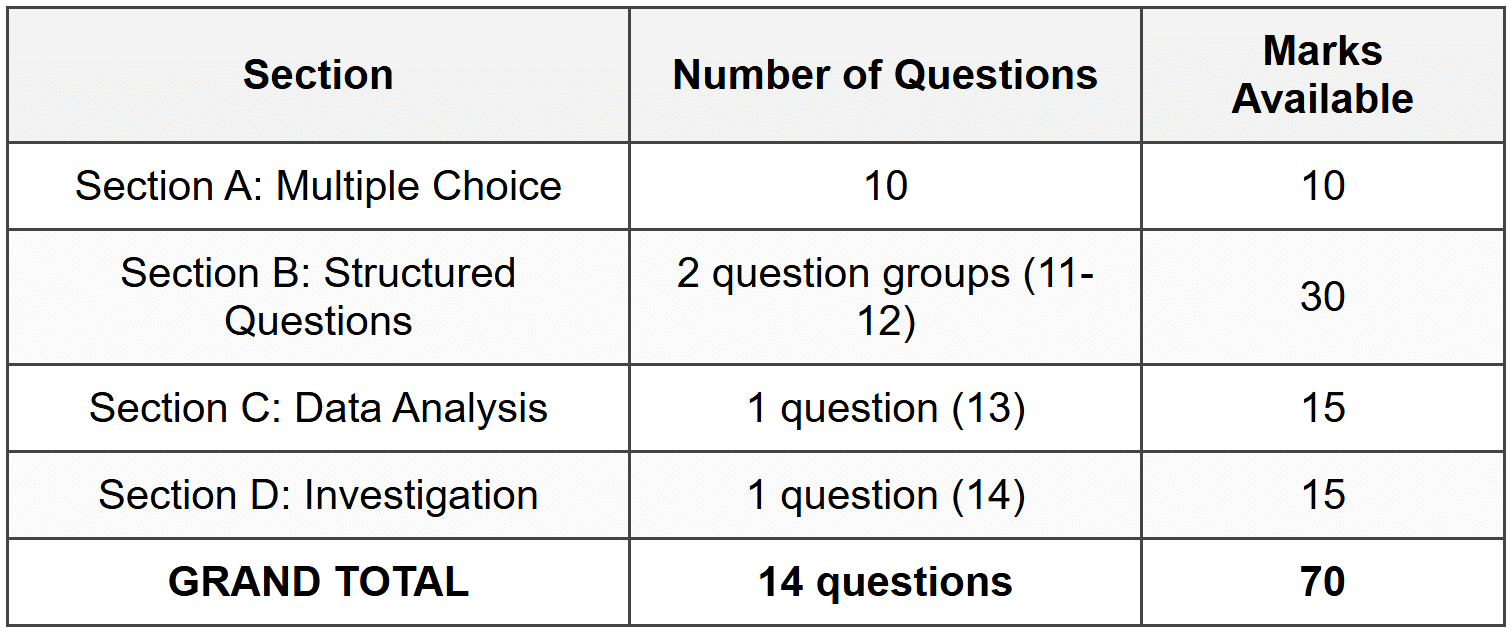
SECTION A: MULTIPLE CHOICE
(Total: 10 marks)
1. Which type of skeleton is found in earthworms?
A. Endoskeleton
B. Exoskeleton
C. Hydrostatic skeleton
D. Cartilaginous skeleton
2. The main function of the vertebral column in humans is to:
A. produce red blood cells
B. protect the spinal cord and support the body
C. store calcium only
D. facilitate gas exchange
3. Which mineral is primarily stored in bones?
A. Iron
B. Sodium
C. Calcium
D. Potassium
4. The hard outer layer of an insect's exoskeleton is made of:
A. calcium carbonate
B. chitin
C. cellulose
D. collagen
5. A snail has an exoskeleton with a mass of 12 g. If the total mass of the snail is 40 g, what percentage of its body mass is the exoskeleton?
A. 20%
B. 25%
C. 30%
D. 35%
6. Which of the following animals has an endoskeleton made entirely of cartilage?
A. Human
B. Shark
C. Crab
D. Bird
7. The process by which insects shed their exoskeleton to grow is called:
A. metamorphosis
B. ossification
C. moulting
D. calcification
8. A grasshopper has a body length of 45 mm. After moulting, its new exoskeleton allows it to grow to 60 mm. What is the percentage increase in body length?
A. 15%
B. 25%
C. 33.3%
D. 50%
9. Which component of the human skeletal system connects bones to other bones at joints?
A. Tendons
B. Ligaments
C. Cartilage
D. Muscles
10. An advantage of an exoskeleton over a hydrostatic skeleton is that it:
A. allows unlimited growth without moulting
B. provides better protection against predators and dehydration
C. requires less energy to maintain
D. provides greater flexibility of movement
SECTION B: STRUCTURED QUESTIONS
(Total: 30 marks)
Question 11
11. Thabo is studying different types of skeletal systems in animals.
(a) Define the term endoskeleton.
(b) Name TWO functions of the human skeletal system besides support.
(c) Explain why birds have hollow bones and how this adaptation relates to their skeletal support system.
(d) The human femur can withstand a compressive force of approximately 1.7 × 10⁴ N before fracturing. If a person with a mass of 75 kg jumps from a height and lands with an impact force that is 3.2 times their weight, calculate whether the femur is at risk of fracture. Show all working. (Take gravitational acceleration g = 10 m·s-2)
(e) Compare the advantages and disadvantages of an endoskeleton versus an exoskeleton in terms of growth, protection, and mobility.
Question 12
12. Nomsa investigates the skeletal systems of different invertebrates found in her garden.
(a) Distinguish between a hydrostatic skeleton and an exoskeleton by describing the structural composition of each.
(b) Explain how an earthworm uses its hydrostatic skeleton to move through soil.
(c) The table below shows data Nomsa collected about a beetle during its growth stages:
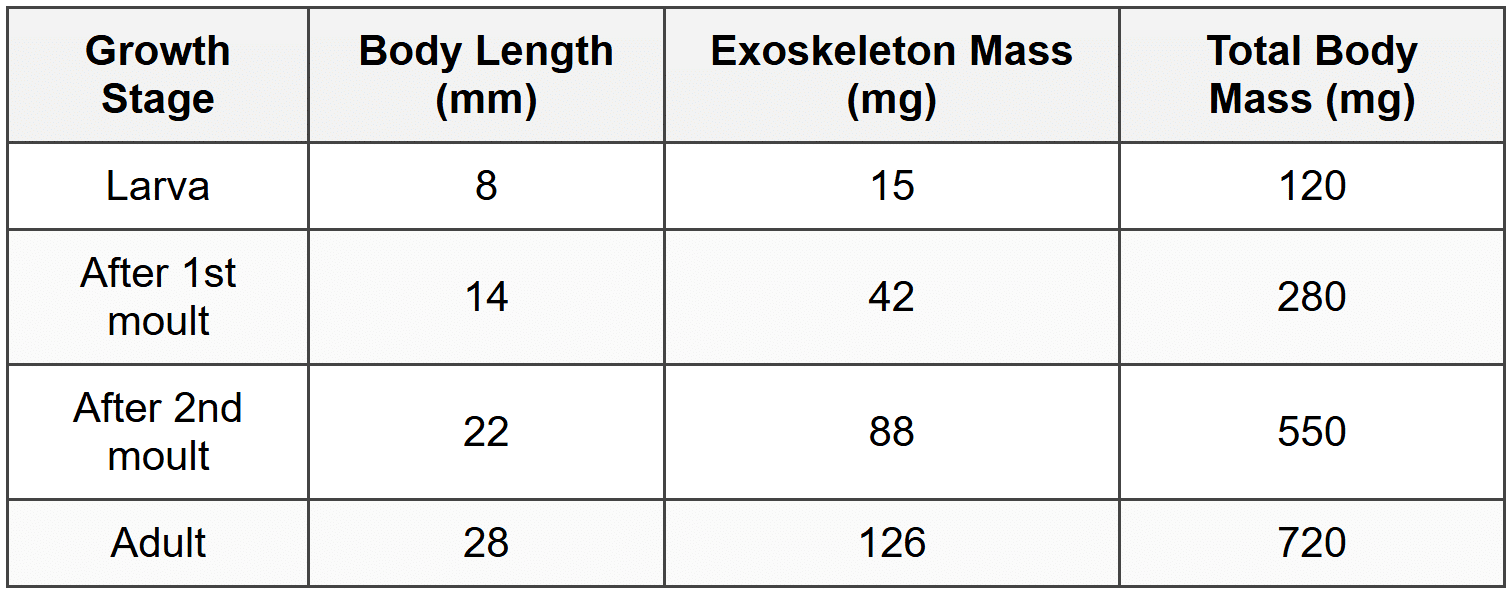
Calculate the percentage of total body mass that the exoskeleton represents in the larval stage and in the adult stage. Show all working.
(d) Based on your calculations in (c), explain what happens to the proportion of exoskeleton mass relative to total body mass as the beetle grows, and suggest a biological reason for this trend.
(e) State TWO disadvantages of having an exoskeleton for a growing animal.
SECTION C: DATA ANALYSIS AND GRAPHING
(Total: 15 marks)
Question 13
13. A research team studied the relationship between body mass and bone density in different vertebrates. They collected the following data:
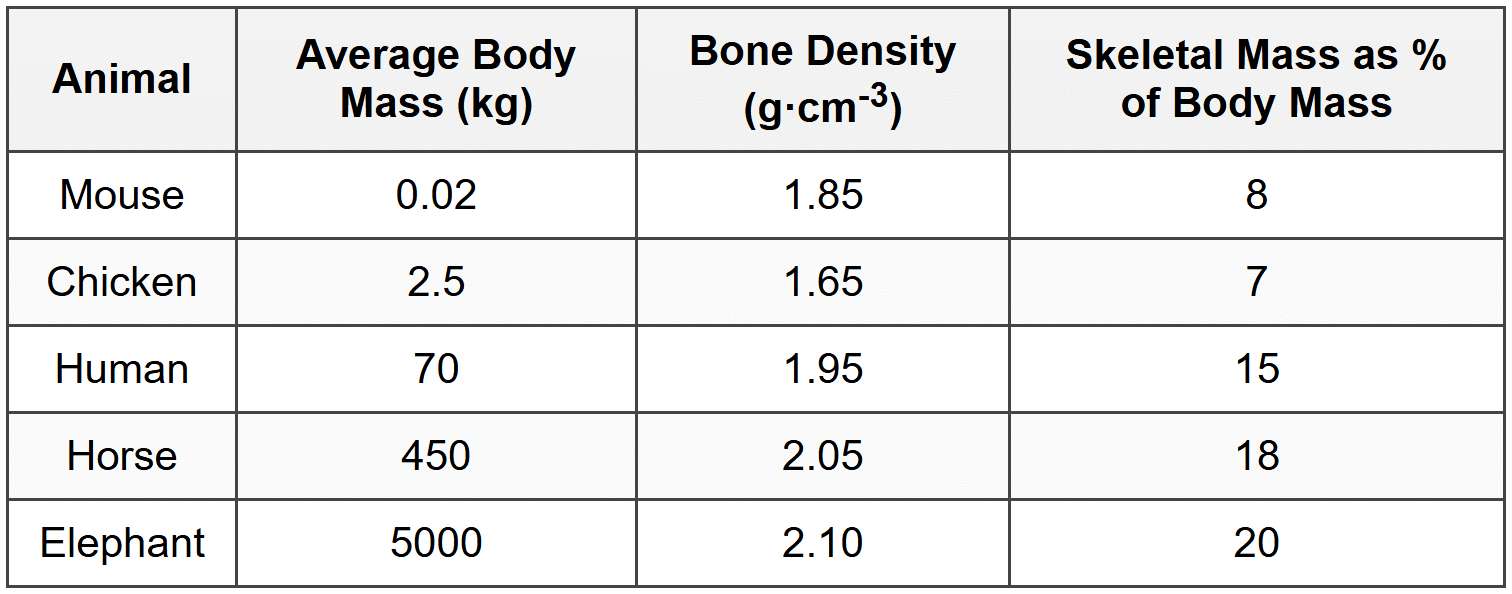
(a) Which animal in the table has the highest bone density?
(b) Calculate the actual skeletal mass in kilograms for the human. Show all working.
(c) Describe the relationship between body mass and the skeletal mass as a percentage of body mass.
(d) Explain why larger animals need a higher percentage of their body mass to be skeletal mass compared to smaller animals, using principles of structural support.
SECTION D: SCIENTIFIC INVESTIGATION
(Total: 15 marks)
Question 14
14. Sipho wants to investigate the effect of calcium intake on bone strength in young rats. He obtains 20 young rats of the same age and mass. He divides them into two equal groups. Group A receives a diet with normal calcium content (1.0% calcium), while Group B receives a diet with reduced calcium content (0.3% calcium). All other conditions are kept the same. After 8 weeks, he measures the force required to fracture a bone sample from each rat. He finds that Group A bones require an average force of 485 N to fracture, while Group B bones require an average force of 310 N to fracture.
(a) Identify the independent variable in this investigation.
(b) Identify the dependent variable in this investigation.
(c) Name ONE controlled variable in this investigation and explain why it must be kept constant.
(d) Write a hypothesis for this investigation in the format: If [condition], then [expected result], because [scientific reason].
(e) Based on the results described, draw a conclusion about the effect of calcium intake on bone strength. State whether the hypothesis was supported by the results and provide a scientific explanation for the findings.
GRAND TOTAL: 70
ANSWER KEY
Well done on completing this worksheet on Support Systems in Animals! Use this answer key to check your understanding and identify areas where you can improve. Remember to review any concepts you found challenging.
SECTION A - Question 1
C. Hydrostatic skeleton
Earthworms have a hydrostatic skeleton consisting of fluid-filled compartments surrounded by muscle layers. This type of skeleton provides support through the pressure of the internal fluid against the body wall, allowing the earthworm to move and burrow through soil.
SECTION A - Question 2
B. protect the spinal cord and support the body
The vertebral column (backbone) has two main functions: it protects the delicate spinal cord that runs through it, and it provides structural support for the body, allowing upright posture and serving as an attachment point for muscles and ribs.
SECTION A - Question 3
C. Calcium
Bones serve as the primary storage site for calcium in the body. Approximately 99% of the body's calcium is stored in bones and teeth, and this calcium can be released into the bloodstream when needed for various physiological functions.
SECTION A - Question 4
B. chitin
The exoskeleton of insects is composed primarily of chitin, a tough, flexible polysaccharide. This material provides protection, prevents water loss, and gives the body its shape, while being light enough to allow movement and flight.
SECTION A - Question 5
C. 30%
Step 1: Use the percentage formula: Percentage = (part ÷ whole) × 100
Step 2: Substitute the values: Percentage = (12 g ÷ 40 g) × 100
Step 3: Calculate:
= 0.3 × 100
= 30
Step 4: The exoskeleton represents 30% of the snail's body mass.
SECTION A - Question 6
B. Shark
Sharks belong to the class Chondrichthyes, which includes fish with skeletons made entirely of cartilage rather than bone. This cartilaginous skeleton is lighter than bone, which aids in buoyancy, and is still strong enough to provide support and protection.
SECTION A - Question 7
C. moulting
Moulting (or ecdysis) is the process by which insects and other arthropods shed their old exoskeleton to allow for growth. The old exoskeleton splits open, the animal emerges with a soft new exoskeleton, which then hardens. This must occur periodically because the rigid exoskeleton cannot expand.
SECTION A - Question 8
C. 33.3%
Step 1: Use the percentage increase formula: Percentage increase = [(new value - original value) ÷ original value] × 100
Step 2: Substitute the values: Percentage increase = [(60 mm - 45 mm) ÷ 45 mm] × 100
Step 3: Calculate:
= (15 mm ÷ 45 mm) × 100
= 0.333... × 100
= 33.3
Step 4: The percentage increase in body length is 33.3%.
SECTION A - Question 9
B. Ligaments
Ligaments are strong, fibrous connective tissues that connect bone to bone at joints. They provide stability to joints while allowing controlled movement. Tendons, in contrast, connect muscle to bone.
SECTION A - Question 10
B. provides better protection against predators and dehydration
An exoskeleton is a hard, rigid outer covering that provides excellent protection against physical damage from predators and environmental hazards. It also prevents water loss, which is particularly important for terrestrial animals. Hydrostatic skeletons offer less protection and are found mainly in soft-bodied animals in moist environments.
SECTION B - Question 11(a)
An endoskeleton is an internal skeletal system found inside the body of an animal, composed of bone and/or cartilage, that provides support, protection for internal organs, and attachment points for muscles.
Full marks: Definition includes "internal," mentions bone/cartilage, and states at least one function.
Partial marks: Definition states it is internal but lacks detail on composition or function.
SECTION B - Question 11(b)
Any TWO of the following functions:
- Protection of internal organs (e.g., skull protects brain, ribcage protects heart and lungs)
- Production of blood cells (red bone marrow produces red blood cells, white blood cells, and platelets)
- Storage of minerals (bones store calcium and phosphorus)
- Muscle attachment (bones provide attachment points for muscles, enabling movement)
Full marks: Two correct functions clearly stated.
SECTION B - Question 11(c)
Birds have hollow bones (also called pneumatic bones) that contain air spaces. This adaptation significantly reduces the overall mass of the skeleton while maintaining structural strength. The reduced body mass is crucial for flight, as it decreases the energy required to become airborne and stay aloft. Despite being hollow, these bones are reinforced with internal struts that provide strength, allowing the skeleton to still support the body and withstand the forces generated during flight.
Full marks: Explains that hollow bones reduce mass, relates this to flight, and mentions that strength is maintained through structural adaptations.
Partial marks: States that hollow bones reduce mass and help with flight but does not explain how strength is maintained.
SECTION B - Question 11(d)
Step 1: Calculate the weight of the person using W = m × g, then calculate the impact force.
Step 2: Substitute values:
Weight = 75 kg × 10 m·s-2 = 750 N
Impact force = 3.2 × 750 N
Step 3: Calculate the impact force:
Impact force = 3.2 × 750 N
= 2400 N
Step 4: Compare the impact force to the fracture threshold: The impact force is 2400 N, which is much less than the femur's fracture threshold of 1.7 × 10⁴ N (17 000 N). Therefore, the femur is not at risk of fracture under these conditions.
Unit requirement: The final answer must include the unit N (newtons) for force. Deduct 1 mark if the unit is missing.
SECTION B - Question 11(e)
Endoskeleton advantages:
- Allows continuous growth without the need for moulting
- Grows with the animal, so no vulnerable periods
- Allows greater range of movement at joints
- Can support larger body sizes
Endoskeleton disadvantages:
- Provides less protection for the body surface
- Soft external body is more vulnerable to injury and dehydration
Exoskeleton advantages:
- Provides excellent protection against predators and physical damage
- Prevents water loss (important for terrestrial life)
- Provides rigid attachment points for muscles
Exoskeleton disadvantages:
- Requires moulting to allow growth, during which the animal is vulnerable
- Limits maximum body size due to weight
- Restricts flexibility and range of movement
Full marks: Provides at least two advantages and two disadvantages for each type, with clear comparison across growth, protection, and mobility.
Partial marks: Lists advantages and disadvantages but does not adequately compare across the specified criteria.
SECTION B - Question 12(a)
A hydrostatic skeleton consists of fluid-filled body compartments (coelom) surrounded by layers of circular and longitudinal muscles. The incompressible fluid provides support through hydrostatic pressure.
An exoskeleton is a rigid external covering made of hard materials such as chitin (in insects) or calcium carbonate (in molluscs). It is a non-living secreted structure that covers the outside of the body.
Full marks: Correctly describes the structural composition of both types, mentioning fluid and muscles for hydrostatic, and hard external material for exoskeleton.
SECTION B - Question 12(b)
An earthworm moves by alternately contracting its circular muscles and longitudinal muscles in different segments of its body. When circular muscles contract, the body segments become long and thin, pushing forward. When longitudinal muscles contract, the segments become short and fat, anchoring that part of the body. The hydrostatic pressure of the coelomic fluid maintains body shape and provides resistance against which the muscles work. Bristles called setae grip the soil to prevent backward slipping. This creates a wave-like motion that propels the worm through the soil.
Full marks: Explains the role of both muscle types, mentions hydrostatic pressure, and describes the coordinated movement pattern.
Partial marks: Mentions muscle contraction but does not explain how hydrostatic pressure contributes to movement.
SECTION B - Question 12(c)
For larval stage:
Step 1: Use the formula: Percentage = (exoskeleton mass ÷ total body mass) × 100
Step 2: Substitute values for larva: Percentage = (15 mg ÷ 120 mg) × 100
Step 3: Calculate:
= 0.125 × 100
= 12.5
Step 4: The exoskeleton represents 12.5% of the larva's total body mass.
For adult stage:
Step 1: Use the formula: Percentage = (exoskeleton mass ÷ total body mass) × 100
Step 2: Substitute values for adult: Percentage = (126 mg ÷ 720 mg) × 100
Step 3: Calculate:
= 0.175 × 100
= 17.5
Step 4: The exoskeleton represents 17.5% of the adult's total body mass.
Deduct 1 mark if percentage symbol is missing from final answers.
SECTION B - Question 12(d)
As the beetle grows from larval stage to adult, the proportion of body mass that is exoskeleton increases from 12.5% to 17.5%. This trend occurs because larger animals require proportionally stronger structural support to maintain body shape and withstand external forces. As body volume (and mass) increases with the cube of linear dimensions, while the strength of the exoskeleton increases only with the square of linear dimensions (cross-sectional area), the exoskeleton must become proportionally thicker and heavier to provide adequate support and protection. This is an example of the square-cube law affecting biological structures.
Full marks: States that the proportion increases, provides correct percentage values from calculations, and explains the biological/physical reason related to scaling and structural support.
Partial marks: States the trend correctly but provides incomplete or unclear explanation of the biological reason.
SECTION B - Question 12(e)
Any TWO of the following disadvantages:
- The animal must periodically moult (shed its exoskeleton) to grow, during which it is vulnerable to predators and injury
- During and immediately after moulting, the animal cannot move effectively and has no protection
- Moulting requires significant energy expenditure to produce a new exoskeleton
- Growth is discontinuous rather than continuous, occurring only in spurts after moulting
- The rigid exoskeleton limits maximum body size because it becomes too heavy relative to body mass in very large animals
Full marks: Two clear, distinct disadvantages related to growth.
SECTION C - Question 13(a)
Elephant has the highest bone density at 2.10 g·cm-3.
SECTION C - Question 13(b)
Step 1: Use the formula: Skeletal mass = (Skeletal mass as % of body mass ÷ 100) × Body mass
Step 2: Substitute values for human: Skeletal mass = (15 ÷ 100) × 70 kg
Step 3: Calculate:
= 0.15 × 70 kg
= 10.5 kg
Step 4: The human skeletal mass is 10.5 kg.
The unit kg is essential. Deduct 1 mark if missing.
SECTION C - Question 13(c)
As body mass increases, the skeletal mass as a percentage of body mass also increases. The data shows a clear positive correlation: the mouse at 0.02 kg has only 8% skeletal mass, while the elephant at 5000 kg has 20% skeletal mass. Medium-sized animals like humans (70 kg) have intermediate values (15%).
Full marks: Describes the positive relationship clearly and references specific data values from the table.
Partial marks: States the relationship but does not support with specific data.
SECTION C - Question 13(d)
Larger animals need a higher percentage of skeletal mass because of scaling principles related to the square-cube law. As body size increases, body mass increases with the cube of linear dimensions, while the cross-sectional area of bones (which determines their strength) increases only with the square of linear dimensions. This means that to support proportionally greater weight, bones must become disproportionately thicker and heavier. Additionally, larger animals experience greater gravitational forces and impact forces relative to their structural capacity, requiring stronger skeletal systems. The increased bone density in larger animals (shown in the table) also contributes to this pattern, as denser, heavier bones are needed to support large body masses while resisting fracture and deformation.
Full marks: Explains the square-cube law or scaling principle, relates it to support requirements, and references the data showing increased bone density in larger animals.
Partial marks: States that larger animals need more support but does not explain the mathematical/physical principles, or does not reference the data.
SECTION D - Question 14(a)
The independent variable is the calcium content of the diet (or percentage of calcium in the diet). This is the variable that Sipho deliberately manipulated by providing different diets to the two groups.
SECTION D - Question 14(b)
The dependent variable is the bone strength, measured as the force required to fracture a bone sample (measured in newtons, N). This is the variable that Sipho measured to determine the effect of calcium intake.
SECTION D - Question 14(c)
One controlled variable is the age of the rats (or initial mass of rats, type of diet besides calcium content, environmental conditions such as temperature or lighting, or duration of the experiment).
It must be kept constant because if rats were of different ages, their bone development would already be at different stages, and this would affect bone strength independently of calcium intake. This would introduce a confounding variable, making it impossible to determine whether differences in bone strength were due to calcium intake or age differences.
Full marks: Names a valid controlled variable and provides a clear explanation of why it must be controlled.
Partial marks: Names a controlled variable but explanation is unclear or incomplete.
SECTION D - Question 14(d)
Model hypothesis: If young rats receive a diet with reduced calcium content (0.3%) compared to normal calcium content (1.0%), then their bones will require less force to fracture (be weaker), because calcium is a primary mineral component of bone tissue and is essential for bone mineralization and structural strength.
Full marks: Hypothesis is in correct format with clear condition, expected result, and scientifically accurate reason linking calcium to bone structure.
Partial marks: Hypothesis has correct format but the scientific reason is weak or incomplete.
SECTION D - Question 14(e)
Model conclusion: The results show that rats fed a reduced-calcium diet (Group B) had significantly weaker bones (310 N fracture force) compared to rats fed a normal-calcium diet (Group A, 485 N fracture force). This represents a reduction of approximately 36% in bone strength. The hypothesis is supported by the results. The data confirms that calcium intake directly affects bone strength in young, growing animals. This occurs because calcium phosphate crystals (hydroxyapatite) are deposited in the bone matrix during bone formation, providing rigidity and resistance to fracture. When dietary calcium is insufficient, bones form with reduced mineralization, making them weaker and more susceptible to fracture. This investigation demonstrates the critical importance of adequate calcium intake during periods of growth for proper skeletal development.
Full marks: States a clear conclusion with reference to specific data values, explicitly states whether hypothesis was supported, and provides detailed scientific explanation linking calcium to bone mineralization and strength.
Partial marks: States conclusion and whether hypothesis was supported but scientific explanation is incomplete, or does not reference specific data values.
MARK ALLOCATION SUMMARY