Cells: the Basic Units of Life

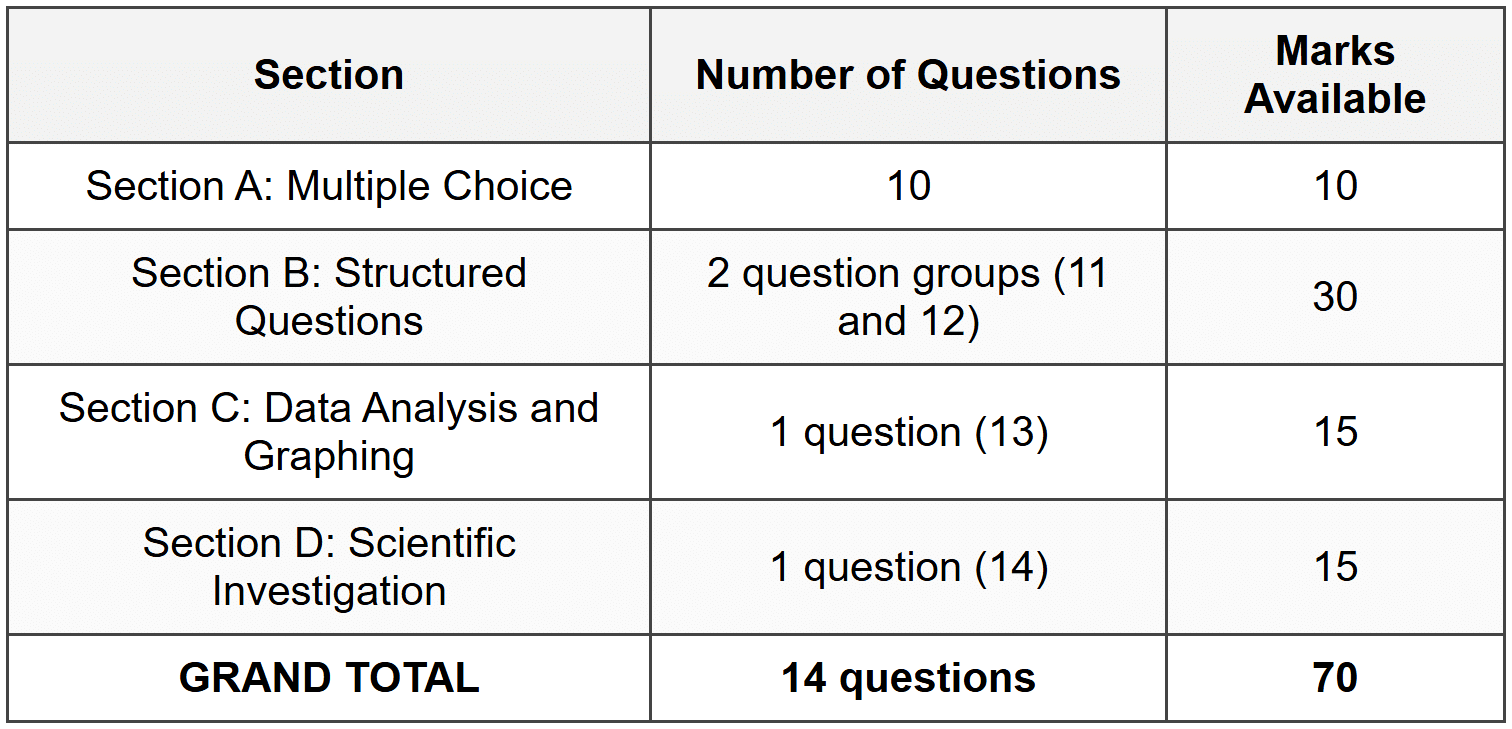
SECTION A: MULTIPLE CHOICE
(Total: 10 marks)
1. Which organelle is responsible for producing energy in the form of ATP through cellular respiration?
A. Ribosome
B. Mitochondrion
C. Golgi body
D. Lysosome
2. A plant cell was placed in a hypertonic solution. What would happen to the cell?
A. The cell would burst due to water entering by osmosis
B. The cell would undergo plasmolysis as water leaves by osmosis
C. The cell would remain unchanged as no osmosis occurs
D. The cell would divide into two daughter cells
3. Which of the following structures is found in prokaryotic cells but NOT in eukaryotic cells?
A. Cell membrane
B. Ribosomes
C. Nucleoid region
D. Cytoplasm
4. Thabo observed a cell under a microscope with a magnification of 400×. If the actual size of the cell is 0.05 mm, what is the size of the image he observes?
A. 0.000125 mm
B. 2 mm
C. 20 mm
D. 200 mm
5. Which molecule forms the bilayer structure of the cell membrane?
A. Proteins
B. Phospholipids
C. Carbohydrates
D. Nucleic acids
6. During active transport, a cell moves glucose molecules from a region of low concentration to a region of high concentration. What is required for this process?
A. Energy from ATP
B. A concentration gradient
C. Oxygen only
D. No additional requirements
7. A red blood cell has a diameter of 7 μm. What is this measurement in millimetres?
A. 0.007 mm
B. 0.07 mm
C. 0.7 mm
D. 7000 mm
8. Which organelle contains digestive enzymes that break down worn-out cell components and foreign materials?
A. Smooth endoplasmic reticulum
B. Chloroplast
C. Lysosome
D. Vacuole
9. A cell is examined and found to have a cell wall, chloroplasts, and a large central vacuole. What type of cell is this?
A. Animal cell
B. Plant cell
C. Bacterial cell
D. Fungal cell
10. The surface area of a cube-shaped cell is 96 μm² and its volume is 64 μm³. What is the surface area to volume ratio?
A. 0.67:1
B. 1.5:1
C. 2:1
D. 32:1
SECTION B: STRUCTURED QUESTIONS
(Total: 30 marks)
Question 11
11. Cells must exchange materials with their environment to survive.
(a) Define the term diffusion.
(b) Explain why small cells are more efficient at exchanging materials with their environment than large cells.
(c) A spherical cell has a radius of 2 μm. Calculate the surface area of this cell using the formula: Surface area = 4πr². (Use π = 3.14)
(d) Calculate the volume of the same cell using the formula: Volume = (4/3)πr³.
(e) Calculate the surface area to volume ratio for this cell and explain what happens to this ratio as cells increase in size.
(f) Lindiwe investigated the rate of diffusion of potassium permanganate in water at two different temperatures: 25°C and 45°C. She measured how far the purple colour spread in 5 minutes. At 25°C, the colour spread 12 mm, while at 45°C it spread 28 mm. Explain why temperature affected the rate of diffusion and relate this to the kinetic energy of particles.
Question 12
12. The structure of a cell is closely related to its function.
(a) Name THREE structures found in plant cells that are NOT present in animal cells.
(b) Describe the function of the mitochondrion in a cell.
(c) Red blood cells have no nucleus while muscle cells contain many mitochondria. Explain how each of these structural features relates to the function of the respective cell.
(d) A student observed a specimen under a microscope. The eyepiece lens has a magnification of 10× and the objective lens has a magnification of 40×. Calculate the total magnification of the microscope.
(e) The student measured the image of a cell to be 4 mm in length under the total magnification calculated in (d). Calculate the actual length of the cell in micrometres (μm).
(f) Sipho placed plant cells in three different solutions: pure water (Solution A), 5% salt solution (Solution B), and 15% salt solution (Solution C). After 30 minutes, cells in Solution A were turgid, cells in Solution B showed no change, and cells in Solution C underwent plasmolysis. Explain what happened to the water concentration inside and outside the cells in Solution C and why plasmolysis occurred.
SECTION C: DATA ANALYSIS AND GRAPHING
(Total: 15 marks)
Question 13
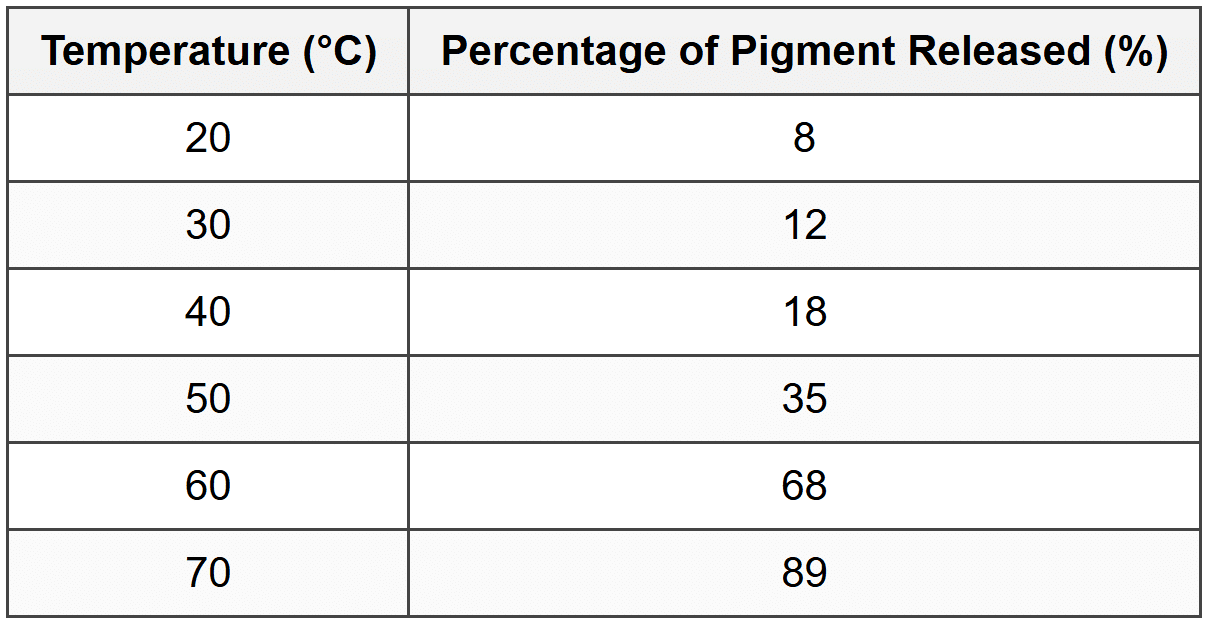
13. Nombuso investigated the effect of temperature on the permeability of beetroot cell membranes. She placed identical pieces of beetroot tissue in water at different temperatures and measured the percentage of red pigment that leaked out of the cells after 15 minutes. Her results are shown in the table below.
(a) Identify the independent variable in this investigation.
(b) What is the percentage of pigment released at 40°C?
(c) Calculate the increase in percentage of pigment released when the temperature increased from 50°C to 70°C.
(d) Describe the relationship between temperature and the permeability of the cell membrane as shown in the data.
(e) The cell membrane is made up of phospholipids and proteins. Explain why very high temperatures (above 60°C) cause such a large increase in pigment release, referring to the effect of heat on membrane structure.
(f) A student suggests that at 80°C, the percentage of pigment released would be 95%. Evaluate whether this prediction is scientifically reasonable based on the pattern in the data and your knowledge of cell membrane structure.
SECTION D: SCIENTIFIC INVESTIGATION
(Total: 15 marks)
Question 14
14. Zanele wanted to investigate whether the size of potato cells affects the rate of osmosis. She cut potato cubes of three different sizes: 5 mm × 5 mm × 5 mm, 10 mm × 10 mm × 10 mm, and 15 mm × 15 mm × 15 mm. She placed each cube in a beaker containing distilled water and measured the percentage increase in mass after 2 hours. She found that the smallest cubes gained 18% mass, the medium cubes gained 12% mass, and the largest cubes gained 8% mass.
(a) Identify the independent variable in Zanele's investigation.
(b) Identify the dependent variable in Zanele's investigation.
(c) Name TWO variables that Zanele should have kept constant during this investigation and explain why each one must be controlled.
(d) Write a hypothesis for this investigation in the correct format: If [condition], then [expected result], because [scientific reason].
(e) Calculate the surface area to volume ratio for the smallest cube (5 mm × 5 mm × 5 mm) and for the largest cube (15 mm × 15 mm × 15 mm). Show all working.
(f) Based on the results described, draw a conclusion about the relationship between cell size and the rate of osmosis. State whether Zanele's results support your hypothesis from part (d), and explain how the surface area to volume ratio accounts for the pattern in the results.
GRAND TOTAL: 70
ANSWER KEY
Well done for completing this worksheet on Cells: the Basic Units of Life! Use this answer key to check your understanding and identify areas where you need to revise. Remember that in science, showing your working is just as important as getting the correct answer.
SECTION A - Question 1
B. Mitochondrion
The mitochondrion is the organelle responsible for cellular respiration, the process that produces ATP (adenosine triphosphate), which is the energy currency of the cell. This process occurs in the inner membrane and matrix of the mitochondrion.
SECTION A - Question 2
B. The cell would undergo plasmolysis as water leaves by osmosis
In a hypertonic solution, the water concentration outside the cell is lower than inside the cell. Water moves from high to low concentration by osmosis, so water leaves the cell. In plant cells, this causes the cell membrane to pull away from the cell wall, a process called plasmolysis.
SECTION A - Question 3
C. Nucleoid region
Prokaryotic cells (bacteria) have a nucleoid region where their genetic material is located, but they do not have a membrane-bound nucleus. Eukaryotic cells have a true nucleus surrounded by a nuclear membrane. Both cell types have cell membranes, ribosomes, and cytoplasm.
SECTION A - Question 4
C. 20 mm
Step 1: State the formula used
Magnification = Image size ÷ Actual size, therefore Image size = Magnification × Actual size
Step 2: Substitute the given values with units into the formula
Image size = 400 × 0.05 mm
Step 3: Show all arithmetic working
Image size = 400 × 0.05 mm
Image size = 20 mm
Step 4: State the final answer with the correct SI unit
Image size = 20 mm
The unit must be included in the final answer for full marks.
SECTION A - Question 5
B. Phospholipids
The cell membrane has a phospholipid bilayer structure. Each phospholipid molecule has a hydrophilic (water-loving) head and two hydrophobic (water-fearing) tails. The bilayer forms with the hydrophobic tails facing inward and the hydrophilic heads facing outward toward the watery environments inside and outside the cell.
SECTION A - Question 6
A. Energy from ATP
Active transport moves substances against their concentration gradient (from low to high concentration), which requires energy input. This energy comes from ATP produced during cellular respiration. Active transport uses carrier proteins that change shape when ATP is broken down.
SECTION A - Question 7
A. 0.007 mm
Step 1: State the conversion relationship
1 μm = 0.001 mm or 1 mm = 1000 μm
Step 2: Substitute the given value
7 μm = 7 × 0.001 mm
Step 3: Show all arithmetic working
7 × 0.001 = 0.007 mm
Step 4: State the final answer with the correct SI unit
0.007 mm
The unit must be included in the final answer for full marks.
SECTION A - Question 8
C. Lysosome
Lysosomes are membrane-bound organelles that contain digestive enzymes. These enzymes break down worn-out organelles, food particles, and foreign materials such as bacteria that enter the cell. This process is important for cellular maintenance and defence.
SECTION A - Question 9
B. Plant cell
The presence of a cell wall, chloroplasts, and a large central vacuole are characteristic features of plant cells. Animal cells lack all three of these structures. Bacterial cells have cell walls but no chloroplasts or membrane-bound organelles. Fungal cells have cell walls but no chloroplasts.
SECTION A - Question 10
B. 1.5:1
Step 1: State the formula used
Surface area to volume ratio = Surface area ÷ Volume
Step 2: Substitute the given values into the formula
Ratio = 96 μm² ÷ 64 μm³
Step 3: Show all arithmetic working
Ratio = 96 ÷ 64
Ratio = 1.5
Ratio = 1.5:1
Step 4: State the final answer
Surface area to volume ratio = 1.5:1
The ratio is expressed without units as it is a comparison.
SECTION B - Question 11(a)
Diffusion is the net movement of particles (molecules or ions) from a region of high concentration to a region of low concentration down a concentration gradient, as a result of the random movement of particles.
Full marks require: mention of movement, from high to low concentration, and the concept of a concentration gradient or random particle movement.
SECTION B - Question 11(b)
Small cells are more efficient at exchanging materials because they have a larger surface area to volume ratio compared to large cells. This means that for every unit of volume (cytoplasm requiring materials), there is proportionally more cell membrane surface area available for materials to diffuse across. As cells get larger, their volume increases faster than their surface area, making exchange less efficient and limiting cell size.
Full marks: Reference to surface area to volume ratio, explanation that small cells have a higher ratio, and link to efficiency of exchange across the membrane.
Partial marks: Mention of surface area or volume only, without explaining the relationship to efficiency.
SECTION B - Question 11(c)
Step 1: State the formula used
Surface area = 4πr²
Step 2: Substitute the given values with units into the formula
Surface area = 4 × 3.14 × (2 μm)²
Step 3: Show all arithmetic working
Surface area = 4 × 3.14 × 4 μm²
Surface area = 12.56 × 4 μm²
Surface area = 50.24 μm²
Step 4: State the final answer with the correct SI unit
Surface area = 50.24 μm²
The unit μm² must be included for full marks.
SECTION B - Question 11(d)
Step 1: State the formula used
Volume = (4/3)πr³
Step 2: Substitute the given values with units into the formula
Volume = (4/3) × 3.14 × (2 μm)³
Step 3: Show all arithmetic working
Volume = (4/3) × 3.14 × 8 μm³
Volume = 1.333 × 3.14 × 8 μm³
Volume = 1.333 × 25.12 μm³
Volume = 33.49 μm³
Step 4: State the final answer with the correct SI unit
Volume = 33.49 μm³
The unit μm³ must be included for full marks.
SECTION B - Question 11(e)
Step 1: State the formula used
Surface area to volume ratio = Surface area ÷ Volume
Step 2: Substitute the calculated values from parts (c) and (d)
Ratio = 50.24 μm² ÷ 33.49 μm³
Step 3: Show all arithmetic working
Ratio = 50.24 ÷ 33.49
Ratio = 1.5
Ratio = 1.5:1
Step 4: State the final answer
Surface area to volume ratio = 1.5:1
Explanation: As cells increase in size, the surface area to volume ratio decreases. This is because volume increases as the cube of the radius (r³) while surface area increases as the square of the radius (r²). A decreasing ratio means that there is proportionally less membrane surface area available for exchange per unit of cytoplasm, making large cells less efficient at obtaining nutrients and removing waste.
Full marks: Correct ratio calculated and clear explanation that the ratio decreases as cell size increases, with reference to the implications for efficiency of exchange.
Partial marks: Correct calculation only, or explanation that mentions the ratio decreases without linking to efficiency.
SECTION B - Question 11(f)
Temperature affects the rate of diffusion because at higher temperatures, particles have more kinetic energy. At 45°C, the water molecules and potassium permanganate ions are moving faster than at 25°C due to this increased kinetic energy. Faster-moving particles collide more frequently and move more rapidly through the water, resulting in the purple colour spreading further (28 mm compared to 12 mm) in the same time period. The relationship between temperature and kinetic energy directly affects the speed of particle movement and therefore the rate of diffusion.
Full marks: Mention of increased kinetic energy at higher temperature, link to faster particle movement, and reference to the specific data provided showing greater distance travelled at higher temperature.
Partial marks: Correct mention that higher temperature increases diffusion rate without explaining the role of kinetic energy, or explanation of kinetic energy without reference to the data.
SECTION B - Question 12(a)
THREE structures found in plant cells but NOT in animal cells:
1. Cell wall
2. Chloroplasts
3. Large central vacuole
Accept any three of the above. Award one mark for each correct structure, up to 3 marks.
SECTION B - Question 12(b)
The mitochondrion is the site of cellular respiration, where glucose and oxygen are used to produce ATP (adenosine triphosphate), which is the energy currency of the cell. The mitochondrion releases energy from organic molecules to power cellular processes.
Full marks: Mention of cellular respiration and production of ATP or energy release.
Partial marks: Mention of energy production only without reference to cellular respiration or ATP.
SECTION B - Question 12(c)
Red blood cells: The absence of a nucleus allows more space for haemoglobin, the protein that carries oxygen. This structural adaptation maximizes the cell's capacity to transport oxygen, which is its primary function. The lack of a nucleus also makes the cell more flexible to squeeze through narrow capillaries.
Muscle cells: Muscle cells contain many mitochondria because muscle contraction requires large amounts of ATP (energy). The numerous mitochondria provide the continuous supply of energy needed for the repeated contraction and relaxation of muscle fibres during movement.
Full marks: Clear explanation linking the structural feature to the function for both cell types, with appropriate scientific reasoning.
Partial marks: Correct structure-function link for only one cell type, or incomplete explanation that does not clearly show the relationship.
SECTION B - Question 12(d)
Step 1: State the formula used
Total magnification = Eyepiece magnification × Objective magnification
Step 2: Substitute the given values into the formula
Total magnification = 10× × 40×
Step 3: Show all arithmetic working
Total magnification = 10 × 40
Total magnification = 400
Step 4: State the final answer
Total magnification = 400×
The multiplication sign (×) should be included to indicate magnification.
SECTION B - Question 12(e)
Step 1: State the formula used
Magnification = Image size ÷ Actual size, therefore Actual size = Image size ÷ Magnification
Step 2: Substitute the given values with units into the formula
Actual size = 4 mm ÷ 400
Step 3: Show all arithmetic working
Actual size = 4 ÷ 400 mm
Actual size = 0.01 mm
Convert to micrometres: 0.01 mm = 0.01 × 1000 μm
Actual size = 10 μm
Step 4: State the final answer with the correct SI unit
Actual size = 10 μm
The unit μm must be included for full marks. Accept also 0.01 mm if correctly converted.
SECTION B - Question 12(f)
Solution C (15% salt solution) is hypertonic relative to the cell sap inside the plant cells. This means the water concentration outside the cells is lower than the water concentration inside the cells. Water moves by osmosis from the region of higher water concentration (inside the cell) to the region of lower water concentration (outside the cell, in the salt solution). As water leaves the cell, the cytoplasm shrinks and the cell membrane pulls away from the cell wall. This process is called plasmolysis. The cells in Solution B showed no change because this solution was isotonic (same water concentration as the cell sap), so there was no net movement of water.
Full marks: Correct identification of Solution C as hypertonic, clear explanation of water concentration gradient, description of water movement by osmosis out of the cell, and explanation that the cytoplasm shrinks causing the membrane to pull away from the cell wall (plasmolysis).
Partial marks: Correct identification of osmosis direction and that water leaves the cell, but incomplete explanation of concentration gradient or plasmolysis mechanism.
SECTION C - Question 13(a)
Temperature (measured in °C)
The independent variable is the factor that the investigator deliberately changes or manipulates. In this investigation, Nombuso changed the temperature of the water.
SECTION C - Question 13(b)
18%
This can be read directly from the table.
SECTION C - Question 13(c)
Step 1: State the calculation required
Increase in percentage = Final value - Initial value
Step 2: Substitute the values from the table
Increase = 89% - 35%
Step 3: Show all arithmetic working
Increase = 89 - 35
Increase = 54
Step 4: State the final answer with the correct unit
Increase = 54%
The percentage symbol must be included for full marks.
SECTION C - Question 13(d)
There is a positive correlation between temperature and membrane permeability: as temperature increases, the percentage of pigment released increases. The relationship is non-linear. At lower temperatures (20°C to 40°C), the increase in pigment release is gradual and small (8% to 18%). However, at higher temperatures (50°C to 70°C), there is a rapid and dramatic increase in pigment release (35% to 89%), indicating that the membrane becomes much more permeable at high temperatures.
Full marks: Clear description of positive correlation, recognition that the relationship is non-linear, and specific reference to data showing gradual increase at low temperatures and rapid increase at high temperatures.
Partial marks: Correct statement that pigment release increases with temperature, but no recognition of the non-linear pattern or no specific data reference.
SECTION C - Question 13(e)
At very high temperatures (above 60°C), the phospholipids in the cell membrane gain so much kinetic energy that they move much more rapidly. The proteins embedded in the membrane begin to denature (lose their three-dimensional structure and function). As proteins denature and phospholipids move apart, the membrane structure breaks down and develops gaps or holes. The red pigment molecules (betalains) stored in the vacuole can leak out through these gaps in large quantities, which explains why 68% and 89% of the pigment is released at 60°C and 70°C respectively. The membrane essentially loses its selective permeability and can no longer control what enters or leaves the cell.
Full marks: Explanation includes reference to protein denaturation, breakdown of membrane structure with increased temperature, formation of gaps allowing pigment to escape, and link to the large percentage increases shown in the data at high temperatures.
Partial marks: Mention that high temperature damages the membrane or denatures proteins, but no clear explanation of how this leads to increased pigment release, or no reference to the data.
SECTION C - Question 13(f)
The prediction of 95% pigment release at 80°C has some scientific merit but may not be entirely accurate. Looking at the data pattern, the percentage increase becomes very large above 60°C (from 35% at 50°C to 89% at 70°C). However, the increase from 60°C to 70°C (from 68% to 89%) is 21%, which is smaller than the increase from 50°C to 60°C (which was 33%). This suggests the rate of increase may be slowing down as it approaches a maximum. Since the membrane is largely destroyed by 70°C (with 89% pigment already released), there is only 11% of pigment remaining. At 80°C, it is reasonable to expect that nearly all remaining pigment would be released, so 95% or even close to 100% is scientifically plausible. However, 95% represents only a 6% increase from 70°C, which continues the pattern of decreasing increments. The prediction is therefore reasonable, though it might be slightly conservative as complete membrane breakdown could release closer to 98-100% of the pigment.
Full marks: Evaluation includes analysis of the data pattern (increasing but with decreasing rate of change at high temperatures), application of knowledge about membrane structure breakdown being nearly complete at 70°C, logical reasoning about remaining pigment available for release, and a clear judgment about whether the prediction is reasonable with scientific justification.
Partial marks: Simple agreement that the prediction is reasonable because temperature increases permeability, without detailed analysis of the data pattern or application of knowledge about limits to membrane breakdown.
SECTION D - Question 14(a)
The size of the potato cubes (or dimensions of the potato cubes, or volume of the potato cubes)
This is the variable that Zanele deliberately changed in the investigation: she tested three different cube sizes. The independent variable is always the factor being manipulated by the investigator.
SECTION D - Question 14(b)
The percentage increase in mass (or the rate of osmosis, or the mass gained)
This is the variable that Zanele measured in response to the change in cube size. The dependent variable is always the factor being measured or observed.
SECTION D - Question 14(c)
Variable 1: Temperature of the water
Temperature must be kept constant because it affects the rate of osmosis. At higher temperatures, water molecules have more kinetic energy and move faster, increasing the rate of osmosis. If temperature varied between the beakers, Zanele would not know whether differences in mass gain were due to cube size or temperature differences.
Variable 2: Concentration of the solution (using distilled water for all)
The concentration of the solution must be kept constant because the concentration gradient determines the direction and rate of osmosis. If different concentrations were used, this would affect how much water enters the potato cells, making it impossible to determine the effect of cube size alone.
Other acceptable controlled variables with explanations:
Time period (2 hours): The duration must be constant because osmosis occurs over time. Longer time periods would allow more water to enter the cells, affecting the percentage mass gain independently of cube size.
Type of potato (same variety and source): Different potato varieties might have different cell structures or initial water concentrations, which would affect osmosis rate independently of size.
Volume of water in each beaker: Must be kept constant to ensure that there is sufficient water available for osmosis and that concentration does not change due to water entering the potato.
Full marks: Two correctly identified controlled variables, each with a clear scientific explanation of why controlling that variable is necessary to ensure a fair test.
Partial marks: Two controlled variables correctly identified but with weak or incomplete explanations, or only one controlled variable with a good explanation.
SECTION D - Question 14(d)
If the size of the potato cubes decreases, then the percentage increase in mass will be greater, because smaller cubes have a larger surface area to volume ratio, allowing water to diffuse into the cells more efficiently relative to the volume of the cells.
Alternative acceptable hypothesis:
If the potato cubes have a smaller volume, then the rate of osmosis per unit volume will be higher, because there is proportionally more surface area available for water to move across the cell membranes.
A complete hypothesis must include: the independent variable (size/volume), the expected effect on the dependent variable (percentage mass increase or rate of osmosis), and a scientific reason based on surface area to volume ratio or membrane surface area available for diffusion.
SECTION D - Question 14(e)
For the smallest cube (5 mm × 5 mm × 5 mm):
Step 1: Calculate the surface area
Surface area = 6 × (side)²
Surface area = 6 × (5 mm)²
Surface area = 6 × 25 mm²
Surface area = 150 mm²
Step 2: Calculate the volume
Volume = (side)³
Volume = (5 mm)³
Volume = 125 mm³
Step 3: Calculate the surface area to volume ratio
Ratio = Surface area ÷ Volume
Ratio = 150 mm² ÷ 125 mm³
Ratio = 1.2
Ratio = 1.2:1
For the largest cube (15 mm × 15 mm × 15 mm):
Step 1: Calculate the surface area
Surface area = 6 × (side)²
Surface area = 6 × (15 mm)²
Surface area = 6 × 225 mm²
Surface area = 1350 mm²
Step 2: Calculate the volume
Volume = (side)³
Volume = (15 mm)³
Volume = 3375 mm³
Step 3: Calculate the surface area to volume ratio
Ratio = Surface area ÷ Volume
Ratio = 1350 mm² ÷ 3375 mm³
Ratio = 0.4
Ratio = 0.4:1
Summary:
Small cube surface area to volume ratio = 1.2:1
Large cube surface area to volume ratio = 0.4:1
The calculations show that the smallest cube has a surface area to volume ratio that is three times larger than the largest cube.
SECTION D - Question 14(f)
Conclusion: The results show that there is an inverse relationship between the size of potato cubes and the rate of osmosis: as cube size increases, the percentage mass gained decreases (18% for small cubes, 12% for medium cubes, and 8% for large cubes). The hypothesis is supported by the data.
Scientific explanation: The surface area to volume ratio calculations in part (e) show that the smallest cube has a ratio of 1.2:1 while the largest cube has a ratio of 0.4:1. A higher surface area to volume ratio means that there is proportionally more cell membrane surface area available through which water can diffuse by osmosis, relative to the volume of cytoplasm that needs to receive the water. In the smallest cubes, water can diffuse into the cells more efficiently because every unit of volume has more surface area exposed to the surrounding water. In contrast, the largest cubes have less surface area per unit volume, so water takes longer to reach the cells in the center of the cube, resulting in a lower overall percentage mass gain in the same time period. The data showing 18% mass gain for small cubes versus only 8% for large cubes directly reflects the difference in their surface area to volume ratios (1.2:1 versus 0.4:1), confirming that surface area to volume ratio is a limiting factor in the rate of diffusion and osmosis.
Full marks: Clear conclusion stating the relationship between cube size and osmosis rate with reference to specific data values; explicit statement that the hypothesis is supported; detailed scientific explanation linking surface area to volume ratio to efficiency of osmosis; reference to the calculated ratios from part (e); explanation of why smaller ratios result in slower osmosis for larger cubes.
Partial marks: Conclusion that smaller cubes gain more mass with some data reference, statement that hypothesis is supported, but weak or incomplete explanation of the role of surface area to volume ratio; or good explanation of surface area to volume ratio concept but no reference to the specific calculated values or data from the investigation.
MARK ALLOCATION SUMMARY