Biodiversity and Classification

SECTION A: MULTIPLE CHOICE
(Total: 10 marks)
1. Biodiversity refers to:
A. The variety of life forms in a specific area
B. The number of animal species only
C. The classification of organisms into kingdoms
D. The study of fossils and extinct species
2. Which level of biodiversity refers to the variation in genes within a single species?
A. Ecosystem diversity
B. Species diversity
C. Genetic diversity
D. Habitat diversity
3. In a forest ecosystem, researchers identified 45 plant species, 23 insect species, 12 bird species, and 8 mammal species. What is the total species diversity recorded?
A. 45 species
B. 68 species
C. 80 species
D. 88 species
4. The binomial nomenclature system was developed by:
A. Charles Darwin
B. Carolus Linnaeus
C. Gregor Mendel
D. Robert Hooke
5. In the scientific name Panthera leo, which part represents the species name?
A. Panthera
B. leo
C. Both Panthera and leo
D. Neither, as both represent the genus
6. A nature reserve contains 3 different biomes, 127 plant species, and genetic variation within each plant population. This description illustrates how many levels of biodiversity?
A. One level only
B. Two levels
C. Three levels
D. Four levels
7. Which of the following represents the correct hierarchical order of classification from broadest to most specific?
A. Kingdom → Phylum → Class → Order → Family → Genus → Species
B. Kingdom → Class → Phylum → Order → Family → Genus → Species
C. Species → Genus → Family → Order → Class → Phylum → Kingdom
D. Kingdom → Phylum → Order → Class → Family → Genus → Species
8. A sample of 200 organisms from a pond includes 80 dragonfly larvae, 60 water beetles, 40 tadpoles, and 20 snails. What percentage of the sample is composed of dragonfly larvae?
A. 20%
B. 30%
C. 40%
D. 80%
9. Which kingdom contains organisms that are prokaryotic, unicellular, and can be found in extreme environments?
A. Protista
B. Fungi
C. Monera
D. Plantae
10. Two plant populations of the same species are separated by a mountain range. Over time, one population develops tolerance to drought while the other does not. This is an example of:
A. Species diversity
B. Ecosystem diversity
C. Genetic diversity
D. Taxonomic diversity
SECTION B: STRUCTURED QUESTIONS
(Total: 30 marks)
Question 11
11. Thabo is studying biodiversity in two different nature reserves in South Africa.
(a) Define the term biodiversity.
(b) Explain why genetic diversity is important for the survival of a species.
(c) Thabo records the following data from Reserve A: 4 different habitat types, 89 plant species, 34 animal species, and genetic variation within each species. From Reserve B, he records: 2 habitat types, 45 plant species, 18 animal species, and limited genetic variation. Compare the overall biodiversity of the two reserves and explain which reserve demonstrates higher biodiversity. Justify your answer by referring to all three levels of biodiversity.
(d) In Reserve A, Thabo identifies a plant species that has three distinct color variations (red, yellow, and white flowers) within the same population. In a sample of 240 plants, he counts 96 with red flowers, 84 with yellow flowers, and 60 with white flowers. Calculate the percentage of plants with yellow flowers in this population.
Question 12
12. Naledi is working on a classification project and must correctly name and categorize various organisms.
(a) State the two main components that make up a scientific name in binomial nomenclature.
(b) Explain two advantages of using scientific names rather than common names when communicating about organisms internationally.
(c) Naledi is given the following organisms to classify: a mushroom, a bacteria, an oak tree, an amoeba, and a lion. Using the five-kingdom classification system, place each organism into its correct kingdom and provide one characteristic that justifies each placement.
(d) An unfamiliar organism is discovered with the following characteristics: it is multicellular, has a cell wall made of chitin, is heterotrophic, and reproduces using spores. To which kingdom does this organism belong? Explain your reasoning by referring to at least three of the characteristics provided.
SECTION C: DATA ANALYSIS AND GRAPHING
(Total: 15 marks)
Question 13
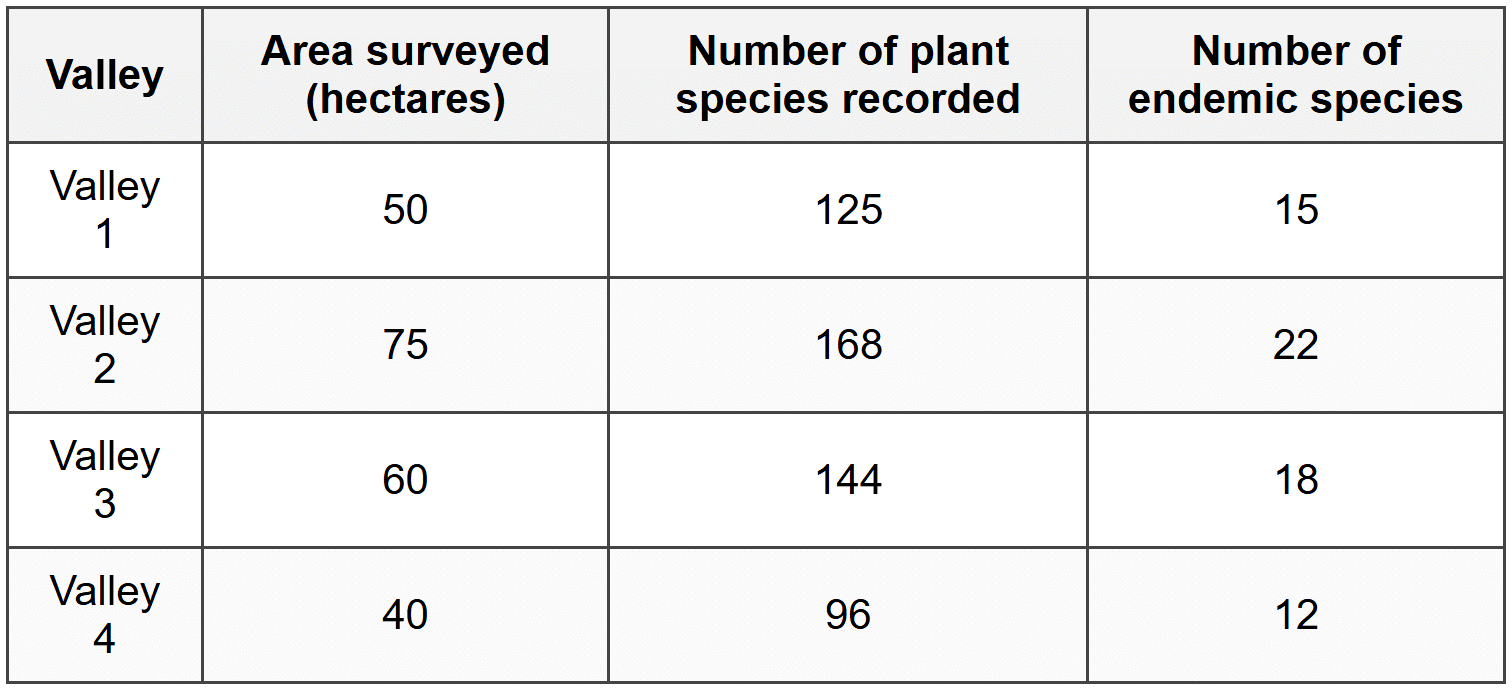
13. A team of ecologists surveyed the plant species diversity in four different valleys in the Drakensberg mountain region. The data collected is shown in the table below:
(a) Which valley has the highest absolute number of plant species recorded?
(b) Calculate the species density (number of species per hectare) for Valley 3.
(c) Calculate the percentage of endemic species in Valley 2.
(d) Based on the data in the table, explain the relationship between the area surveyed and the number of plant species recorded. Support your explanation with specific reference to at least two valleys.
SECTION D: SCIENTIFIC INVESTIGATION
(Total: 15 marks)
Question 14
14. Zanele conducted an investigation to determine how habitat diversity affects insect species diversity. She selected four study sites with different numbers of habitat types within the same region. Site 1 had 1 habitat type (grassland only), Site 2 had 2 habitat types (grassland and shrubland), Site 3 had 3 habitat types (grassland, shrubland, and wetland), and Site 4 had 4 habitat types (grassland, shrubland, wetland, and forest). Zanele used the same sampling method at each site and counted the number of different insect species present. Her results showed that Site 1 had 23 insect species, Site 2 had 41 insect species, Site 3 had 58 insect species, and Site 4 had 72 insect species.
(a) Identify the independent variable in this investigation.
(b) Identify the dependent variable in this investigation.
(c) Name one variable that Zanele should have controlled in this investigation and explain why it is important to keep this variable constant.
(d) Write a hypothesis for Zanele's investigation in the format: If [condition], then [expected result], because [scientific reason].
(e) Based on the results described, write a conclusion for Zanele's investigation. In your conclusion, state whether the hypothesis was supported and provide scientific justification by referring to the relationship between the variables and the data collected.
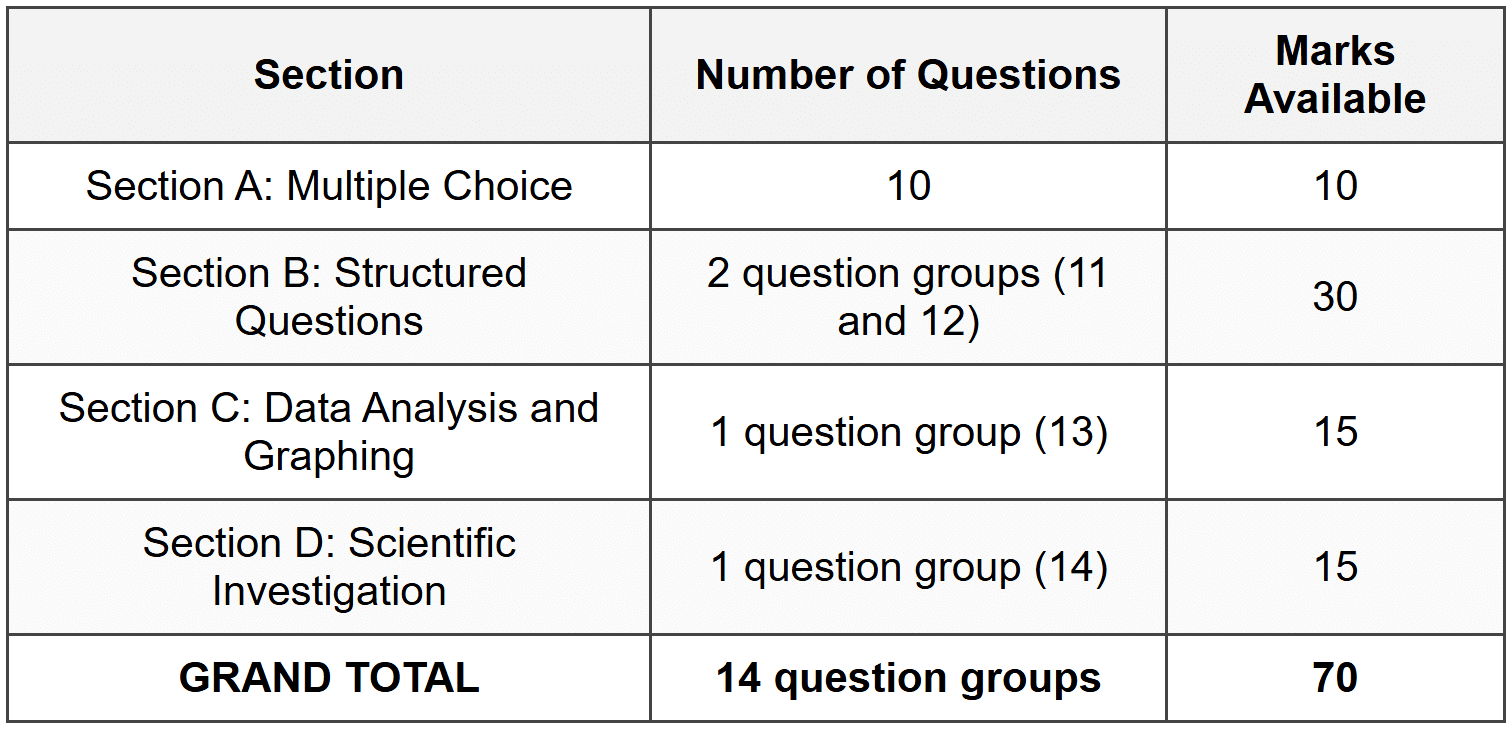
GRAND TOTAL: 70
ANSWER KEY
Well done on completing this worksheet! Use this answer key to check your understanding and identify areas where you can improve. Remember that in science, showing your working and reasoning is just as important as getting the correct final answer.
SECTION A - Question 1
A. The variety of life forms in a specific area
Biodiversity is defined as the variety of all living organisms in a particular area or ecosystem. Option B is incorrect because biodiversity includes plants, microorganisms, and all life forms, not just animals. Option C describes classification, not biodiversity itself. Option D refers to paleontology, not biodiversity.
SECTION A - Question 2
C. Genetic diversity
Genetic diversity refers to the variation in genes and alleles within individuals of the same species. Species diversity refers to the variety of different species, and ecosystem diversity refers to the variety of habitats and ecosystems. Habitat diversity is a component of ecosystem diversity.
SECTION A - Question 3
D. 88 species
Species diversity is calculated by adding all the different species recorded: 45 + 23 + 12 + 8 = 88 species. This represents the total number of different species found in the forest ecosystem.
SECTION A - Question 4
B. Carolus Linnaeus
Carolus Linnaeus developed the binomial nomenclature system in the 18th century, which is still used today to name organisms using a two-part Latin name consisting of genus and species.
SECTION A - Question 5
B. leo
In binomial nomenclature, the first word (Panthera) represents the genus name, and the second word (leo) represents the species name. Together, they form the scientific name of the African lion.
SECTION A - Question 6
C. Three levels
The description includes ecosystem diversity (3 different biomes), species diversity (127 plant species), and genetic diversity (genetic variation within populations). These are the three levels of biodiversity.
SECTION A - Question 7
A. Kingdom → Phylum → Class → Order → Family → Genus → Species
This is the correct hierarchical order of taxonomic classification from the broadest (Kingdom) to the most specific (Species). A helpful mnemonic is: King Philip Came Over For Good Soup.
SECTION A - Question 8
C. 40%
Percentage calculation: (80 ÷ 200) × 100 = 40%. Dragonfly larvae make up 80 out of 200 organisms, which equals 40% of the total sample.
SECTION A - Question 9
C. Monera
Kingdom Monera contains prokaryotic organisms (bacteria) that are unicellular and can survive in extreme environments such as hot springs, very salty water, or highly acidic conditions. Protista organisms are eukaryotic, and Fungi are also eukaryotic.
SECTION A - Question 10
C. Genetic diversity
The development of different traits (drought tolerance) within the same species represents genetic diversity. The two populations are accumulating different genetic variations that allow them to adapt to their specific environments.
SECTION B - Question 11(a)
Biodiversity is the variety of all living organisms in a particular area or on Earth, including the variety of species, the genetic variation within species, and the variety of ecosystems.
Full marks require mentioning variety of life or living organisms. Accept definitions that include reference to different levels of biodiversity.
SECTION B - Question 11(b)
Genetic diversity is important because it increases the chances that some individuals in a population will possess genes or alleles that allow them to survive when environmental conditions change. A population with high genetic diversity is more likely to adapt to diseases, climate change, or other challenges. If all individuals are genetically similar, a single threat could wipe out the entire population.
Full marks: Must mention adaptation or survival advantage AND provide a consequence of low genetic diversity or a specific example of environmental change.
Partial marks: Mentions only that genetic diversity helps survival without explanation.
SECTION B - Question 11(c)
Reserve A demonstrates higher biodiversity. At the ecosystem level, Reserve A has 4 different habitat types compared to only 2 in Reserve B, showing greater ecosystem diversity. At the species level, Reserve A has 123 total species (89 plants + 34 animals) while Reserve B has only 63 species (45 plants + 18 animals), demonstrating higher species diversity. At the genetic level, Reserve A shows genetic variation within species while Reserve B has limited genetic variation. All three levels of biodiversity are higher in Reserve A, making it the more biodiverse reserve overall.
Full marks: Must explicitly compare all three levels of biodiversity with reference to specific data from both reserves AND state which reserve has higher biodiversity with justification.
Partial marks: Compares only two levels of biodiversity, or mentions all three but without using the data to justify the comparison.
SECTION B - Question 11(d)
Step 1: Use the percentage formula
\( \text{Percentage} = \frac{\text{number of yellow-flowered plants}}{\text{total number of plants}} \times 100 \)
Step 2: Substitute the given values
\( \text{Percentage} = \frac{84}{240} \times 100 \)
Step 3: Calculate
= 0.35 × 100
= 35
Step 4: State the final answer
The percentage of plants with yellow flowers is 35%
Students must show working. Deduct marks if no working is shown even if the answer is correct. The percentage symbol is required.
SECTION B - Question 12(a)
The two components are the genus name and the species name (or specific epithet).
Accept "generic name" for genus name. Both components must be correctly identified for full marks.
SECTION B - Question 12(b)
Two advantages include: (1) Scientific names are universal and are the same in all languages and countries, eliminating confusion that arises from different common names in different languages. (2) Scientific names are unique - each species has only one correct scientific name, whereas common names can refer to multiple different species or one species can have many different common names in different regions.
Full marks: Two clear advantages with explanations.
Partial marks: Two advantages listed but with incomplete or unclear explanations, or only one advantage with full explanation.
SECTION B - Question 12(c)
Mushroom: Kingdom Fungi. Characteristic: Fungi are heterotrophic organisms with cell walls made of chitin that absorb nutrients from their environment and often reproduce using spores.
Bacteria: Kingdom Monera. Characteristic: Monera are prokaryotic organisms (cells without a nucleus) that are mostly unicellular.
Oak tree: Kingdom Plantae. Characteristic: Plants are multicellular, autotrophic organisms with cell walls made of cellulose that perform photosynthesis.
Amoeba: Kingdom Protista. Characteristic: Protists are eukaryotic organisms that are mostly unicellular and do not fit into the other kingdoms.
Lion: Kingdom Animalia. Characteristic: Animals are multicellular, heterotrophic organisms without cell walls that can move and respond quickly to stimuli.
Full marks: All five organisms correctly placed with appropriate characteristics. Deduct marks for each incorrect kingdom or missing/incorrect characteristic.
SECTION B - Question 12(d)
This organism belongs to Kingdom Fungi. The characteristics support this classification because: it is multicellular (eliminating Monera and most Protista), it has a cell wall made of chitin (which is unique to fungi, not found in plants or animals), it is heterotrophic (eliminating Plantae), and it reproduces using spores (a common method in fungi). All four characteristics together clearly indicate Kingdom Fungi.
Full marks: Correct kingdom identified with clear explanation referring to at least three characteristics and explaining how they eliminate other kingdoms or confirm Fungi.
Partial marks: Correct kingdom identified but weak explanation with reference to fewer than three characteristics.
SECTION C - Question 13(a)
Valley 2 has the highest absolute number of plant species with 168 species recorded.
Students must identify Valley 2 and may include the number for full clarity.
SECTION C - Question 13(b)
Step 1: State the formula
\( \text{Species density} = \frac{\text{number of species}}{\text{area surveyed}} \)
Step 2: Substitute the values for Valley 3
\( \text{Species density} = \frac{144 \text{ species}}{60 \text{ hectares}} \)
Step 3: Calculate
= 2.4
Step 4: State the final answer with unit
The species density for Valley 3 is 2.4 species per hectare (or 2.4 species·hectare⁻¹)
The unit must be included. Accept "species per hectare" or "species·hectare⁻¹". Deduct marks for missing unit.
SECTION C - Question 13(c)
Step 1: Use the percentage formula
\( \text{Percentage of endemic species} = \frac{\text{number of endemic species}}{\text{total number of species}} \times 100 \)
Step 2: Substitute the values for Valley 2
\( \text{Percentage} = \frac{22}{168} \times 100 \)
Step 3: Calculate
= 0.131 × 100
= 13.1
Step 4: State the final answer
The percentage of endemic species in Valley 2 is 13.1% (or 13%)
Accept answers rounded to 13.1% or 13%. The percentage symbol must be included. Deduct marks if no working is shown.
SECTION C - Question 13(d)
There is a positive relationship between the area surveyed and the number of plant species recorded. As the area surveyed increases, the number of species recorded also increases. For example, Valley 2 has the largest area (75 hectares) and recorded the highest number of species (168), while Valley 4 has the smallest area (40 hectares) and recorded the fewest species (96). This relationship occurs because larger areas typically contain more habitat diversity or microhabitats, which can support more species, and larger areas have a higher probability of encountering more species during sampling.
Full marks: Identifies the positive relationship, supports with specific data from at least two valleys, AND explains WHY this relationship exists (more habitat diversity, more resources, sampling effect, etc.)
Partial marks: Identifies the relationship and provides data but no scientific explanation, OR provides explanation but weak reference to data.
SECTION D - Question 14(a)
The independent variable is the number of habitat types (or habitat diversity).
This is the variable that Zanele deliberately changed or selected across the four sites to test its effect on insect diversity.
SECTION D - Question 14(b)
The dependent variable is the number of insect species (or insect species diversity).
This is the variable that Zanele measured in response to changes in the independent variable.
SECTION D - Question 14(c)
One controlled variable is sampling method (or sampling time, or season, or weather conditions, or time of day).
It is important to keep the sampling method constant because different sampling techniques may catch different types or numbers of insects. If Zanele used different methods at different sites, she would not know whether differences in insect species counts were due to habitat diversity or due to the different sampling methods. To ensure a fair test, only the independent variable should change while all other variables are kept the same.
Full marks: Names an appropriate controlled variable AND explains why it must be kept constant with reference to fair testing or preventing confounding variables.
Partial marks: Names a controlled variable but provides weak or incomplete explanation.
SECTION D - Question 14(d)
If the number of habitat types increases, then the number of insect species will increase, because greater habitat diversity provides more ecological niches, food sources, and shelter options that can support a wider variety of insect species.
Full marks: Hypothesis must be in the correct format (If... then... because...), must identify the relationship between the independent and dependent variables, and must provide a valid scientific reason. Accept alternative valid scientific reasoning such as reference to resources, niches, or biodiversity principles.
Partial marks: Correct format and variables but weak or missing scientific reasoning.
SECTION D - Question 14(e)
The results show that as the number of habitat types increased from 1 to 4, the number of insect species increased from 23 to 72. This represents a clear positive correlation between habitat diversity and insect species diversity. The hypothesis is supported by the data. Site 1 (1 habitat type) had the lowest species count (23 species), while Site 4 (4 habitat types) had the highest species count (72 species), and the intermediate sites showed intermediate values. This trend confirms that greater habitat diversity supports higher species diversity, likely because different habitat types provide different resources, microclimates, and ecological niches that allow more species to coexist. The consistent pattern across all four sites strengthens the conclusion.
Full marks: States whether hypothesis was supported, references specific data from the investigation, explains the relationship between variables, and provides scientific reasoning for why the results occurred. Must explicitly state that the hypothesis is supported (or not) and justify this with data.
Partial marks: States whether hypothesis was supported and references some data but provides limited scientific explanation, OR provides good explanation but does not clearly reference the data.
MARK ALLOCATION SUMMARY