Representing Chemical Change

SECTION A: SHORT QUESTIONS
(Total: 40 marks)
A1: Give the correct biological term
(Total: 8 marks)
1. The process by which green plants use light energy to convert carbon dioxide and water into glucose and oxygen.
2. The coloured pigment found in chloroplasts that absorbs light energy for photosynthesis.
3. The process by which cells release energy from glucose in the presence of oxygen, producing carbon dioxide and water.
4. The openings on the leaf surface through which gaseous exchange occurs during photosynthesis and cellular respiration.
A2: True or False - if False, correct the underlined word or phrase only
(Total: 8 marks)
5. During photosynthesis, oxygen is used as a raw material and glucose is produced as a product.
6. Chlorophyll is located in the mitochondria of plant cells where it absorbs light energy.
7. Cellular respiration occurs in all living cells and releases energy stored in glucose molecules.
8. The chemical equation for photosynthesis shows that six molecules of carbon dioxide react with six molecules of water to produce one molecule of glucose and six molecules of nitrogen.
A3: Match Column A to Column B
(Total: 10 marks)
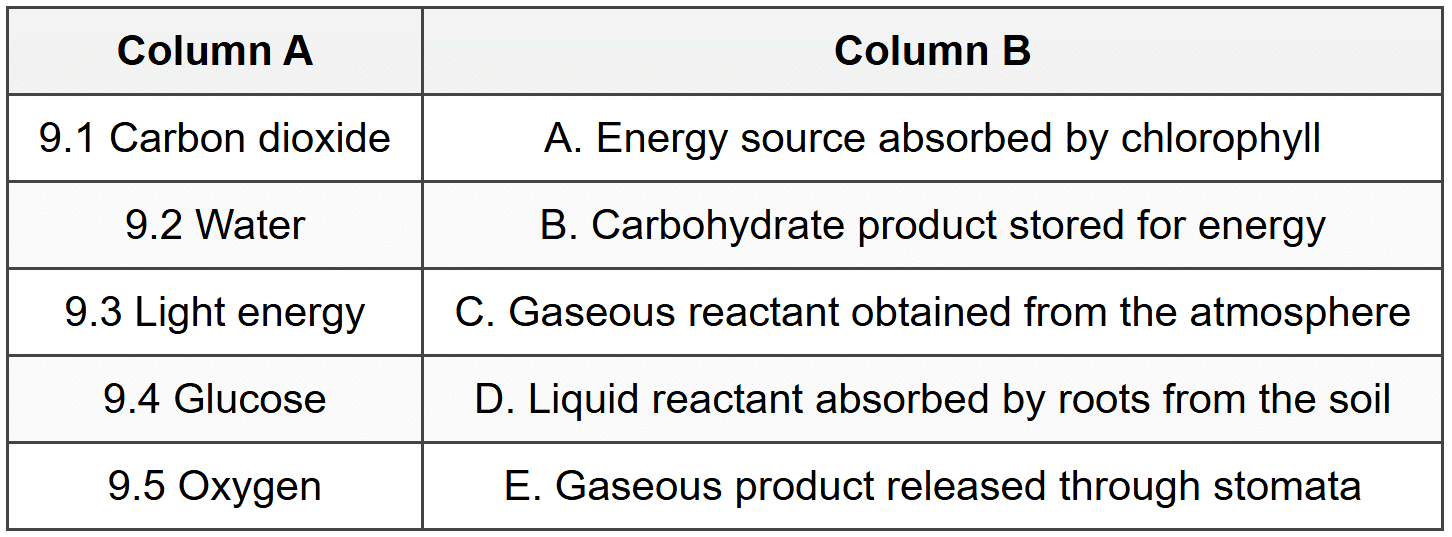
9. Match the component in Column A with its role in the photosynthesis equation in Column B. Write down the number from Column A and the letter from Column B next to it.
A4: Multiple Choice Questions
(Total: 14 marks)
10. Thandi investigated the effect of light intensity on the rate of photosynthesis in Elodea canadensis. She counted the number of oxygen bubbles released per minute at different distances from a light source. Which statement correctly explains her expected results?
A. Oxygen bubble production increases as distance from the light source increases because carbon dioxide concentration increases.
B. Oxygen bubble production decreases as distance from the light source increases because light intensity decreases and photosynthesis rate slows down.
C. Oxygen bubble production remains constant at all distances because water availability does not change.
D. Oxygen bubble production increases as distance from the light source increases because chlorophyll concentration increases.
11. The balanced chemical equation for cellular respiration is C6H12O6 + 6O2 → 6CO2 + 6H2O + energy. What does this equation represent in terms of matter transformation?
A. Glucose and oxygen are created from carbon dioxide and water.
B. One glucose molecule and six oxygen molecules are broken down to produce six carbon dioxide molecules and six water molecules while releasing energy.
C. Six glucose molecules combine with one oxygen molecule to form carbon dioxide.
D. Carbon dioxide is converted into glucose without the use of oxygen.
12. A student writes the word equation: carbon dioxide + water → glucose + oxygen. Which biological process does this represent and where does it occur in plant cells?
A. Cellular respiration occurring in the mitochondria.
B. Photosynthesis occurring in the chloroplasts.
C. Cellular respiration occurring in the chloroplasts.
D. Photosynthesis occurring in the mitochondria.
13. Sipho compared the chemical equations for photosynthesis and cellular respiration. Which statement accurately describes the relationship between these two processes?
A. Both processes produce glucose as an end product.
B. The products of photosynthesis are the reactants of cellular respiration, and the products of cellular respiration are the reactants of photosynthesis.
C. Both processes require light energy to proceed.
D. Both processes occur only in plant cells and never in animal cells.
14. In a controlled experiment, a potted plant was placed in a sealed transparent container with a solution that absorbs carbon dioxide. After several hours in bright light, which outcome would most likely occur and why?
A. The rate of photosynthesis would increase because oxygen concentration increases.
B. The rate of photosynthesis would decrease because carbon dioxide availability is reduced, limiting the production of glucose.
C. The rate of photosynthesis would remain unchanged because light energy is still available.
D. The rate of photosynthesis would increase because water is still present in the soil.
SECTION B: DIAGRAM AND LABELLING QUESTIONS
(Total: 15 marks)
Study the representation of photosynthesis shown in Figure 1 below.

15. Answer the following questions based on Figure 1:
(a) Identify each of the components numbered 1 to 6 using the correct biological term.
(b) Explain the function of component 3 in the process of photosynthesis.
(c) Describe the function of component 6 in photosynthesis.
(d) Predict what would happen to the rate of photosynthesis if component 1 was not available to the plant. Explain your answer using scientific reasoning.
SECTION C: STRUCTURED QUESTIONS
(Total: 25 marks)
Question 16: Analysis of Photosynthesis
Nomvula conducted an investigation to determine the effect of carbon dioxide concentration on the rate of photosynthesis. She used an aquatic plant and placed it in water with different concentrations of dissolved carbon dioxide. She measured the number of oxygen bubbles produced per minute and recorded her results.
16. Answer the following questions based on the investigation described above:
(a) Write the balanced chemical equation for photosynthesis using chemical formulae.
(b) Explain why Nomvula measured oxygen bubble production as an indicator of the rate of photosynthesis.
(c) Predict and explain what would happen to the rate of oxygen production if the carbon dioxide concentration in the water was significantly increased, assuming all other factors remain constant.
(d) Nomvula noticed that when she moved the plant to a dark room, no oxygen bubbles were produced even though carbon dioxide was present in high concentrations. Explain this observation using your knowledge of photosynthesis.
Question 17: Cellular Respiration and Energy Release
All living organisms require energy to carry out life processes. This energy is stored in glucose molecules and is released through cellular respiration. The process can be represented by a chemical equation.
17. Answer the following questions about cellular respiration:
(a) Write the word equation for cellular respiration, clearly showing all reactants and products.
(b) State the name of the organelle in which cellular respiration occurs in both plant and animal cells.
(c) Compare the chemical equation for cellular respiration with the chemical equation for photosynthesis. Explain how these two processes are related in maintaining life on Earth.
(d) A student claims that plants do not carry out cellular respiration because they produce their own food through photosynthesis. Evaluate this claim by providing scientific evidence to support or refute it.
SECTION D: SCIENTIFIC ESSAY
(Total: 20 marks)
18. Write a scientific essay on the relationship between photosynthesis and cellular respiration in maintaining the balance of oxygen and carbon dioxide in the atmosphere.
Your essay must include the following:
- A description of the process of photosynthesis, including the balanced chemical equation, the reactants required, and the products formed.
- A description of the process of cellular respiration, including the balanced chemical equation, the reactants required, and the products formed.
- An explanation of how the products of photosynthesis serve as reactants for cellular respiration and vice versa.
- A discussion of the significance of these two processes in maintaining atmospheric gas balance and supporting life on Earth.
- At least one example of an organism that performs photosynthesis using correct binomial nomenclature, and an explanation of how both processes occur in this organism.
Mark allocation guide:
- Description of photosynthesis with correct chemical equation and identification of reactants and products (5 marks)
- Description of cellular respiration with correct chemical equation and identification of reactants and products (5 marks)
- Explanation of the interdependence between photosynthesis and cellular respiration (4 marks)
- Discussion of significance in atmospheric gas balance and supporting life (4 marks)
- Example with correct binomial nomenclature and explanation of both processes in the organism (2 marks)
GRAND TOTAL: 100 marks
ANSWER KEY
Well done for completing this worksheet on Representing Chemical Change! Use this answer key to check your understanding and identify areas that need further study. Pay special attention to the correct biological terminology required for full marks.
SECTION A1 - Questions 1 to 4
Question 1: Photosynthesis
This is the anabolic process by which autotrophic organisms manufacture their own organic food using light energy.
Question 2: Chlorophyll
This green pigment is essential for trapping light energy and converting it into chemical energy during the light-dependent reactions of photosynthesis.
Question 3: Aerobic respiration or Cellular respiration
This catabolic process occurs in the mitochondria where glucose is broken down in the presence of oxygen to release energy in the form of ATP.
Question 4: Stomata (singular: stoma)
These pores are mainly found on the lower epidermis of leaves and are surrounded by guard cells that regulate their opening and closing to control gaseous exchange.
SECTION A2 - Questions 5 to 8
Question 5: FALSE
Corrected word: carbon dioxide
During photosynthesis, carbon dioxide and water are the reactants (raw materials), while glucose and oxygen are the products. Oxygen is released as a by-product, not used as a reactant.
Question 6: FALSE
Corrected word: chloroplasts
Chlorophyll is located in the chloroplasts, specifically in the thylakoid membranes of the grana. Mitochondria are the sites of cellular respiration, not photosynthesis.
Question 7: TRUE
Cellular respiration is a universal process occurring in both plant and animal cells to release energy from glucose for metabolic activities.
Question 8: FALSE
Corrected word: oxygen
The correct chemical equation shows that six molecules of oxygen (O2) are produced, not nitrogen. The oxygen is released as a by-product of the photolysis of water.
SECTION A3 - Question 9

9.1 = C: Carbon dioxide diffuses into the leaf through stomata from the surrounding atmosphere where it is used as a raw material for photosynthesis.
9.2 = D: Water is absorbed from the soil by root hair cells through osmosis and transported via xylem vessels to the leaves where it participates in photosynthesis.
9.3 = A: Light energy from the sun is absorbed by chlorophyll molecules in the chloroplasts and converted into chemical energy to drive the synthesis of glucose.
9.4 = B: Glucose is the carbohydrate product of photosynthesis that can be used immediately for cellular respiration or converted to starch for storage.
9.5 = E: Oxygen is produced as a by-product of photosynthesis when water molecules are split, and it diffuses out of the leaf through stomata into the atmosphere.
SECTION A4 - Questions 10 to 14
Question 10: B. Oxygen bubble production decreases as distance from the light source increases because light intensity decreases and photosynthesis rate slows down.
Light intensity is a limiting factor for photosynthesis. As the plant is moved further from the light source, the intensity of light energy available for chlorophyll to absorb decreases, resulting in a slower rate of the light-dependent reactions and consequently fewer oxygen molecules produced per unit time.
Question 11: B. One glucose molecule and six oxygen molecules are broken down to produce six carbon dioxide molecules and six water molecules while releasing energy.
The balanced chemical equation shows the stoichiometric relationship between reactants and products in aerobic respiration. Glucose (C6H12O6) is oxidized and oxygen is used to break down the glucose molecule, releasing carbon dioxide, water, and energy in the form of ATP.
Question 12: B. Photosynthesis occurring in the chloroplasts.
The word equation describes the anabolic process of photosynthesis where simple inorganic molecules (carbon dioxide and water) are combined to form complex organic molecules (glucose) with oxygen as a by-product. This process occurs specifically in the chloroplasts of plant cells where chlorophyll is present.
Question 13: B. The products of photosynthesis are the reactants of cellular respiration, and the products of cellular respiration are the reactants of photosynthesis.
Photosynthesis produces glucose and oxygen which are used as reactants in cellular respiration. Cellular respiration produces carbon dioxide and water which are used as reactants in photosynthesis. This demonstrates the interdependence and cyclical nature of these two fundamental life processes.
Question 14: B. The rate of photosynthesis would decrease because carbon dioxide availability is reduced, limiting the production of glucose.
Carbon dioxide is an essential reactant for photosynthesis. When it is removed from the environment, it becomes a limiting factor. Even though light energy and water may be present, the absence of sufficient carbon dioxide prevents the Calvin cycle from fixing carbon into glucose molecules, thereby reducing or stopping the rate of photosynthesis.
SECTION B - Question 15
15(a) Identification of components:
1. Carbon dioxide (CO2)
2. Water (H2O)
3. Light energy or Solar energy
4. Glucose (C6H12O6)
5. Oxygen (O2)
6. Chloroplast
Each correct biological term scores 1 mark. Students must use the precise terminology.
15(b) Function of component 3 (Light energy):
Light energy is absorbed by chlorophyll molecules located in the thylakoid membranes of the chloroplast. This energy is converted into chemical energy which is used to split water molecules (photolysis) and to drive the synthesis of glucose from carbon dioxide and water during the light-independent reactions (Calvin cycle).
Required for full marks: Must mention that light energy is absorbed by chlorophyll, converted to chemical energy, and used to synthesize glucose. The term photosynthesis must be clearly linked to the use of this energy.
15(c) Function of component 6 (Chloroplast):
The chloroplast is the organelle where photosynthesis occurs. It contains chlorophyll in the thylakoid membranes where the light-dependent reactions take place, and the stroma where the light-independent reactions (Calvin cycle) occur to fix carbon dioxide into glucose.
Required for full marks: Must identify chloroplast as the site of photosynthesis and mention either the grana/thylakoids for light reactions or stroma for carbon fixation, or both.
15(d) Consequence if component 1 (Carbon dioxide) was not available:
If carbon dioxide was not available, the rate of photosynthesis would decrease significantly or stop completely. Carbon dioxide is a reactant in the Calvin cycle (light-independent reactions) where it is fixed into organic molecules to form glucose. Without carbon dioxide, the plant cannot produce glucose, which is essential for cellular respiration to provide energy for metabolic processes. The plant would eventually die as it would be unable to manufacture food or release energy for growth and other life processes.
Full marks: Must explain that carbon dioxide is a reactant needed for glucose synthesis in the Calvin cycle, and that without it photosynthesis cannot proceed, leading to no glucose production and eventual death of the plant.
Partial marks: Stating that photosynthesis would stop without explaining the biochemical reason (role of CO2 in the Calvin cycle) or without mentioning the consequence for glucose production.
SECTION C - Question 16
16(a) Balanced chemical equation for photosynthesis:
6CO2 + 6H2O → C6H12O6 + 6O2
Alternative acceptable format: 6CO2 + 6H2O + light energy → C6H12O6 + 6O2
Required for full marks: Correct chemical formulae with correct subscript numbers, correct stoichiometric coefficients (6, 6, 1, 6), and arrow pointing in the correct direction. Light energy may be written above the arrow or on the left side.
16(b) Why oxygen bubble production indicates photosynthesis rate:
Oxygen is a product of photosynthesis, released when water molecules are split during the light-dependent reactions (photolysis). The rate of oxygen production is directly proportional to the rate of photosynthesis because more photosynthesis means more water molecules are split, releasing more oxygen molecules. Therefore, counting oxygen bubbles per minute gives a measurable indicator of how fast photosynthesis is occurring under different conditions.
Required for full marks: Must state that oxygen is a product of photosynthesis, and that the rate of oxygen production is proportional to the rate of photosynthesis, making it a valid indicator.
16(c) Effect of increased carbon dioxide concentration:
If carbon dioxide concentration is significantly increased, the rate of oxygen production would initially increase, assuming all other factors (light intensity, temperature, water availability) remain constant. This is because carbon dioxide is a reactant in photosynthesis, and increasing its concentration provides more substrate for the Calvin cycle to fix carbon into glucose. However, this increase would continue only up to a certain point, after which carbon dioxide would no longer be the limiting factor, and other factors such as light intensity or enzyme availability would limit the rate of photosynthesis.
Required for full marks: Must explain that oxygen production increases because CO2 is a reactant, but must also mention that this increase plateaus when another factor becomes limiting.
16(d) Why no oxygen is produced in darkness:
In the dark room, no oxygen bubbles were produced because photosynthesis requires light energy to proceed. Even though carbon dioxide was present in high concentrations, the absence of light means chlorophyll cannot absorb energy to drive the light-dependent reactions. Without the light-dependent reactions, photolysis of water cannot occur, so no oxygen is released. Additionally, without the energy from light reactions, the Calvin cycle cannot function because it depends on ATP and NADPH produced during the light-dependent stage.
Required for full marks: Must explain that light energy is essential for the light-dependent reactions, and without light, photolysis cannot occur to release oxygen. Must link the absence of light to the inability of both light-dependent and light-independent reactions to proceed.
SECTION C - Question 17
17(a) Word equation for cellular respiration:
Glucose + Oxygen → Carbon dioxide + Water + Energy (ATP)
Alternative acceptable format: Glucose + Oxygen → Carbon dioxide + Water + ATP
Required for full marks: All reactants (glucose and oxygen) on the left, all products (carbon dioxide, water, and energy or ATP) on the right, with correct arrow direction and correct spelling of all terms.
17(b) Organelle where cellular respiration occurs:
Mitochondrion (plural: mitochondria)
The mitochondrion is present in both plant and animal cells and is the site of aerobic respiration where glucose is broken down in the presence of oxygen to release energy.
Required for full marks: The term mitochondrion or mitochondria must be used. "Powerhouse of the cell" is not acceptable as it is not the correct biological term.
17(c) Comparison and relationship between cellular respiration and photosynthesis:
The chemical equation for cellular respiration is essentially the reverse of the chemical equation for photosynthesis. In photosynthesis, carbon dioxide and water are used as reactants with light energy to produce glucose and oxygen. In cellular respiration, glucose and oxygen are used as reactants to produce carbon dioxide, water, and energy (ATP). These two processes are interdependent and complementary: photosynthesis captures and stores energy from sunlight in glucose molecules, while cellular respiration releases that stored energy for use in metabolic activities. Together, they maintain the cycling of oxygen and carbon dioxide in the atmosphere and the flow of energy through ecosystems, sustaining life on Earth.
Required for full marks: Must compare the equations showing they are reverse processes, must explain that the products of one are the reactants of the other, and must explain their role in maintaining atmospheric gas balance and energy flow in ecosystems.
17(d) Evaluation of the student's claim:
The student's claim is incorrect. Although plants produce their own food through photosynthesis, they still carry out cellular respiration continuously in all their living cells. Plants need to release the energy stored in glucose molecules to carry out essential life processes such as active transport, protein synthesis, cell division, and growth. Photosynthesis only occurs in cells containing chloroplasts (mainly in leaves) and only during daylight hours when light energy is available. However, cellular respiration occurs in all living cells of the plant (roots, stems, leaves, flowers) and happens 24 hours a day, both in light and in darkness. During the day, the rate of photosynthesis in plants is typically higher than the rate of cellular respiration, resulting in a net release of oxygen. At night, when photosynthesis stops, plants continue to respire, taking in oxygen and releasing carbon dioxide just like animals do.
Required for full marks: Must state the claim is incorrect, explain that plants perform both photosynthesis and cellular respiration, explain that respiration occurs in all cells continuously while photosynthesis occurs only in chloroplast-containing cells during daylight, and explain why plants need cellular respiration (to release energy for life processes).
SECTION D - Question 18 (Essay)
Model Essay Answer:
1. Description of photosynthesis:
Photosynthesis is the process by which green plants, algae, and some bacteria manufacture their own organic food (glucose) using light energy. The process occurs in the chloroplasts, specifically in two stages: the light-dependent reactions in the thylakoid membranes and the light-independent reactions (Calvin cycle) in the stroma. The balanced chemical equation for photosynthesis is: 6CO2 + 6H2O + light energy → C6H12O6 + 6O2. The reactants required are six molecules of carbon dioxide (obtained from the atmosphere through stomata), six molecules of water (absorbed from the soil by roots), and light energy (absorbed by chlorophyll). The products formed are one molecule of glucose (a carbohydrate used for energy or stored as starch) and six molecules of oxygen (released as a by-product into the atmosphere through stomata).
Full marks criteria: Must include the term photosynthesis, location (chloroplasts), balanced chemical equation with correct formulae and coefficients, all reactants named correctly (carbon dioxide, water, light energy), all products named correctly (glucose, oxygen), and mention of where reactants come from and where products go.
Partial marks: Correct equation but missing explanation of reactants and products, or missing location, or incorrect chemical formulae.
2. Description of cellular respiration:
Cellular respiration is the process by which all living cells break down glucose molecules in the presence of oxygen to release energy for metabolic activities. The process occurs in the mitochondria and involves three main stages: glycolysis (in the cytoplasm), the Krebs cycle, and the electron transport chain (both in the mitochondria). The balanced chemical equation for aerobic respiration is: C6H12O6 + 6O2 → 6CO2 + 6H2O + energy (ATP). The reactants required are one molecule of glucose (obtained from digested food or, in plants, from photosynthesis) and six molecules of oxygen (obtained from the atmosphere through gaseous exchange). The products formed are six molecules of carbon dioxide (released into the atmosphere as a waste product), six molecules of water, and energy in the form of ATP (adenosine triphosphate) which is used to power cellular processes.
Full marks criteria: Must include the term cellular respiration or aerobic respiration, location (mitochondria), balanced chemical equation with correct formulae and coefficients, all reactants named correctly (glucose, oxygen), all products named correctly (carbon dioxide, water, energy/ATP), and mention that this occurs in all living cells.
Partial marks: Correct equation but missing explanation of reactants and products, or missing location, or incorrect chemical formulae, or no mention of ATP.
3. Interdependence between photosynthesis and cellular respiration:
The products of photosynthesis serve as the reactants for cellular respiration, and vice versa, creating a cyclical relationship. The glucose and oxygen produced during photosynthesis are used as reactants in cellular respiration to release energy. Conversely, the carbon dioxide and water produced during cellular respiration are used as reactants in photosynthesis to manufacture glucose. This interdependence ensures a continuous exchange of materials between these two processes. In ecosystems, autotrophic organisms (plants) produce oxygen through photosynthesis which is used by both plants and heterotrophic organisms (animals) for cellular respiration. Animals release carbon dioxide during respiration which is then used by plants for photosynthesis, maintaining a balanced cycle.
Full marks criteria: Must clearly explain that the products of one process are the reactants of the other, must name the specific molecules involved (glucose, oxygen, carbon dioxide, water), and must explain the cyclical nature of this relationship in ecosystems involving both plants and animals.
Partial marks: Stating that the processes are related but not explaining the specific products-reactants relationship, or not mentioning the ecosystem-level importance.
4. Significance in maintaining atmospheric gas balance and supporting life:
Photosynthesis and cellular respiration are crucial for maintaining the balance of oxygen and carbon dioxide in the Earth's atmosphere, which is essential for supporting life. Through photosynthesis, plants remove carbon dioxide from the atmosphere and release oxygen, preventing the excessive accumulation of carbon dioxide which would lead to increased greenhouse effect and global warming. The oxygen released is vital for the survival of most living organisms that depend on aerobic respiration. Through cellular respiration, organisms consume oxygen and release carbon dioxide, which is then available for plants to use in photosynthesis. This continuous cycling ensures that atmospheric oxygen levels remain relatively constant at approximately 21%, supporting aerobic life forms. Without photosynthesis, oxygen would be depleted from the atmosphere and carbon dioxide would accumulate to toxic levels. Without cellular respiration, the energy stored in glucose could not be released for use in metabolic processes, and life as we know it could not exist.
Full marks criteria: Must explain the role of both processes in maintaining oxygen and carbon dioxide balance, must mention the importance of oxygen for aerobic organisms and the removal of excess carbon dioxide, must discuss the consequences if either process did not occur, and must link to the broader context of supporting life on Earth.
Partial marks: Explaining only one aspect (e.g., oxygen production) without discussing carbon dioxide cycling, or not explaining the broader ecological significance.
5. Example with correct binomial nomenclature:
An example of an organism that performs photosynthesis is Triticum aestivum (common wheat), a flowering plant. As an autotroph, Triticum aestivum carries out photosynthesis in the chloroplasts of its leaf cells during daylight hours, using sunlight to convert carbon dioxide and water into glucose and oxygen. However, like all living organisms, Triticum aestivum also carries out cellular respiration continuously in the mitochondria of all its living cells (roots, stems, leaves, flowers, seeds) both day and night to release the energy stored in glucose for growth, reproduction, active transport of minerals, and other metabolic processes. During the day, the rate of photosynthesis exceeds the rate of respiration, resulting in net oxygen production and glucose accumulation. At night, when photosynthesis stops, the plant continues to respire, using stored glucose and consuming oxygen.
Full marks criteria: Must provide a correct binomial name in proper format (genus capitalized, species lowercase, both italicized), must explain that the organism performs both photosynthesis and cellular respiration, and must mention where each process occurs in the organism.
Partial marks: Correct binomial nomenclature but incomplete explanation of both processes, or incorrect formatting of scientific name, or only mentioning one process.
Marker's note on common errors: Students commonly confuse the reactants and products of photosynthesis and cellular respiration. Many students incorrectly state that plants only photosynthesize and animals only respire, forgetting that plants perform both processes. Students often omit the correct biological terminology such as chloroplasts, mitochondria, autotroph, and heterotroph. Chemical equations are frequently unbalanced or have incorrect chemical formulae. Binomial nomenclature is often written incorrectly without proper capitalization or italics. Students sometimes fail to explain the cyclical nature and interdependence of the two processes at the ecosystem level.
MARK ALLOCATION SUMMARY





