Assignment : Verbal Communication Excellence


Section 1: Multiple Choice Questions
- Q1. During a team meeting, your colleague presents an idea, but you notice their tone is hesitant and their body language is closed. What does effective verbal communication require you to do in this situation?
- Immediately point out the inconsistency between their words and body language
- Listen actively to their words while being aware of non-verbal cues, then ask clarifying questions
- Ignore the non-verbal signals and focus only on the content of their message
- Wait until after the meeting to discuss your observations privately
- Q2. You need to deliver negative feedback to a team member about missed deadlines. Which verbal communication approach demonstrates excellence?
- Using vague language to soften the message and avoid confrontation
- Being direct and specific about the issue while maintaining a respectful and constructive tone
- Delivering the feedback publicly during a team meeting to set an example
- Sending a written message instead to avoid verbal communication altogether
- Q3. In a client presentation, you are asked a question you cannot answer immediately. What verbal response demonstrates professional communication excellence?
- Provide a general answer even if you are unsure, to appear knowledgeable
- Acknowledge the question, commit to finding the accurate information, and specify when you will follow up
- Redirect the question to another team member without explanation
- Change the subject to avoid revealing gaps in your knowledge
- Q4. You are facilitating a discussion where two team members have opposing views. How should you apply verbal communication excellence to manage this situation?
- Support the viewpoint that aligns with your own opinion
- Paraphrase each person's perspective to ensure understanding, then guide the conversation toward common ground
- Let them debate without intervention to see who presents the stronger argument
- Postpone the discussion until both parties can agree
- Q5. When communicating complex technical information to a non-technical audience, which strategy best exemplifies verbal communication excellence?
- Use industry jargon to establish credibility and expertise
- Simplify concepts using analogies and examples relevant to the audience's experience
- Provide all technical details to ensure completeness of information
- Speak quickly to cover more information in less time
Section 2: Conceptual Understanding
- Q1. Define verbal communication excellence and explain why it is essential in professional business environments.
- Q2. What are the key components that contribute to clear and effective verbal communication?
- Q3. Explain the difference between assertive communication and aggressive communication, providing examples of each.
- Q4. What role does active listening play in achieving verbal communication excellence?
Section 3: Situational / Applied Questions
- Q1. You are leading a virtual meeting with team members across different time zones, some of whom are not native English speakers. Describe how you would adapt your verbal communication to ensure clarity and inclusivity for all participants.
- Q2. A customer calls your company upset about a service failure. They are speaking loudly and using emotional language. How would you use verbal communication skills to de-escalate the situation and work toward a resolution?
- Q3. During a job interview, you are asked to describe a time when you failed at a task. How would you structure your verbal response to demonstrate honesty while maintaining professionalism and highlighting what you learned?
Section 4: Skill Demonstration Task
You have been asked to deliver a 2-minute verbal introduction for a new company initiative at the upcoming all-hands meeting. The initiative involves transitioning to a flexible work policy.
Your task is to create a structured outline for your verbal presentation that includes:
- An opening statement that captures attention and states the purpose
- Two to three key points explaining the initiative and its benefits
- Anticipated concerns and how you will address them verbally
- A closing statement that encourages questions and engagement
- Notes on tone, pace, and language choices you will use
Section 5: Self-Reflection
- Q1. Reflect on a recent professional conversation where you felt your verbal communication was effective. What specific techniques or approaches contributed to that success?
- Q2. Identify one area of verbal communication where you feel you need improvement (e.g., clarity, tone, conciseness, listening). What steps can you take to develop this skill?
- Q3. How do you typically respond when someone disagrees with you verbally in a professional setting? Evaluate whether your current approach aligns with communication excellence and what you might change.
Answer Key
Section 1 - MCQ Answers
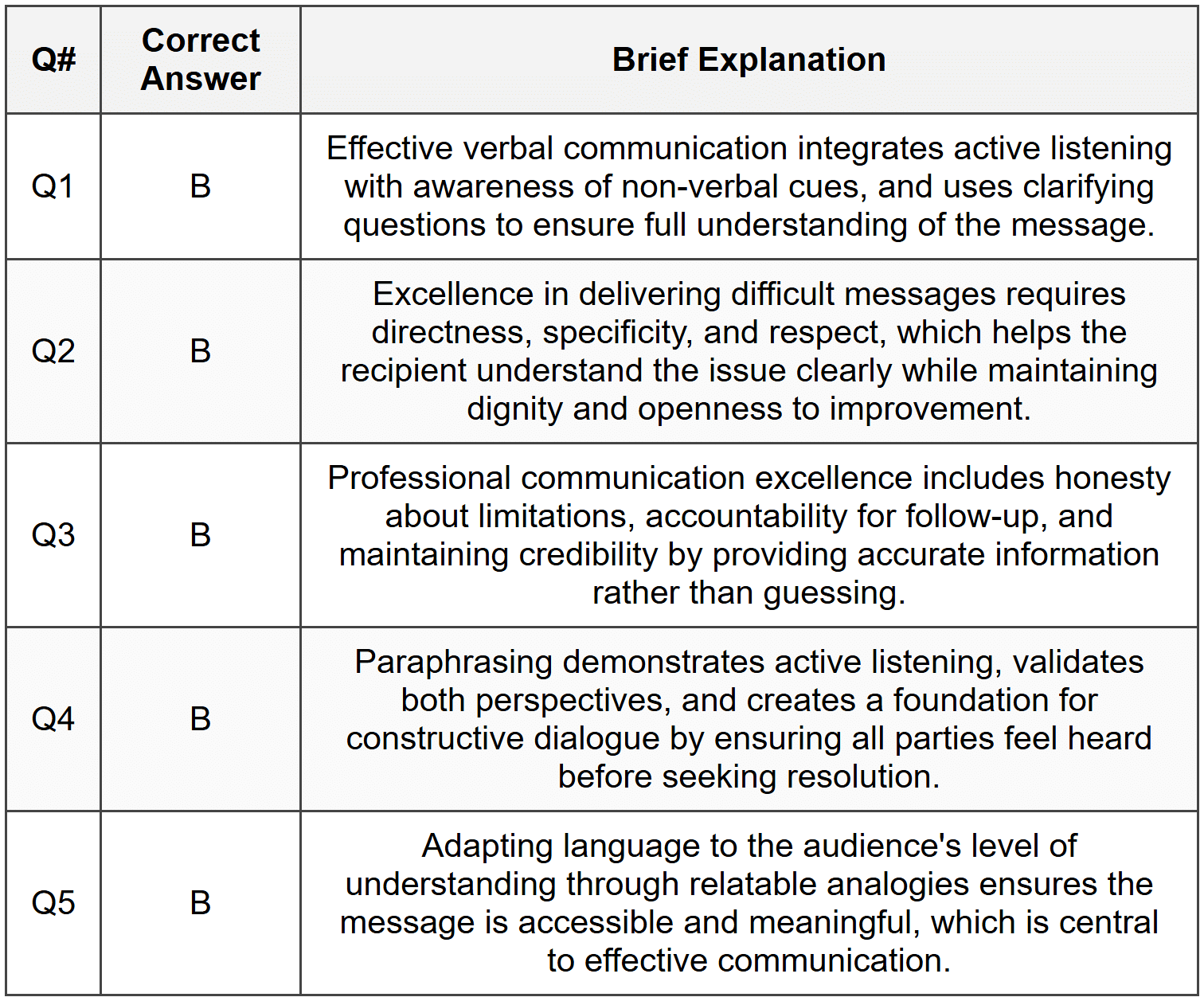
Section 2 Answers
Q1. Verbal communication excellence refers to the ability to convey ideas, information, and emotions clearly, effectively, and appropriately through spoken words. It encompasses not only the content of what is said but also how it is delivered, including tone, pace, volume, and word choice. In professional business environments, verbal communication excellence is essential because it directly impacts collaboration, decision-making, relationship building, conflict resolution, and organizational productivity. Clear verbal communication reduces misunderstandings, builds trust among team members, enhances leadership effectiveness, and contributes to a positive workplace culture.
Q2. The key components of clear and effective verbal communication include: clarity (using simple, precise language that avoids ambiguity); conciseness (conveying messages succinctly without unnecessary information); appropriate tone (matching emotional expression to context and audience); active listening (giving full attention and responding thoughtfully); confidence (speaking with assurance while remaining open to feedback); empathy (considering the perspective and feelings of the listener); and adaptability (adjusting communication style based on audience, situation, and purpose).
Q3. Assertive communication involves expressing one's thoughts, feelings, and needs clearly and respectfully while also respecting the rights and perspectives of others. It is characterized by confidence, directness, and honesty without being confrontational. For example, saying "I need this report by Friday to meet our deadline" is assertive. Aggressive communication, on the other hand, involves expressing oneself in a way that violates the rights of others, often through hostile, demanding, or disrespectful language. For example, saying "You never get anything done on time, and I'm tired of your excuses" is aggressive. The key difference is that assertiveness seeks mutual respect and solutions, while aggression seeks dominance and control.
Q4. Active listening is fundamental to verbal communication excellence because it ensures that communication is a two-way process rather than a monologue. Active listening involves fully concentrating on the speaker, understanding their message, responding thoughtfully, and remembering key points. It demonstrates respect, builds trust, and helps prevent misunderstandings. In professional settings, active listening enables better problem-solving, fosters collaboration, and allows communicators to tailor their responses appropriately. Without active listening, even the most articulate speaker cannot achieve true communication excellence because the exchange lacks understanding and connection.
Section 3 Answers
Q1. In a virtual meeting with diverse participants across time zones and language backgrounds, I would adapt my verbal communication by: speaking at a moderate, clear pace to ensure comprehension; avoiding idioms, slang, or culturally specific references that may not translate well; using simple, direct language and shorter sentences; pausing frequently to allow for processing time and questions; encouraging participation by explicitly inviting input from quieter members; using visual aids to reinforce verbal messages; repeating or paraphrasing key points for emphasis; and being mindful of time zones by keeping the meeting focused and efficient. I would also confirm understanding by asking open-ended questions rather than simply asking "Does everyone understand?"
Q2. To de-escalate an upset customer using verbal communication skills, I would: remain calm and speak in a steady, empathetic tone; acknowledge their emotions by saying something like "I understand this situation is frustrating for you"; listen actively without interrupting, allowing them to fully express their concerns; avoid defensive or dismissive language; use their name to personalize the interaction; paraphrase their issue to demonstrate I have heard and understood them; apologize sincerely for the inconvenience; take ownership of finding a solution by saying "Let me see what I can do to resolve this for you"; provide clear next steps and realistic timelines; and follow through on all commitments. Throughout the conversation, I would maintain a respectful, solution-focused approach.
Q3. When describing a professional failure in an interview, I would structure my verbal response using a clear narrative framework: First, I would briefly describe the situation and task, being honest about what went wrong without making excuses. For example, "In my previous role, I underestimated the time required for a project and missed a deadline." Second, I would explain what I learned from the experience, focusing on specific insights and growth. Third, I would describe the concrete actions I took to improve, such as implementing new planning tools or seeking feedback. Finally, I would conclude by connecting this experience to how it has made me a more effective professional. I would maintain a confident, reflective tone rather than apologetic, demonstrating self-awareness and resilience.
Section 4 - Sample Demonstration
Sample 2-Minute Verbal Presentation Outline: Flexible Work Policy Initiative
1. Opening Statement (15 seconds):
"Good morning, everyone. I'm excited to share an important initiative that will positively impact how we work together. Today, I want to introduce our new flexible work policy, designed to enhance both productivity and work-life balance."
Tone: Enthusiastic and positive; Pace: Moderate; Language: Inclusive ("we," "our")
2. Key Points (60 seconds):
Point 1: "Starting next month, employees will have the option to choose their work location-whether in-office, remote, or hybrid-based on their role requirements and team needs."
Point 2: "This policy benefits you by reducing commute time, increasing schedule flexibility, and allowing you to work in environments where you're most productive."
Point 3: "For the organization, we anticipate improved employee satisfaction, retention, and the ability to attract top talent from wider geographic areas."
Tone: Clear and informative; Pace: Steady with pauses between points; Language: Benefit-focused
3. Addressing Concerns (30 seconds):
"I know some of you might wonder about team collaboration and communication. We've addressed this by implementing new collaboration tools, establishing core hours for team availability, and scheduling regular in-person team days. Your managers will work with you individually to create arrangements that serve both your needs and team objectives."
Tone: Reassuring and proactive; Pace: Slightly slower for important details; Language: Anticipatory
4. Closing Statement (15 seconds):
"We're committed to making this transition smooth and successful for everyone. Detailed guidelines will be shared by end of week. I welcome your questions now, and my door is always open for further discussion. Thank you."
Tone: Warm and open; Pace: Relaxed; Language: Action-oriented with clear next steps
Overall Communication Notes: Maintain eye contact with different sections of the audience; use open hand gestures; vary vocal emphasis on key benefits; smile genuinely when appropriate; pause after asking for questions to encourage participation.
Section 5 - Reflection Guidance
Q1 Sample Response: In a recent project debrief meeting, I felt my verbal communication was particularly effective when presenting challenges our team faced. I used specific techniques including: organizing my thoughts beforehand with clear structure; using concrete examples rather than vague generalizations; maintaining a solution-focused tone even when discussing problems; actively inviting input by pausing and asking "What are your thoughts on this approach?"; and adjusting my language based on audience reactions. I also practiced active listening by paraphrasing others' contributions before responding, which helped build collaborative dialogue. The meeting resulted in actionable decisions and positive feedback about clarity, which confirmed that preparation, structure, and genuine engagement are critical to communication success.
Q2 Sample Response: I recognize that I need improvement in maintaining conciseness during verbal communication, especially when I'm passionate about a topic. I tend to provide excessive detail and background information, which can cause listeners to lose focus on the main message. To develop this skill, I plan to: practice the "headline first" approach where I state my main point before providing supporting details; use the PREP method (Point, Reason, Example, Point) to structure impromptu responses; record myself in practice presentations to identify rambling; ask trusted colleagues for feedback on my communication efficiency; and implement a personal rule of limiting initial explanations to two minutes before checking for questions. I will track my progress by noting meeting outcomes and requesting specific feedback on clarity and brevity.
Q3 Sample Response: When someone disagrees with me verbally in professional settings, my typical response is to immediately explain my reasoning in more detail, sometimes before fully hearing their complete perspective. While this shows engagement, it doesn't fully align with communication excellence because it can come across as defensive and may shut down productive dialogue. Reflecting honestly, I sometimes feel the need to "win" the point rather than seeking the best solution. To improve, I should: pause before responding to disagreement; ask clarifying questions like "Can you help me understand your perspective on this?"; acknowledge valid points in their argument before presenting alternative views; use phrases like "I see your point, and I'm also considering..." rather than "but"; and focus on collaborative language such as "How can we integrate both perspectives?" This shift would demonstrate greater maturity, openness, and commitment to truly excellent communication.