Assignment : Mastering Business Writing


Section 1: Multiple Choice Questions
- Q1. A company receives a complaint email from a dissatisfied customer about a delayed shipment. Which of the following responses best demonstrates effective business writing principles?
- We apologize for any inconvenience this may have caused and we will look into it.
- We sincerely apologize for the delay in your shipment. Our records show your order will arrive by Friday, December 15th. We have also applied a 15% discount to your account as compensation.
- Sorry about that! These things happen sometimes in shipping. We'll try to do better next time.
- Your complaint has been received and forwarded to the relevant department for processing.
- Q2. When writing a business proposal to a potential client, which organizational structure would be most effective?
- Chronological order of your company's history, followed by services offered, then pricing
- Problem identification, proposed solution, benefits and outcomes, implementation plan, costs and timeline
- Detailed technical specifications first, followed by a brief introduction and conclusion
- Executive summary at the end after all details have been presented
- Q3. You need to inform employees about a new workplace policy that may be unpopular. Which approach best applies the principles of effective business writing?
- Use passive voice throughout to avoid assigning responsibility for the decision
- Start with the policy details, then explain the rationale, and end with implementation date
- Begin with context and reasons for the change, clearly state the new policy, explain benefits, provide implementation timeline, and invite questions
- Send a brief announcement with minimal explanation to avoid potential controversy
- Q4. In reviewing a colleague's business report, you notice sentences like "It is important to note that there are several factors that contribute to the decline in productivity." How should this be revised to improve clarity and conciseness?
- It should be noted that productivity decline has several contributing factors
- Several factors contribute to the productivity decline
- There are several factors that are important in understanding why productivity is declining
- The decline in productivity is something that has several factors contributing to it
- Q5. Which of the following subject lines best demonstrates effective business email writing for a message requesting a meeting to discuss quarterly budget allocations?
- Meeting
- Important: Please Read
- Request: Meeting on Q4 Budget Allocation - Nov 20 or 21
- I need to talk to you about the budget situation
Section 2: Conceptual Understanding
- Q1. What are the key differences between formal and informal business writing, and when is each style appropriate? Provide specific examples of situations where each would be used.
- Q2. Explain the concept of "audience analysis" in business writing. Why is it important, and what factors should a writer consider when analyzing their audience?
- Q3. What is the "you-attitude" in business writing, and how does it differ from a writer-centered approach? Provide an example of a sentence written both ways.
- Q4. Describe the purpose and key components of an executive summary. How does it differ from an introduction or conclusion?
Section 3: Situational / Applied Questions
- Q1. You are the customer service manager at an online retail company. A customer has written an angry email stating that they received a damaged product and demanding a full refund plus compensation for their inconvenience. The company policy allows for replacement or refund but not additional compensation. Write a response email that addresses the customer's concerns while maintaining company policy and preserving the customer relationship.
- Q2. As a project manager, you need to inform your team that a major project deadline has been moved up by two weeks due to client requirements. This will require overtime work and schedule adjustments. Draft a memo that communicates this change effectively while maintaining team morale and ensuring compliance.
- Q3. You have been asked to write a brief report recommending whether your company should adopt a new software system. The software costs $50,000, would save approximately 15 hours of staff time per week, but requires 3 months of training and implementation. Your supervisor needs to make a decision by next week. Outline the structure of this report and write the executive summary.
Section 4: Skill Demonstration Task
You are the Human Resources Manager at a mid-sized technology company. Your company is implementing a new flexible working policy that allows employees to work from home up to three days per week, effective from the beginning of next month. Create a complete business communication package that includes:
- A formal announcement email to all employees (200-250 words) that:
- Announces the new policy with enthusiasm
- Explains the key details (eligibility, approval process, expectations)
- Provides clear next steps for employees who wish to participate
- Maintains a professional yet positive tone
- A one-page FAQ document (5-7 questions and answers) that addresses:
- Common questions employees might have
- Clarifications on policy details
- Contact information for further inquiries
- A brief manager's guide (bullet points acceptable) on:
- How to approve flexible work requests
- How to maintain team productivity and communication
- Key points to discuss with team members
Section 5: Self-Reflection
- Q1. Reflect on your current business writing habits. What are two specific areas where you tend to struggle (e.g., conciseness, tone, organization, grammar), and what strategies from this chapter could you apply to improve?
- Q2. Think about a recent business email or document you wrote. If you were to revise it using the principles learned in this chapter, what three changes would you make and why?
- Q3. How confident do you feel adapting your writing style for different audiences and purposes? Describe a situation where you successfully (or unsuccessfully) adjusted your tone and style, and what you learned from that experience.
Answer Key
Section 1 - MCQ Answers
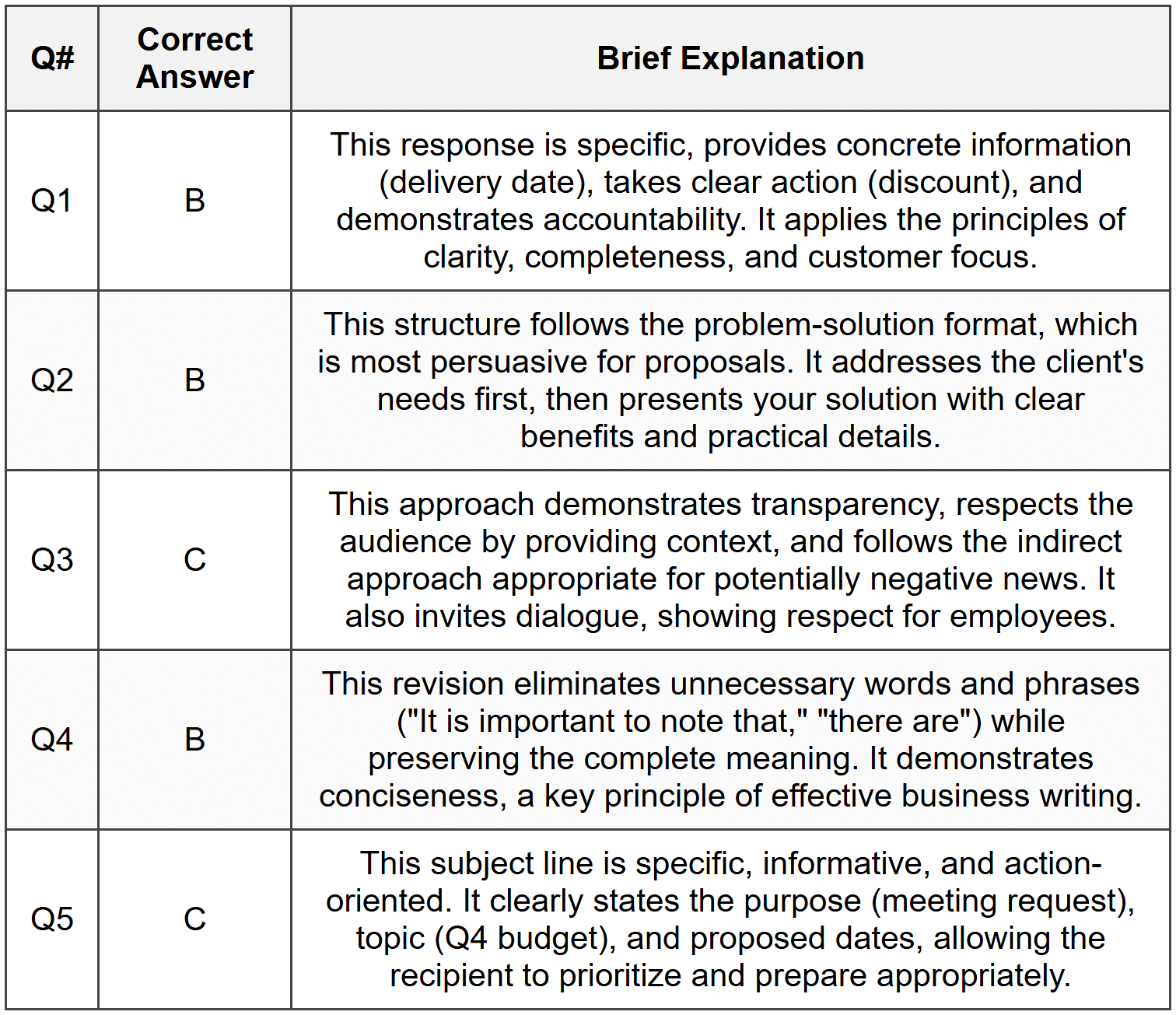
Section 2 Answers
Q1: Formal business writing uses complete sentences, professional vocabulary, proper grammar, and an objective tone. It avoids contractions, slang, and personal opinions. It is appropriate for external communications with clients, official reports, proposals, legal documents, and communications with senior executives. Examples include annual reports, contracts, formal proposals, and official policy documents.
Informal business writing is more conversational, may use contractions, and can include a personal tone while remaining professional. It is appropriate for internal team communications, routine emails to colleagues, quick updates, and messages to familiar business contacts. Examples include team meeting notes, casual check-in emails to coworkers, internal chat messages, and informal progress updates.
Q2: Audience analysis is the process of understanding who will read your business communication and tailoring the message accordingly. It is important because effective communication depends on meeting the reader's needs, expectations, and level of understanding. Factors to consider include: the reader's position and authority level, their familiarity with the topic, their likely attitude toward the message (positive, neutral, or negative), their primary concerns and priorities, cultural and language considerations, the decision-making authority they hold, and the action you want them to take. This analysis influences decisions about tone, level of detail, organizational structure, and vocabulary.
Q3: The "you-attitude" focuses on the reader's perspective, needs, and benefits rather than the writer's perspective. It emphasizes what the reader gains or how information affects them. A writer-centered approach focuses on what the writer or organization wants or has done. Example: Writer-centered: "We have implemented a new online portal that allows us to process requests more efficiently." You-attitude: "You can now submit requests through our new online portal and receive responses within 24 hours instead of three days." The you-attitude builds goodwill and makes communication more persuasive by showing readers what matters to them.
Q4: An executive summary is a brief, standalone overview of a longer document that presents the main points, key findings, conclusions, and recommendations. Its purpose is to allow busy executives to understand the essential content and make decisions without reading the entire document. Key components include: background or context (1-2 sentences), main findings or situation analysis, key conclusions, primary recommendations or proposed actions, and sometimes anticipated outcomes. It differs from an introduction, which previews what the document will cover, and from a conclusion, which appears at the end and summarizes what has been discussed. An executive summary is comprehensive enough to stand alone and typically appears at the beginning of the document.
Section 3 Answers
Q1 - Sample Response:
Subject: Your Order #12345 - Immediate Resolution
Dear Mr. Johnson,
Thank you for bringing this matter to our attention. I sincerely apologize that your order arrived damaged - this does not reflect the quality of service we strive to provide.
I have immediately processed a full refund to your original payment method, which you will see within 3-5 business days. Additionally, I would like to offer you two options:
- A replacement item shipped via express delivery at no cost, arriving within 2 business days
- A 20% discount code for your next purchase, valid for six months
Please reply to this email with your preference, or contact me directly at (555) 123-4567.
We value your business and appreciate your patience as we resolve this issue. I have also forwarded your feedback to our shipping department to prevent similar issues in the future.
Sincerely,
Sarah Martinez
Customer Service Manager
Q2 - Sample Response:
MEMORANDUM
TO: Project Phoenix Team Members
FROM: Michael Chen, Project Manager
DATE: November 10, 2024
SUBJECT: Revised Project Deadline - Action RequiredI want to update you on an important change to our Project Phoenix timeline. Our client has requested that we advance the final delivery date from December 15 to December 1 due to their year-end planning requirements. While this presents a challenge, I am confident in our team's ability to meet this deadline.
What This Means:
We will need to accelerate our current schedule by two weeks. This will require additional effort over the next three weeks, including some overtime work.Revised Schedule:
- Design completion: November 17 (previously November 24)
- Development and testing: November 18-28
- Final review: November 29-30
- Client delivery: December 1
Support Provided:
To support you during this intensive period, the company is offering: overtime compensation at 1.5× regular rate, catered dinner for evening work sessions, and two additional flex days to be used in December after project completion.I will schedule individual check-ins this week to discuss your specific tasks and address any concerns. Please contact me immediately if you foresee any obstacles to meeting these deadlines.
Thank you for your professionalism and dedication. Your hard work is essential to our success.
Q3 - Report Structure and Executive Summary:
Report Structure:
- Executive Summary
- Current Situation Analysis
- Software System Overview
- Cost-Benefit Analysis
- Implementation Requirements
- Risk Assessment
- Recommendation
- Appendices (vendor information, detailed cost breakdown)
Executive Summary:
This report evaluates the proposed adoption of the StreamlinePro software system to improve operational efficiency. The system costs $50,000 with an estimated 3-month implementation period requiring staff training and process adjustments.
Key Findings: The software would save approximately 15 hours of staff time weekly (780 hours annually), equivalent to $23,400 in labor costs at current rates. The system would achieve full ROI in 25 months, with additional benefits including improved accuracy, better data reporting, and enhanced customer service capabilities.
Challenges: The 3-month implementation period will temporarily reduce productivity by approximately 20% as staff undergo training. This timing coincides with our Q1 busy period, which may impact customer service levels.
Recommendation: Approve the software purchase with implementation beginning in Q2 rather than immediately. This delayed start allows us to complete the current busy season, provides time for comprehensive staff preparation, and enables us to negotiate the implementation timeline with the vendor. The benefits significantly outweigh the costs over a 3-year period, making this a sound investment in operational efficiency.
Section 4 - Sample Demonstration
1. Formal Announcement Email:
Subject: New Flexible Working Policy - Effective December 1, 2024
Dear Team,
I am pleased to announce that TechInnovate Solutions is implementing a new Flexible Working Policy, effective December 1, 2024. This initiative reflects our commitment to supporting work-life balance while maintaining the high performance standards that define our organization.
Key Policy Details:
Eligible employees may work remotely up to three days per week, with at least two days per week in the office to maintain team collaboration and culture. Eligibility includes all full-time employees who have completed their probationary period and whose roles can be performed remotely. Department managers will coordinate schedules to ensure adequate office coverage.How to Participate:
Complete the Flexible Work Request Form available on the HR portal by November 20. Discuss your proposed schedule with your direct manager. Receive formal approval before beginning flexible work arrangements.Requirements:
Participants must maintain regular working hours, remain accessible via email and video conferencing, attend all required in-person meetings, and meet all performance standards. Home workspaces must meet basic safety and privacy requirements outlined in the detailed policy document.We believe this policy will enhance productivity and job satisfaction while preserving the collaborative culture that makes TechInnovate successful. Complete details are available in the Flexible Working Policy Guide attached to this email.
For questions, please contact HR at flexwork@techinnovate.com or extension 5500.
Best regards,
Jennifer Thompson
Human Resources Manager
2. FAQ Document:
Flexible Working Policy - Frequently Asked Questions
Q: Am I eligible for flexible working arrangements?
A: All full-time employees who have successfully completed their probationary period (90 days) and whose job responsibilities can be performed remotely are eligible. Part-time employees and roles requiring physical presence (such as facilities management and in-person customer service) are not currently eligible.Q: Can I choose which days I work from home?
A: Yes, in coordination with your manager and team. However, all team members must be in the office on designated collaboration days (typically Tuesdays and Thursdays). Your manager will work with you to create a schedule that meets both your needs and team requirements.Q: What technology support will I receive?
A: The IT department will provide a laptop, secure VPN access, and necessary software licenses. You are responsible for providing reliable internet connection and a suitable workspace. Additional equipment requests can be submitted through your manager.Q: What happens if my performance declines while working flexibly?
A: Your manager will discuss any performance concerns with you promptly. If issues persist, your flexible working arrangement may be modified or suspended while we work together to address the challenges. The goal is to find arrangements that work for both you and the organization.Q: Can my flexible working arrangement be changed later?
A: Yes. You can request modifications to your schedule quarterly, subject to manager approval. The company also reserves the right to modify arrangements based on business needs with two weeks' notice.Q: Are there any roles that cannot participate?
A: Roles requiring physical presence (facilities, reception, hands-on technical support) and positions handling sensitive physical documents are excluded. If you are unsure about your eligibility, please consult with your manager or HR.Q: Who do I contact with additional questions?
A: Please contact the HR department at flexwork@techinnovate.com or extension 5500. Your direct manager can also answer questions about team-specific implementation.
3. Manager's Guide:
Flexible Working Policy - Manager's Implementation Guide
Approving Flexible Work Requests:
- Review employee's request form within 5 business days of submission
- Consider: job role suitability, performance history, team coverage needs, client service requirements
- Discuss proposed schedule with employee to address any concerns
- Ensure at least 40% of team members are in office daily for collaboration
- Document approval or denial with clear reasoning in HR system
- For denials, offer to revisit decision in 90 days or suggest alternative arrangements
Maintaining Team Productivity:
- Establish clear performance metrics and deliverables for remote work days
- Schedule regular video check-ins (daily or weekly depending on team needs)
- Use project management tools to track progress transparently
- Set expectations for response times to emails and messages
- Ensure all team members have equal access to information regardless of location
- Monitor workload distribution to prevent burnout
Maintaining Team Communication and Culture:
- Designate specific in-office days for team meetings and collaboration
- Use video conferencing for all meetings to include remote participants equally
- Create virtual channels for informal communication and team building
- Recognize and celebrate achievements publicly, both in-person and virtually
- Address any signs of isolation or disconnection promptly
- Model flexible working yourself when appropriate to normalize the practice
Key Discussion Points with Team Members:
- Individual schedule preferences and team coordination
- Communication expectations and availability windows
- Performance goals and how they will be measured
- Technology needs and setup support
- Trial period expectations (first 30 days)
- Process for addressing challenges or requesting schedule modifications
For Support: Contact HR at flexwork@techinnovate.com or attend the Manager's Implementation Workshop on November 15.
Section 5 - Reflection Guidance
Q1 - Sample Reflective Response:
Upon reflection, I recognize that conciseness and organization are my two main challenges in business writing. I tend to over-explain concepts, which makes my emails and reports longer than necessary and may cause readers to lose interest before reaching key points. To improve conciseness, I will apply the principle of eliminating redundant phrases and cutting unnecessary qualifiers. Before sending any business communication, I will review it specifically to remove words like "very," "really," and phrases like "in order to" that can be simplified to "to."
Regarding organization, I sometimes begin writing without a clear structure, which results in disjointed messages that jump between topics. I will implement the strategy of outlining key points before drafting any substantial communication. For emails, I will use the technique of stating the purpose in the first sentence, providing necessary details in the middle, and ending with a clear call to action. This structured approach should make my writing more reader-friendly and increase the likelihood of getting timely responses.
Q2 - Sample Reflective Response:
Last week, I sent an email to my team requesting updates on their project tasks. Looking back with the principles from this chapter, I would make three significant changes. First, I would revise my subject line from "Update" to "Action Required: Project Status Update Due Nov 15, 5 PM" to make it specific and action-oriented. This would help team members prioritize the email and understand the deadline immediately.
Second, I would restructure the body using bullet points instead of long paragraphs. My original email buried the specific information I needed in the second paragraph, which likely caused some team members to miss it. I would place the requested information in a bulleted list format: what I need, the format required, and the deadline clearly stated.
Third, I would apply the "you-attitude" by explaining why these updates are important for the team rather than just stating that "I need this information." I would revise to say something like "Your status updates will help us identify any roadblocks early and ensure we can support each other to meet our December 1 deadline." This approach shows team members how their response benefits them and the collective goal, making them more likely to provide thorough, timely updates.
Q3 - Sample Reflective Response:
I would rate my current confidence in adapting writing style at about 6 out of 10. I am comfortable adjusting between casual and professional tones, but I sometimes struggle with the middle ground, particularly when writing to senior executives or external stakeholders I don't know well. I tend to either be too formal (which can come across as stiff) or too casual (which may seem unprofessional).
A situation where I successfully adapted my style was when communicating about a project delay. I wrote differently to three audiences: to my immediate team, I used a collaborative, problem-solving tone with casual language; to my manager, I used a professional but direct tone focusing on solutions and resource needs; and to the client, I used a formal, reassuring tone that acknowledged the issue, took responsibility, and outlined specific corrective actions with revised timelines. The outcome was positive across all three audiences because each received information appropriate to their needs and relationship with me.
An unsuccessful experience occurred when I sent the same formal, lengthy report to both my CEO and my peer team leads. My peers felt it was unnecessarily formal and told me I could have just sent a quick summary. The CEO's assistant later asked me to provide a one-page executive summary because the full report was too detailed for his schedule. This taught me that audience analysis must happen before writing, not after. I learned to ask myself: What does this specific person need to know? How much detail do they want? What action do I need from them? These questions now guide how I structure and style every business communication.