Assignment : Presentation and Public Speaking Skills


Section 1: Multiple Choice Questions
- Q1. During a product launch presentation, you notice that audience members in the back rows are leaning forward and straining to hear. According to effective presentation principles, what should be your immediate response?
- Continue at the same pace and volume to maintain professionalism
- Pause briefly, acknowledge the issue, and adjust your volume while checking if everyone can hear
- Ask the audience members to move to the front rows
- Distribute printed handouts so they can read the content instead
- Q2. A presenter uses the phrase "um" approximately every 10 seconds throughout a 20-minute presentation. What is the most likely impact on audience perception?
- The audience will perceive the speaker as more relatable and human
- It will have no significant impact as audiences typically ignore filler words
- The audience may perceive the speaker as unprepared or lacking confidence
- The audience will appreciate the speaker's honesty and authenticity
- Q3. You are presenting quarterly results to stakeholders with varying levels of financial expertise. How should you structure your content to ensure maximum comprehension?
- Use highly technical financial terminology throughout to demonstrate expertise
- Present only high-level summaries without detailed data
- Layer information from key insights to supporting details, defining technical terms when first introduced
- Create separate presentations for each expertise level and present them sequentially
- Q4. During a presentation, an audience member asks a complex question that you cannot fully answer. What is the most professional response?
- Provide a partial answer and quickly move on to avoid embarrassment
- Acknowledge the excellent question, commit to researching it thoroughly, and offer to follow up with a detailed response
- Deflect by asking the audience member to share their own perspective first
- Admit you don't know and ask if anyone else in the audience can answer
- Q5. When designing visual aids for a presentation on organizational change, which principle should guide your slide design?
- Include as much information as possible on each slide to reduce the total number of slides
- Use multiple fonts and colors to distinguish different types of information
- Apply the 6×6 rule and ensure each visual reinforces one key message
- Use detailed charts with complete datasets to demonstrate thoroughness
Section 2: Conceptual Understanding
- Q1. Explain the difference between informative and persuasive presentations. Provide one specific example of a business context where each type would be most appropriate.
- Q2. What is the "rule of three" in presentation structure, and why is it considered effective for audience retention?
- Q3. Describe the concept of "audience analysis" and identify three specific factors a presenter should analyze before preparing a business presentation.
- Q4. What is the purpose of a "hook" or attention-grabber in the opening of a presentation? Provide two different techniques that can serve as effective hooks.
Section 3: Situational / Applied Questions
- Q1. You are scheduled to present a new employee benefits program to 200 employees in a large auditorium. Fifteen minutes before your presentation, you discover that the projector is malfunctioning and cannot display your slides. Describe the specific steps you would take to deliver an effective presentation without visual aids.
- Q2. During your presentation on workplace safety protocols, you notice that several audience members are checking their phones and appear disengaged. You are only 10 minutes into a 30-minute presentation. What techniques would you employ to re-engage your audience while maintaining your presentation flow?
- Q3. You have been asked to present complex financial forecasting data to a mixed audience that includes both the finance team and the marketing department. How would you structure your presentation to ensure both groups find value and can understand the key takeaways? Describe your approach to content organization and delivery.
Section 4: Skill Demonstration Task
You have been selected to deliver a 5-minute presentation at your company's annual meeting on the topic: "The Importance of Effective Communication in Remote Work Environments."
Prepare a complete presentation outline that includes the following deliverables:
- Opening (Hook): Write the exact words you would use in the first 30 seconds to capture audience attention. This should include your hook and a clear statement of your presentation's purpose.
- Three Main Points: Identify three key messages you will communicate. For each point, write:
- A clear topic sentence
- One supporting example or piece of evidence
- A transition sentence to the next point
- Visual Aid Description: Describe one slide you would create to support your second main point. Specify:
- The slide title
- What visual elements it would contain (chart, image, bullet points, etc.)
- The key message the slide should reinforce
- Closing Statement: Write your concluding remarks, including a summary of your main points and a memorable final statement or call to action.
- Anticipated Question: Identify one challenging question an audience member might ask and write your complete response to that question.
Section 5: Self-Reflection
- Q1. Reflect on your current public speaking abilities. What specific aspect of presentation delivery (such as eye contact, voice modulation, body language, or handling questions) do you find most challenging, and why do you think this is difficult for you?
- Q2. Describe a presentation or public speaking experience you have had (or observed) that was particularly effective. What specific techniques did the speaker use that made the presentation memorable or impactful?
- Q3. Identify three concrete actions you can take over the next month to improve your presentation and public speaking skills. For each action, explain how it addresses a specific weakness or builds on an existing strength.
Answer Key
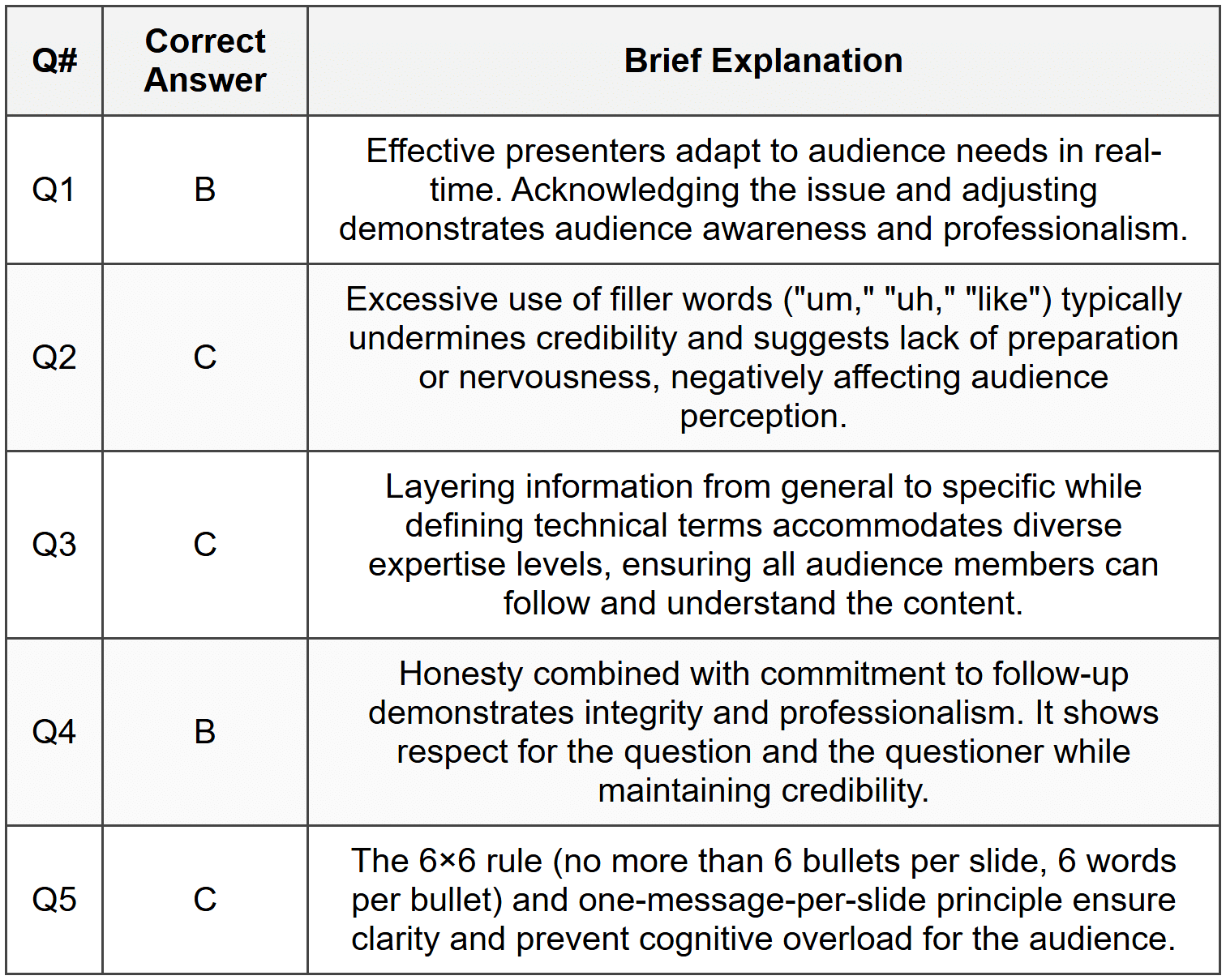
Section 1 - MCQ Answers
Section 2 Answers
Q1: Informative presentations aim to educate the audience by presenting facts, data, or instructions without advocating for a particular position or action. An example would be a training session explaining how to use new software. Persuasive presentations, in contrast, seek to change attitudes, beliefs, or behaviors by presenting arguments and evidence to convince the audience to adopt a specific viewpoint or take action. An example would be a sales pitch convincing clients to purchase a product or service.
Q2: The "rule of three" suggests organizing presentation content into three main points or sections. This structure is effective because the human brain naturally processes and remembers information in groups of three more easily than larger sets. Three points create a pattern that feels complete yet manageable, enhancing audience comprehension and retention. It also provides a clear, balanced framework that prevents information overload.
Q3: Audience analysis is the systematic process of gathering and analyzing information about the people who will receive your presentation to tailor content, language, and delivery appropriately. Three specific factors to analyze include: (1) Knowledge level-understanding what the audience already knows about the topic to avoid oversimplification or excessive complexity; (2) Demographic characteristics-considering age, professional background, cultural context, and position within the organization; (3) Attitudes and expectations-identifying what the audience hopes to gain from the presentation and any preexisting opinions or concerns about the topic.
Q4: A hook or attention-grabber serves to immediately engage the audience's interest, establish relevance, and create a compelling reason to listen to the entire presentation. It transitions the audience from their previous thoughts to active focus on your message. Two effective techniques include: (1) Startling statistic or fact-presenting a surprising, relevant data point that challenges assumptions or highlights the importance of your topic; (2) Compelling story or anecdote-sharing a brief, relatable narrative that emotionally connects the audience to your subject matter and illustrates why it matters.
Section 3 Answers
Q1: In this situation, I would take the following steps: First, I would remain calm and quickly assess available alternatives (whiteboard, flipchart, or handouts). Second, I would inform the audience of the technical issue honestly and professionally, demonstrating composure under pressure. Third, I would restructure my delivery to rely more heavily on verbal communication, using clear storytelling and concrete examples to illustrate key points about the benefits program. Fourth, I would increase audience interaction by asking questions and encouraging discussion to maintain engagement. Fifth, I would use the whiteboard or flipchart to write key terms, numbers, or draw simple diagrams to reinforce important information. Finally, I would commit to sending detailed materials via email immediately after the presentation so employees have reference documentation. This approach demonstrates adaptability and keeps the focus on effective communication rather than technical obstacles.
Q2: To re-engage the disengaged audience members, I would employ several techniques immediately: First, I would change my vocal delivery by varying my pace, volume, and tone to create renewed auditory interest. Second, I would incorporate a direct question to the audience, either asking for a show of hands on a relevant safety concern or inviting someone to share a brief experience, which creates participation and breaks the passive listening pattern. Third, I would physically move to a different location in the presentation space, as movement naturally draws attention. Fourth, I would introduce a concrete, relatable example or brief story that connects workplace safety to real consequences, making the content more emotionally resonant. Fifth, I would acknowledge the audience's potential concerns directly by saying something like, "I know safety training can feel routine, but what I'm about to share could prevent a serious incident in your department." This combination of vocal variety, interaction, movement, storytelling, and direct relevance addresses multiple engagement factors simultaneously.
Q3: For a mixed-expertise audience, I would structure the presentation using a layered approach: First, I would begin with an executive summary that presents the key financial forecasts and their business implications in plain language, ensuring everyone understands the bottom line regardless of financial expertise. Second, I would organize content into two parallel tracks-presenting each forecast with both a "what it means" explanation for non-finance staff and a "how we calculated it" section for the finance team. Third, I would use visual aids strategically, showing simplified charts and graphs for key trends while offering detailed data tables in an appendix for those who want deeper analysis. Fourth, I would employ analogies and real-world comparisons when introducing complex financial concepts, such as comparing cash flow to household budgeting. Fifth, I would clearly signpost which sections are technical deep-dives, allowing those less interested in methodology to understand what's coming. Finally, I would allocate time for questions, specifically inviting both practical business application questions and technical methodology questions. This structure ensures the marketing team understands strategic implications while the finance team receives the analytical rigor they require.
Section 4 - Sample Demonstration
1. Opening (Hook):
"Imagine trying to build a house when your team is scattered across different cities, working in different time zones, and you've never met face-to-face. Sounds challenging, right? Yet this is exactly what we do every day in our remote work environment. Today, I want to share why effective communication isn't just helpful in remote work-it's the foundation that determines whether our virtual teams thrive or struggle. Over the next five minutes, I'll show you three practical ways communication makes or breaks remote work success."
2. Three Main Points:
Point 1: Clear communication prevents costly misunderstandings in remote environments.
Supporting example: Research from Harvard Business Review shows that remote teams experience 2.5 times more misunderstandings than co-located teams, primarily because they lack non-verbal cues and spontaneous clarification opportunities. When a simple email is misinterpreted, it can lead to duplicated work, missed deadlines, or damaged client relationships-all because we couldn't quickly turn to a colleague and ask, "What did you mean by that?"
Transition: While preventing misunderstandings is crucial, communication serves another vital function in remote work.
Point 2: Effective communication builds trust and team cohesion across distances.
Supporting example: In our own organization, teams that have regular video check-ins-not just for work updates, but for brief personal connection-report 40% higher job satisfaction and collaboration scores. When team members in different locations communicate intentionally and personally, they develop the trust necessary to work effectively together, even when they're thousands of miles apart.
Transition: Beyond trust-building, there's a third critical dimension to remote communication.
Point 3: Structured communication channels increase productivity and reduce information overload.
Supporting example: A recent study found that remote workers receive an average of 56 emails and 36 instant messages daily, leading to constant interruptions and decision fatigue about which messages require immediate attention. Organizations that establish clear communication protocols-such as using specific channels for urgent matters versus general updates-see a 30% improvement in focused work time and project completion rates.
Transition: These three elements-clarity, connection, and structure-form the backbone of successful remote communication.
3. Visual Aid Description:
Slide Title: "The Trust Gap: Remote vs. Co-Located Teams"
Visual Elements: A side-by-side comparison bar chart showing trust and collaboration metrics for teams with different communication frequencies. The left side shows co-located teams (baseline), the middle shows remote teams with minimal communication (significantly lower bars in red), and the right shows remote teams with regular video and personal check-ins (bars approaching or matching co-located teams in green). Include simple icons: office building for co-located, laptop for minimal communication remote, and video camera for high-communication remote.
Key Message: Intentional, personal communication bridges the trust gap that physical distance creates, making remote teams as cohesive as traditional ones.
4. Closing Statement:
"Today we've seen that effective communication in remote work environments does three essential things: it prevents the costly misunderstandings that distance amplifies, it builds the trust and connection that physical proximity once provided automatically, and it creates the structure that turns potential chaos into productive collaboration. As we continue to navigate our remote and hybrid work reality, remember this: distance is just geography, but communication is the bridge that connects us. The question isn't whether we can work effectively from anywhere-the question is whether we'll communicate intentionally enough to make it work. Thank you."
5. Anticipated Question and Response:
Question: "You mentioned that remote workers receive 56 emails and 36 instant messages daily. Doesn't increasing communication, as you suggest, just add to this overload problem?"
Response: "That's an excellent and important question, thank you. The distinction here is between intentional, structured communication and reactive message overload. What creates overwhelm isn't communication itself-it's unstructured, unclear communication across too many channels without agreed-upon protocols. When I advocate for effective communication in remote work, I'm specifically recommending that organizations establish clear guidelines: for example, using email for non-urgent information, instant messaging for quick questions, and video calls for complex discussions or relationship-building. This actually reduces the total cognitive load because team members no longer have to decide which channel to use or constantly monitor all channels for urgent messages. Studies show that organizations implementing communication protocols see a reduction in total messages by about 20%, while simultaneously improving response quality and team satisfaction. So we're not adding more communication-we're making existing communication more purposeful and less overwhelming."
Section 5 - Reflection Guidance
Q1 Sample Response: The aspect of presentation delivery I find most challenging is maintaining consistent eye contact with audience members throughout my presentation. I think this is difficult for me because I tend to rely heavily on my notes or slides for security, especially when I'm nervous. When I look at my notes, I feel more in control and less vulnerable, but I recognize this creates a barrier between me and the audience. I also find it uncomfortable to hold someone's gaze for more than a few seconds, as it feels confrontational rather than connective. I believe this challenge stems from a combination of nervousness about forgetting my content and a deeper discomfort with the vulnerability that direct eye contact creates. Recognizing this pattern is the first step; now I need to practice techniques like familiarizing myself thoroughly with content so I need notes less, and consciously practicing the "3-5 second rule" where I hold eye contact with one person for a complete thought before moving to another section of the audience.
Q2 Sample Response: I recently observed a presentation by our company's CEO during a difficult organizational transition that was particularly effective. She opened not with corporate talking points, but with a personal story about her own experience during a previous company restructuring, immediately establishing authenticity and empathy. Her vocal delivery was conversational rather than formal-she spoke as if having a serious conversation with trusted colleagues rather than delivering a corporate announcement. She used deliberate pauses after key points, giving the audience time to absorb difficult information rather than rushing through. When addressing concerns, she repeated questions before answering them, ensuring everyone heard the question and demonstrating that she was truly listening. Perhaps most memorably, she acknowledged uncertainty honestly, saying "I don't know yet" when asked about timeline specifics, but followed with concrete commitments about when and how she would communicate updates. These techniques-personal vulnerability, conversational tone, strategic pausing, active listening, and honest acknowledgment of limitations-created an environment of trust and made the presentation impactful despite delivering challenging news.
Q3 Sample Response: Over the next month, I will take three specific actions to improve my presentation skills. First, I will record myself delivering a 5-minute presentation on a work-related topic each week and review the recording to identify specific verbal tics, filler words, and body language patterns. This addresses my weakness of unconsciously using "um" and "like" excessively-by making these habits conscious through observation, I can begin to eliminate them. Second, I will volunteer to present at least twice in team meetings or other low-stakes environments, specifically focusing on maintaining eye contact by using the 3-5 second rule with different audience members. This builds on my existing strength of content preparation by adding the challenge of delivery technique in real situations with immediate feedback. Third, I will join a local Toastmasters club or similar public speaking group to practice regularly in a supportive environment with structured feedback. This addresses my overall need for consistent practice and constructive criticism from people outside my immediate work circle. Each action is measurable, time-bound, and directly targets either a specific weakness or builds upon an existing strength to create comprehensive skill improvement.