Assignment : Business Communication for Leaders


Section 1: Multiple Choice Questions
- Q1. A CEO needs to announce a major organizational restructuring that will result in layoffs. Which communication approach best demonstrates leadership communication principles?
- Sending a brief email to all employees to maintain efficiency
- Holding face-to-face town halls, acknowledging concerns, and providing clear rationale and support resources
- Delegating the announcement to department heads to avoid direct confrontation
- Posting the information on the company intranet for employees to discover
- Q2. During a crisis situation, a leader receives conflicting information from different teams. What is the most appropriate communication strategy?
- Wait until all information is verified before any communication to avoid confusion
- Communicate immediately what is known, what is being investigated, and when updates will follow
- Share all conflicting information with stakeholders and let them decide
- Communicate only with senior management until clarity is achieved
- Q3. A leader notices that team members from different cultural backgrounds interpret direct feedback differently. How should the leader adapt their communication?
- Maintain one standard communication style to ensure consistency
- Avoid giving feedback to prevent misunderstandings
- Develop cultural awareness and adjust feedback delivery while maintaining message clarity
- Only communicate through written channels to create documentation
- Q4. When communicating a strategic vision to diverse stakeholders including employees, investors, and customers, what principle should guide the leader's approach?
- Use identical messaging across all groups to maintain consistency
- Tailor the message to each audience's interests while maintaining core vision integrity
- Focus communication efforts only on the most important stakeholder group
- Delegate communication to specialized departments for each audience
- Q5. A leader receives critical feedback about their communication style being too authoritative. What response best demonstrates effective leadership communication?
- Defend the current style by explaining its necessity for maintaining authority
- Immediately adopt a completely passive communication approach
- Acknowledge the feedback, seek specific examples, and collaboratively explore balanced approaches
- Ignore the feedback as subjective opinion that doesn't warrant change
Section 2: Conceptual Understanding
- Q1. Explain the difference between transactional communication and transformational communication in a leadership context. Provide one example of each.
- Q2. What are the key components of executive presence in business communication, and why is it important for leaders?
- Q3. Describe the concept of "communication cascading" in organizational settings and explain two challenges leaders face when implementing it.
- Q4. How does active listening differ from passive hearing in leadership communication? Identify three specific techniques leaders can use to demonstrate active listening.
Section 3: Situational / Applied Questions
- Q1. You are leading a project team that has missed a critical deadline due to resource constraints beyond their control. Senior management is demanding explanations, while your team is demoralized. How would you communicate with both groups? Outline your communication strategy, including key messages for each audience, timing, and channels you would use.
- Q2. As a department head, you must communicate an unpopular policy change mandated by upper management that you personally disagree with. How do you maintain your credibility and leadership while effectively communicating this change to your team?
- Q3. You discover through informal channels that rumors about potential company acquisition are spreading rapidly and causing anxiety among employees. You have limited verified information. What communication approach would you take, and what specific messages would you convey?
Section 4: Skill Demonstration Task
You are the newly appointed Director of Operations at a manufacturing company. The organization has experienced declining productivity and low employee morale over the past year. Your preliminary assessment reveals communication gaps between management and frontline workers, lack of clarity about organizational goals, and insufficient feedback mechanisms.
Task: Develop a comprehensive communication plan to address these issues. Your plan must include:
- A vision statement (2-3 sentences) that you will communicate to all employees about the communication culture you want to build
- Three specific communication initiatives you will implement, with clear objectives for each
- Identification of key stakeholder groups and how you will tailor communication to each
- Methods you will use to measure the effectiveness of your communication efforts
- A timeline for implementing these initiatives over the next six months
Section 5: Self-Reflection
- Q1. Reflect on a time when you had to deliver difficult news or feedback. What communication strategies did you use? What would you do differently based on what you have learned about leadership communication?
- Q2. Assess your current communication strengths as a leader or potential leader. Identify two areas where you excel and two areas that need development. What specific steps will you take to improve in the areas needing development?
- Q3. How comfortable are you with adapting your communication style to different audiences and situations? Provide a specific example where you successfully adapted your style, and one where you struggled to do so. What did you learn from these experiences?
Answer Key
Section 1 - MCQ Answers
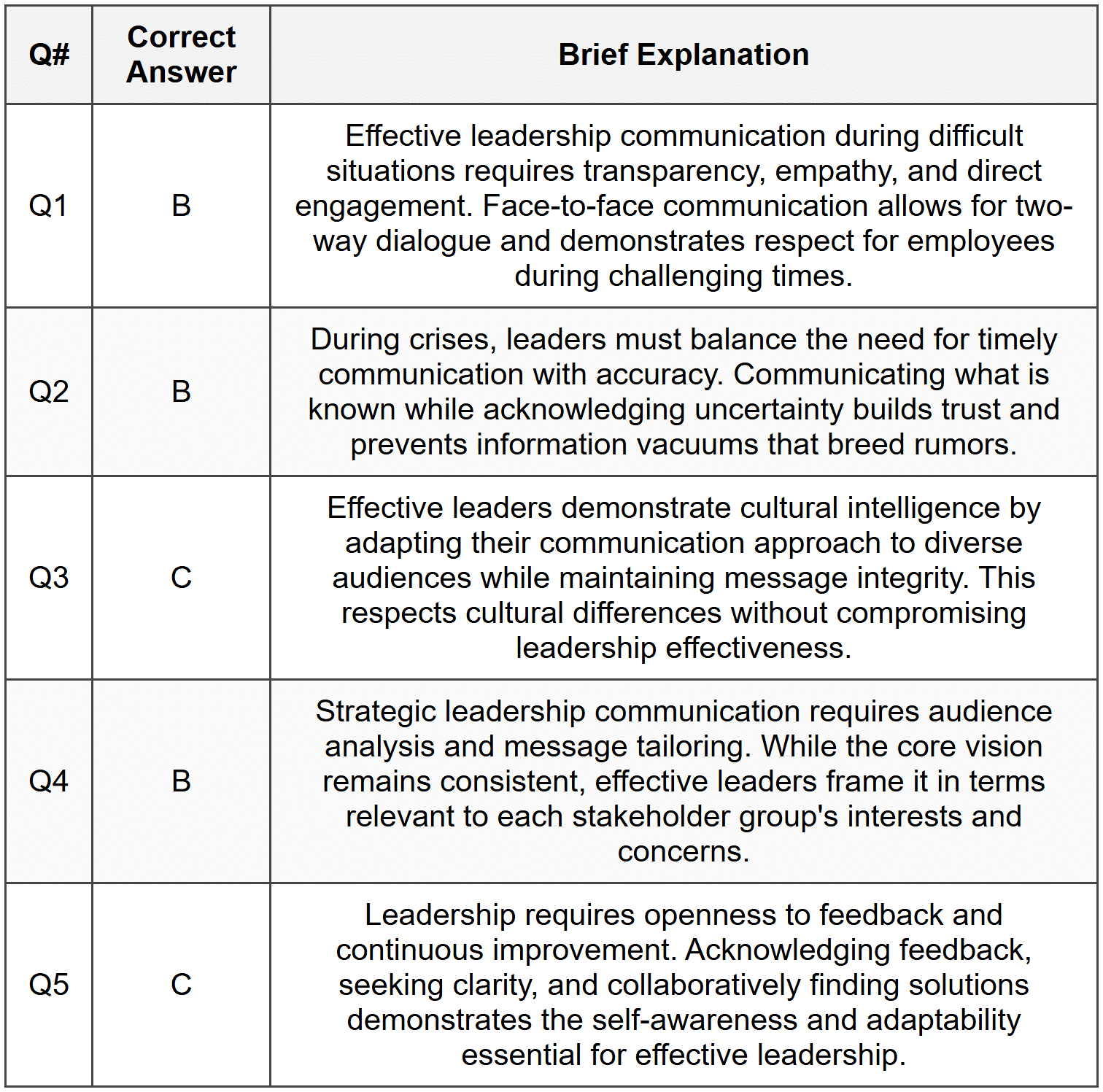
Section 2 Answers
Q1: Transactional communication focuses on exchanging information and completing specific tasks, such as a manager sending instructions for a project deadline. Transformational communication inspires and motivates people toward a shared vision, such as a CEO articulating how the organization's work creates meaningful social impact. While transactional communication is necessary for daily operations, transformational communication is essential for engaging hearts and minds, creating commitment, and driving organizational change.
Q2: Executive presence in business communication comprises three key components: gravitas (the substance and confidence in what you communicate), communication skills (the ability to articulate ideas clearly and persuasively), and appearance (professional demeanor and body language). It is important for leaders because it influences how seriously their messages are received, affects their ability to inspire confidence in stakeholders, and impacts their effectiveness in representing the organization. Leaders with strong executive presence can command attention, build credibility quickly, and influence decision-making at all organizational levels.
Q3: Communication cascading is the process by which information flows systematically from top leadership through successive organizational levels to reach all employees. In this model, each management level receives information and is responsible for communicating it to the next level down. Two significant challenges include message distortion, where the original message becomes altered or diluted as it passes through multiple layers, and timing inconsistencies, where different parts of the organization receive information at different times, creating confusion and rumors. Additionally, middle managers may lack the context or communication skills to effectively convey strategic messages, or they may filter information based on their own interpretations.
Q4: Active listening involves fully concentrating on, understanding, and responding thoughtfully to what others communicate, while passive hearing is simply receiving sound without engagement or comprehension. Three specific active listening techniques for leaders include: (1) Paraphrasing and summarizing what the speaker said to confirm understanding, (2) Asking clarifying questions that demonstrate interest and help uncover deeper meaning, and (3) Providing non-verbal cues such as maintaining eye contact, nodding, and leaning forward to show engagement. Active listening also requires eliminating distractions, withholding judgment until the speaker finishes, and reflecting on emotional content as well as factual information.
Section 3 Answers
Q1: This situation requires differentiated communication strategies for each audience while maintaining honesty and consistency. For senior management, I would schedule an immediate meeting to present a factual analysis of what caused the delay, emphasizing the resource constraints, providing data to support the team's efforts despite limitations, and proposing a realistic revised timeline with required resources. The communication would be concise, data-driven, and solution-focused. For the team, I would hold a team meeting to acknowledge their efforts and frustration, take responsibility as their leader for advocating for resources, share (appropriately) what I communicated to management, and collaboratively develop the recovery plan. The key messages would emphasize that I am representing their situation accurately to leadership while also working with them to find solutions. Timing is critical-I would communicate with management first to understand their expectations, then quickly follow up with the team to prevent anxiety and speculation. Written follow-up emails would document agreements and next steps for both audiences.
Q2: This scenario tests leadership integrity and communication authenticity. My approach would involve first ensuring I fully understand the reasoning behind the policy to communicate it accurately. When presenting to the team, I would be transparent about the mandate's source, explain the organizational reasoning as objectively as possible, and acknowledge that change can be challenging. I would avoid undermining the decision or distancing myself from it, as this would damage organizational cohesion and my credibility as a leader. Instead, I would focus on how we can implement the policy effectively and what support I can provide during the transition. If I have concerns about the policy, I would communicate them through appropriate channels to upper management separately, not through complaining to my team. I would also create space for the team to express concerns and ask questions, and commit to advocating for their needs within the constraints of the new policy. This approach maintains leadership credibility by demonstrating organizational loyalty while showing empathy and support for the team.
Q3: In this situation, silence or delayed communication would allow rumors to escalate and damage trust. My immediate action would be to communicate proactively, even with limited information. I would send a communication to all employees acknowledging that I am aware of circulating rumors about a potential acquisition, clearly stating what I know to be factual at this moment, explicitly identifying what I do not yet know, and committing to a specific timeframe for providing updates as information becomes available. The message would be delivered through multiple channels-email for documentation and an all-hands meeting or video message for personal connection. Key messages would emphasize that speculation is natural but unproductive, that leadership takes employee concerns seriously, and that official information will be communicated through proper channels as soon as it is available. I would also establish a mechanism for employees to submit questions and commit to addressing them. This approach demonstrates leadership presence, prevents the information vacuum from being filled with speculation, and maintains trust by being honest about uncertainty while committing to transparency.
Section 4 - Sample Demonstration
Vision Statement: "We are building a communication culture where every voice is heard, information flows transparently in all directions, and every team member understands how their work contributes to our collective success. Through open dialogue and mutual respect, we will create an environment where people feel informed, valued, and empowered to contribute their best work."
Three Communication Initiatives:
Initiative 1: Bi-weekly Leadership Listening Sessions
Objective: Create direct communication channels between frontline workers and management to surface concerns and ideas.
Implementation: Schedule rotating small-group sessions (8-10 employees) where I and other managers meet with frontline workers without their direct supervisors present. Use structured questions to understand challenges, gather improvement suggestions, and explain organizational decisions. Document themes and commit to visible follow-up actions.
Success Metric: Participation rate of at least 80% of workforce within three months and implementation of at least three employee-suggested improvements.
Initiative 2: Strategic Communication Cascade with Accountability
Objective: Ensure organizational goals, decisions, and performance information reach all levels consistently and promptly.
Implementation: Establish monthly leadership briefings where strategic information is shared with all managers, who then have 48 hours to cascade to their teams using provided talking points. Implement a verification system where random employee surveys check message reception and understanding.
Success Metric: 75% of employees able to articulate current organizational priorities and how their work connects to them within four months.
Initiative 3: Multi-directional Feedback System
Objective: Create formal mechanisms for upward, downward, and peer feedback to improve performance and engagement.
Implementation: Launch quarterly pulse surveys on communication effectiveness, establish anonymous suggestion channels with guaranteed leadership review and response, and train all supervisors on giving constructive feedback. Publish aggregated survey results and action plans.
Success Metric: 70% favorable ratings on communication-related survey questions by month six, up from current baseline.
Stakeholder Communication Tailoring:
- Frontline Workers: Focus on practical impacts, use simple language, emphasize two-way dialogue, prefer face-to-face and small group settings, address "what this means for me" explicitly
- Supervisors/Middle Management: Provide context and rationale, equip with communication tools and talking points, involve in feedback loop, acknowledge their dual role as message receivers and communicators
- Senior Management: Present data and metrics, focus on strategic alignment, provide regular progress reports, seek input on major communication decisions
- Support Staff: Ensure inclusion in information flow, recognize their unique perspective across departments, leverage them as communication champions
Measurement Methods:
- Quarterly employee engagement surveys with specific communication effectiveness questions
- Monthly spot-checks through random employee interviews about message reception
- Tracking of participation rates in listening sessions and feedback mechanisms
- Analysis of communication channel usage and response rates
- Correlation analysis between communication metrics and productivity indicators
- 360-degree feedback on leadership communication effectiveness
Six-Month Implementation Timeline:
- Month 1: Conduct baseline communication audit, launch first listening sessions, communicate vision to all employees, train managers on new processes
- Month 2: Implement communication cascade system, launch feedback mechanisms, continue listening sessions
- Month 3: Conduct first pulse survey, analyze early results, make visible adjustments based on initial feedback, publish first progress report
- Month 4: Expand successful initiatives, address identified gaps, conduct mid-point assessment, celebrate early wins
- Month 5: Refine processes based on data, conduct second pulse survey, prepare case studies of communication improvements
- Month 6: Comprehensive review of all initiatives, present results to senior management, plan for sustainability and continuous improvement, recognize communication champions
Section 5 - Reflection Guidance
Q1 Sample Response: When I had to inform my team that our project budget was being cut significantly, I initially focused only on delivering the facts quickly to "get it over with." While I provided the information, I did not adequately prepare for the emotional response or create space for the team to process and ask questions. Based on what I have learned about leadership communication, I would now approach this differently by: first, anticipating the emotional impact and preparing empathetic messaging; second, choosing a face-to-face setting rather than email to allow for dialogue; third, clearly explaining the broader context and reasons rather than just stating the decision; fourth, acknowledging the difficulty and validating feelings of frustration; and fifth, immediately pivoting to collaborative problem-solving about how we could adapt. I would also follow up individually with team members to address personal concerns. The key lesson is that difficult communication is not just about information transfer-it is about leading people through challenging situations with empathy and engagement.
Q2 Sample Response: My communication strengths include the ability to articulate complex ideas clearly and concisely, making technical or strategic concepts accessible to diverse audiences, and my natural tendency toward transparency and honesty, which builds trust. I also excel at written communication, crafting well-structured messages that people find easy to understand and act upon. However, I need development in two key areas: first, my active listening skills, particularly when I am under pressure or disagree with what is being said-I tend to formulate responses before the speaker finishes, which can make others feel unheard; and second, my comfort with informal communication, as I tend to default to formal channels even when casual conversation might be more effective for relationship-building. To improve my listening, I will practice the "wait three seconds" technique before responding and will ask at least one clarifying question before offering my perspective. To develop informal communication skills, I will schedule regular informal check-ins with team members, practice small talk, and observe leaders who excel at building relationships through casual interaction.
Q3 Sample Response: I am moderately comfortable adapting my communication style, though this is an evolving skill. I successfully adapted when presenting a technical project to both the engineering team and the marketing department. For the engineers, I used detailed technical specifications, data models, and architectural diagrams, diving deep into implementation challenges. For marketing, I translated the same project into customer benefits, market positioning, and competitive advantages, using visual mockups instead of technical diagrams. This worked well because I took time to understand what each audience cared about and what language resonated with them. However, I struggled when attempting to communicate with a potential international partner from a high-context culture. My direct, explicit American communication style, which works well domestically, came across as overly blunt and somewhat disrespectful. I failed to recognize the importance of relationship-building, indirect communication, and reading non-verbal cues in that cultural context. From these experiences, I learned that effective adaptation requires not just changing vocabulary but understanding fundamental differences in communication values and norms. I now invest time in researching cultural and professional communication preferences before important interactions and seek feedback on how my style is received by different audiences.