Assignment : Market Research & Competitive Intelligence


Section 1: Multiple Choice Questions
- Q1. A product manager is deciding between conducting primary and secondary research for a new feature launch. The team has limited budget and tight deadlines but needs to understand competitor pricing strategies. Which approach should they prioritize?
- Conduct in-depth customer interviews to understand willingness to pay
- Analyze publicly available competitor websites, pricing pages, and industry reports
- Run a comprehensive survey with 1,000+ respondents
- Organize focus groups in multiple geographic locations
- Q2. A SaaS company notices its competitor has suddenly reduced prices by 30% and added two new features. What is the most strategic first step in competitive intelligence gathering?
- Immediately match the price reduction to avoid losing customers
- Conduct a comprehensive competitive analysis to understand the competitor's positioning, target segment, and potential strategic shift
- Launch a marketing campaign highlighting your product's existing features
- Wait six months to see if the competitor's strategy succeeds before taking action
- Q3. A product manager has gathered qualitative data from 15 customer interviews and quantitative data from a survey of 500 users. The qualitative data suggests users want feature A, but the quantitative data shows 70% prefer feature B. How should this be interpreted?
- Always trust quantitative data because it has a larger sample size
- Discard the qualitative data as it contradicts the survey results
- Investigate the discrepancy by examining user segments, interview contexts, and how questions were framed in both research methods
- Build feature A because interview participants are more engaged users
- Q4. When creating a competitive positioning map for a productivity app, which combination of axes would provide the most actionable strategic insights?
- Price vs. Number of Features
- Brand Recognition vs. Company Size
- Ease of Use vs. Power/Functionality
- Year Founded vs. Number of Employees
- Q5. A product team wants to understand why users are churning to a competitor. Which market research method would provide the deepest insights into user motivations and decision-making processes?
- Analyzing website analytics to see drop-off points
- Sending a one-question NPS survey
- Conducting exit interviews or churn interviews with recently departed customers
- Reading competitor product reviews on third-party sites
Section 2: Conceptual Understanding
- Q1. Explain the difference between primary and secondary research in the context of product management. Provide one example of when each type would be most appropriate.
- Q2. What is competitive intelligence and why is it critical for product managers? Describe three specific sources a product manager might use to gather competitive intelligence.
- Q3. Describe the concept of market segmentation and explain how it relates to conducting effective market research.
- Q4. What are the key limitations of relying solely on quantitative data when making product decisions? How can qualitative research complement quantitative findings?
Section 3: Situational / Applied Questions
- Q1. You are launching a new mobile banking app targeting millennials. Your CEO wants to understand the competitive landscape before finalizing the feature roadmap. Design a competitive intelligence framework that includes:
- At least four dimensions to analyze competitors on
- Three direct competitors and two indirect competitors to research
- Specific sources you would use to gather this intelligence
- How you would present findings to inform product strategy
- Q2. Your product team has received conflicting feedback: your Net Promoter Score (NPS) is high at 45, but customer support tickets have increased 60% in the last quarter. Design a market research plan to investigate this discrepancy. Include:
- Research objectives
- Target audience for research
- Specific research methods you would employ
- Key questions you need answered
- Q3. A competitor has just launched a feature that your customers have been requesting for months. Your development team says it will take 6 months to build a similar capability. As a product manager, outline your approach to competitive analysis and strategic response. Include:
- Immediate actions to assess competitive threat
- Information you need to gather about the competitor's feature
- How you would validate whether your customers truly need this feature
- Alternative strategic responses beyond directly copying the feature
Section 4: Skill Demonstration Task
Create a comprehensive competitive analysis document for a hypothetical project management software product (you may use a real product category you are familiar with). Your deliverable should include:
- Identification of 3-5 key competitors (you may use real or fictional company names)
- A comparison table analyzing competitors across at least 6 dimensions (e.g., pricing, target market, key features, strengths, weaknesses, market positioning)
- A competitive positioning map with clearly labeled axes and competitor placements
- A SWOT analysis for your product relative to the competitive landscape
- Three strategic recommendations based on your competitive analysis
- Identification of market gaps or opportunities your analysis revealed
Format this as a structured document using appropriate HTML headings, tables, and lists. This should represent a document you could present to stakeholders.
Section 5: Self-Reflection
- Q1. Reflect on a time when you made a decision without adequate research or competitive analysis (this could be personal or professional). What information were you missing? How might the outcome have been different with better market intelligence?
- Q2. What aspects of market research and competitive intelligence do you find most challenging? Is it gathering data, analyzing information, synthesizing insights, or presenting findings? Why do you think this is challenging for you?
- Q3. How would you balance the need for comprehensive market research with the speed required in fast-moving markets? Describe your personal approach to making decisions when you have incomplete information.
Answer Key
Section 1 - MCQ Answers
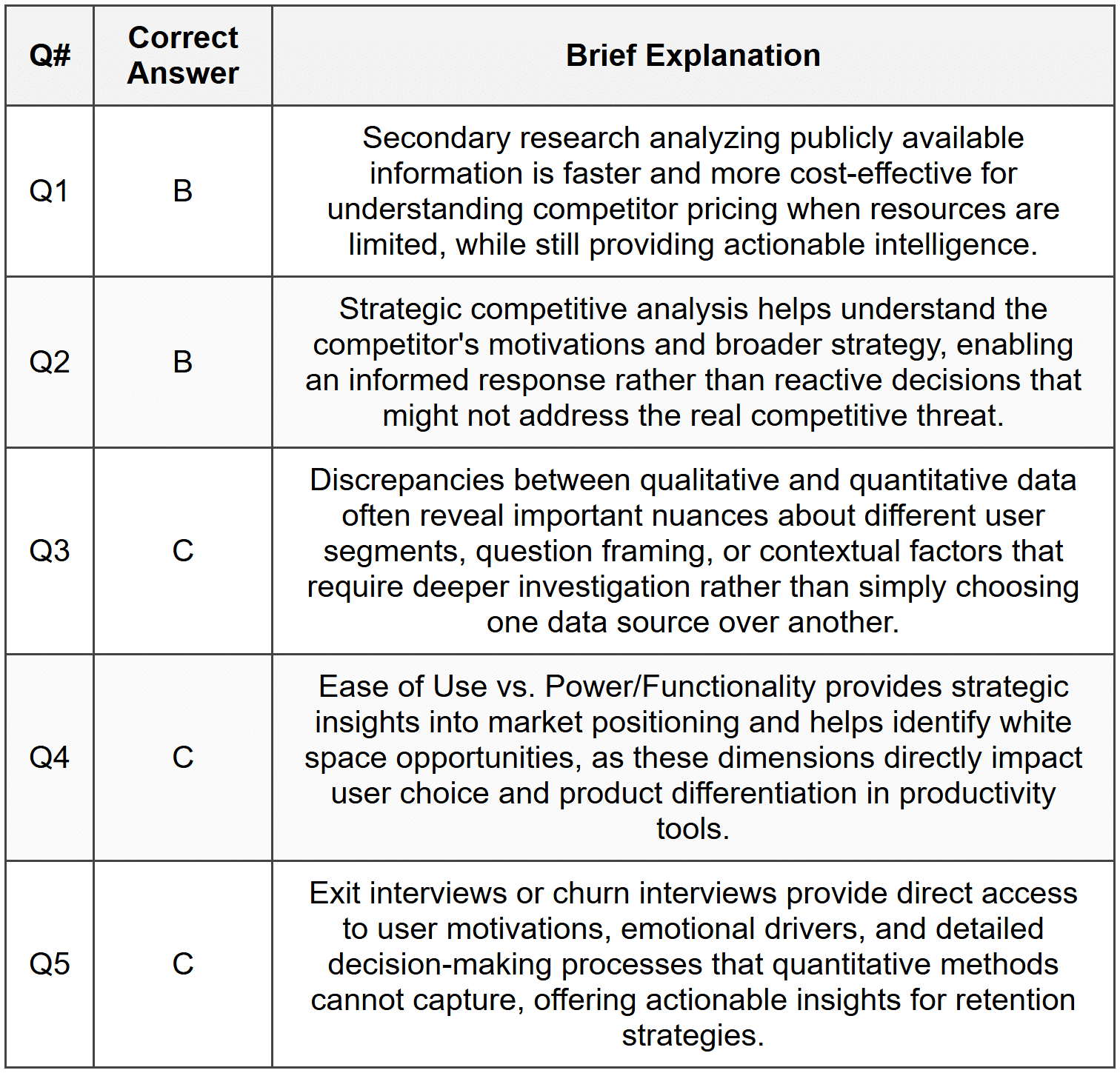
Section 2 Answers
Q1. Primary research involves collecting original data directly from sources through methods like interviews, surveys, observations, or experiments. Secondary research involves analyzing existing data that has already been collected by others, such as industry reports, academic papers, or competitor websites. Primary research is most appropriate when you need specific insights tailored to your product or customer base, such as conducting user interviews to understand pain points with a new feature. Secondary research is most appropriate when you need general market information quickly and cost-effectively, such as analyzing industry trend reports to understand market size and growth projections.
Q2. Competitive intelligence is the systematic collection and analysis of information about competitors, market trends, and the competitive environment to inform strategic product decisions. It is critical for product managers because it helps identify market opportunities, anticipate competitive threats, benchmark product features and pricing, and make informed strategic decisions about product positioning and roadmap prioritization. Three specific sources include: (1) competitor websites and product pages to understand feature sets and positioning, (2) customer reviews on third-party platforms like G2 or Capterra to understand competitor strengths and weaknesses from the user perspective, and (3) industry analyst reports from firms like Gartner or Forrester for market trends and competitive landscape assessments.
Q3. Market segmentation is the process of dividing a broad market into distinct subgroups of consumers who share similar characteristics, needs, behaviors, or preferences. It relates to effective market research by ensuring that research efforts are focused on the most relevant customer segments, allowing for more targeted data collection and analysis. By understanding different segments, product managers can tailor research questions, select appropriate research methodologies, and gather insights that are specific to the needs and behaviors of each segment, leading to more actionable product decisions.
Q4. Quantitative data alone lacks context, depth, and the ability to capture the "why" behind user behaviors and preferences. It can tell you what is happening but not why it is happening or what users are thinking and feeling. Key limitations include: inability to uncover unexpected insights, lack of emotional and motivational context, potential for misinterpretation without understanding user mental models, and difficulty identifying emerging needs or problems users cannot articulate in structured surveys. Qualitative research complements quantitative findings by providing rich context, uncovering underlying motivations, validating or challenging quantitative patterns, exploring unexpected findings in depth, and generating hypotheses that can be tested quantitatively.
Section 3 Answers
Q1. A comprehensive competitive intelligence framework for a mobile banking app targeting millennials should include:
Dimensions to analyze:
- Core features and functionality (mobile-first capabilities, budgeting tools, investment options)
- User experience and interface design (ease of use, visual appeal, onboarding flow)
- Pricing and fee structure (monthly fees, transaction fees, ATM fees)
- Target audience and positioning (millennials, gen Z, underbanked, tech-savvy users)
- Technology and security features (biometric authentication, fraud protection, API integrations)
- Customer service and support (24/7 chat, phone support, response times)
Competitors to research:
- Direct competitors: Chime, Varo, Current (digital-first banks targeting young users)
- Indirect competitors: Traditional banks with mobile apps (Chase Mobile, Bank of America), personal finance apps (Mint, YNAB)
Sources for intelligence gathering:
- Competitor apps (direct usage and feature exploration)
- User reviews on App Store and Google Play
- Social media monitoring (Twitter, Reddit financial communities)
- Industry reports from banking and fintech analysts
- Competitor press releases and blog posts
- Customer forums and community discussions
Presentation format: Create a competitive matrix comparing all dimensions, develop a positioning map on axes like "Feature Richness" vs. "Ease of Use," present a SWOT analysis highlighting opportunities and gaps, and provide strategic recommendations for differentiation with supporting data from the research.
Q2. Market research plan to investigate the NPS vs. support ticket discrepancy:
Research objectives:
- Understand which user segments are submitting support tickets vs. responding to NPS surveys
- Identify specific issues driving support ticket volume increases
- Determine if high NPS respondents are experiencing the same issues but not reporting them as problems
- Assess whether recent product changes have created usability issues for certain user segments
Target audience:
- Users who submitted support tickets in the last quarter
- Users who gave high NPS scores (promoters)
- Users who gave low NPS scores (detractors)
- New users (onboarded in last 30 days) vs. long-term users
Research methods:
- Quantitative: Analyze support ticket data by category, user segment, and timeline to identify patterns
- Quantitative: Survey recent support ticket submitters about their experience and overall satisfaction
- Qualitative: Conduct 10-15 interviews with users who submitted tickets to understand pain points in depth
- Qualitative: Review support ticket transcripts to identify common themes and language used by frustrated users
- Mixed: Analyze correlation between NPS scores and support ticket submission within the same user cohorts
Key questions to answer:
- Are NPS respondents and support ticket submitters different user segments?
- What specific features or workflows are generating the most support requests?
- Are high-NPS users tolerating issues that other users find unacceptable?
- Has a recent product release introduced bugs or usability problems?
- Are support tickets reflecting genuine product issues or gaps in user education and onboarding?
Q3. Competitive response approach when a competitor launches a requested feature:
Immediate actions to assess competitive threat:
- Conduct rapid competitive analysis by testing the competitor's new feature firsthand
- Monitor social media and review sites for customer reactions to the competitor's launch
- Analyze customer support tickets and sales conversations for mentions of the competitor's feature
- Review recent churn data to identify if customers are leaving specifically for this capability
Information to gather about competitor's feature:
- Specific functionality and implementation approach
- Pricing structure (included in base plan or premium tier)
- Target user segment and use cases being addressed
- User reception and adoption rates (from reviews, social media, industry coverage)
- Technical approach and any limitations or gaps in their implementation
Customer validation approach:
- Conduct rapid interviews with 10-15 customers who previously requested this feature
- Send targeted survey to high-value customer segments asking about feature importance and urgency
- Analyze product analytics to understand if customers are attempting workarounds for this functionality
- Review win/loss data from sales team to quantify how often this feature impacts deals
Alternative strategic responses:
- Build a differentiated version that solves the problem better or differently than the competitor
- Accelerate delivery of complementary features that create a superior overall workflow
- Partner with or integrate a third-party solution to provide the capability faster
- Double down on existing differentiators and communicate value proposition more effectively
- Identify adjacent customer needs that the competitor's feature doesn't address and solve those instead
- Provide interim solutions, templates, or education to help customers achieve similar outcomes with existing features
Section 4 - Sample Demonstration
Competitive Analysis: Project Management Software
1. Key Competitors Identified
- Asana (direct competitor)
- Monday.com (direct competitor)
- Trello (direct competitor)
- Microsoft Project (indirect competitor - enterprise focused)
- Notion (indirect competitor - broader workspace tool)
2. Competitive Comparison Table
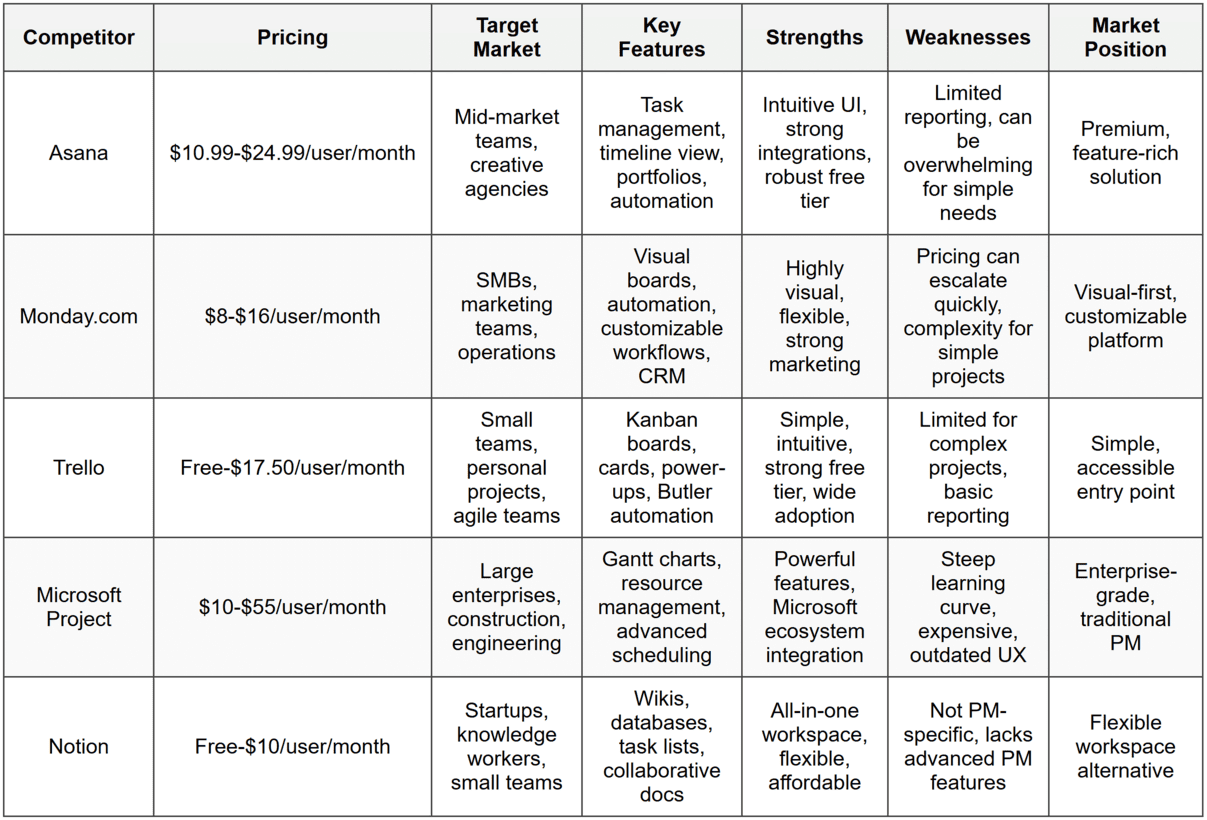
3. Competitive Positioning Map
Axes: Ease of Use (X-axis: Simple → Complex) vs. Power/Functionality (Y-axis: Basic → Advanced)
- Simple + Basic: Trello (top-left quadrant)
- Simple + Advanced: Monday.com (top-right quadrant)
- Moderate complexity + Advanced: Asana (middle-right)
- Complex + Advanced: Microsoft Project (bottom-right quadrant)
- Simple + Moderate: Notion (middle-left)
Market gap identified: Upper-right quadrant could accommodate a product that combines advanced features with exceptional ease of use.
4. SWOT Analysis (for hypothetical product "TaskFlow")
Strengths:
- AI-powered task prioritization and scheduling
- Superior mobile experience compared to competitors
- Built-in time tracking without third-party integrations
- Transparent, predictable pricing model
Weaknesses:
- New market entrant with limited brand recognition
- Smaller integration ecosystem than established players
- No free tier to drive viral adoption
- Limited enterprise features for large organizations
Opportunities:
- Growing remote work market seeking better collaboration tools
- Dissatisfaction with pricing complexity of Monday.com and Asana
- Gap in mobile-first PM solutions
- AI/ML features not yet mainstream in competitor products
Threats:
- Established competitors have strong brand loyalty and switching costs
- Microsoft and Google could enhance their PM capabilities
- Market saturation with numerous PM tools available
- Economic downturn could reduce willingness to switch tools
5. Strategic Recommendations
- Differentiate through AI-powered intelligence: Position TaskFlow as the "smart" project management tool that uses AI to automate scheduling, predict delays, and optimize resource allocation-capabilities that current competitors offer only in limited forms.
- Target mobile-first teams: Focus initial marketing and product development on remote-first companies and distributed teams who need excellent mobile experiences, an area where Asana and Monday.com are weaker.
- Adopt transparent, value-based pricing: Implement simple per-user pricing without feature gates or usage limits, addressing the common complaint about competitor pricing complexity and unexpected cost escalation.
6. Market Gaps and Opportunities
- AI-enhanced project management: None of the major competitors have deeply integrated AI for predictive analytics, intelligent scheduling, or automated workflow optimization
- Mobile-native experience: Most competitors are desktop-first with mobile as an afterthought; opportunity for mobile-native design
- Integrated time tracking: Most solutions require third-party integrations; built-in capability could differentiate
- Simpler enterprise solution: Gap between simple tools (Trello) and complex enterprise solutions (Microsoft Project) for mid-sized companies
- Pricing transparency: Opportunity to win customers frustrated with unpredictable pricing from current solutions
Section 5 - Reflection Guidance
Q1 - Sample Response: In a previous role, I recommended investing heavily in a new product feature based on requests from a few vocal customers without conducting broader market research. I was missing data on how many customers actually needed this feature, what they would pay for it, and how competitors were addressing similar needs. After spending three months building the feature, we discovered that only a small segment valued it, and competitors were offering it as a free add-on. With proper market research, I would have validated demand through surveys, analyzed competitive pricing, and potentially discovered that investing in a different feature would have served more customers and generated better ROI. This experience taught me that passionate feedback from engaged users doesn't always represent broader market needs.
Q2 - Sample Response: I find synthesizing insights from multiple data sources most challenging, particularly when qualitative and quantitative data point in different directions. This is challenging because it requires balancing analytical rigor with interpretive judgment-knowing when contradictions reveal important nuances versus when they indicate research flaws. It also requires resisting the temptation to cherry-pick data that supports pre-existing assumptions. To improve, I'm working on developing structured frameworks for data triangulation, being more explicit about my analytical assumptions, and regularly checking my interpretations with colleagues who might see patterns I've missed.
Q3 - Sample Response: I believe in applying a "progressive confidence" approach: start with rapid, low-cost research to build directional confidence, then invest in deeper research for high-stakes decisions. For fast-moving markets, I prioritize secondary research and lightweight primary research (quick surveys, brief interviews with existing customers) to establish a baseline understanding within days. I set explicit decision thresholds-for example, if preliminary research shows 70%+ customer interest and no obvious competitive blockers, I might proceed with an MVP while continuing research in parallel. I also build in checkpoints to validate assumptions with each release. The key is acknowledging uncertainty explicitly, making reversible decisions when possible, and being willing to pivot quickly when new information emerges. Perfect information is never available, so I focus on being roughly right quickly rather than precisely right too late.

 | Explore Courses for Product & Project Management exam |  |
 | Get EduRev Notes directly in your Google search | |