Assignment : Chords & Harmony – Building Musical Depth


Section 1: Multiple Choice Questions
- Q1. You are composing a piece in C major and want to create a strong resolution at the end of a phrase. Which chord progression would provide the most effective authentic cadence?
- I - IV - I
- IV - V - I
- V - I
- vi - IV - I
- Q2. A composer analyzes a chord and finds it contains the notes F, A, C, and E. What type of seventh chord is this, and what is its most likely function in the key of C major?
- Dominant seventh chord; creates tension requiring resolution
- Major seventh chord; provides stable tonic function
- Minor seventh chord; serves as a subdominant
- Diminished seventh chord; acts as a leading tone chord
- Q3. When harmonizing a melody note 'E' in the key of C major, a student must choose between C major (I), A minor (vi), and E minor (iii) chords. Which factor should primarily guide this decision?
- The chord that appears most frequently in popular music
- The harmonic context created by preceding and following chords
- Always choosing the chord where the melody note is the root
- Selecting the chord with the most notes in common with C major
- Q4. A jazz musician encounters a ii - V - I progression in the key of G major. Which set of chords correctly represents this progression?
- G major - C major - D major
- A minor - D major - G major
- D major - G major - C major
- E minor - A major - D major
- Q5. While analyzing a baroque composition, you notice a chord progression that moves from I to vi. What harmonic technique does this represent, and what effect does it create?
- Parallel motion; creates harmonic instability
- Deceptive cadence; surprises the listener by avoiding expected resolution
- Plagal cadence; provides a gentle, hymn-like conclusion
- Chromatic modulation; shifts to a distantly related key
Section 2: Conceptual Understanding
- Q1. Explain the difference between a triad and a seventh chord. What additional harmonic color does a seventh chord provide compared to a simple triad?
- Q2. Define chord inversion and explain why composers use inversions rather than always placing chords in root position. Provide at least two musical reasons.
- Q3. What is the functional relationship between tonic, subdominant, and dominant chords in establishing tonality? How do these three functions work together to create musical stability and tension?
- Q4. Describe the concept of voice leading and explain why it is important when moving from one chord to another in four-part harmony.
Section 3: Situational / Applied Questions
- Q1. You are arranging a folk song in the key of D major for a school choir. The melody ends on the note D, and you want to create a strong sense of finality. The two measures before the final note currently have the chords E minor and A major. Explain what type of cadence this creates and whether you would modify it. If so, describe your changes and justify them using harmonic principles.
- Q2. A student composer shows you a progression in F major: F - Bb - F - C - F. They feel it sounds "boring" and want to make it more interesting without changing the key. Suggest two specific harmonic techniques they could apply to add variety while maintaining the overall tonal structure. Explain how each technique would enhance the progression.
- Q3. While playing a piece in A minor, you need to harmonize a melodic phrase that moves: A - G - F - E. You must choose appropriate chords that support this descending line while maintaining good voice leading. Propose a chord progression for these four notes, identify each chord by Roman numeral analysis, and explain your harmonic choices.
Section 4: Skill Demonstration Task
Create a complete four-measure chord progression in the key of G major that demonstrates your understanding of harmonic function and chord progression principles.
Requirements:
- Use at least five different chords from the key of G major
- Include at least one seventh chord
- Include at least one chord inversion (specify which inversion)
- End with an authentic cadence (V - I or V7 - I)
- Label each chord using Roman numeral analysis
- Indicate the inversion for any inverted chords using figured bass notation (e.g., I6, V6/4)
Deliverable format:
- Write your progression showing measure numbers (1-4)
- Under each measure, write the Roman numeral analysis
- Below your progression, write a brief explanation (3-4 sentences) describing the harmonic journey your progression creates and why you made your specific chord choices
Section 5: Self-Reflection
- Q1. Reflect on your current ability to identify chords by ear. Can you reliably distinguish between major and minor triads? What about seventh chords? Identify one specific area of chord recognition where you would like to improve and suggest a practice strategy to develop this skill.
- Q2. When you compose or improvise music, how consciously do you think about chord progressions and harmonic function? Describe your current approach and identify whether you rely more on theoretical knowledge or on what "sounds good" to your ear. How might you balance these two approaches more effectively?
- Q3. Evaluate your understanding of voice leading principles. Can you move smoothly between chords while avoiding parallel fifths and octaves? What specific aspect of voice leading do you find most challenging, and what steps could you take to master it?
Answer Key
Section 1 - MCQ Answers
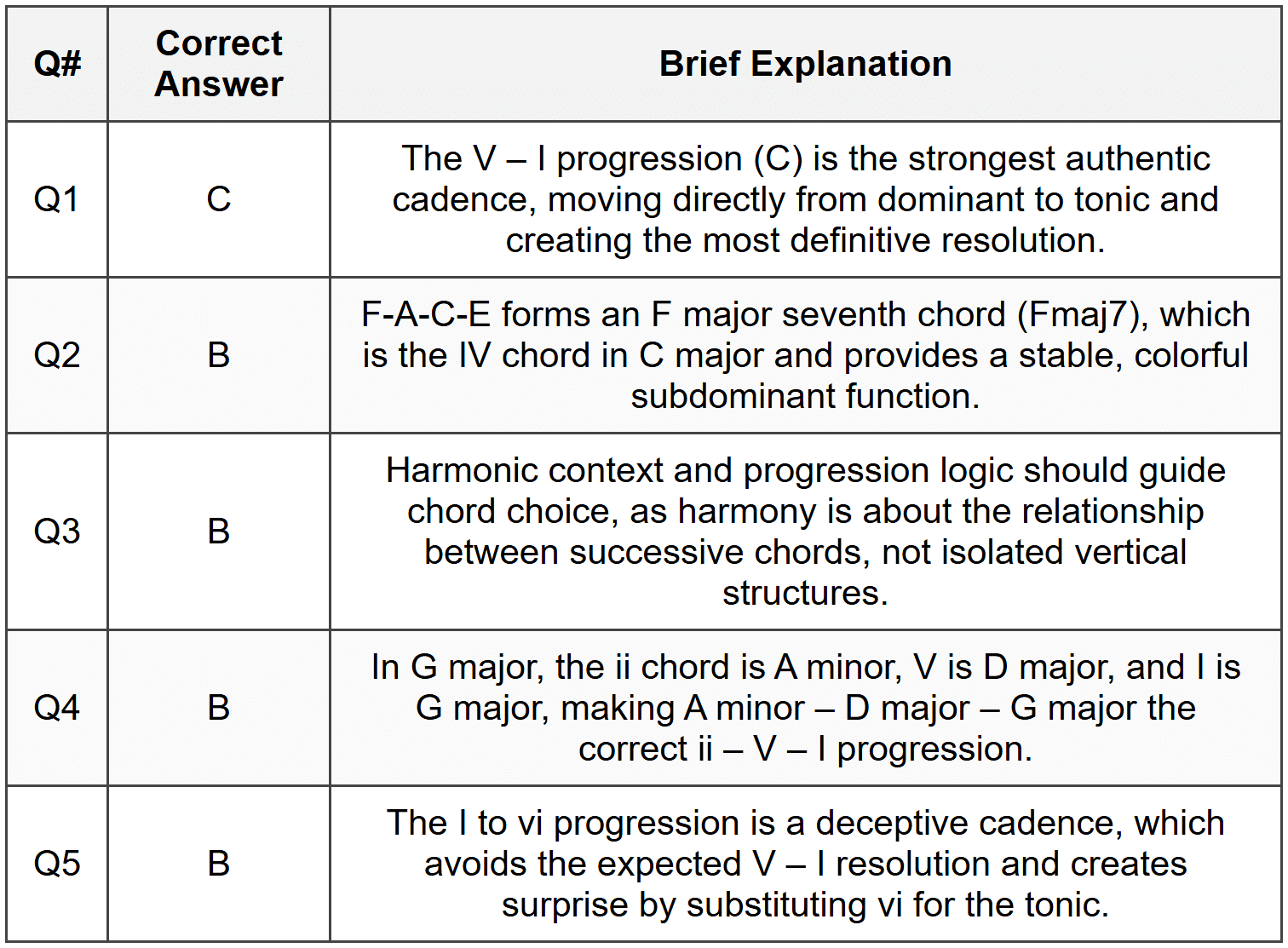
Section 2 Answers
Q1: A triad consists of three notes: a root, third, and fifth, stacked in thirds. A seventh chord adds a fourth note-a seventh above the root-to the triad structure. The seventh adds additional harmonic complexity and color, creating more tension that typically requires resolution. Seventh chords are particularly effective in creating forward motion in harmonic progressions, as the dissonance of the seventh interval naturally wants to resolve downward.
Q2: Chord inversion occurs when a note other than the root is placed in the bass (lowest voice). The first inversion has the third in the bass, and the second inversion has the fifth in the bass. Composers use inversions for several reasons: to create smoother bass lines with stepwise motion rather than large leaps, to maintain better voice leading between chords, to add variety to harmonic texture, and to control the stability of chords (inverted chords generally sound less stable than root position chords, which can be useful for creating tension or forward motion).
Q3: The tonic (I) chord represents home base and provides complete stability and rest. The dominant (V) chord creates tension and strong pull back to the tonic due to the presence of the leading tone and the tendency of the fifth scale degree to resolve to the tonic. The subdominant (IV) chord provides contrast to the tonic and often serves as a bridge between tonic and dominant, moving away from tonic stability toward dominant tension. Together, these three functions create a complete harmonic cycle: stability (I) → departure (IV) → tension (V) → resolution (I), which forms the foundation of tonal harmony.
Q4: Voice leading refers to the smooth, logical movement of individual melodic lines (voices) as harmony changes from chord to chord. Good voice leading is important because it creates smooth, singable melodic lines in each voice part, avoids awkward leaps that are difficult to perform, prevents problematic parallel motion (especially parallel fifths and octaves) that weakens the independence of voices, and maintains clear harmonic progressions. Proper voice leading involves moving each voice to the nearest chord tone in the next chord whenever possible, maintaining common tones between chords, and resolving tendency tones (like the leading tone) in their expected directions.
Section 3 Answers
Q1: The progression E minor (ii) to A major (V) to D (I) creates an authentic cadence, specifically a perfect authentic cadence if both the V and I chords are in root position with the tonic in the soprano voice of the final chord. This is an excellent choice and would not require modification, as it provides the strongest possible sense of finality and closure. The ii - V - I progression is one of the most fundamental and satisfying progressions in tonal music. The E minor chord moves smoothly to the A major dominant chord, which contains the leading tone (C#) that strongly pulls toward the final tonic note D. If the student wanted even more finality, they could use A7 (a dominant seventh) instead of A major to increase the tension before the final resolution.
Q2: First technique: Add seventh chords to create richer harmonic color. The student could change the progression to Fmaj7 - Bb - F - C7 - F, where the major seventh on the tonic adds warmth and the dominant seventh on C creates stronger pull toward the final F chord. Second technique: Use chord inversions to create a more interesting bass line. For example: F - Bb/D - F/A - C/E - F, where the slash indicates the bass note. This creates a stepwise ascending bass line (F - D - A - E - F through octaves) that adds melodic interest while maintaining the same basic harmonic structure. Both techniques preserve the tonal center while adding sophistication and variety to the progression.
Q3: A recommended progression would be: A minor (i) - C major (III) - D minor (iv) - A minor (i) or E major (V). For the note A, use A minor (i) in root position, providing tonic stability. For G, use C major (III), where G is the fifth of the chord-this chord shares two common tones with A minor (C and E), ensuring smooth voice leading. For F, use D minor (iv), where F is the third-this provides subdominant function and continues the descending melodic motion. For the final E, you have two strong options: return to A minor (i) for a stable conclusion, or use E major (V) if this phrase continues and needs to set up further resolution. This progression creates a logical harmonic descent that supports the melodic line while maintaining good voice leading, with minimal motion in the inner voices and a clear sense of harmonic direction.
Section 4 - Sample Demonstration
Sample Four-Measure Progression in G Major:
Measure 1: G major (I)
Measure 2: C major in first inversion (IV6)
Measure 3: E minor seventh (vi7)
Measure 4: D major - G major (V - I)
Roman Numeral Analysis:
I - IV6 - vi7 - V - I
Explanation: This progression creates a satisfying harmonic journey that begins and ends with tonic stability. The opening G major chord establishes the key clearly. Moving to C major in first inversion (IV6) creates a smooth bass line (G to E) while introducing subdominant color and moving away from tonic. The E minor seventh chord in measure 3 adds harmonic richness through the seventh (D) and provides a darker, more introspective quality before the final resolution. The progression concludes with a classic authentic cadence (V - I), where D major creates dominant tension that resolves decisively to the tonic G major chord. The use of the inverted IV chord and the seventh chord on vi adds sophistication beyond basic triads while maintaining clear tonal direction and functional harmony throughout.
Section 5 - Reflection Guidance
Q1 Sample Response: Currently, I can identify major versus minor triads with about 80% accuracy when I hear them in isolation, but I struggle significantly with seventh chords, especially distinguishing between major seventh, minor seventh, and dominant seventh chords. The added complexity of the seventh interval makes it harder for my ear to categorize these sounds quickly. I would particularly like to improve my ability to identify dominant seventh chords in musical context, as these are so common in jazz and popular music. My practice strategy would involve daily ear training exercises using a piano or app, where I first play and sing each type of seventh chord to internalize the sound, then practice identifying randomly played seventh chords. I would start with isolated chords, then progress to identifying them within progressions, spending 10-15 minutes daily for at least a month to develop this skill systematically.
Q2 Sample Response: When I compose or improvise, I tend to rely heavily on what sounds good to my ear, with only occasional conscious reference to theoretical principles. I might intuitively choose a progression because it feels right, but I often couldn't explain why in theoretical terms. This approach has both strengths and limitations-it keeps my music spontaneous and emotionally genuine, but sometimes I get stuck in repetitive patterns because I lack the theoretical vocabulary to intentionally explore new harmonic territory. To balance these approaches better, I plan to spend time analyzing progressions in music I love, identifying the Roman numerals and functional relationships, then consciously experimenting with similar patterns in my own work. This way, I can build theoretical understanding that informs rather than constrains my intuitive choices, expanding my harmonic palette while maintaining creative freedom.
Q3 Sample Response: My understanding of voice leading is intermediate-I grasp the basic principles of moving to the nearest chord tone and maintaining common tones, but I frequently make errors when working with four-part harmony. The aspect I find most challenging is avoiding parallel fifths while also creating smooth melodic lines in all voices simultaneously; focusing on one voice often causes problems in another. To master this skill, I would take a three-step approach: First, I would practice two-voice counterpoint exercises to develop a strong foundation in creating independent melodic lines. Second, I would analyze Bach chorales, specifically tracking how each voice moves and noting how he resolves apparent voice-leading dilemmas. Third, I would compose short four-part progressions daily, starting with simple I-IV-V-I progressions and gradually adding more complex chords, always checking my work both by playing it and by analyzing each voice pair for parallel motion. Consistent daily practice over several months should significantly improve my voice-leading skills.