Assignment : Lyric Writing


Section 1: Multiple Choice Questions
- Q1. A songwriter is revising a chorus and notices that the rhyme scheme feels predictable and childish. Which technique would best elevate the lyrical sophistication while maintaining memorability?
- Replace all rhymes with non-rhyming lines to appear more artistic
- Use slant rhymes or internal rhymes instead of perfect end rhymes
- Add more syllables to each line to make it sound complex
- Remove all repetition from the chorus entirely
- Q2. A verse describes a character's emotional state, but beta listeners report feeling disconnected from the song. What is the most likely issue with the lyric writing approach?
- The lyrics use too many metaphors
- The lyrics tell rather than show the emotion through concrete imagery
- The verse is too short to convey meaning
- The rhyme scheme is too consistent
- Q3. When writing lyrics for a bridge section, which approach typically creates the most effective contrast and maintains listener engagement?
- Repeat the exact same lyrical theme as the chorus but with different words
- Introduce a new perspective, revelation, or shift in the narrative or emotional tone
- Use the bridge to list additional examples of what was stated in the verses
- Make the bridge twice as long as the verse to add variety
- Q4. A songwriter wants to address a universal theme while keeping the lyrics personal and relatable. Which balance would best achieve this goal?
- Use only abstract language and broad generalizations throughout
- Write exclusively about a highly specific personal experience with no universal language
- Ground universal emotions in specific, concrete details and imagery
- Alternate lines between abstract concepts and unrelated specific details
- Q5. When evaluating whether a lyric successfully employs prosody, what relationship should the songwriter examine most closely?
- The relationship between the number of verses and choruses
- The relationship between lyrical meaning and melodic contour or rhythm
- The relationship between rhyme scheme complexity and song length
- The relationship between the songwriter's intention and listener interpretation
Section 2: Conceptual Understanding
- Q1. Explain the difference between "showing" and "telling" in lyric writing, and describe why "showing" is generally considered more effective for creating emotional connection with listeners.
- Q2. What is the function of a song's "hook," and how does it differ from the chorus? Provide an example of how a hook might appear in different sections of a song.
- Q3. Describe the concept of "lyrical economy" and explain why it is particularly important in songwriting as opposed to other forms of writing like poetry or prose.
- Q4. What role does point of view (first person, second person, third person) play in shaping a song's narrative, and how might changing the point of view alter the listener's experience of the same story?
Section 3: Situational / Applied Questions
- Q1. You are writing a song about overcoming a difficult breakup. Your first draft of the chorus is: "I am sad because you left me / Now I cry every day / I wish you would come back / But I know you won't stay." Rewrite this chorus using concrete imagery and "showing" techniques instead of direct statements of emotion. Then explain what specific changes you made and why they improve the lyric.
- Q2. A collaborator has written a verse with the following rhyme scheme: AABB (couplets). The melody is upbeat and contemporary, but the lyric feels old-fashioned. Suggest three specific techniques to modernize the lyrical approach while keeping the same general theme, and explain how each technique contributes to a more contemporary sound.
- Q3. You're writing a song where the verses describe struggle and hardship, but the chorus needs to convey hope and resilience. Describe how you would use contrasting imagery, word choice, and possibly rhythm or meter to create this emotional shift between sections. Provide specific examples of word choices or images you might use in each section.
Section 4: Skill Demonstration Task
Choose one of the following universal themes:
- New beginnings
- Feeling misunderstood
- Home and belonging
- Personal transformation
Create a complete chorus (4-8 lines) that addresses your chosen theme. Your chorus must demonstrate the following:
- At least one concrete, sensory image (something you can see, hear, touch, smell, or taste)
- A clear rhyme scheme (you may use perfect rhymes, slant rhymes, or internal rhymes)
- "Showing" rather than "telling" for at least one emotional moment
- A memorable hook or repeated phrase
- Appropriate prosody (the natural rhythm of the words should suggest a singable melody)
After writing your chorus, provide a brief explanation (3-5 sentences) identifying where you applied each of the five required elements and why you made those specific choices.
Section 5: Self-Reflection
- Q1. When you write lyrics, do you tend to prioritize rhyme, meaning, or rhythm first? Reflect on how this priority affects your writing process and the final quality of your lyrics. What might you gain by adjusting this priority?
- Q2. Identify a song whose lyrics you admire. What specific lyric writing techniques does the songwriter use that you find effective? Which of these techniques do you currently use in your own writing, and which would you like to develop further?
- Q3. Think about a recent lyric you wrote that you felt didn't quite work. Looking back with the knowledge from this chapter, what specific aspect of lyric writing could you improve (imagery, point of view, showing vs. telling, prosody, etc.), and how would you revise it now?
Answer Key
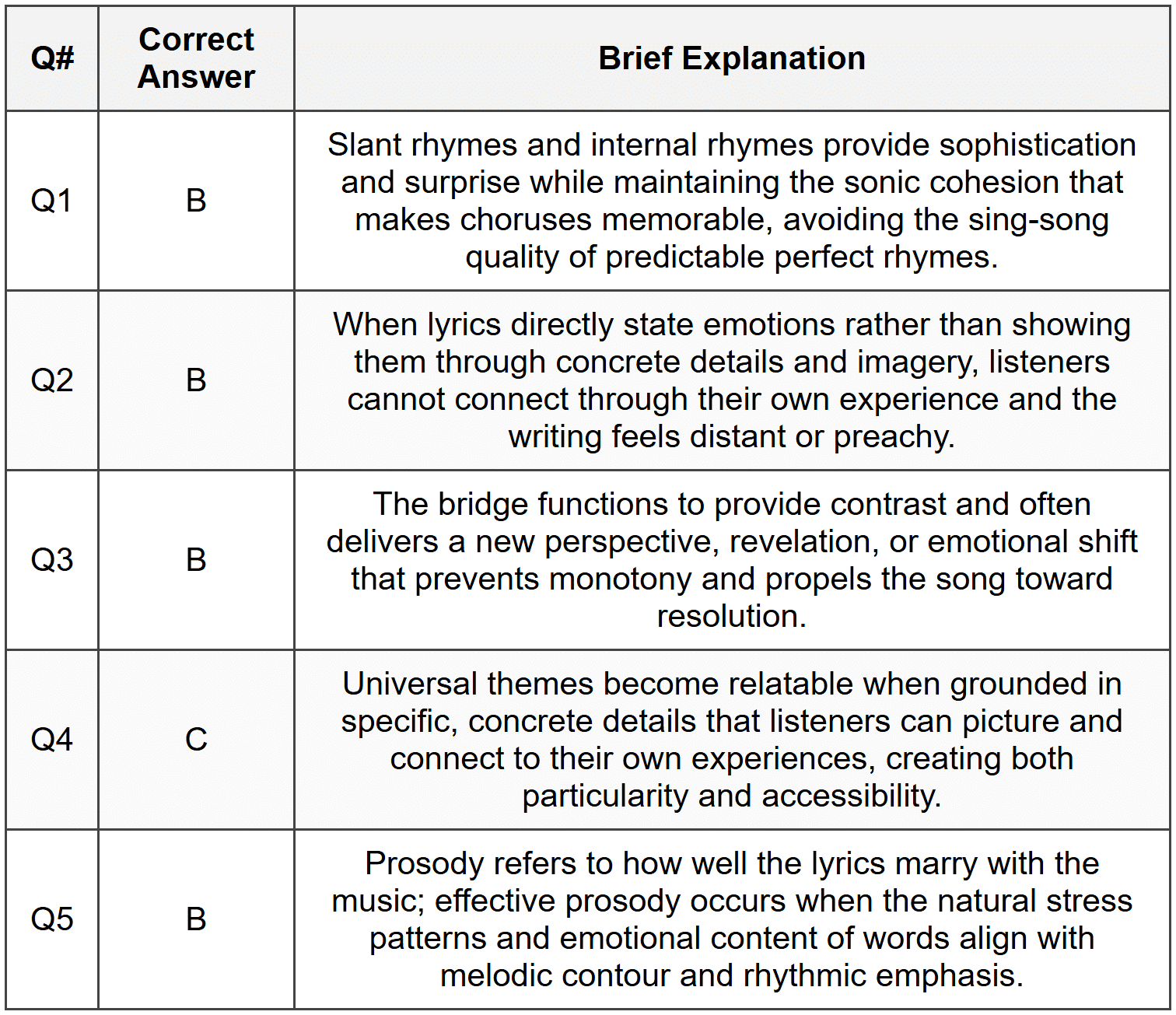
Section 1 - MCQ Answers
Section 2 Answers
Q1. "Showing" in lyric writing means using concrete, sensory details and imagery to evoke an emotion or situation, allowing listeners to experience it themselves. "Telling" means directly stating an emotion or fact. For example, "I'm heartbroken" is telling, while "Your coffee cup still sits beside the sink" shows the absence and lingering presence of someone who's gone. Showing is more effective because it engages the listener's imagination and allows them to arrive at the emotional truth themselves, creating a more powerful and personal connection to the song.
Q2. A hook is the most memorable, catchy element of a song-the part that "hooks" the listener and stays in their mind. While the chorus is a structural section that typically contains the main message and repeats throughout the song, the hook is often a specific phrase, melodic motif, or lyrical moment within the chorus, though it can appear anywhere. For example, in a verse-chorus song, the hook might be the title phrase that appears at the end of each chorus, or it could be a distinctive opening line that also appears in the intro and outro.
Q3. Lyrical economy means using the fewest, most precise words to convey the maximum meaning and emotional impact. In songwriting, this is particularly important because lyrics are experienced in real time with music, giving listeners limited opportunity to process complex language, and because melody and rhythm impose constraints on syllable count and word placement. Unlike poetry or prose, songs cannot be re-read or paused for contemplation in the moment, so every word must work efficiently to create immediate impact and clarity.
Q4. Point of view determines the relationship between the narrator and the story, shaping intimacy and perspective. First person ("I") creates immediacy and personal confession, making the listener feel they're inside the narrator's experience. Second person ("you") creates direct address, either pulling the listener into the story as a character or addressing another person, which can feel intimate or confrontational. Third person ("he/she/they") provides distance and can allow for storytelling with multiple characters or more objective observation. Changing point of view can shift a song from feeling like a personal diary entry to a universal story or from an intimate conversation to an observed narrative.
Section 3 Answers
Q1. A stronger revision might be: "Your coffee cup still stains the counter / Rain sounds different now you're gone / I trace the empty side of the bed / And face the morning on my own." This revision shows sadness through concrete images (the coffee cup, the empty bed) rather than stating "I am sad." The sensory details (stains, rain sounds, tracing) allow listeners to feel the emptiness and loneliness. The emotional truth emerges from specific, observable moments rather than abstract declarations, making the experience more vivid and relatable.
Q2. Three modernizing techniques: (1) Use slant rhymes or assonance instead of perfect rhymes to create a more conversational, less predictable feel-for example, pairing "away" with "shake" rather than "day." (2) Employ enjambment, allowing thoughts to run across line breaks rather than stopping at each rhyme, which creates natural speech patterns. (3) Incorporate contemporary imagery and specific cultural references rather than generic or archaic language, grounding the lyric in the present moment. These techniques help the lyric feel more natural and less formal, matching contemporary melodic and production aesthetics.
Q3. In the verses, use darker, heavier imagery with concrete physical details: words like "weight," "concrete," "shadows," "thorns," or images of closed doors, empty pockets, or rough textures. Use shorter, choppier phrases or internal pauses to create a halting, burdened rhythm. In the chorus, shift to imagery of light, movement, and openness: words like "rise," "wings," "horizon," "breathe," or images of open roads, sunrise, or breaking through. Use more flowing, connected phrases and longer vowel sounds to create lift. This contrast in both the semantic field (word associations) and the sonic qualities creates an emotional arc that the listener can feel even before processing the literal meaning.
Section 4 - Sample Demonstration
Sample Chorus (Theme: New Beginnings)
I'm packing light, leaving the weight behind
These highways hum a different song
The rearview mirror's getting small
I'm learning how to start
Before I know where I belong
Explanation of Elements:
Concrete sensory image: "The rearview mirror's getting small" provides a visual image the listener can picture, representing both literal travel and metaphorical distance from the past. Rhyme scheme: The lines use a loose ABCDC pattern with slant rhymes (behind/song, small/belong) that feel natural rather than forced. Showing rather than telling: Rather than saying "I'm ready for change," the act of "packing light" and "leaving the weight behind" shows the decision to let go and move forward. Hook: "I'm learning how to start / Before I know where I belong" serves as the memorable phrase that captures the theme's central tension. Prosody: The rhythm follows natural speech patterns with emphasis on key words like "light," "weight," "small," and "start," suggesting a melodic rise on "highways hum" and a resolution on "belong."
Section 5 - Reflection Guidance
Q1 Sample Response: I tend to prioritize rhyme first, which sometimes leads me to choose words that fit the rhyme scheme but don't precisely capture the meaning I want to convey. This can result in lyrics that sound polished but feel slightly forced or generic. If I prioritized meaning first and then found creative rhyming solutions-including slant rhymes or repositioning where rhymes occur-I might create more authentic, emotionally resonant lyrics. The technical craft would still be present, but it would serve the emotional truth rather than constraining it.
Q2 Sample Response: I admire the lyrics in Joni Mitchell's "A Case of You" because she uses specific, unexpected imagery ("I could drink a case of you and still be on my feet") that's both concrete and metaphorical, creating layers of meaning. She also uses conversational language that feels intimate rather than performative. I currently use conversational language in my writing, but I tend to rely on more conventional metaphors. I'd like to develop her ability to find fresh, surprising images that capture complex emotions in ways that feel both unique and immediately understandable.
Q3 Sample Response: I recently wrote a verse about feeling overwhelmed that included the line "Everything is just too much, I can't handle all this stuff." Looking back, this is clearly telling rather than showing. I could improve this by replacing the abstract statement with concrete imagery that demonstrates the feeling of being overwhelmed-perhaps describing a pile of unopened mail, missed calls lighting up a phone, or the physical sensation of shallow breathing. By grounding the emotion in specific, observable details, the listener could experience the overwhelm rather than just being told about it, creating a stronger emotional connection.