Assignment : Editing and Improving Songs


Section 1: Multiple Choice Questions
- Q1. You are reviewing a song and notice the second verse introduces a new melody that doesn't appear anywhere else in the song. Which principle of songwriting would most likely guide your editing decision?
- Repetition creates familiarity and helps listeners remember the song
- Every verse must have identical melodic contours
- Melody should never be modified after the first draft
- Unique elements always improve a song's quality
- Q2. During the editing process, you discover that your chorus arrives 90 seconds into a pop song. What is the most effective editing strategy to address this issue?
- Add more instrumental sections before the chorus
- Shorten or remove sections before the chorus to reach it earlier
- Keep the structure unchanged as listener patience is unlimited
- Replace the chorus with a bridge section
- Q3. You receive feedback that your song's lyrics are "too abstract" for the intended audience. Which editing approach would best address this concern?
- Remove all metaphors and use only literal language
- Replace abstract images with more concrete, relatable details while preserving emotion
- Ignore the feedback as abstraction is always artistic
- Add more verses to explain the abstract concepts
- Q4. While editing, you notice your verses have 8 lines each, but your chorus has only 2 lines and feels underdeveloped. What structural editing technique would most effectively balance your song?
- Reduce all verses to 2 lines to match the chorus
- Expand the chorus with additional melodic or lyrical hooks to give it more weight
- Remove the chorus entirely and use only verses
- Add a pre-chorus before every verse
- Q5. You are editing a song where the bridge repeats the same chord progression as the verse and chorus. What is the primary reason to revise the bridge's harmonic structure?
- Bridges must always be in a different key than the rest of the song
- The bridge should provide contrast and prevent listener fatigue by offering fresh harmonic material
- Chord progressions can never be repeated in professional songs
- The bridge is unimportant and should be removed entirely
Section 2: Conceptual Understanding
- Q1. Explain the difference between revising and editing in the context of songwriting. Why are both processes essential for creating a polished song?
- Q2. What is "lyrical economy" and why is it an important consideration when editing song lyrics?
- Q3. Describe three common reasons why a songwriter might decide to change or remove a section of a song during the editing process.
- Q4. How can distance (time away from the song) improve the editing process? What specific benefits does it provide to a songwriter?
Section 3: Situational / Applied Questions
- Q1. You have written a song with the following structure: Verse 1 - Verse 2 - Chorus - Verse 3 - Chorus - Outro. A trusted collaborator suggests the song feels repetitive and loses energy in the middle. How would you apply editing techniques to restructure this song for better listener engagement? Provide a revised structure and explain your reasoning.
- Q2. A line in your chorus is: "The feelings inside my heart are like a thousand storms raging in the ocean of my soul." During editing, you recognize this may be overwritten. Rewrite this line applying the principle of lyrical economy while preserving the emotional intent.
- Q3. You receive feedback from three different listeners: one says your song is "too long," another says "the melody is forgettable," and a third says "the lyrics don't match the upbeat music." Prioritize these feedback points and explain which you would address first during editing and why.
Section 4: Skill Demonstration Task
You will practice editing a song excerpt by applying multiple editing techniques.
Original Song Excerpt:
Verse 1:
Walking down the street today, I saw the sun
The sun was shining bright and warm
I thought about the times we had together, you and me
When everything was perfect and nothing could go wrong at all
Chorus:
I miss you
I miss you
Your Task:
- Identify at least three specific problems with this excerpt (consider lyrical economy, imagery, rhythm, chorus strength, and clichés)
- Provide a revised version of both the verse and chorus that addresses these problems
- Write a brief explanation (3-4 sentences) of the editing choices you made and how they improve the song
Section 5: Self-Reflection
- Q1. What aspect of song editing do you find most challenging (structural changes, lyrical refinement, melodic adjustments, or cutting material you've written)? Why do you think this is difficult for you?
- Q2. Describe a time when you received feedback on your creative work (musical or otherwise). How did you respond emotionally, and how did you decide which feedback to incorporate?
- Q3. On a scale of 1-10, how objective can you be when evaluating your own songs? What strategies could you develop to become more objective during the editing process?
Answer Key
Section 1 - MCQ Answers
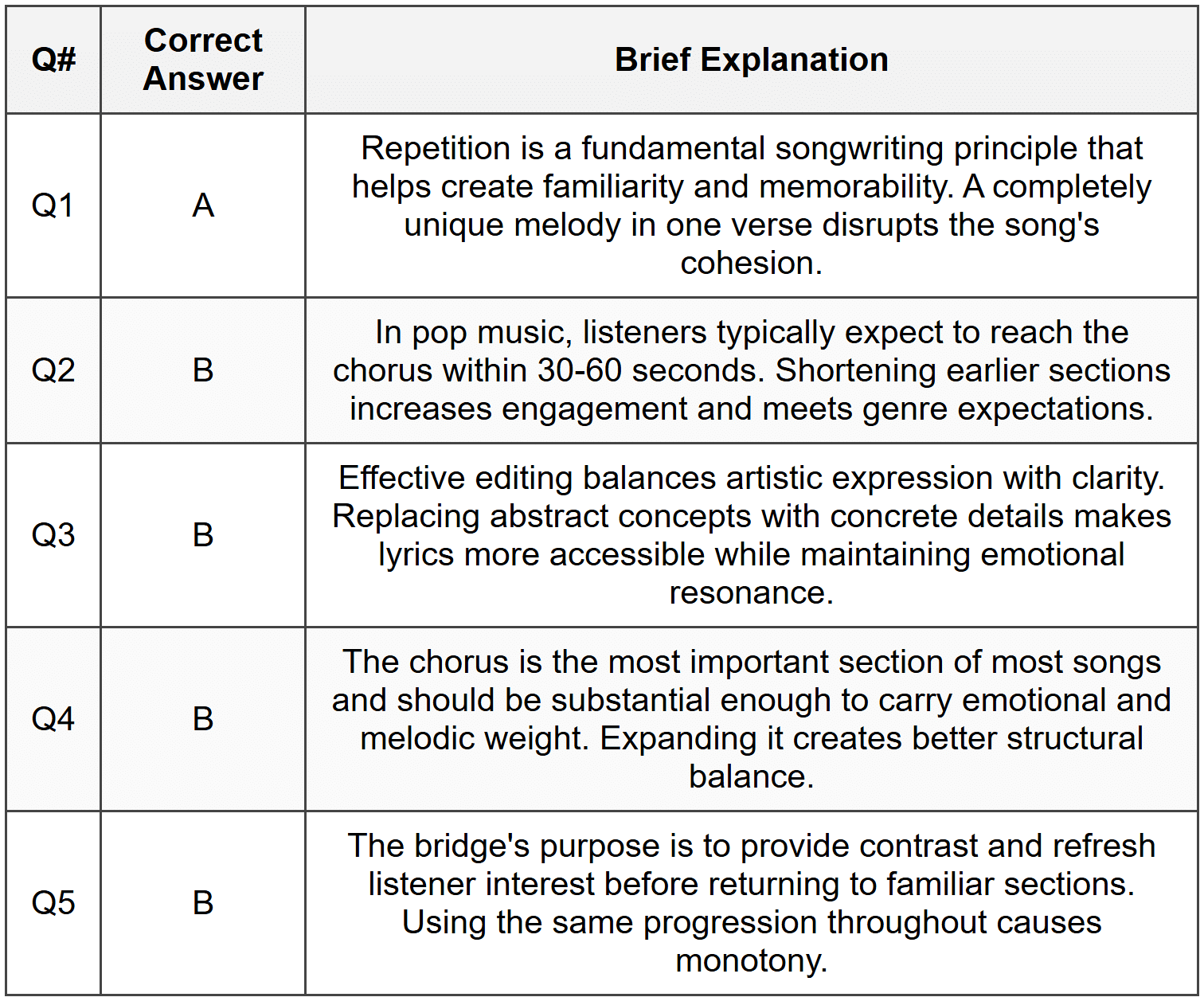
Section 2 Answers
Q1. Revising involves making larger structural and conceptual changes to a song, such as rewriting entire sections, changing the song's perspective, or altering the fundamental message or melody. Editing focuses on refining what already exists by tightening lyrics, improving word choices, adjusting rhythms, and polishing smaller details. Both processes are essential because revising ensures the song's foundation is strong and coherent, while editing ensures every element is as effective and polished as possible. A song needs both the right structure and refined execution to resonate with listeners.
Q2. Lyrical economy refers to the practice of conveying meaning and emotion using the fewest, most effective words possible. It is important in songwriting because songs are brief, time-limited art forms where every word must earn its place. Economy prevents wordiness, reduces clichés, and ensures that each phrase carries maximum emotional or narrative impact. Songs with strong lyrical economy feel tighter, more memorable, and more powerful because there is no unnecessary language diluting the message.
Q3. Three common reasons to change or remove a section include: (1) the section disrupts the song's flow or pacing, causing listener disengagement; (2) the section is repetitive or redundant, saying something already expressed elsewhere in the song; and (3) the section doesn't serve the song's emotional arc or narrative purpose, making it feel like filler rather than meaningful content. Removing weak sections strengthens the overall song by maintaining focus and momentum.
Q4. Taking time away from a song allows a songwriter to return with fresh ears and greater objectivity. During the writing process, creators can become too attached to certain phrases, melodies, or sections, making it difficult to recognize weaknesses. Distance provides emotional detachment, making it easier to identify problems like repetitive melodies, unclear lyrics, or structural imbalances. It also allows the songwriter to experience the song more like a listener would, revealing whether the intended emotion or message actually comes through.
Section 3 Answers
Q1. The original structure lacks dynamic contrast and delays the hook too long. A more effective structure would be: Intro - Verse 1 - Chorus - Verse 2 - Chorus - Bridge - Chorus - Outro. This revision introduces the chorus earlier (after the first verse instead of the second), which captures listener attention faster. The bridge replaces the third verse, providing fresh harmonic and melodic material that prevents monotony and builds anticipation for the final chorus. This structure maintains energy by varying the sections and using the bridge strategically to create a climactic moment before the final chorus.
Q2. Revised line: "My heart's a storm you left behind." This revision condenses the original 17-word line into 7 words while preserving the core emotional metaphor of inner turmoil. It removes redundant imagery (both "thousand storms" and "ocean" convey chaos), eliminates the vague phrase "feelings inside," and creates a more direct, memorable image. The revision also improves rhythm and singability while maintaining poetic quality.
Q3. Prioritization: (1) Address "lyrics don't match the upbeat music" first, as this represents a fundamental mismatch between musical and lyrical tone that confuses listeners and weakens the song's emotional impact. (2) Next, address "melody is forgettable," since melody is the primary hook that makes songs memorable and engaging. (3) Finally, consider "too long," which may resolve naturally after addressing the other issues-tightening lyrics and strengthening melody often results in a more concise song. The first issue is most critical because tonal inconsistency undermines the entire song's effectiveness, while length is often a symptom rather than a root problem.
Section 4 - Sample Demonstration
Identified Problems:
- The verse contains redundancy: "I saw the sun" followed immediately by "The sun was shining" repeats the same information unnecessarily
- The fourth line is excessively wordy and contains the cliché phrase "nothing could go wrong"
- The chorus is underdeveloped, consisting only of two identical short lines with no melodic or lyrical variation, making it weak as a song's centerpiece
- The imagery is generic (sun shining, walking down the street) and doesn't create a distinctive or memorable picture
Revised Version:
Verse 1:
Walking past your street today beneath the morning light
I traced the steps we used to take
When summer stretched before us
And every promise felt unbreakable
Chorus:
I miss you more than words can hold
I miss the way you made me whole
Every empty moment proves
I miss you
Explanation: The revision applies lyrical economy by removing redundant descriptions and tightening each line. Specific details like "past your street" and "morning light" replace generic images, creating stronger visualization. The clichéd phrase "nothing could go wrong" becomes "every promise felt unbreakable," which is more original and emotionally specific. The chorus is expanded from 2 lines to 4 lines with varied content, creating a stronger hook through both repetition ("I miss you") and development (explaining how and why). These changes make the excerpt more memorable, emotionally resonant, and professionally crafted.
Section 5 - Reflection Guidance
Q1 Sample Response: I find cutting material I've written most challenging during the editing process. Even when I recognize that a line or section doesn't serve the song, I feel attached to it because I remember the effort and inspiration that went into creating it. This difficulty stems from the personal investment we make in our creative work-each phrase feels like a small piece of ourselves. To overcome this, I'm learning to save cut material in a separate document rather than deleting it permanently, which helps me let go knowing I can potentially use those ideas in future songs. I'm also practicing viewing the song from the listener's perspective rather than the creator's, asking "does this serve the song?" instead of "do I like this phrase?"
Q2 Sample Response: When I shared a song with my music class last semester, I received mixed feedback-some loved the melody while others found the lyrics confusing. Initially, I felt defensive because I understood what the lyrics meant and felt the criticism was unfair. After some time, I realized that my understanding doesn't matter if listeners can't access the meaning. I decided to incorporate the feedback about lyrical clarity by adding more concrete images, while keeping the melodic elements that people responded to positively. This experience taught me that negative feedback, though uncomfortable, often reveals blind spots in my work that I can't see alone. I'm learning to separate my ego from my work and view feedback as information rather than judgment.
Q3 Sample Response: Honestly, I'd rate my objectivity around a 4 or 5 out of 10 when evaluating my own songs immediately after writing them. I tend to either be overly critical (thinking everything is terrible) or overly attached (thinking every line is perfect). To become more objective, I could develop several strategies: First, implement a mandatory waiting period of at least 24 hours before editing anything I've written, which would provide emotional distance. Second, record myself performing the song and listen back as if I were hearing someone else's work, which shifts my perspective from creator to audience. Third, create a specific editing checklist based on craft principles (Does each section serve a purpose? Is the language economical? Does the melody support the lyrics?) so I'm evaluating against objective criteria rather than subjective feelings. Finally, I could regularly practice editing other people's songs to develop critical skills I can then apply to my own work.