Assignment : Authority Building & Content Strategy


Section 1: Multiple Choice Questions
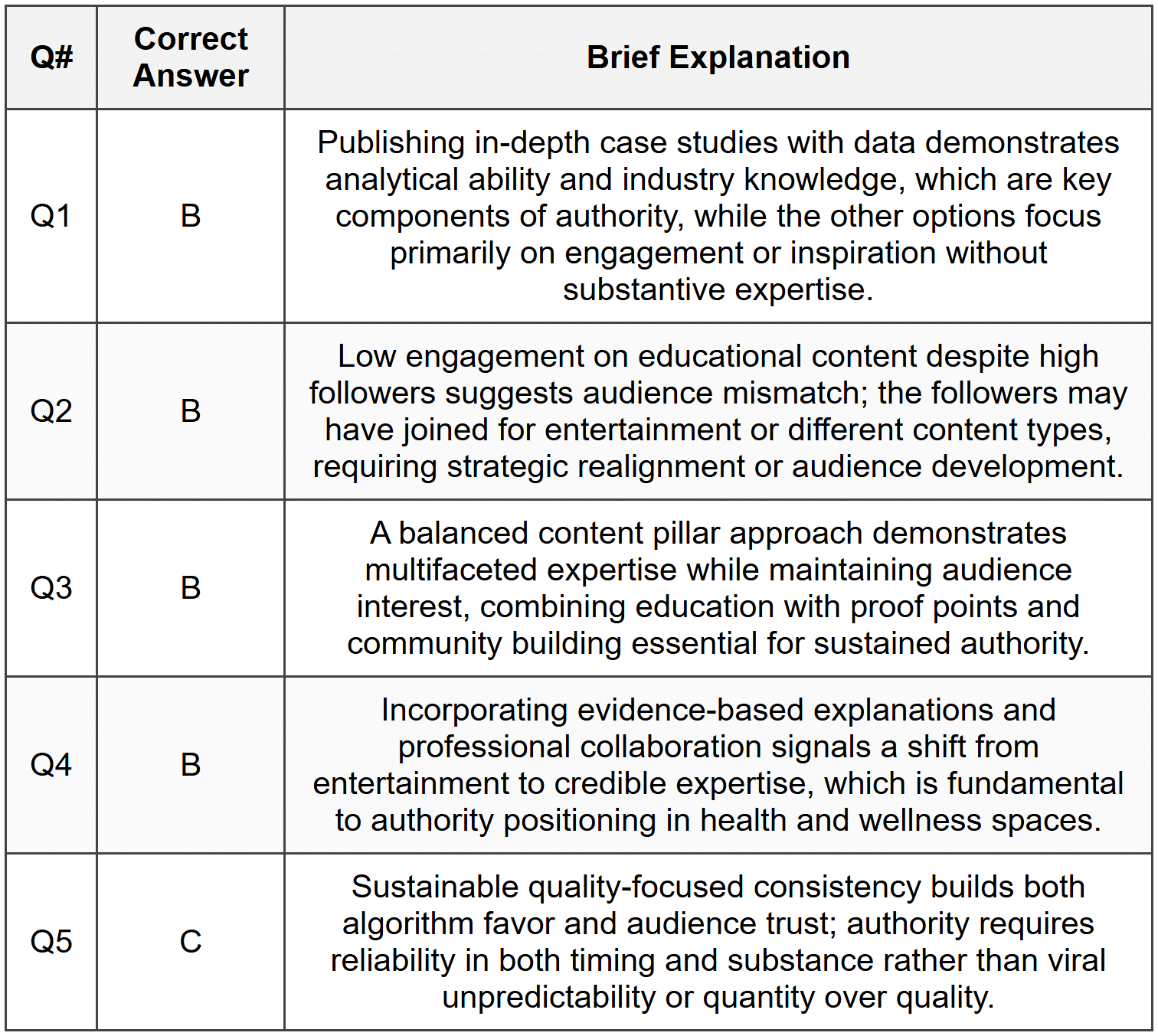
- Q1. A marketing consultant wants to establish authority in sustainable fashion. Which content strategy would most effectively demonstrate expertise rather than just opinion?
- Posting daily motivational quotes about sustainability
- Publishing in-depth case studies analyzing successful sustainable brands with data and insights
- Sharing personal shopping hauls featuring eco-friendly products
- Creating viral challenges encouraging followers to buy sustainable items
- Q2. An influencer has 100,000 followers but low engagement on educational content about digital marketing. What does this scenario most likely indicate about their authority positioning?
- They have successfully built authority and should continue the same approach
- Their audience may have followed for different reasons and they need to realign content with audience expectations or attract a new audience segment
- Educational content never performs well on social media platforms
- Follower count is the only metric that matters for authority building
- Q3. Which content pillar framework best supports long-term authority building in a professional niche?
- 100% promotional content about products and services
- A balanced mix of educational content, thought leadership, case studies, and community engagement
- Exclusively entertaining viral content to maximize reach
- Random content posted whenever inspiration strikes
- Q4. A personal trainer wants to transition from fitness entertainment to recognized health authority. Which strategic content shift would be most effective?
- Increasing posting frequency of workout videos without additional context
- Incorporating evidence-based explanations, citing research, collaborating with healthcare professionals, and addressing common misconceptions
- Focusing solely on before-and-after transformation photos
- Copying content from established fitness authorities
- Q5. When developing a content calendar for authority building, what principle should guide the balance between consistency and quality?
- Post as frequently as possible regardless of content quality to maintain visibility
- Only post when content goes viral to maximize impact
- Establish a sustainable posting schedule that maintains high quality standards while building audience expectation
- Post randomly to create surprise and novelty for the audience
Section 2: Conceptual Understanding
- Q1. Explain the difference between popularity and authority in the context of personal branding. Why might an influencer with fewer followers have greater authority than one with millions of followers?
- Q2. What are the three core elements that must be present in content for it to contribute to authority building rather than just engagement?
- Q3. Describe the concept of "content pillars" and explain how they support strategic authority positioning in influencer marketing.
- Q4. How does consistent positioning across different content formats and platforms strengthen perceived authority? Provide specific examples.
Section 3: Situational / Applied Questions
- Q1. You are a financial advisor trying to build authority on Instagram, where your target audience scrolls quickly and prefers visual content. However, financial advice requires nuance and cannot be oversimplified. How would you structure your content strategy to balance platform requirements with the need to demonstrate expertise and provide accurate information?
- Q2. An influencer in the technology space has been creating content for six months but is not being recognized as an authority by industry professionals, though they have decent follower growth. Analyze what might be missing from their content strategy and recommend three specific tactical changes they should implement.
- Q3. A client wants to establish authority in career coaching but is entering a saturated market with many established voices. Design a differentiation strategy that identifies a unique angle and corresponding content types that would help them stand out while building credibility.
Section 4: Skill Demonstration Task
Develop a comprehensive 4-week content strategy for authority building in a niche of your choice. Your deliverable must include:
- A clear statement of your chosen niche and target audience
- Your unique authority positioning statement (what makes your perspective valuable and different)
- Three content pillars with specific themes for each
- A weekly content calendar showing:
- Content topic/title
- Format (article, video, carousel, podcast, etc.)
- Which content pillar it supports
- Key expertise element being demonstrated
- Platform for distribution
- One detailed content brief for your flagship piece (the most important authority-building content in the month), including:
- Objective
- Key points to cover
- Research or data sources to reference
- Call-to-action that reinforces authority
Section 5: Self-Reflection
- Q1. Assess your current level of understanding about the difference between creating content for engagement versus content for authority. What specific areas do you need to develop further?
- Q2. Identify three personal or professional areas where you have genuine expertise that could form the foundation of authority-based content. What would you need to do to validate and demonstrate this expertise credibly?
- Q3. Reflect on content creators you personally view as authorities in their fields. What specific content strategies and patterns do they employ that build your trust in their expertise? How can you adapt these principles to your own context?
Answer Key
Section 1 - MCQ Answers
Section 2 Answers
Q1: Popularity refers to the number of people who follow or recognize someone, often based on entertainment value, relatability, or viral content. Authority, in contrast, refers to the perceived expertise, credibility, and trustworthiness someone has in a specific domain. An influencer with fewer followers may have greater authority if their content demonstrates deep expertise, is referenced by industry professionals, influences decision-making, and is backed by credentials, research, or proven results. For example, a niche medical professional with 10,000 followers who publishes peer-reviewed insights has more authority in healthcare than an entertainment influencer with millions of followers discussing health trends superficially.
Q2: The three core elements that must be present in authority-building content are: (1) Expertise demonstration - showing deep knowledge through insights, analysis, or unique perspectives that others cannot easily replicate; (2) Evidence or substantiation - supporting claims with data, research, case studies, or credible sources rather than opinion alone; and (3) Consistency in positioning - maintaining a coherent point of view and area of focus over time that allows the audience to identify what the creator is an authority on.
Q3: Content pillars are 3-5 core themes or topic categories that organize all content creation efforts. They serve as the strategic foundation for what an influencer will consistently discuss, ensuring focused expertise rather than scattered topics. For authority building, content pillars help establish clear domain boundaries, make content planning systematic, ensure comprehensive coverage of a subject area, and signal to audiences exactly what expertise they can expect. For example, a leadership coach might have pillars of "team dynamics," "decision-making frameworks," "communication strategies," and "organizational culture," with all content falling under these categories.
Q4: Consistent positioning across platforms strengthens perceived authority by creating a unified expert identity that audiences recognize regardless of where they encounter the content. When messaging, visual identity, tone, and areas of focus align across YouTube, LinkedIn, Instagram, and a blog, it signals professionalism and intentional expertise rather than opportunistic trend-chasing. For example, a cybersecurity expert who discusses the same core principles but adapts format (quick tips on Instagram, long-form analysis on YouTube, professional commentary on LinkedIn) appears more authoritative than someone who discusses fitness on one platform and technology on another with no connection.
Section 3 Answers
Q1: The strategy should involve creating layered content that draws people in visually while providing depth for those who engage further. Specifically: (1) Use eye-catching infographics or charts as the primary post format to stop scrolling, with key financial concepts simplified into 3-5 main points; (2) Write comprehensive captions that provide the necessary nuance and disclaimers, training the audience to read captions for full value; (3) Use Instagram Stories for deeper dives and to answer questions with more context; (4) Direct engaged followers to long-form content on blogs or YouTube for complete analysis; (5) Include consistent disclaimers and ethical boundaries to maintain credibility; (6) Share case study highlights with clear "see full analysis" call-to-actions. This approach respects platform behavior while not compromising expertise quality.
Q2: The influencer likely has surface-level follower growth but lacks depth in authority signals. Missing elements probably include: lack of original insights (possibly just curating others' content), absence of professional network engagement, no demonstration of real-world application or results, inconsistent subject focus, or purely promotional rather than educational tone. Three tactical changes: (1) Create original research or analysis - conduct surveys, analyze trends with data, or provide unique frameworks rather than repeating common knowledge; (2) Engage with industry professionals - comment meaningfully on expert posts, collaborate with established voices, speak at or attend industry events, and share those interactions; (3) Showcase practical application - publish detailed case studies, before-after analyses, or implementation guides that prove the advice works in real scenarios, moving beyond theory.
Q3: Differentiation strategy: (1) Identify a specific underserved niche - for example, "career transitions for mid-level professionals in non-profit sectors" rather than general career coaching; (2) Unique angle - position as someone who has made the transition themselves and now works inside the sector, providing insider knowledge others cannot; (3) Content types to establish credibility - weekly "sector spotlight" interviews with hiring managers in non-profits (access others don't have), salary transparency reports with crowdsourced data from the niche, detailed application teardowns showing real examples, monthly "insider job listings" with context about organizational culture, and quarterly trend reports about the non-profit job market. This strategy demonstrates specific expertise, provides unique value, and builds authority through exclusive access and focused consistency.
Section 4 - Sample Demonstration
Sample 4-Week Content Strategy for Authority Building
Niche: Sustainable product design for consumer goods
Target Audience: Product designers, brand managers, and entrepreneurs in consumer packaged goods interested in sustainability
Authority Positioning Statement: I help product designers and brands implement genuinely sustainable design practices by combining materials science knowledge with market viability analysis, moving beyond greenwashing to create products that are both environmentally responsible and commercially successful.
Content Pillars:
- Materials Science Education - Deep dives into sustainable materials, their properties, limitations, and applications
- Design Process & Frameworks - Practical methodologies for integrating sustainability into product development
- Market Analysis & Case Studies - Real-world examples of sustainable products, analyzing what worked, what didn't, and why
Weekly Content Calendar:
Week 1:
- Monday: LinkedIn Article - "The Hidden Carbon Cost of 'Biodegradable' Packaging: A Materials Analysis" | Pillar: Materials Science | Expertise: Technical breakdown with citations | Platform: LinkedIn
- Wednesday: Instagram Carousel - "5 Questions to Ask Before Claiming 'Eco-Friendly'" | Pillar: Design Process | Expertise: Framework application | Platform: Instagram
- Friday: YouTube Video - "Case Study: How Brand X Reduced Packaging Waste by 60%" | Pillar: Market Analysis | Expertise: Detailed analysis with data | Platform: YouTube
Week 2:
- Monday: Blog Post - "Mushroom Mycelium vs. Traditional Foam: Complete Comparison" | Pillar: Materials Science | Expertise: Technical comparison with test results | Platform: Website/Blog
- Wednesday: LinkedIn Post - "Common Mistakes in Sustainable Design RFPs" | Pillar: Design Process | Expertise: Professional insights | Platform: LinkedIn
- Friday: Podcast Episode - Interview with packaging engineer about real-world constraints | Pillar: Market Analysis | Expertise: Industry access | Platform: Podcast
Week 3:
- Monday: Newsletter - "Monthly Materials Update: New Innovations & Research" | Pillar: Materials Science | Expertise: Curated research synthesis | Platform: Email
- Wednesday: Instagram Reel - "60-second design decision framework walkthrough" | Pillar: Design Process | Expertise: Simplified methodology | Platform: Instagram
- Friday: LinkedIn Article (FLAGSHIP) - "The Sustainable Product Design Index: 2024 Market Analysis" | All Pillars | Expertise: Original research | Platform: LinkedIn + Website
Week 4:
- Monday: Blog Post - "Behind the Scenes: Redesigning a Product for Circularity" | Pillar: Design Process | Expertise: Detailed process documentation | Platform: Website/Blog
- Wednesday: Instagram Carousel - "Myth vs. Reality: Sustainable Materials Edition" | Pillar: Materials Science | Expertise: Fact-checking common beliefs | Platform: Instagram
- Friday: YouTube Video - "Q&A: Your Sustainable Design Questions Answered" | All Pillars | Expertise: Responsive expertise | Platform: YouTube
Flagship Content Brief - Week 3 Friday:
Title: "The Sustainable Product Design Index: 2024 Market Analysis"
Objective: Establish authority through original research that becomes a reference document in the industry, demonstrating analytical capability and market knowledge while providing unique value that cannot be found elsewhere.
Key Points to Cover:
- Methodology: How 50 sustainable consumer products were evaluated across 10 criteria
- Scoring framework combining environmental impact, market performance, and design innovation
- Top 10 products analysis with detailed breakdowns
- Trend identification: What successful sustainable products have in common
- Gaps in the market: Opportunities for improvement
- Predictions for 2024-2025 based on data patterns
- Actionable takeaways for designers and brands
Research and Data Sources:
- Product lifecycle assessments from manufacturers (publicly available data)
- Sales data from market research firms
- Consumer reviews analysis (sentiment analysis on 1000+ reviews)
- Material certifications and third-party testing results
- Expert interviews with 5 product designers for qualitative insights
- Academic research on material sustainability metrics
Call-to-Action: "Download the complete 25-page Sustainable Product Design Index report to access detailed scoring, full methodology, and product-by-product analysis. Join 500+ designers using this framework to evaluate their own products." This reinforces authority by offering deeper value while building an email list of qualified professionals.
Section 5 - Reflection Guidance
Q1 Sample Response: I now understand that engagement-focused content prioritizes immediate reactions (likes, shares, comments) through emotional appeal, entertainment, or relatability, while authority-focused content prioritizes demonstrating expertise and building long-term credibility, even if individual pieces get less immediate engagement. I need to develop further in: (1) balancing both types strategically rather than choosing one or the other; (2) measuring authority-building success through different metrics like industry recognition, speaking invitations, and professional opportunities rather than just engagement rates; and (3) creating content that educates while still being engaging enough to reach people in algorithm-driven platforms. I also need to become more comfortable with some content performing less well numerically if it's building the right reputation.
Q2 Sample Response: Three areas where I have genuine expertise: (1) Project management in small non-profit organizations - I've managed 15+ projects over 5 years with limited budgets; (2) Volunteer coordination and retention - I've built systems that increased volunteer retention by 40%; (3) Grant writing for community programs - I've secured over $200,000 in funding. To validate and demonstrate this credibly, I would: create detailed case studies with specific metrics and outcomes, not just claims; seek testimonials or collaboration with organizations I've worked with; publish my frameworks and templates showing the actual tools I use; pursue relevant certifications or additional training to formalize knowledge; present at non-profit conferences or webinars; write content that solves specific problems I've personally encountered and solved; and be transparent about my experience level and boundaries of expertise.
Q3 Sample Response: Content creators I view as authorities: (1) A marketing strategist who always cites specific campaign data and explains why strategies worked or failed, not just what to do; (2) A financial educator who breaks down complex topics but never oversimplifies to the point of inaccuracy, always including necessary nuance; (3) A software engineer who shows their actual work and thought process, including mistakes and iterations. Common patterns: they admit what they don't know, they provide evidence for claims, they go deeper than surface-level advice, they're consistent in their subject focus, they engage thoughtfully with criticism or questions, and they demonstrate ongoing learning. I can adapt these by: being more transparent about my methodology and reasoning, including more specific examples from my own work, focusing on fewer topics with more depth rather than broad shallow coverage, engaging more substantively in my niche community, and documenting my learning process rather than only sharing polished final insights.