Assignment : Marketing Mix (4Ps)

Section 1: Multiple Choice Questions
- Q1. A premium smartphone manufacturer decides to maintain high prices despite competitor pressure, arguing that lowering prices would damage brand perception. Which pricing strategy element of the marketing mix is being prioritized here?
- Cost-plus pricing to ensure profit margins
- Psychological pricing based on perceived value
- Penetration pricing to gain market share
- Economy pricing to reduce production costs
- Q2. A beverage company distributes its products through supermarkets, convenience stores, vending machines, and online platforms simultaneously. This approach primarily addresses which P of the marketing mix?
- Product, by ensuring quality consistency
- Price, by creating competitive advantages
- Place, by maximizing market coverage
- Promotion, by increasing brand visibility
- Q3. A software company offers a basic free version and a premium paid version with advanced features. How does this strategy integrate multiple elements of the marketing mix?
- It focuses solely on promotional strategies to attract users
- It combines product differentiation with tiered pricing to serve different customer segments
- It emphasizes place by expanding distribution channels
- It relies exclusively on advertising to communicate value
- Q4. An organic food brand invests heavily in educating consumers about health benefits through social media, in-store demonstrations, and influencer partnerships. Which aspect of promotion is most central to this strategy?
- Personal selling exclusively to retail partners
- Sales promotion through discount coupons
- Integrated marketing communication to build awareness and educate
- Public relations focused only on crisis management
- Q5. A furniture manufacturer decides to sell directly to consumers through its own showrooms instead of using retail intermediaries. What is the primary trade-off in this place strategy decision?
- Higher control over customer experience but increased investment in distribution infrastructure
- Lower product quality but faster market penetration
- Reduced pricing flexibility but improved promotional opportunities
- Decreased brand recognition but higher profit margins
Section 2: Case Study 1 - Launching a Sustainable Fashion Brand
Background
EcoThreads is a new fashion brand preparing to launch a line of clothing made from recycled materials and organic cotton. The target market consists of environmentally conscious millennials and Gen Z consumers aged 22-35 who value sustainability and are willing to pay premium prices for ethical products. The company has completed product development and is now finalizing its go-to-market strategy. The competitive landscape includes both fast-fashion brands offering low prices and established sustainable brands with strong market presence. The founder must decide on pricing levels, distribution channels, and promotional approaches that align with the brand's values while ensuring commercial viability.
Your Role
You are the Marketing Manager at EcoThreads, responsible for developing a comprehensive marketing mix strategy for the product launch.
Questions
- Q1. Design a product strategy for EcoThreads that extends beyond the physical clothing items. What additional product elements (packaging, labeling, customer service, warranties, or product lines) would strengthen the brand's sustainable positioning and create competitive advantage?
- Q2. Recommend a pricing strategy for EcoThreads considering the premium costs of sustainable materials, target market characteristics, and competitive environment. Should the brand use premium pricing, competitive pricing, or value-based pricing? Justify your recommendation with specific reasoning.
- Q3. Develop a distribution (place) strategy that balances brand control, market reach, and sustainability values. Should EcoThreads sell through its own e-commerce site exclusively, partner with sustainable retailers, use pop-up stores, or pursue a multi-channel approach? Explain the advantages and potential challenges of your chosen approach.
- Q4. Create an integrated promotion strategy that effectively communicates EcoThreads' value proposition to the target audience. Identify at least three promotional tools or channels you would use and explain how each contributes to building brand awareness and driving purchases.
Section 3: Case Study 2 - Repositioning a Legacy Coffee Chain
Background
BrewMasters is a 25-year-old coffee chain with 150 locations across the country. Once popular for its cozy atmosphere and quality coffee, the brand has experienced declining sales over the past three years as newer specialty coffee shops and convenient mobile ordering options have changed consumer expectations. Customer feedback indicates that BrewMasters is perceived as outdated, with slow service and inconsistent product quality across locations. The company has invested in updating its coffee sourcing and barista training but has not updated its store design, menu offerings, or customer experience approach. The executive team recognizes the need for a comprehensive marketing mix overhaul to regain relevance and compete effectively.
Your Role
You are the Director of Marketing Strategy at BrewMasters, tasked with leading the brand repositioning effort.
Questions
- Q1. Analyze how each element of the current marketing mix may be contributing to BrewMasters' declining performance. Identify specific problems related to product, price, place, and promotion that need addressing.
- Q2. Propose product modifications or additions that would make BrewMasters more competitive without abandoning its core identity. Consider menu innovation, service improvements, technology integration, or new product lines that align with current consumer expectations.
- Q3. The executive team is debating whether to maintain current pricing or adjust it. Some suggest lowering prices to compete with fast-food coffee, while others recommend increasing prices to signal premium quality. What pricing strategy would you recommend and why? Consider the relationship between price and the other marketing mix elements in your answer.
- Q4. Design a promotional campaign to announce the repositioned brand to both existing customers and new target segments. What key messages should be communicated, and through which promotional channels would you reach your audience most effectively?
Section 4: Concept Application
- Q1. Explain how the four Ps of the marketing mix must work together as an integrated system rather than independent elements. Use examples from either case study to illustrate the interdependencies between product, price, place, and promotion decisions.
- Q2. Both EcoThreads and BrewMasters face decisions about whether to pursue premium pricing strategies. Compare and contrast the factors that would make premium pricing successful or unsuccessful for each brand. What conditions must be present in the other marketing mix elements to support a premium price position?
- Q3. Distribution channels (place) have evolved significantly with digital technology and changing consumer behaviors. Discuss how traditional place strategies are being challenged and what new considerations marketers must account for when designing distribution strategies in the current marketplace. Reference both case studies in your response.
Answer Key
Section 1 - MCQ Answers
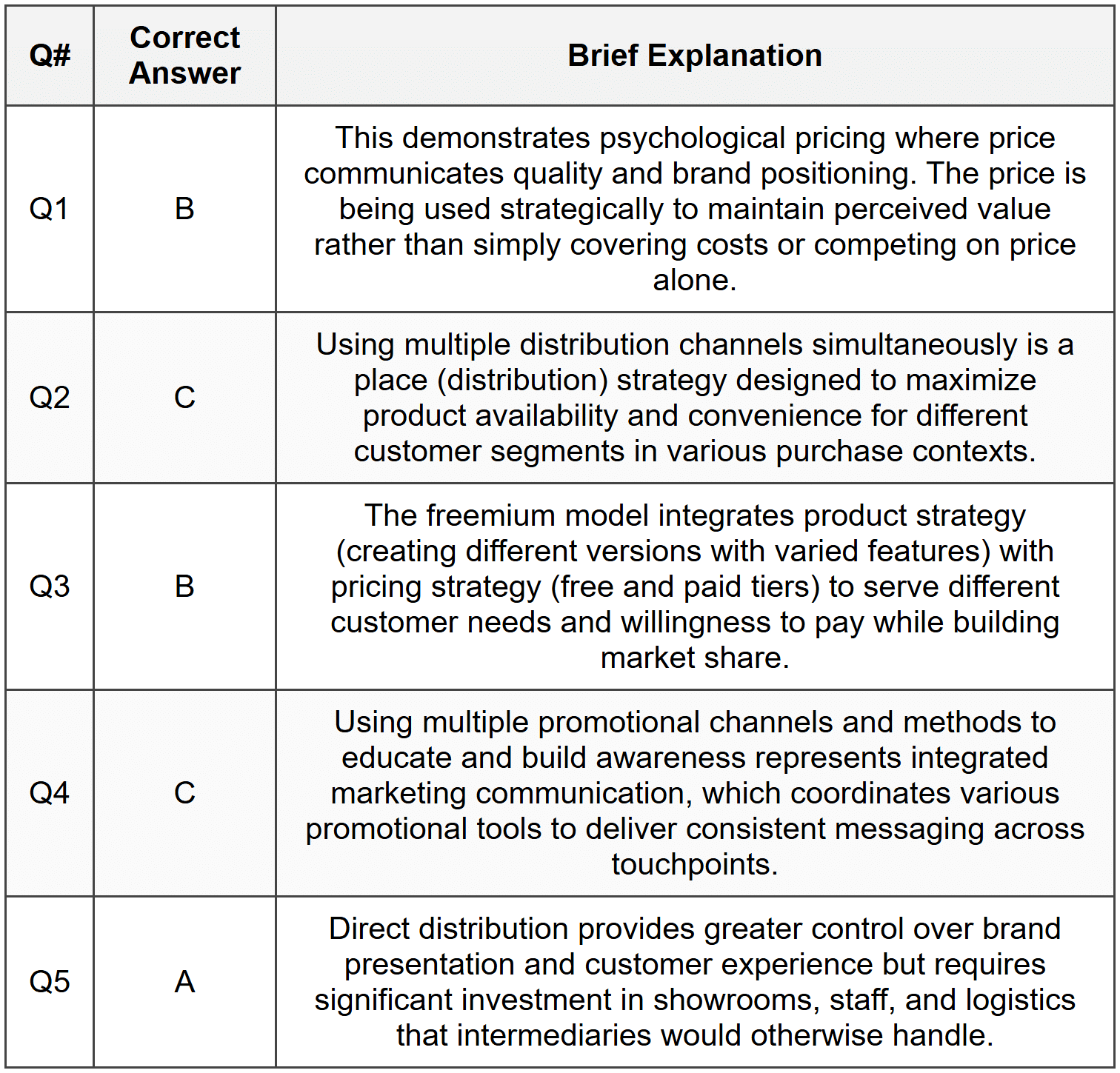
Case Study 1 - Model Answers
Q1. Product Strategy for EcoThreads:
A comprehensive product strategy should include: (1) Minimal, plastic-free packaging made from recycled or biodegradable materials with clear labeling about environmental impact and care instructions to extend garment life; (2) A transparent supply chain story included with each product, perhaps through QR codes linking to information about materials sourcing and manufacturing processes; (3) A clothing repair and recycling program where customers can return worn items for recycling or repair services, extending product lifecycle; (4) Complementary product lines such as sustainable accessories or care products that align with the core values; (5) Educational content about sustainable fashion as part of the product experience. These elements transform the product from merely clothing into a complete sustainable lifestyle offering that differentiates EcoThreads from both fast fashion and competitors.
Q2. Pricing Strategy Recommendation:
EcoThreads should adopt value-based premium pricing. This strategy is appropriate because: (1) The target market of environmentally conscious consumers has demonstrated willingness to pay more for sustainable products that align with their values; (2) Premium pricing signals quality and authenticity in the sustainable fashion market, where low prices might create skepticism about true sustainability; (3) The higher costs of organic and recycled materials, ethical labor, and sustainable production processes require premium pricing to maintain profitability; (4) Premium pricing supports the brand positioning and creates psychological distance from fast fashion competitors. The pricing should be transparent, with communication about why products cost more, turning price into a statement of values rather than a barrier. However, the brand should ensure the price premium is justified through superior product quality, design, and the complete sustainable experience to avoid being perceived as exploitative greenwashing.
Q3. Distribution Strategy Recommendation:
EcoThreads should pursue a selective multi-channel approach: (1) Primary channel: Direct-to-consumer e-commerce website providing complete brand control, detailed sustainability storytelling, and customer data collection while minimizing environmental impact of physical retail; (2) Secondary channel: Partnerships with carefully selected sustainable lifestyle retailers and boutiques that share brand values, providing physical touchpoints in key markets without the investment of owned stores; (3) Tertiary channel: Seasonal pop-up stores in urban centers with high concentrations of target customers, creating brand experiences and community connections without permanent retail commitments. This approach balances market reach with brand control and sustainability values. The advantages include maintaining brand integrity through channel selectivity, minimizing environmental footprint compared to extensive physical retail, and flexibility to test markets. Challenges include potentially limited market reach compared to mass distribution, higher customer acquisition costs through owned channels, and the need to carefully vet retail partners to ensure alignment with brand values.
Q4. Integrated Promotion Strategy:
The promotion strategy should include: (1) Social media marketing focused on Instagram and TikTok with authentic content showing the production process, featuring real customers, and educating about sustainable fashion issues-this builds community and leverages the target audience's preferred platforms; (2) Influencer partnerships with micro-influencers and sustainability advocates who have credible voices in the environmental space rather than traditional fashion influencers-this ensures authenticity and reaches engaged niche audiences; (3) Content marketing including a blog, video series, and email newsletter providing valuable information about sustainable living, garment care, and fashion industry issues-this positions the brand as an educational resource and thought leader; (4) Experiential marketing through clothing swap events, sustainability workshops, and community gatherings that allow target customers to experience brand values firsthand and build emotional connections. Each element works together to build awareness, establish credibility, educate consumers, and create community around shared values, ultimately driving both initial purchases and long-term brand loyalty.
Case Study 2 - Model Answers
Q1. Marketing Mix Problems Analysis:
Product problems include outdated store design that fails to create appealing atmosphere, inconsistent quality across locations undermining brand reliability, lack of menu innovation failing to meet evolving consumer preferences, and absence of technology integration like mobile ordering that customers now expect. Price problems may include misalignment with perceived value-if quality is inconsistent, current prices may seem too high, or if attempting to compete with fast-food coffee on price, margins may be compressed without corresponding value perception. Place problems involve potential location issues as consumer traffic patterns change, inefficient store layouts causing slow service, and lack of digital/delivery channels that competitors offer. Promotion problems include likely insufficient or outdated communication failing to reach younger consumers, lack of engagement with current customers about improvements made, and failure to differentiate from competitors in a crowded market. The core issue is that all elements are misaligned with current market expectations, creating a compounding negative effect on brand perception.
Q2. Product Modification Recommendations:
Product improvements should include: (1) Mobile ordering app with customization options, payment integration, and loyalty rewards to address convenience expectations and speed of service; (2) Menu expansion with health-conscious options like plant-based milk alternatives, protein-enhanced beverages, and lighter food options reflecting current dietary trends; (3) Store redesign creating Instagram-worthy spaces with comfortable seating, good lighting, and work-friendly amenities like power outlets and better WiFi-maintaining coziness while modernizing aesthetics; (4) Consistency program implementing strict quality control protocols, regular barista training updates, and mystery shopper programs to ensure uniform experience; (5) Seasonal limited-edition offerings creating excitement and reasons for repeat visits. These modifications modernize the experience while preserving the core identity of being a comfortable third place with quality coffee, rather than trying to become something entirely different.
Q3. Pricing Strategy Recommendation:
BrewMasters should pursue a moderate premium pricing strategy positioned between fast-food coffee and high-end specialty shops. Lowering prices would be counterproductive because: it would erode already challenged margins, signal lower quality exacerbating perception problems, and position the brand in a segment where it cannot win on convenience against fast-food competitors. Simply raising prices without other improvements would worsen the value perception problem. Instead, the recommended approach involves: (1) Maintaining or slightly increasing base prices while ensuring they reflect genuine quality improvements in coffee sourcing and preparation; (2) Creating clear value through the improved experience, convenience features, and product quality that justify the price premium over fast-food options; (3) Implementing a strong loyalty program that rewards frequent customers with perceived value without broadly discounting; (4) Transparent communication about coffee quality, sourcing, and preparation justifying the price positioning. This strategy requires that product improvements and promotional communication support the price positioning-demonstrating the interdependence of marketing mix elements.
Q4. Repositioning Promotional Campaign:
The campaign should have the theme "Rediscover BrewMasters" with key messages including: (1) "Same heart, new energy"-acknowledging heritage while signaling meaningful change; (2) Quality coffee credentials highlighting improved sourcing and preparation; (3) Modern convenience through mobile ordering and updated stores; (4) Community connection emphasizing the refreshed third-place experience. Promotional channels should include: (1) Email campaign to existing loyalty members with exclusive preview access to new features, making them feel valued and converting them to advocates; (2) Social media campaign on Instagram and Facebook with before/after store transformations, behind-the-scenes barista content, and user-generated content encouraging customers to share their experiences; (3) Local PR and community events in each market as stores are updated, creating grassroots buzz; (4) Strategic partnerships with local businesses or organizations for co-promotion, embedding BrewMasters in community fabric; (5) Limited-time "welcome back" promotion offering special pricing or free upgrades for the first month to drive trial of the improved experience. The campaign should phase in as stores are updated rather than launching all at once, ensuring customers experience the promised improvements when they visit.
Concept Application - Model Answers
Q1. Integration of the Four Ps:
The marketing mix elements must function as an integrated system because decisions about one P directly impact and constrain the others. For EcoThreads, the product decision to use sustainable materials (Product) necessitates premium pricing (Price) to cover higher costs, which in turn requires selective distribution (Place) through channels that support premium positioning, and demands promotional communication (Promotion) that educates consumers about why the premium is justified. If any element is misaligned-such as premium products sold through discount channels or premium-priced products promoted only on price-the strategy fails. Similarly for BrewMasters, improving product quality through better coffee and store redesigns only creates value if pricing appropriately captures that value, distribution makes the improved experience accessible, and promotion effectively communicates the changes to target customers. An integrated approach means each decision reinforces the others: premium product quality supports premium pricing, which funds selective distribution creating exclusive appeal, which is communicated through promotion emphasizing the premium experience. Conversely, inconsistency undermines the entire strategy-BrewMasters' current problem is partly that improved coffee quality (Product) has not been matched with updated stores (Product/Place), communicated to customers (Promotion), or reflected in pricing strategy (Price).
Q2. Premium Pricing Comparison:
Premium pricing can succeed for EcoThreads because: the target market explicitly values sustainability and has demonstrated willingness to pay for it; the product offers genuine differentiation through sustainable materials and ethical production that competitors do not match; the brand can tell an authentic story through promotion justifying the premium; and selective distribution through aligned channels reinforces premium positioning. Premium pricing faces challenges for BrewMasters because: the brand currently lacks clear differentiation from competitors in consumers' minds; inconsistent quality has eroded trust that would support premium pricing; the traditional coffee shop category faces intense competition across price points; and the brand needs to rebuild value perception before pricing can signal quality. For premium pricing to work for BrewMasters, the company must first deliver consistently superior product quality, create distinctive modern atmosphere through updated stores, implement convenience features competitors lack, and effectively communicate these improvements through promotion. The key difference is that EcoThreads builds premium pricing into its strategy from launch with all elements aligned, while BrewMasters must rebuild the supporting elements before pricing can reflect premium positioning. Both cases demonstrate that premium pricing requires premium product quality, distinctive positioning communicated through promotion, and distribution that reinforces rather than undermines the premium image.
Q3. Evolution of Place Strategies:
Traditional place strategies focused on physical distribution through intermediaries-manufacturers selling to wholesalers who sold to retailers who sold to consumers-with decisions about intensive, selective, or exclusive distribution based on product category and positioning. Digital technology and changing behaviors have fundamentally altered these considerations. For EcoThreads, the brand can reach customers globally through e-commerce without traditional retail intermediaries, but must consider how to provide product experience and build trust without physical touchpoints, hence the selective use of partner retailers and pop-ups. The place decision now encompasses website user experience, shipping speed and sustainability, and creating community touchpoints, not just physical locations. For BrewMasters, the traditional strength of owned physical locations is challenged by delivery apps, mobile ordering, and work-from-home trends changing traffic patterns. The brand must integrate digital channels while leveraging physical stores as experiential spaces and community hubs rather than purely transactional locations. New considerations include: omnichannel integration providing seamless experience across physical and digital touchpoints; data collection and personalization through owned digital channels; environmental sustainability of distribution logistics; and the role of physical spaces in creating experiences versus merely distributing products. Both cases show that place is no longer just about where products are available but how customers can access and experience the brand across multiple touchpoints in ways that align with overall positioning.