Assignment : Marketing Strategy

Section 1: Multiple Choice Questions
- Q1. A company producing premium organic skincare products is experiencing declining sales despite increasing market demand for organic products. Market research reveals that competitors are offering similar products at lower prices through direct-to-consumer channels. Which strategic approach would be most appropriate?
- Immediately reduce prices to match competitors and increase market share
- Reposition the brand to emphasize unique value propositions such as sustainability certifications and superior ingredient sourcing
- Exit the organic skincare market and diversify into unrelated product categories
- Maintain current pricing and wait for competitors to raise their prices
- Q2. A software company is using the BCG Matrix to evaluate its product portfolio. Product A has 35% market share in a market growing at 3% annually. Product B has 8% market share in a market growing at 18% annually. How should these products be classified and what strategic action is most appropriate?
- Product A is a Star; Product B is a Question Mark; invest heavily in both products equally
- Product A is a Cash Cow; Product B is a Question Mark; use cash from Product A to selectively invest in Product B
- Product A is a Dog; Product B is a Star; divest Product A immediately and focus exclusively on Product B
- Both are Cash Cows; harvest profits from both and minimize further investment
- Q3. A retail chain is conducting a SWOT analysis and identifies the following: strong brand recognition, aging store infrastructure, growing e-commerce market, and new government regulations on labor costs. Which pairing represents the correct categorization?
- Strength: brand recognition; Weakness: e-commerce growth; Opportunity: aging infrastructure; Threat: labor regulations
- Strength: brand recognition; Weakness: aging infrastructure; Opportunity: e-commerce growth; Threat: labor regulations
- Strength: e-commerce growth; Weakness: brand recognition; Opportunity: labor regulations; Threat: aging infrastructure
- Strength: aging infrastructure; Weakness: brand recognition; Opportunity: labor regulations; Threat: e-commerce growth
- Q4. A beverage company is choosing between a differentiation strategy and a cost leadership strategy for entering a new market. The market research shows high consumer price sensitivity, low brand loyalty, and minimal perceived differences between existing products. Which strategy should the company pursue and why?
- Differentiation strategy, because creating unique features will justify premium pricing in price-sensitive markets
- Cost leadership strategy, because price-sensitive customers with low brand loyalty will favor lower-priced options
- Hybrid strategy combining premium pricing with cost reduction to maximize profitability
- Neither strategy; the company should avoid entering this market altogether
- Q5. A company selling fitness equipment is segmenting its market and has identified four distinct groups: budget-conscious beginners, professional athletes, home fitness enthusiasts, and commercial gym owners. The company has limited resources. Which targeting strategy would be most effective?
- Undifferentiated marketing targeting all segments with one generic marketing mix
- Differentiated marketing creating separate marketing mixes for all four segments simultaneously
- Concentrated marketing focusing resources on one or two segments where the company has competitive advantage
- Mass customization allowing each individual customer to design their own product
Section 2: Case Study 1: Declining Market Share in a Competitive Industry
Background
BlueTech Solutions is a mid-sized company that manufactures smart home devices, including security cameras, smart thermostats, and lighting systems. For the past five years, BlueTech has maintained a 12% market share in the smart home security segment. However, recent quarterly reports show market share declining to 9%, while two major competitors have launched aggressive pricing strategies and introduced AI-powered features. Customer feedback indicates that while BlueTech products are reliable, they lack innovative features and are perceived as overpriced. The company's current marketing strategy focuses primarily on product quality and customer service, with minimal investment in digital marketing channels. The CEO has tasked the marketing department with developing a comprehensive strategy to reverse the market share decline within the next 18 months.
Your Role
You are the newly appointed Marketing Strategy Manager at BlueTech Solutions, reporting directly to the Chief Marketing Officer.
Questions
- Q1. Conduct a situational analysis by identifying the key internal strengths and weaknesses of BlueTech Solutions, as well as the external opportunities and threats it faces. Based on this analysis, what strategic direction would you recommend?
- Q2. Which competitive strategy (cost leadership, differentiation, or focus) would be most appropriate for BlueTech Solutions given the current market conditions? Justify your recommendation with specific reasoning related to the company's resources and market position.
- Q3. Describe how you would reposition BlueTech's products in the market. What specific positioning statement would you develop, and what key messages would support this positioning?
- Q4. Develop a market segmentation approach for BlueTech's smart home security products. Identify at least three distinct customer segments and recommend which segment(s) the company should prioritize and why.
Section 3: Case Study 2: New Product Launch Strategy
Background
GreenLeaf Beverages is an established company known for its line of organic fruit juices sold primarily in health food stores and upscale supermarkets. The company is planning to launch a new product line: plant-based protein smoothies targeting health-conscious millennials and Generation Z consumers. Market research indicates strong growth potential in the plant-based protein category, with the market expected to grow at 14% annually over the next five years. However, the category is becoming increasingly crowded, with both established beverage companies and new startups competing aggressively. GreenLeaf has a strong reputation for quality and sustainability but limited experience in the protein beverage category. The company must decide on pricing strategy, distribution channels, promotional approach, and whether to leverage its existing brand or create a new sub-brand for this product line.
Your Role
You are the Product Marketing Manager responsible for developing the go-to-market strategy for the new plant-based protein smoothie line.
Questions
- Q1. Using Porter's Five Forces framework, analyze the competitive intensity of the plant-based protein smoothie market. Which forces represent the greatest challenges for GreenLeaf's entry into this category?
- Q2. Should GreenLeaf use a penetration pricing strategy or a premium pricing strategy for the new product line? Provide a detailed rationale considering the company's brand positioning, target market characteristics, and competitive landscape.
- Q3. Develop a customer profile for the primary target segment for this product. Include demographic, psychographic, and behavioral characteristics that would inform marketing decisions.
- Q4. Would you recommend launching this product under the existing GreenLeaf brand name or creating a distinct new brand? What are the strategic advantages and risks of your recommendation?
Section 4: Concept Application
- Q1. Explain how the marketing strategy process differs from tactical marketing activities. Using examples from either case study, illustrate why strategic planning must precede tactical execution.
- Q2. Both case studies involve competitive markets with multiple players. Compare and contrast the strategic challenges faced by BlueTech Solutions and GreenLeaf Beverages. What common strategic principles apply to both situations?
- Q3. The concept of sustainable competitive advantage is central to marketing strategy. Identify one potential source of sustainable competitive advantage for each company in the case studies and explain why it would be difficult for competitors to imitate.
Answer Key
Section 1 - MCQ Answers
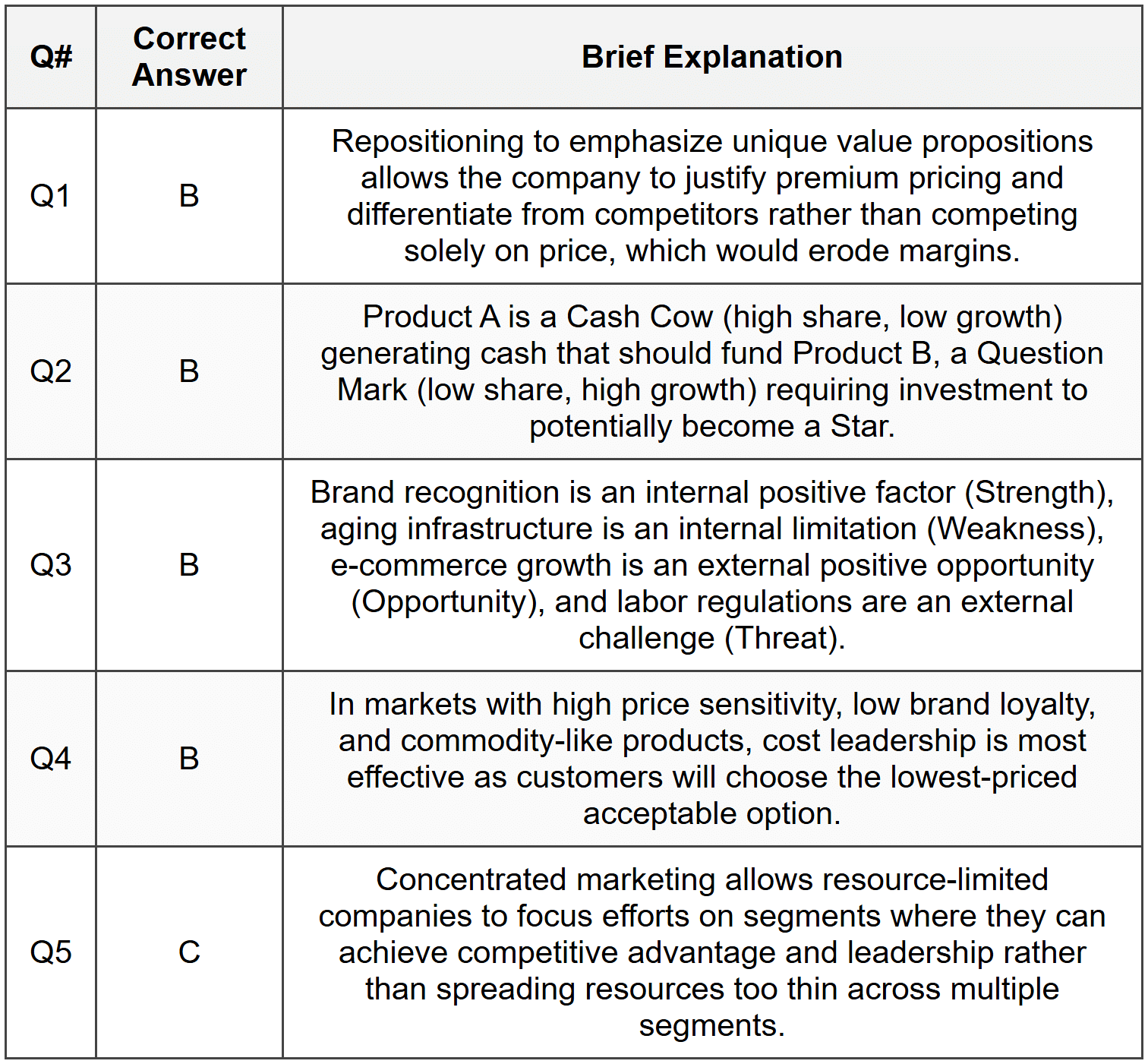
Case Study 1 - Model Answers
Q1. Situational Analysis and Strategic Direction:
Internal Strengths: Established reputation for product reliability and quality; strong customer service capabilities; five years of market presence providing brand recognition and customer base.
Internal Weaknesses: Lack of innovative features compared to competitors; pricing perceived as too high relative to value offered; minimal investment in digital marketing channels; declining market share indicating loss of competitive position.
External Opportunities: Growing smart home market overall; potential to leverage AI and advanced technology features; expanding digital marketing channels to reach target customers; possibility of strategic partnerships or acquisitions to gain technology capabilities.
External Threats: Aggressive pricing strategies from major competitors; rapid technological innovation in the industry; changing customer expectations for advanced features; potential new entrants in the growing market.
Strategic Direction: BlueTech should pursue a differentiation strategy focused on innovation and value enhancement. The company should invest in R&D to develop competitive AI-powered features while leveraging its existing strengths in reliability and customer service. This should be combined with a digital transformation of marketing efforts to better reach and engage target customers, and a value-based pricing strategy that justifies prices through superior features and service rather than competing solely on cost.
Q2. Competitive Strategy Recommendation:
BlueTech Solutions should pursue a differentiation strategy rather than cost leadership or focus. Cost leadership is not appropriate because the company lacks the scale and operational efficiency to compete with larger competitors on price, and attempting to do so would erode already declining margins. A differentiation strategy aligns with BlueTech's existing strengths in quality and customer service, which can be enhanced with innovative features to create a unique value proposition. The company should differentiate through a combination of advanced AI features, superior reliability, exceptional customer service, and perhaps ecosystem integration that competitors cannot easily replicate. This strategy requires investment in R&D and feature development, but allows BlueTech to command fair pricing while avoiding destructive price competition. The focus should be on creating perceived value that justifies a moderate price premium in specific customer segments that value these attributes.
Q3. Repositioning Strategy and Positioning Statement:
BlueTech should reposition from a generic "reliable smart home devices" position to "intelligent security solutions that combine cutting-edge AI technology with unmatched reliability and support." This positioning emphasizes innovation while retaining the reliability strength.
Positioning Statement: "For security-conscious homeowners who want both advanced protection and peace of mind, BlueTech Solutions delivers AI-powered smart security systems that combine innovative threat detection with proven reliability and responsive customer support-unlike competitors who offer either advanced features with questionable reliability or basic functionality at low prices."
Key Supporting Messages: Advanced AI threat detection and prevention; 99.9% uptime reliability backed by data; 24/7 customer support with live specialists; easy integration with existing smart home ecosystems; transparent privacy and data security practices; professional installation and ongoing optimization services.
Q4. Market Segmentation and Targeting:
Segment 1 - Tech-Forward Homeowners: Demographics: Ages 30-45, household income above 100,000, suburban homeowners, college-educated. Psychographics: Early adopters of technology, value innovation and advanced features, willing to pay premium for cutting-edge capabilities. This segment should be the primary priority as they will appreciate AI features and can afford appropriate pricing.
Segment 2 - Security-Conscious Families: Demographics: Ages 35-55, families with children, household income 75,000-150,000, suburban and urban homeowners. Psychographics: Prioritize safety and reliability over latest features, value peace of mind, prefer established brands with proven track records. This segment aligns well with BlueTech's reliability strengths and should be a secondary priority.
Segment 3 - Convenience-Oriented Professionals: Demographics: Ages 28-40, busy professionals, household income above 90,000, urban dwellers. Psychographics: Value convenience and automation, want integrated smart home systems, prefer solutions requiring minimal maintenance, willing to pay for quality and service.
Recommendation: Prioritize Segments 1 and 2, with primary focus on Tech-Forward Homeowners who will value the new AI features and help establish market credibility, while maintaining appeal to Security-Conscious Families through reliability messaging. These segments have sufficient size, purchasing power, and alignment with BlueTech's capabilities to support sustainable growth.
Case Study 2 - Model Answers
Q1. Porter's Five Forces Analysis:
Threat of New Entrants (High): The plant-based protein market has relatively low barriers to entry with numerous startups entering successfully. Capital requirements are moderate, and contract manufacturing is readily available.
Bargaining Power of Suppliers (Moderate): Plant-based protein ingredients are available from multiple suppliers, but organic certification requirements and quality standards may limit options somewhat.
Bargaining Power of Buyers (Moderate to High): Retailers have significant power in shelf space allocation, and end consumers have many alternatives, increasing their bargaining power through choice.
Threat of Substitutes (High): Numerous substitute products exist including dairy-based protein drinks, protein bars, powder supplements, and whole food protein sources, giving consumers many alternatives.
Competitive Rivalry (Very High): This represents the greatest challenge, with intense competition from established beverage companies, specialized protein brands, and innovative startups, all competing for limited shelf space and consumer attention in a crowded category.
Conclusion: Competitive rivalry and threat of substitutes represent the greatest challenges. GreenLeaf must differentiate clearly and establish a defensible market position quickly.
Q2. Pricing Strategy Recommendation:
GreenLeaf should adopt a premium pricing strategy for several compelling reasons. First, the company's established reputation for quality and sustainability supports premium positioning and creates credibility for higher pricing. Second, the target market of health-conscious millennials and Gen Z consumers has demonstrated willingness to pay premium prices for products that align with their values, particularly organic and sustainable options. Third, entering with penetration pricing would contradict GreenLeaf's brand equity and position the product as commodity-like in an already crowded market, making future price increases difficult. Fourth, premium pricing provides margin to invest in quality ingredients, sustainable packaging, and marketing necessary to establish the brand. Fifth, the protein beverage category has successful premium players, demonstrating market acceptance of higher prices for differentiated products. The pricing should be positioned approximately 15-25% above mainstream competitors but justified through superior organic ingredients, sustainability practices, taste, and nutritional profile. This strategy aligns with brand heritage while providing resources for long-term market development.
Q3. Primary Target Customer Profile:
Demographics: Ages 24-35, urban and suburban residents, college-educated with at least bachelor's degree, household income 55,000-95,000, employed in professional or creative fields, single or young families without children, ethnically diverse with higher representation in urban markets.
Psychographics: Health and wellness-oriented lifestyle, environmentally conscious with concern for sustainability, values authenticity and transparency from brands, socially aware and interested in ethical consumption, active on social media particularly Instagram and TikTok, seeks convenience but not at expense of health, willing to invest in self-improvement and wellness, influenced by peer recommendations and online reviews, prefers brands that align with personal values.
Behavioral Characteristics: Regular purchasers of organic and natural foods, shops at Whole Foods, Trader Joe's, and similar retailers, subscribes to fitness or wellness apps, follows health and wellness influencers, regularly exercises 3-5 times weekly, consumes content about nutrition and healthy living, frequently tries new products in health categories, shares product experiences on social media, values on-the-go nutrition solutions for busy lifestyle, reads product labels carefully.
Q4. Branding Recommendation:
Recommendation: Create a distinct sub-brand under the GreenLeaf parent brand, such as "GreenLeaf Protein+" or "GreenLeaf Performance."
Strategic Advantages: A sub-brand approach allows GreenLeaf to leverage its established equity in quality and sustainability while creating a distinct identity suited to the protein beverage category and younger target audience. This provides flexibility to develop unique personality, packaging, and marketing that resonates with millennials and Gen Z without being constrained by the traditional health food store associations of the parent brand. It enables different pricing architecture and distribution strategies while maintaining the credibility transfer from GreenLeaf. The approach also protects the parent brand if the new product encounters problems, while allowing synergies in production, sourcing, and corporate sustainability messaging. Sub-branding facilitates potential line extensions in the performance nutrition category beyond just protein smoothies.
Risks: Sub-branding requires additional marketing investment to establish the new brand identity and may cause some initial confusion about the relationship to GreenLeaf. There is potential for cannibalization if not positioned distinctly enough. The company must maintain consistency in quality and values across both brands to protect overall reputation. However, these risks are manageable and outweighed by the strategic advantages of having a focused brand for this distinct category and target audience.
Concept Application - Model Answers
Q1. Marketing Strategy Process vs. Tactical Marketing Activities:
Marketing strategy involves high-level decisions about target markets, positioning, competitive approach, and value proposition that guide all subsequent marketing activities. It answers fundamental questions about which customers to serve, what value to deliver, and how to compete effectively. Tactical marketing activities are the specific, operational implementations of the strategy, including advertising campaigns, promotional offers, social media posts, pricing adjustments, and distribution decisions.
In the BlueTech case, tactical activities like increasing digital marketing spending would be ineffective without first addressing strategic questions: Which customer segments should we target? What value proposition differentiates us from competitors? Should we compete on innovation or cost? The strategic decision to pursue differentiation through AI features and reliability must precede tactical decisions about messaging, media channels, and promotional campaigns. Similarly, for GreenLeaf, tactical decisions about package design, influencer partnerships, or retail promotions depend entirely on strategic foundations like premium positioning, target segment selection, and sub-brand architecture. Executing tactics without clear strategy leads to wasted resources, conflicting messages, and failure to build sustainable competitive advantage. Strategy provides the framework and direction that makes tactical activities coherent and effective toward achieving long-term business objectives.
Q2. Comparison of Strategic Challenges:
Common Challenges: Both companies face intense competitive pressure in crowded markets with multiple established players and new entrants. Both must differentiate their offerings in categories where product parity is common. Both are targeting increasingly sophisticated, value-conscious consumers who have numerous alternatives. Both must balance investment in innovation with profitability pressures. Both face the challenge of effectively communicating value to justify their pricing in competitive markets.
Contrasting Challenges: BlueTech faces a turnaround situation with declining market share and must revitalize an existing position, while GreenLeaf faces a growth challenge entering a new category from a position of strength. BlueTech's challenge is primarily about innovation and catching up to competitors' features, whereas GreenLeaf's challenge is about entering an unfamiliar category and establishing credibility. BlueTech operates in a mature technology market with rapid innovation cycles, while GreenLeaf enters a growth market in food and beverage with different dynamics.
Common Strategic Principles: Both situations require clear market segmentation and targeting rather than attempting to serve all customers. Both benefit from differentiation strategies that leverage existing strengths rather than competing solely on price. Both require customer-centric value propositions that address real needs and preferences. Both demand alignment between strategic positioning and tactical execution across all marketing mix elements. Both must build sustainable competitive advantages that competitors cannot easily replicate.
Q3. Sustainable Competitive Advantage Sources:
BlueTech Solutions: The combination of proven reliability with advanced AI capabilities and superior customer service represents a potential sustainable competitive advantage. While competitors can develop AI features, the integration of these capabilities with a demonstrated track record of reliability and established customer service infrastructure is difficult to replicate quickly. This advantage is sustainable because it requires significant time to build customer trust in reliability, substantial investment in customer service systems and training, and ongoing R&D to maintain technological parity. The switching costs for satisfied customers who value both innovation and dependable support create barriers to competitive imitation. Competitors offering low prices typically cannot afford the customer service investment, while those offering advanced features often lack the established reliability reputation and service infrastructure.
GreenLeaf Beverages: GreenLeaf's established reputation for organic quality and authentic sustainability practices, combined with existing supply chain relationships with organic ingredient suppliers, represents a sustainable competitive advantage. This advantage is difficult to imitate because building authentic brand equity in sustainability requires years of consistent practices and cannot be quickly manufactured through marketing claims alone. GreenLeaf's existing organic certifications, supplier relationships, and sustainability track record provide credibility that new entrants and conventional beverage companies cannot easily replicate. Consumers increasingly scrutinize sustainability claims, making authentic heritage valuable. Additionally, GreenLeaf's established relationships with premium natural food retailers provide distribution access that supports the premium positioning and is not immediately available to new competitors.