UPSC Exam > UPSC Notes > Indian Polity CSE > Infographics: Central Council of Ministers
Infographics: Central Council of Ministers

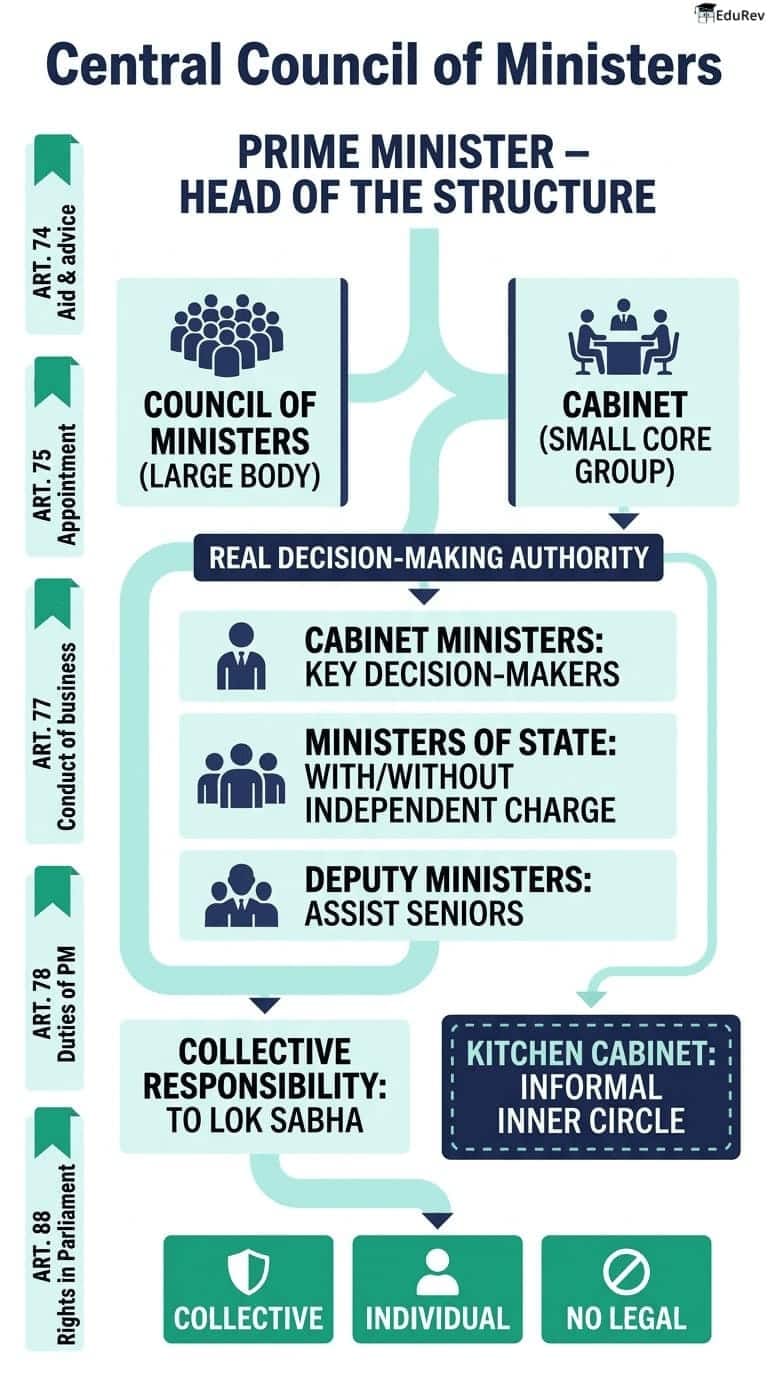
The document Infographics: Central Council of Ministers is a part of the UPSC Course Indian Polity for UPSC CSE.
All you need of UPSC at this link: UPSC
FAQs on Infographics: Central Council of Ministers
| 1. What is the role of the Central Council of Ministers in India? |  |
Ans. The Central Council of Ministers in India is responsible for formulating and executing government policies and decisions. It is headed by the Prime Minister and consists of various ministers who oversee specific departments. The Council plays a crucial role in the legislative process, advising the President and implementing laws passed by Parliament.
| 2. Who appoints the members of the Central Council of Ministers? | |
Ans. Members of the Central Council of Ministers are appointed by the President of India on the advice of the Prime Minister. The Prime Minister selects ministers from among the elected representatives, primarily from the ruling party or coalition in the Lok Sabha, ensuring that the government reflects the majority's will.
| 3. How is the Prime Minister related to the Central Council of Ministers? | |
Ans. The Prime Minister is the chief executive of the Central Council of Ministers and acts as the head of the government. They play a pivotal role in coordinating the functions of various ministries, setting the government's agenda, and representing the Council in discussions with the President and Parliament.
| 4. What are the different categories of ministers within the Central Council of Ministers? | |
Ans. The Central Council of Ministers comprises three categories of ministers: Cabinet Ministers, Ministers of State, and Deputy Ministers. Cabinet Ministers hold the most significant portfolios and are part of the Cabinet, while Ministers of State may assist them or hold independent charges. Deputy Ministers typically assist Cabinet Ministers in their duties.
| 5. Explain the significance of collective responsibility in the context of the Central Council of Ministers. | |
Ans. Collective responsibility is a fundamental principle governing the Central Council of Ministers, whereby all ministers are collectively responsible to the Lok Sabha for the government's policies and decisions. This means that if the Lok Sabha passes a no-confidence motion against the Council, all members must resign, ensuring accountability and unity within the government.
About this Document

4.77/5 Rating

Apr 30, 2026 Last updated
Related Exams
Document Description: Infographics: Central Council of Ministers for UPSC 2026 is part of Indian Polity for UPSC CSE preparation. The notes and questions for Infographics: Central Council of Ministers have been prepared according to the UPSC exam syllabus. Information about Infographics: Central Council of Ministers covers topics like and Infographics: Central Council of Ministers Example, for UPSC 2026 Exam. Find important definitions, questions, notes, meanings, examples, exercises and tests below for Infographics: Central Council of Ministers.
Introduction of Infographics: Central Council of Ministers in English is available as part of our Indian Polity for UPSC CSE for UPSC & Infographics: Central Council of Ministers in Hindi for Indian Polity for UPSC CSE course. Download more important topics related with notes, lectures and mock test series for UPSC Exam by signing up for free. UPSC: Infographics: Central Council of Ministers
Description
Infographics: Central Council of Ministers of Indian Polity provides you one-page visual summary of the chapter covering all the important topics. Download the PDF from EduRev.
Information about Infographics: Central Council of Ministers
In this doc you can find the meaning of Infographics: Central Council of Ministers defined & explained in the simplest way possible. Besides explaining types of Infographics: Central Council of Ministers theory, EduRev gives you an ample number of questions to practice Infographics: Central Council of Ministers tests, examples and also practice UPSC tests



Related Searches
Semester Notes, Important questions, video lectures, past year papers, Free, Infographics: Central Council of Ministers, shortcuts and tricks, Previous Year Questions with Solutions, pdf , Objective type Questions, Infographics: Central Council of Ministers, Viva Questions, Sample Paper, study material, Extra Questions, MCQs, Exam, practice quizzes, Summary, Infographics: Central Council of Ministers, ppt, mock tests for examination;