UPSC Exam > UPSC Notes > Indian Polity CSE > Infographics: Election Commission
Infographics: Election Commission

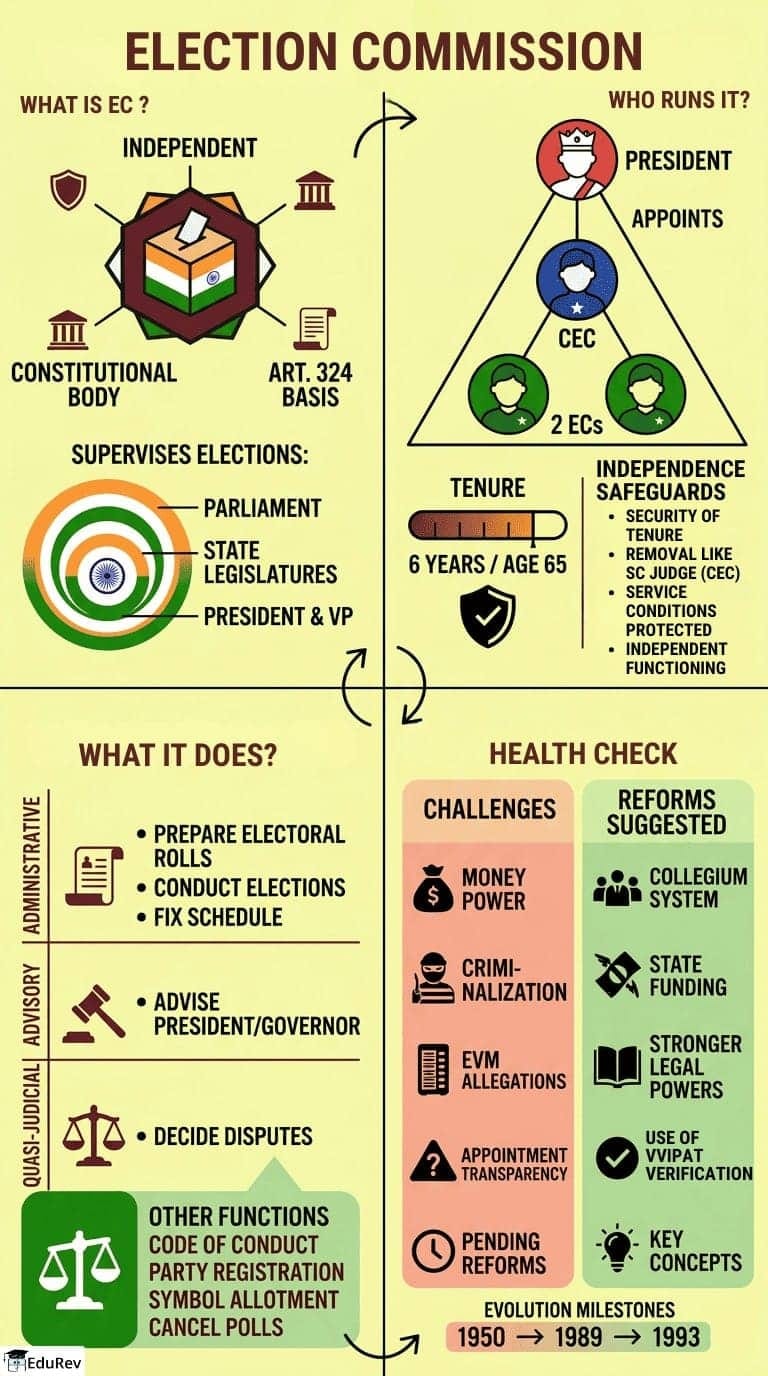
The document Infographics: Election Commission is a part of the UPSC Course Indian Polity for UPSC CSE.
All you need of UPSC at this link: UPSC
FAQs on Infographics: Election Commission
| 1. What is the role of the Election Commission in India? |  |
Ans. The Election Commission of India is an autonomous constitutional authority responsible for administering election processes in India at both the national and state levels. Its primary role includes conducting free and fair elections, overseeing the electoral system, and ensuring adherence to the election laws and regulations. The commission also manages the preparation of electoral rolls and the conduct of various elections, including Lok Sabha, Rajya Sabha, and state legislative assembly elections.
| 2. How is the Election Commission constituted? | |
Ans. The Election Commission is constituted by the President of India and consists of a Chief Election Commissioner and two Election Commissioners. They are appointed on the advice of the Prime Minister. The tenure of the Chief Election Commissioner and Election Commissioners is not fixed, but they serve until the age of 65 years, unless they resign or are removed under specific provisions of the Constitution.
| 3. What are the powers of the Election Commission? | |
Ans. The Election Commission has extensive powers to ensure the conduct of free and fair elections. It can issue directives to the government and political parties regarding the election process, supervise the electoral rolls, and oversee the conduct of elections. The commission also has the authority to impose penalties for violations of election laws, including disqualification of candidates and political parties.
| 4. What are the key functions of the Election Commission during elections? | |
Ans. The key functions of the Election Commission during elections include the preparation and revision of electoral rolls, conducting elections to the Lok Sabha and state assemblies, overseeing the election campaign process, ensuring compliance with the Model Code of Conduct, and addressing grievances and complaints related to the electoral process. The commission also monitors the availability of adequate security and resources for conducting elections.
| 5. What is the Model Code of Conduct, and how does the Election Commission enforce it? | |
Ans. The Model Code of Conduct is a set of guidelines issued by the Election Commission to regulate the behaviour of political parties and candidates during elections. It aims to ensure a level playing field and maintain the integrity of the electoral process. The Election Commission enforces the Model Code by monitoring political activities, addressing complaints, and taking action against violations, such as issuing warnings or imposing penalties on candidates and parties that breach the code.
About this Document

4.68/5 Rating

Apr 30, 2026 Last updated
Related Exams
Document Description: Infographics: Election Commission for UPSC 2026 is part of Indian Polity for UPSC CSE preparation. The notes and questions for Infographics: Election Commission have been prepared according to the UPSC exam syllabus. Information about Infographics: Election Commission covers topics like and Infographics: Election Commission Example, for UPSC 2026 Exam. Find important definitions, questions, notes, meanings, examples, exercises and tests below for Infographics: Election Commission.
Introduction of Infographics: Election Commission in English is available as part of our Indian Polity for UPSC CSE for UPSC & Infographics: Election Commission in Hindi for Indian Polity for UPSC CSE course. Download more important topics related with notes, lectures and mock test series for UPSC Exam by signing up for free. UPSC: Infographics: Election Commission
Description
Infographics: Election Commission of Indian Polity provides you one-page visual summary of the chapter covering all the important topics. Download the PDF from EduRev.
Information about Infographics: Election Commission
In this doc you can find the meaning of Infographics: Election Commission defined & explained in the simplest way possible. Besides explaining types of Infographics: Election Commission theory, EduRev gives you an ample number of questions to practice Infographics: Election Commission tests, examples and also practice UPSC tests



Related Searches
Objective type Questions, study material, Sample Paper, Previous Year Questions with Solutions, past year papers, practice quizzes, Summary, video lectures, Extra Questions, Semester Notes, Important questions, Infographics: Election Commission, shortcuts and tricks, Free, mock tests for examination, Exam, MCQs, ppt, pdf , Viva Questions, Infographics: Election Commission, Infographics: Election Commission;