What are Relational Databases?

Relational Model in DBMS
The relational model in a Database Management System (DBMS) is a framework for managing and organizing data using tables, also known as relations. After designing the conceptual model of the Database using ER diagrams, we need to convert the conceptual model into a relational model that can be implemented using any RDBMS language like Oracle SQL, MySQL, etc.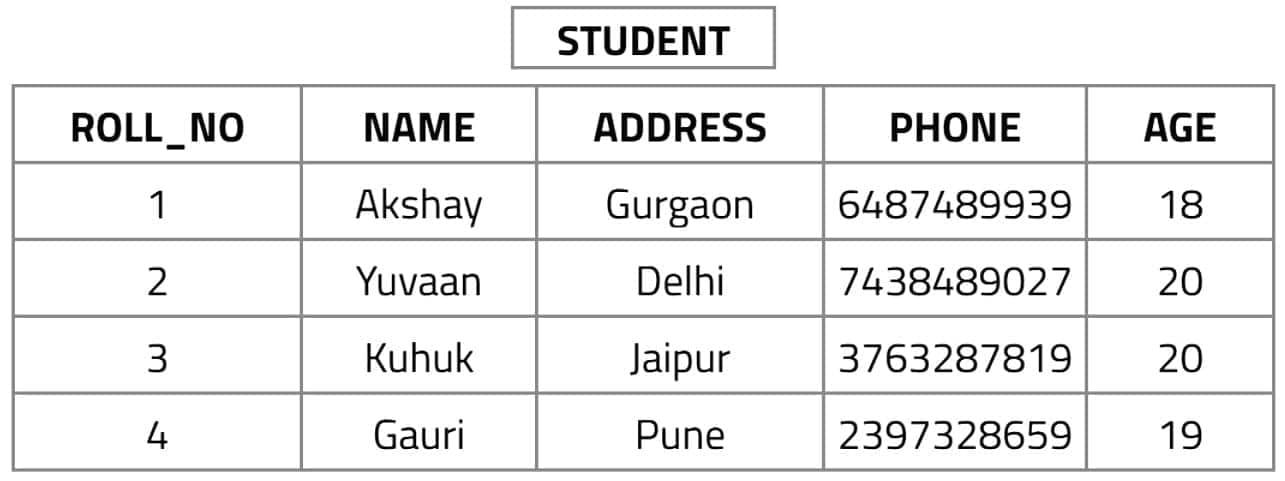
It was introduced by Edgar F. Codd in 1970 and has become the foundation for most modern database systems. The relational model emphasizes the use of a structured, tabular format to store data and the relationships between those data points.
Key Terminologies
- Tables (Relations): Data is stored in tables, which consist of rows and columns. Each table represents a specific entity or concept.
- Rows (Tuples): Each row in a table represents a single record or instance of the entity described by the table.
- Columns (Attributes): Each column in a table represents a specific attribute or property of the entity. All values in a column are of the same data type.
- Degree: The number of attributes in the relation is known as the degree of the relation.
- Cardinality: The number of tuples in a relation is known as cardinality.
Let's take an example of a student table for a class. We would call it the STUDENT relation. The relation STUDENT would have attributes ROLL_NO, NAME, ADDRESS, PHONE, and AGE, which would be represented as columns, and each student would be a record or tuple represented by each row of the table.
Integrity
Data integrity is an important aspect of relational models. Integrity should be maintained and checked for before performing any operation (insertion, deletion, and updation) in the database. If there is a violation of any of the constraints, the operation will fail.
Maintaining integrity constraints involves:
- Domain Integrity: Ensuring that all values in a column are of a specific data type.
- Entity Integrity: Each row must be unique, where keys come into the picture (candidate, super, primary, etc.).
- Referential Integrity: Ensuring that foreign keys correctly reference primary keys in other tables.
The values must be atomic, i.e., they can't be divided further. For example, instead of having a NAME attribute, have separate attribute columns for FIRST_NAME, MIDDLE_NAME, and LAST_NAME.
FAQs on What are Relational Databases?
| 1. What are relational databases? |  |
| 2. What is the significance of keys in relational databases? | |
| 3. What is data integrity in the context of relational databases? | |
| 4. Can you explain the concept of normalisation in relational databases? | |
| 5. What are some common types of integrity constraints in relational databases? | |

 | Explore Courses for Computer Science Engineering (CSE) exam |  |
 | Get EduRev Notes directly in your Google search | |