Definition And Nature Of Literature


Literature is one of the most engaging yet often misunderstood components of the JAMB English syllabus. Understanding what literature is, how it works, and why it matters will not only boost your confidence in exam questions but also sharpen your ability to analyze literary texts critically. This chapter will equip you with clear definitions, distinctions, and examples that directly reflect how JAMB tests your grasp of literature's fundamental nature.
Key Concepts and Definitions
What is Literature?
Literature is the body of written or spoken works that express ideas, emotions, and experiences through creative and imaginative use of language. It is distinguished from ordinary writing by its artistic quality, depth of thought, and enduring value.
In JAMB, literature refers specifically to imaginative or creative writing that includes poetry, prose (novels, short stories), and drama (plays). These forms are valued not just for what they say, but for how they say it-through artistic devices, structure, and style.
Characteristics of Literature
- Imaginative and Creative: Literature goes beyond factual reporting. It invents characters, situations, and worlds that may or may not exist in reality.
- Artistic Use of Language: Writers employ figurative language, symbolism, rhythm, and other literary devices to enhance meaning and beauty.
- Emotional and Intellectual Impact: Literature evokes feelings and stimulates thinking. It makes readers laugh, cry, reflect, or question societal norms.
- Universal and Timeless Themes: Great literature addresses human experiences-love, death, conflict, identity-that remain relevant across cultures and generations.
- Purposeful Structure: Every element in a literary work-plot, setting, character, theme-is deliberately chosen to create a unified effect.
Distinction Between Literature and Non-Literature
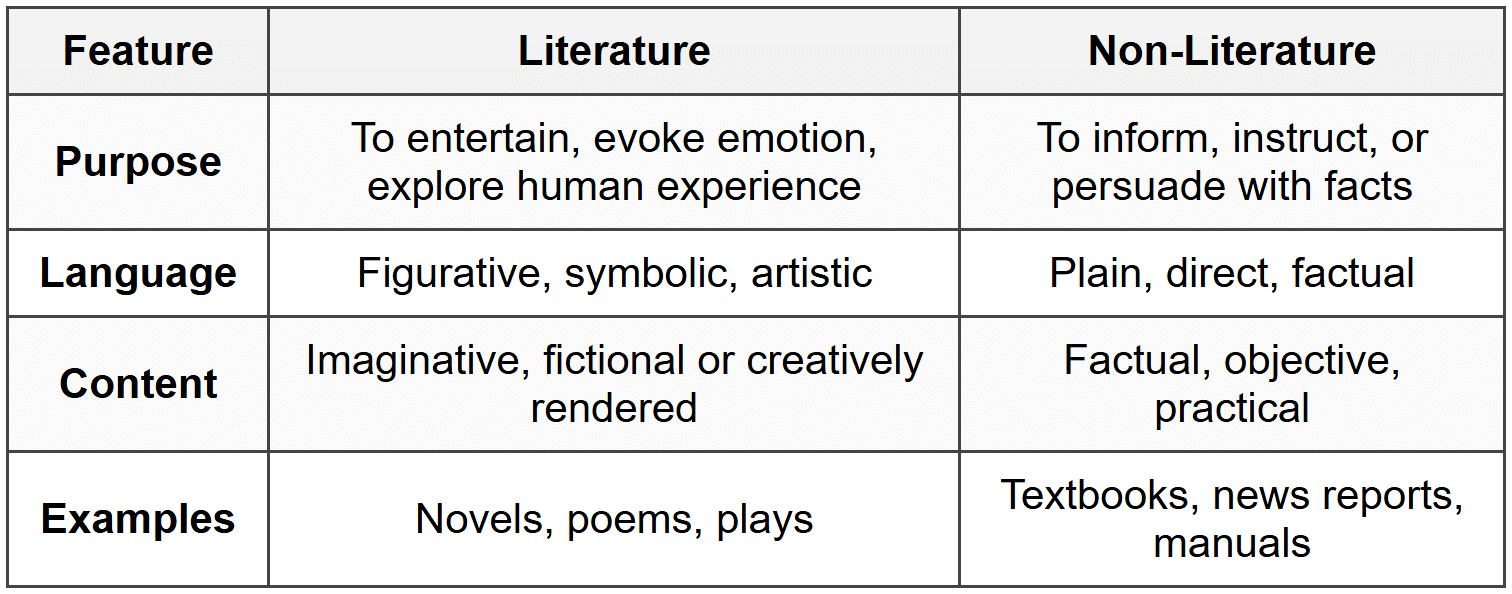
JAMB often tests your ability to distinguish literary texts from non-literary ones. The table below clarifies this difference:
Major Genres of Literature
JAMB divides literature into three main genres. Each has unique features:
1. Prose
Prose is written or spoken language in its ordinary form, without metrical structure. It is the most common form of written literature.
Types of Prose:
- Novel: A long narrative work of fiction with complex characters and plot. Example: Things Fall Apart by Chinua Achebe.
- Novella: A shorter narrative than a novel but longer than a short story. Example: The Old Man and the Sea by Ernest Hemingway.
- Short Story: A brief narrative focusing on a single incident or character. Example: The Voter by Chinua Achebe.
2. Poetry
Poetry is a literary form characterized by rhythmic and often metrical language, condensed expression, and vivid imagery. Poems are written in verses and stanzas.
Types of Poetry:
- Lyric: Expresses personal emotions and thoughts. Example: sonnets, odes.
- Narrative: Tells a story. Example: epics, ballads.
- Dramatic: Written in the voice of a character, not the poet. Example: dramatic monologues.
3. Drama
Drama is literature intended for performance on stage. It tells a story through dialogue and action by characters.
Types of Drama:
- Tragedy: Deals with serious themes and ends in disaster or death. Example: Death of a Salesman.
- Comedy: Light-hearted and humorous, often with a happy ending. Example: The Lion and the Jewel by Wole Soyinka.
- Tragicomedy: Blends elements of both tragedy and comedy.
Functions of Literature
Understanding why literature matters helps you appreciate its nature. JAMB may ask about the roles literature plays in society.
- Entertainment: Literature provides pleasure and enjoyment through storytelling and artistic expression.
- Education: It teaches moral lessons, cultural values, and human behavior.
- Reflection of Society: Literature mirrors societal issues, customs, and historical events.
- Emotional Catharsis: It offers readers an outlet to experience and release emotions.
- Preservation of Culture: Oral and written literature preserves languages, traditions, and histories.
- Criticism and Reform: Writers use literature to critique injustice and advocate for change.
Elements of Literature
All literary works share certain basic elements. JAMB frequently tests your understanding of these components.
Plot
Plot is the sequence of events in a narrative. It typically follows this structure:
- Exposition: Introduction of characters, setting, and background.
- Rising Action: Events that build tension and lead toward the climax.
- Climax: The turning point or most intense moment of the story.
- Falling Action: Events that follow the climax and lead toward resolution.
- Resolution (Dénouement): Conclusion where conflicts are resolved.
Character
Character refers to the people (or sometimes animals or objects personified) in a narrative.
Types of Characters:
- Protagonist: The main character around whom the story revolves.
- Antagonist: The character or force that opposes the protagonist.
- Round Character: Complex and multi-dimensional, capable of change.
- Flat Character: Simple, one-dimensional, with few traits.
- Static Character: Does not undergo significant change.
- Dynamic Character: Undergoes significant internal change.
Setting
Setting is the time and place in which the events of a narrative occur. It includes physical location, historical period, social environment, and even weather or atmosphere.
Theme
Theme is the central idea, message, or underlying meaning of a literary work. Themes are often universal-love, power, betrayal, identity, survival.
Point of View
Point of View refers to the perspective from which a story is told.
- First Person: Narrator is a character in the story (uses "I" or "we").
- Second Person: Narrator addresses the reader directly (uses "you").
- Third Person Limited: Narrator is outside the story but knows the thoughts of one character.
- Third Person Omniscient: Narrator knows the thoughts and feelings of all characters.
Style and Tone
Style is the author's unique way of writing, including word choice, sentence structure, and use of literary devices.
Tone is the author's attitude toward the subject or audience, reflected through word choice and style. Tone can be serious, humorous, sarcastic, melancholic, etc.
Oral and Written Literature
Oral Literature
Oral Literature consists of stories, songs, proverbs, riddles, and poems passed down by word of mouth from generation to generation. It existed long before writing systems developed.
Features of Oral Literature:
- Passed down orally through performance and memorization
- Often communal and reflects collective values
- Uses repetition, chants, call-and-response for memorability
- Subject to variation with each retelling
- Examples: folktales, myths, legends, praise poetry, proverbs
Written Literature
Written Literature is recorded in text form. It is permanent, allows for individual authorship, and can be distributed widely.
Features of Written Literature:
- Fixed in written form
- Individual authorship is usually known
- Can be revised and edited before publication
- Examples: novels, plays, written poetry
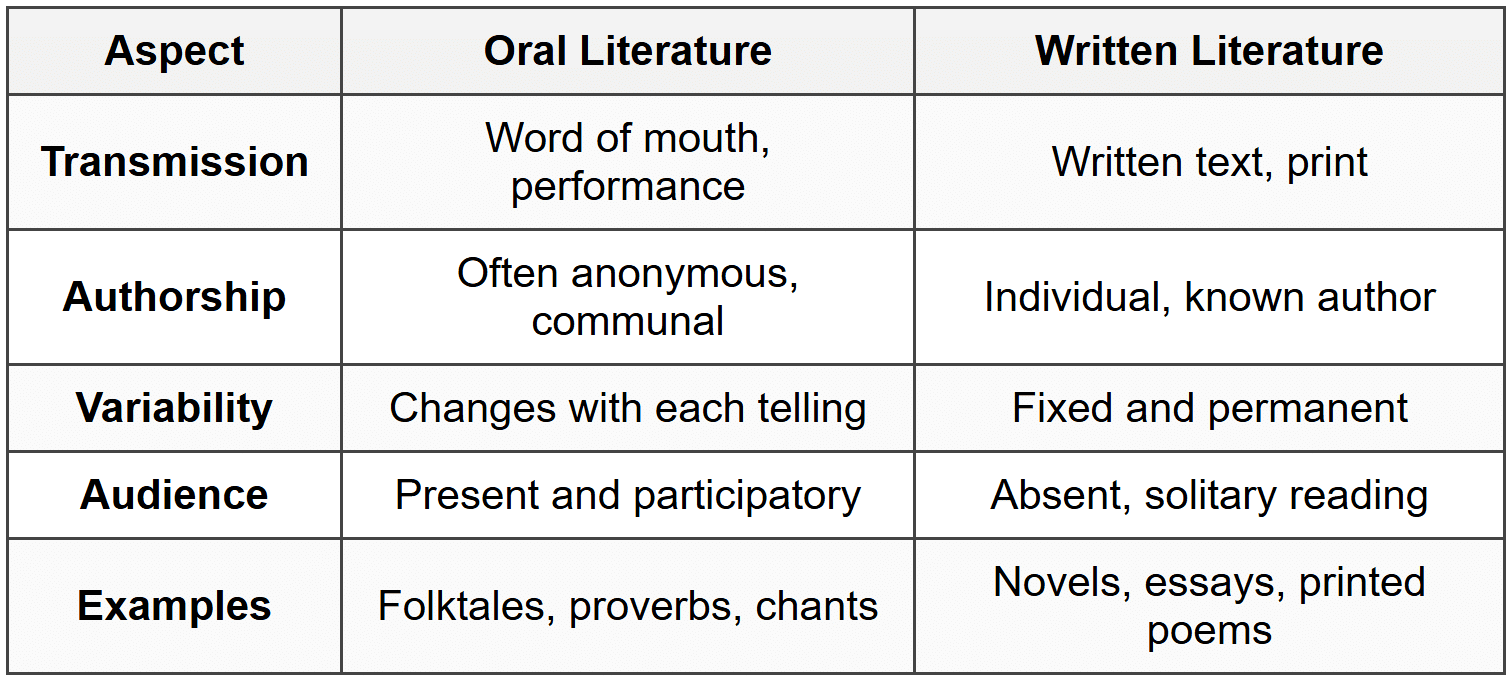
Comparison of Oral and Written Literature
Literary Devices and Techniques
JAMB tests your knowledge of techniques writers use to enhance meaning and artistry. Below are the most commonly examined devices:
Figurative Language
- Simile: A comparison using "like" or "as." Example: "Her smile was as bright as the sun."
- Metaphor: A direct comparison without "like" or "as." Example: "Time is a thief."
- Personification: Giving human qualities to non-human things. Example: "The wind whispered through the trees."
- Hyperbole: Exaggeration for emphasis. Example: "I've told you a million times."
- Irony: A contrast between expectation and reality. Types include verbal, situational, and dramatic irony.
- Symbolism: Use of symbols to represent ideas. Example: A dove symbolizes peace.
Sound Devices (Mainly in Poetry)
- Alliteration: Repetition of initial consonant sounds. Example: "Peter Piper picked a peck."
- Assonance: Repetition of vowel sounds. Example: "The rain in Spain falls mainly on the plain."
- Rhyme: Matching sounds at the end of lines.
- Rhythm: The pattern of stressed and unstressed syllables.
- Onomatopoeia: Words that imitate sounds. Example: "buzz," "bang," "hiss."
Worked Examples
Q1: Which of the following is a characteristic of oral literature?
(a) It is fixed and unchanging
(b) It is passed down through written texts
(c) It is transmitted by word of mouth
(d) It is always authored by a known individual
Ans: (c)
Oral literature is defined by its method of transmission-through spoken word from one generation to the next. It is not fixed (option a), relies on memory and performance rather than writing (option b), and is often communal or anonymous, not individually authored (option d). This is a foundational distinction JAMB uses to test understanding of literature's forms.
Q2: In a novel, the sequence of events that make up the storyline is referred to as the:
(a) Theme
(b) Setting
(c) Plot
(d) Characterization
Ans: (c)
The plot is the ordered arrangement of events in a narrative. The theme (option a) is the central message or idea; setting (option b) refers to time and place; characterization (option d) is the process of creating and developing characters. JAMB often tests your ability to identify and define core literary elements like plot.
Q3: "The classroom was a zoo" is an example of:
(a) Simile
(b) Metaphor
(c) Personification
(d) Hyperbole
Ans: (b)
This is a metaphor because it makes a direct comparison between the classroom and a zoo without using "like" or "as." A simile (option a) would say "The classroom was like a zoo." Personification (option c) gives human traits to non-human things, and hyperbole (option d) is exaggeration. Recognizing figurative language is a key JAMB skill, and metaphor versus simile is a frequent test point.
Quick Summary
- Literature is imaginative, creative writing that uses artistic language to express ideas and emotions.
- The three main genres are prose, poetry, and drama.
- Prose includes novels, novellas, and short stories; poetry includes lyric, narrative, and dramatic forms; drama includes tragedy, comedy, and tragicomedy.
- Literature differs from non-literature in purpose (entertainment vs. information), language (figurative vs. factual), and content (imaginative vs. objective).
- Key elements of literature: plot, character, setting, theme, point of view, style, and tone.
- Oral literature is transmitted orally and is often communal; written literature is fixed in text and individually authored.
- Common literary devices include simile, metaphor, personification, hyperbole, irony, symbolism, alliteration, assonance, and rhyme.
- Plot structure typically follows: exposition, rising action, climax, falling action, resolution.
- Characters can be protagonist, antagonist, round, flat, static, or dynamic.
- Functions of literature: entertainment, education, reflection of society, emotional catharsis, preservation of culture, criticism and reform.
Practice Questions (MCQs)
Q1: Which of the following is NOT a function of literature?
(a) Entertainment
(b) Preservation of culture
(c) Calculation of numerical data
(d) Emotional catharsis
Q2: The central idea or message of a literary work is called:
(a) Plot
(b) Setting
(c) Theme
(d) Conflict
Q3: A story told from the perspective of a character using "I" is written in:
(a) Third person omniscient
(b) First person
(c) Second person
(d) Third person limited
Q4: "The stars danced in the sky" is an example of:
(a) Simile
(b) Hyperbole
(c) Personification
(d) Irony
Q5: Which genre of literature is intended for performance on stage?
(a) Prose
(b) Poetry
(c) Drama
(d) Essay
Q6: A character who undergoes significant internal change during a story is called:
(a) Flat character
(b) Static character
(c) Dynamic character
(d) Antagonist
Answer Key and Explanations
Q1: Ans: (c)
Literature serves functions like entertainment, cultural preservation, and emotional release. Calculation of numerical data is a function of mathematics or statistics, not literature. JAMB uses this kind of question to test whether you understand literature's purpose and scope.
Q2: Ans: (c)
Theme refers to the underlying message or central idea explored in a literary work. Plot (option a) is the sequence of events; setting (option b) is time and place; conflict (option d) is the struggle between opposing forces. JAMB frequently tests definitions of core literary terms.
Q3: Ans: (b)
First person point of view uses "I" or "we," placing the narrator inside the story as a character. Third person (options a and d) uses "he," "she," or "they"; second person (option c) uses "you." Understanding point of view is critical for analyzing narrative perspective in JAMB.
Q4: Ans: (c)
Personification gives human qualities (dancing) to non-human things (stars). A simile (option a) uses "like" or "as"; hyperbole (option b) is exaggeration; irony (option d) involves contrast between expectation and reality. JAMB often asks you to identify figurative language in sentences.
Q5: Ans: (c)
Drama is the genre of literature written for stage performance. Prose (option a) and poetry (option b) are primarily for reading; essay (option d) is non-literary writing. Genre identification is a foundational skill tested in JAMB literature questions.
Q6: Ans: (c)
A dynamic character changes internally over the course of a narrative. Flat characters (option a) are simple and undeveloped; static characters (option b) do not change; the antagonist (option d) is the character opposing the protagonist, not defined by change. JAMB tests your ability to classify character types accurately.



