Plot


Plot is one of the most exciting and practical elements you'll study in literature, and it appears frequently in JAMB English Language exam questions. Whether analyzing a prose passage, a drama excerpt, or even discussing a recommended text, you need to understand how a story is built, how events connect, and how conflict drives everything forward. This chapter will teach you the structure of plot, its essential parts, and how to identify them quickly in any text you encounter in the exam.
Key Concepts and Definitions
What is Plot?
Plot is the sequence of events in a story. It is the arrangement of incidents that make up the narrative. Think of plot as the "what happens" in any story you read or watch.
Important distinction: Plot is not the same as story. The story is simply a list of events in chronological order, while the plot is how those events are arranged to create meaning, suspense, and emotional effect.
Example:
Story: "A man died, then his wife died of grief."
Plot: "A man died, and then his wife died. Why? Because of grief."
The plot version shows cause and effect. JAMB often tests whether you understand this difference.
Elements of Plot
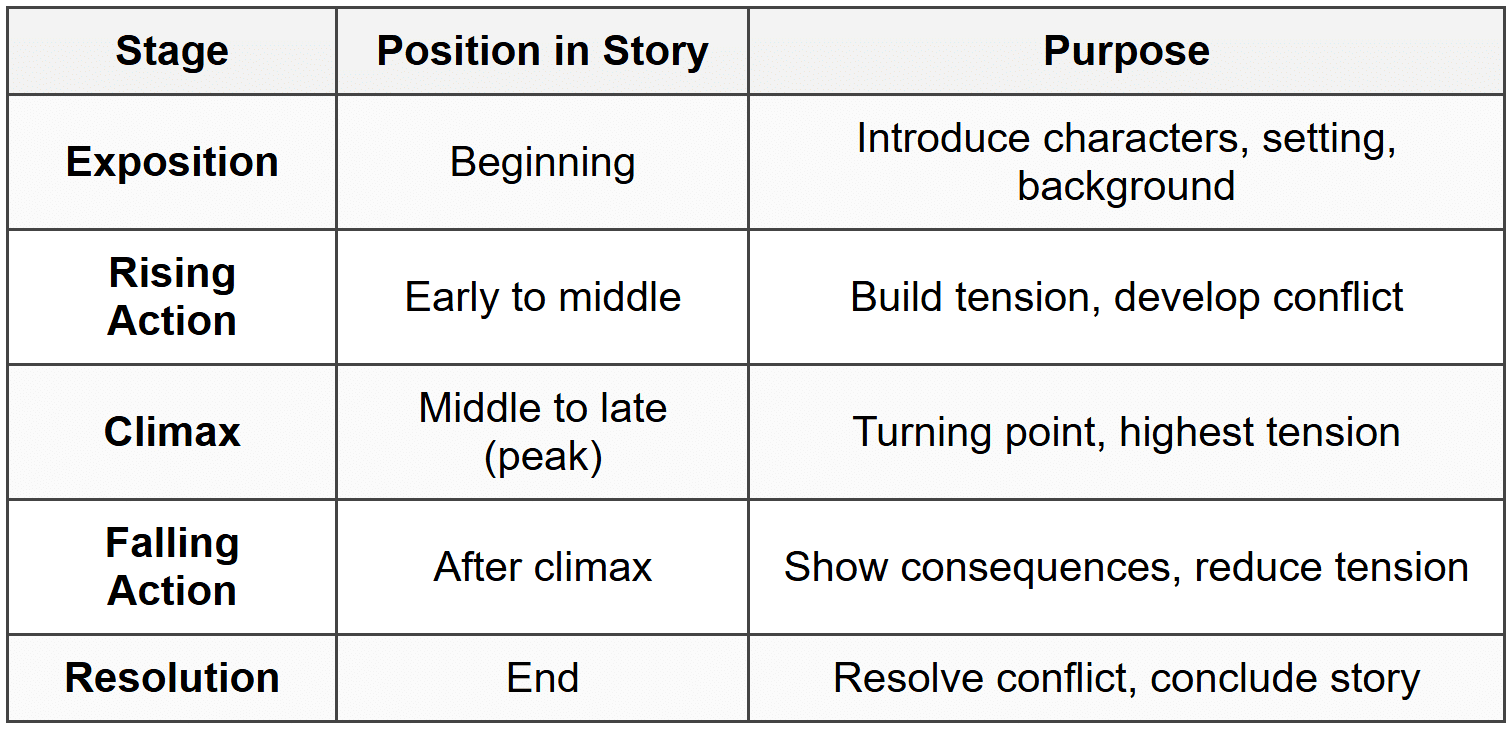
Every well-constructed plot has five main parts. You must memorize these and be able to identify them in passages:
1. Exposition
This is the introduction or beginning of the story. Here, the writer introduces the characters, setting, and background information. You learn who the story is about, where it takes place, and what the situation is before the main action begins.
Example: In a story about a student preparing for JAMB, the exposition might describe the student's school, home, family expectations, and academic struggles.
2. Rising Action
This is the series of events that create suspense, interest, and tension. Conflicts begin to develop. The main character faces challenges and obstacles. This is usually the longest part of the story.
Example: The student begins studying seriously, faces distractions from friends, deals with financial problems that threaten exam registration, and struggles with difficult topics like Mathematics and English.
3. Climax
This is the turning point or the most intense moment of the story. It is the peak of the conflict, where the main character faces the biggest challenge. After the climax, we usually know how things will turn out.
Example: On the day of the JAMB exam, the student discovers their admission slip is missing and must decide whether to panic or find a solution quickly.
4. Falling Action
These are the events that happen after the climax. Tension decreases, and loose ends begin to tie up. We see the consequences of the climax.
Example: The student finds a way to print a duplicate slip at a café near the exam center, gets into the exam hall late but is allowed to write, and completes the test.
5. Resolution (Denouement)
This is the conclusion of the story. All conflicts are resolved, and the story ends. The reader learns the final outcome.
Example: Two weeks later, the student checks their JAMB result and discovers they scored 287. The family celebrates, and the student gains admission.
Plot Structure Diagram
Types of Conflict in Plot
Conflict is the struggle between opposing forces. It is what makes a plot interesting. JAMB may ask you to identify the type of conflict in a passage.
1. Man vs. Man (Character vs. Character)
One character struggles against another character.
Example: A student competes with a classmate for the best JAMB score in their school.
2. Man vs. Self (Internal Conflict)
A character struggles with their own emotions, thoughts, or decisions.
Example: A student is torn between going to a party the night before JAMB or staying home to revise.
3. Man vs. Society
A character struggles against social norms, laws, or cultural expectations.
Example: A brilliant girl whose family believes women should not pursue university education fights to take JAMB.
4. Man vs. Nature
A character struggles against natural forces like weather, animals, or disease.
Example: A student's exam center is flooded due to heavy rain, and they must find a way to reach it.
5. Man vs. Fate (Supernatural)
A character struggles against forces beyond human control, such as destiny or the supernatural.
Example: A character believes they are cursed to fail every exam they take, despite studying hard.
Linear vs. Non-Linear Plot
Linear Plot: Events are arranged in chronological order from beginning to end. This is the most common plot structure.
Example: A story that starts with a boy's birth, moves through his childhood, schooling, and ends with his graduation.
Non-Linear Plot: Events are not arranged chronologically. The story may begin in the middle (in medias res), use flashbacks, or jump between different times.
Example: A story that starts with a student receiving their JAMB result, then flashes back to show their preparation journey, struggles, and exam day.
JAMB may give you a passage and ask whether the plot is linear or non-linear, or ask you to identify a flashback.
Subplot
A subplot is a secondary plot that runs alongside the main plot. It often involves minor characters and supports or contrasts with the main story.
Example: In a novel where the main plot is about a student preparing for JAMB, a subplot might involve the student's younger sibling dealing with bullying at school. The subplot adds depth but is less central than the main plot.
Rules and Explanations
How to Identify Plot Elements in JAMB Passages
JAMB typically gives you a prose or drama excerpt and asks questions about the plot. Follow these steps:
- Read the passage carefully. Identify who the characters are, what they want, and what problems they face.
- Look for the conflict. What struggle or challenge is presented?
- Determine where in the plot the passage falls. Is it introducing characters (exposition)? Building tension (rising action)? Showing the peak moment (climax)?
- Note cause-and-effect relationships. Plot is about how one event leads to another.
- Identify any flashbacks or foreshadowing. These are clues about past or future events.
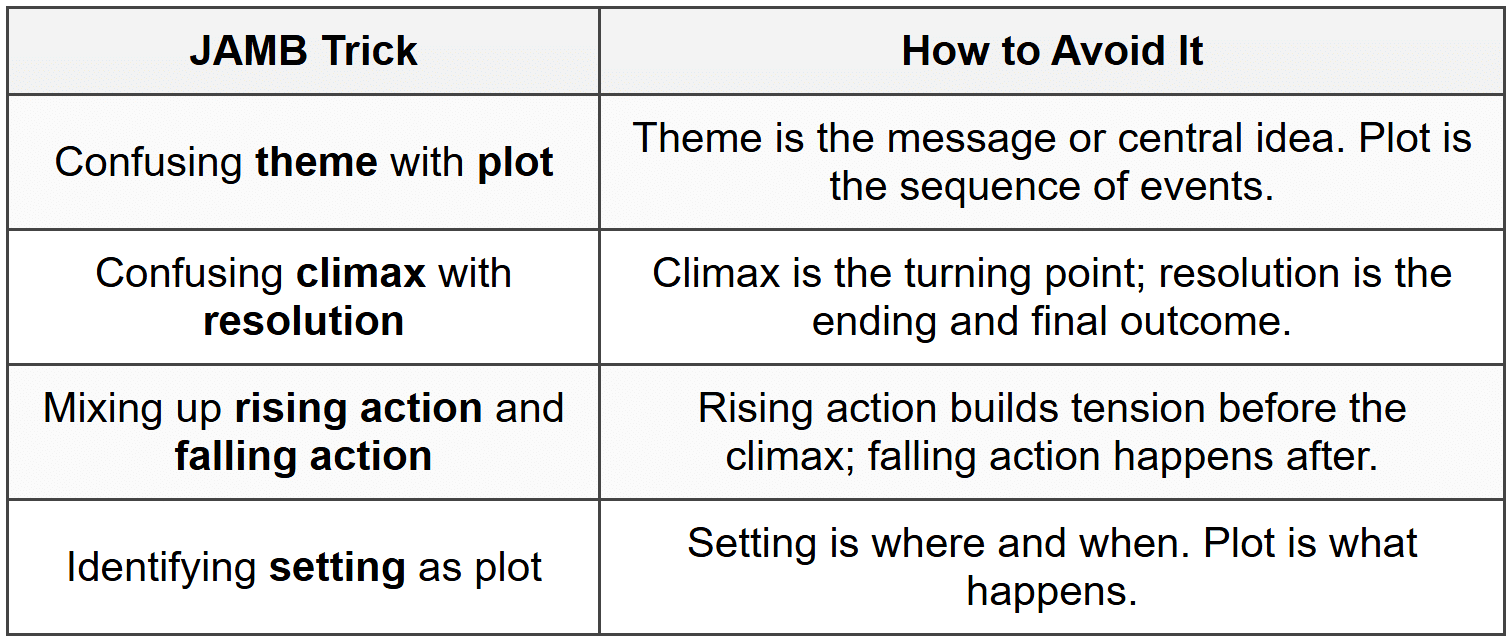
Common JAMB Tricks and How to Avoid Them
Foreshadowing and Flashback
Foreshadowing is a hint or clue about what will happen later in the story. Writers use it to build suspense.
Example: "As Chidi left for the exam center that morning, his mother warned him to be careful. Little did he know how important that advice would be."
Flashback is a scene that takes the reader back to an earlier time to provide background or explain current events.
Example: "Sitting in the exam hall, Amina remembered the day her teacher told her she would never pass JAMB. That memory fueled her determination."
JAMB may ask you to identify these techniques in a passage.
Worked Examples
Q1: Read the following passage and answer the question.
"Tunde had always dreamed of becoming a doctor. On the morning of his JAMB examination, he woke up feeling confident. But as he stepped outside, he realized his exam slip was not in his bag. Panic gripped him. His mother quickly called a neighbor who helped him print another copy online. Tunde arrived at the center late but was allowed in. When his results came out two weeks later, he had scored 289."
At what point in the plot does Tunde realize his slip is missing?
(a) Exposition
(b) Rising action
(c) Climax
(d) Falling action
Ans: (b)
The moment Tunde realizes his exam slip is missing is part of the rising action. This is where the conflict begins to build. The exposition is when we learn about his dream of becoming a doctor. The climax occurs when he must decide how to solve the problem under time pressure. The falling action is when he gets into the exam hall and writes. The resolution is when he receives his result.
Q2: In a story, the main character struggles with the decision to cheat during an exam or to remain honest despite the risk of failure. What type of conflict is this?
(a) Man vs. Man
(b) Man vs. Nature
(c) Man vs. Self
(d) Man vs. Society
Ans: (c)
This is an internal conflict where the character wrestles with their own conscience and values. Man vs. Man would involve a struggle with another character. Man vs. Society would involve challenging social rules or norms. Man vs. Nature involves natural forces. Since the struggle is entirely within the character's mind, it is Man vs. Self.
Q3: "As the final bell rang, Ngozi smiled. She had passed her JAMB exam with flying colors, and her admission letter had just arrived. All the sleepless nights and sacrifices had paid off."
This excerpt most likely represents which part of the plot?
(a) Exposition
(b) Rising action
(c) Climax
(d) Resolution
Ans: (d)
This is the resolution because all conflicts have been resolved. Ngozi has passed the exam and received admission. The story has reached a conclusion. The exposition would introduce her and her goals. Rising action would show her preparation and challenges. The climax would be the exam itself or receiving the result for the first time.
Quick Summary
- Plot is the sequence of related events in a story, showing cause and effect.
- Exposition introduces characters, setting, and background.
- Rising action builds suspense and develops conflict.
- Climax is the turning point or most intense moment.
- Falling action shows the consequences after the climax.
- Resolution concludes the story and resolves conflicts.
- Conflict is the struggle that drives the plot. Types include Man vs. Man, Man vs. Self, Man vs. Society, Man vs. Nature, and Man vs. Fate.
- Linear plot follows chronological order; non-linear plot does not.
- Subplot is a secondary storyline that supports the main plot.
- Foreshadowing hints at future events; flashback shows past events.
- Plot is different from theme, setting, and character.
- Always identify the conflict and determine where in the plot structure a passage falls.
Practice Questions (MCQs)
Q1: Which of the following best defines plot?
(a) The central message of a story
(b) The sequence of events arranged to show cause and effect
(c) The time and place where a story occurs
(d) The personality traits of the main character
Q2: "The night before the exam, Ada could not sleep. She kept thinking about all the topics she had not revised. Her mind raced with fear and doubt."
This passage illustrates which type of conflict?
(a) Man vs. Man
(b) Man vs. Self
(c) Man vs. Nature
(d) Man vs. Society
Q3: In which part of the plot are characters and setting usually introduced?
(a) Climax
(b) Exposition
(c) Falling action
(d) Rising action
Q4: A technique in which a writer provides hints about what will happen later in the story is called:
(a) Flashback
(b) Irony
(c) Foreshadowing
(d) Climax
Q5: "The village elders refused to allow Okon to attend university because they believed education was only for the wealthy. Okon decided to challenge this belief."
What type of conflict does this represent?
(a) Man vs. Self
(b) Man vs. Society
(c) Man vs. Nature
(d) Man vs. Fate
Q6: Read the passage below:
"After months of preparation, Bola entered the examination hall. Her heart pounded as the invigilator distributed the question papers. She opened hers and froze-none of the questions looked familiar. This was the moment she had dreaded."
Which part of the plot does this passage represent?
(a) Exposition
(b) Rising action
(c) Climax
(d) Resolution
Answer Key and Explanations
Q1: (b)
Plot is the sequence of events arranged to show cause and effect. Option (a) describes theme, option (c) describes setting, and option (d) describes characterization.
Q2: (b)
Ada is struggling internally with fear and doubt. This is a classic example of Man vs. Self conflict, where the character battles their own emotions or thoughts.
Q3: (b)
The exposition is the beginning of the plot where the writer introduces the characters, setting, and background information necessary to understand the story.
Q4: (c)
Foreshadowing is the technique of giving hints or clues about future events. Flashback shows past events. Irony involves a contrast between expectation and reality. Climax is a plot element, not a technique.
Q5: (b)
Okon is struggling against the beliefs and norms of his society. This is Man vs. Society conflict, where a character opposes cultural, social, or traditional expectations.
Q6: (c)
This is the climax because it is the turning point and moment of highest tension. Bola has reached the exam and now faces her greatest fear-unfamiliar questions. What happens next will determine the outcome of her story.
