Setting


Understanding setting is critical when tackling comprehension passages, poetry, and prose questions in JAMB English. Setting refers to the time, place, and social environment in which a literary work takes place. You'll learn how to identify different types of setting, analyze how authors use setting to shape meaning, and answer questions that test your ability to connect setting to theme, character, and mood-skills JAMB tests frequently.
Key Concepts and Definitions
What is Setting?
Setting is the backdrop against which the events of a narrative unfold. It includes:
- Physical location: Where the story happens (a village, city, school, forest, etc.)
- Time period: When the story happens (past, present, future; specific year, season, or time of day)
- Social and cultural environment: The customs, beliefs, values, and societal structures that influence characters
Example: In Chinua Achebe's Things Fall Apart, the setting is Umuofia (physical location), pre-colonial Nigeria (time period), and a traditional Igbo society (social environment).
Types of Setting
JAMB often expects you to distinguish between different dimensions of setting:
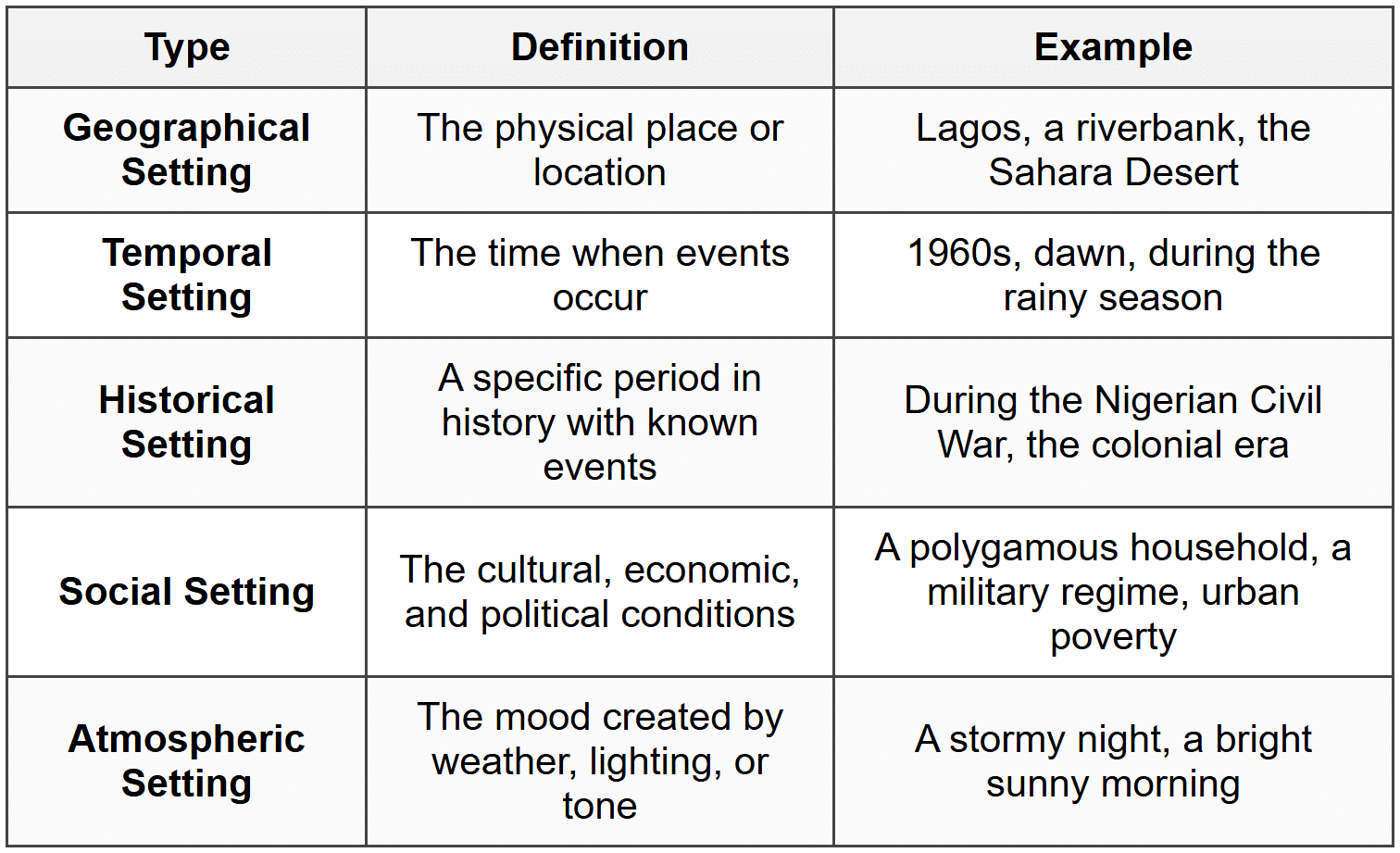
JAMB Tip: Questions may ask you to identify which type of setting is emphasized in a passage. Always read carefully to see whether the writer focuses more on place, time, or mood.
Functions of Setting in Literature
Understanding why an author includes specific details about setting helps you answer deeper comprehension questions. Setting serves several purposes:
- Establishes context: Helps readers understand where and when the story occurs
- Creates mood and atmosphere: Dark forests create suspense; sunny fields suggest peace
- Reflects or influences character: A character from a rural village may behave differently than one from Lagos
- Develops theme: A story set during war may explore themes of conflict, loss, or survival
- Drives plot: Events may only make sense in a particular time or place
- Adds realism: Specific details (like local dialects, customs, landmarks) make the story believable
Example: If a passage describes a character walking through a graveyard at midnight, the setting creates a tense, eerie mood. JAMB may ask: "The setting in this passage is used primarily to..." and the answer would relate to mood or atmosphere.
---Rules and Explanations
How to Identify Setting in a Passage
When reading a comprehension passage or poem, look for clues that reveal setting:
- Time markers: Words like "dawn," "1980," "during the harmattan," "yesterday," "in the future"
- Place names: Cities, countries, specific buildings, natural landmarks (e.g., "River Niger," "Ibadan," "the market square")
- Descriptive details: Weather, seasons, architecture, vegetation (e.g., "the dusty savannah," "corrugated iron roofs")
- Cultural references: Festivals, traditions, clothing, language (e.g., "masquerade festival," "wearing agbada," "speaking Yoruba")
- Historical events: References to wars, independence, technological periods (e.g., "before the oil boom," "after independence")
JAMB frequently tests: Your ability to infer setting even when it's not directly stated. For example, if a passage mentions "cassava farms," "mud houses," and "villagers fetching water from the stream," you can infer a rural, traditional setting.
Distinguishing Setting from Other Literary Elements
JAMB loves to test whether you can separate setting from similar concepts. Here's how:
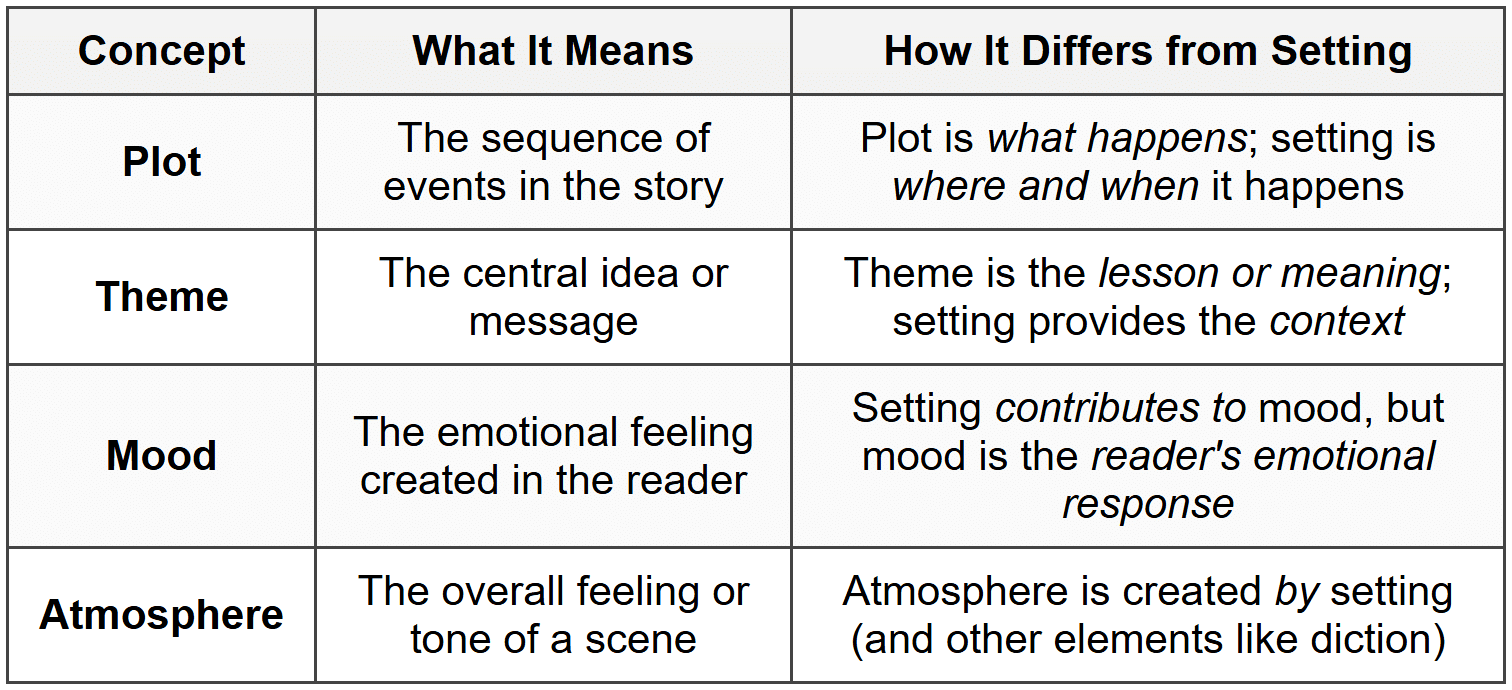
Example: If a passage describes "a crowded Lagos street during rush hour," the setting is urban Lagos at a busy time. The mood might be chaotic or stressful. The theme could be about modern life's pressures.
How Setting Affects Other Elements
JAMB often asks how setting influences or relates to other story elements:
Setting and Character
- Characters' behavior, speech, and values are shaped by where and when they live
- A fisherman from the Niger Delta will have different concerns than a civil servant in Abuja
JAMB-style question: "The character's dialect and occupation suggest which type of setting?"
Setting and Conflict
- Environmental or social settings can create external conflicts (e.g., drought, war, poverty)
- Time periods may bring specific challenges (e.g., colonial oppression, military rule)
Example: A story set during the Biafran War will naturally involve conflict related to that historical period.
Setting and Theme
- The setting often reinforces the theme
- A story about corruption set in a government office building emphasizes institutional decay
Setting and Symbolism
- Elements of setting can be symbolic
- A decaying mansion might symbolize a family's decline
- A journey from village to city might symbolize loss of innocence
Worked Examples
Q1: Read the passage below and answer the question.
"The harmattan wind blew fiercely across the compound, raising clouds of dust that settled on the thatched roofs. Women wrapped their wrappers tightly as they hurried to the stream before nightfall. In the distance, the sound of talking drums announced the arrival of the masquerades."
The setting of this passage is primarily:
(a) Urban and modern
(b) Rural and traditional
(c) Historical and colonial
(d) Futuristic and technological
Ans: (b)
Explanation: The passage contains several clues pointing to a rural, traditional setting: "harmattan wind" (seasonal weather in rural areas), "thatched roofs" (traditional housing), "stream" (water source in villages), "wrappers" (traditional clothing), and "masquerades" (traditional cultural practice). There's no mention of cities, modern technology, or colonial elements, so options (a), (c), and (d) are incorrect.
Q2: Read the excerpt and answer the question.
"The streetlights flickered on as Chidi locked the door of his two-bedroom flat. Below, the sounds of generators hummed in rhythm with the honking of yellow danfo buses. He checked his wristwatch-7:45 p.m.-and hurried toward the bus stop."
Which element of setting is most emphasized in this excerpt?
(a) Historical period
(b) Social environment
(c) Geographical location and time of day
(d) Cultural traditions
Ans: (c)
Explanation: The passage emphasizes where (urban area with flats, streetlights, danfo buses-likely Lagos or another Nigerian city) and when (evening, specifically 7:45 p.m.). While we can infer some social environment (urban life, electricity issues), the dominant focus is on geographical location and temporal setting. There's no strong emphasis on historical period or cultural traditions, making (c) the best answer.
Q3: Read the passage and answer the question.
"The year was 1967, and the radio crackled with news of advancing troops. Mama gathered us under the iroko tree, her face drawn with worry. 'We must leave tonight,' she whispered, glancing toward the distant sound of artillery."
The setting of this passage contributes primarily to:
(a) Creating a cheerful, festive mood
(b) Establishing the characters' occupations
(c) Developing a theme about war and displacement
(d) Describing the characters' physical appearance
Ans: (c)
Explanation: The setting-1967 (the year the Nigerian Civil War began), references to "advancing troops" and "artillery," and the family's urgent need to flee-directly supports themes of war and displacement. The setting creates tension and fear, not cheerfulness (eliminating option a). It doesn't focus on occupations or physical descriptions (eliminating options b and d). JAMB often tests whether you understand how setting reinforces theme.
Quick Summary
- Setting = time + place + social/cultural environment where a story occurs
- Types of setting: geographical, temporal, historical, social, atmospheric
- Key functions: establishes context, creates mood, influences character, develops theme, drives plot
- Look for clues: time markers, place names, weather, cultural references, historical events
- Setting vs. other elements: Plot = events; Theme = message; Mood = reader's feeling; Atmosphere = overall tone
- Setting influences: character behavior, conflict type, symbolic meaning, thematic development
- JAMB tests: identifying setting types, inferring unstated settings, analyzing how setting affects other elements
- Always connect setting to meaning: Don't just identify where/when; explain why the author chose that setting
Practice Questions
Q1: Which of the following best defines setting in literature?
(a) The main character's personality traits
(b) The time, place, and environment where a story occurs
(c) The central message or lesson of a story
(d) The sequence of events in a narrative
Q2: Read the excerpt below.
"The sun had barely risen when Adeola joined the queue outside the INEC office. Around her, voters clutched their PVCs, chatting nervously about the upcoming election."
The temporal setting of this passage is:
(a) Midnight
(b) Early morning
(c) Afternoon
(d) Evening
Q3: "The old colonial building stood at the heart of the city, its walls bearing faded inscriptions from 1898. Inside, the scent of old books mixed with the humid Lagos air."
Which types of setting are present in this excerpt?
(a) Only geographical
(b) Geographical and historical
(c) Only temporal
(d) Social and futuristic
Q4: In a story where the main character struggles to survive during a severe drought, the setting primarily functions to:
(a) Describe the character's physical appearance
(b) Create external conflict and challenge the character
(c) Establish the author's writing style
(d) Provide comic relief
Q5: Read the passage.
"As the church bell tolled midnight, shadows danced across the empty cemetery. A cold wind rattled the iron gates, and somewhere in the darkness, an owl hooted mournfully."
The setting in this passage is used primarily to:
(a) Create a suspenseful, eerie atmosphere
(b) Establish a joyful, celebratory mood
(c) Develop the theme of friendship
(d) Describe urban development
Q6: Which statement about setting is NOT correct?
(a) Setting can be inferred from descriptive details even when not directly stated
(b) Setting includes both physical location and time period
(c) Setting never influences the characters' actions or values
(d) Setting can contribute to the mood and atmosphere of a story
Answer Key and Explanations
Q1: (b)
Setting encompasses time, place, and environment. Option (a) describes character, (c) describes theme, and (d) describes plot. This is a straightforward definitional question JAMB uses to test basic understanding.
Q2: (b)
The phrase "The sun had barely risen" indicates early morning. "Barely risen" means the sun just came up, which happens in the morning. This tests your ability to identify temporal setting from contextual clues rather than explicit time statements.
Q3: (b)
The passage mentions both geographical setting ("the heart of the city," "Lagos") and historical setting ("colonial building," "inscriptions from 1898"). The presence of both historical references and specific location makes (b) correct. This medium-difficulty question tests whether you can identify multiple setting dimensions simultaneously.
Q4: (b)
When the setting itself (drought) creates challenges for the character, it functions to create external conflict. The environment becomes an obstacle the character must overcome. Setting doesn't describe appearance (a), establish style (c), or provide comedy (d). This tests understanding of how setting drives plot and conflict.
Q5: (a)
Every detail in the passage-midnight, cemetery, shadows, cold wind, rattling gates, hooting owl-works together to create a suspenseful, eerie atmosphere. There's nothing joyful, friendly, or urban about this scene. This harder question requires you to synthesize multiple setting elements and determine their cumulative effect.
Q6: (c)
This is a negative question (asking what is NOT correct). Statement (c) is false because setting does influence characters' actions and values-a person's environment shapes their behavior, beliefs, and choices. All other statements are accurate. JAMB uses negative questions to test careful reading and deeper understanding, so always read the question stem carefully.
