Theme And Subject Matter


When you read a story, watch a movie, or even listen to a song, there's always something deeper going on beyond just the surface events. In JAMB, you're expected to identify what a passage is really about-not just the story it tells, but the deeper message or ideas behind it. This chapter will teach you the difference between subject matter and theme, how to spot them in passages, and how to answer JAMB questions that test your understanding of these concepts.
Key Concepts and Definitions
What is Subject Matter?
The subject matter is what a text is about on the surface level. It answers the question: "What is happening in this passage?" or "What topic is being discussed?"
Think of subject matter as the raw material of the story or passage-the events, characters, settings, and actions that you can see or read directly.
- It is concrete and straightforward
- It can be summarized in a few words or a sentence
- It deals with the literal content of the text
- Multiple texts can share the same subject matter but have different themes
Examples of Subject Matter:
- A young girl struggling to pass her WAEC exams
- A farmer dealing with crop failure during drought
- Two friends who have a misunderstanding over money
- A corrupt politician facing investigation
- Soldiers fighting in a civil war
What is Theme?
The theme is the underlying message, central idea, or deeper meaning that the writer wants to communicate through the text. It answers the question: "What is the writer trying to say about life, society, or human nature?"
Theme goes beyond what happens in the story to explore why it matters and what we should learn from it.
- It is abstract and conceptual
- It requires interpretation and deeper thinking
- It reflects universal truths or insights about life
- It is not explicitly stated but implied through characters, events, and outcomes
- A single text can have multiple themes, though usually one is dominant
Examples of Common Themes:
- The consequences of greed and corruption
- The importance of hard work and perseverance
- The power of love to overcome obstacles
- The conflict between tradition and modernity
- The struggle for freedom and justice
- The impact of poverty on family life
- The value of education in transforming lives
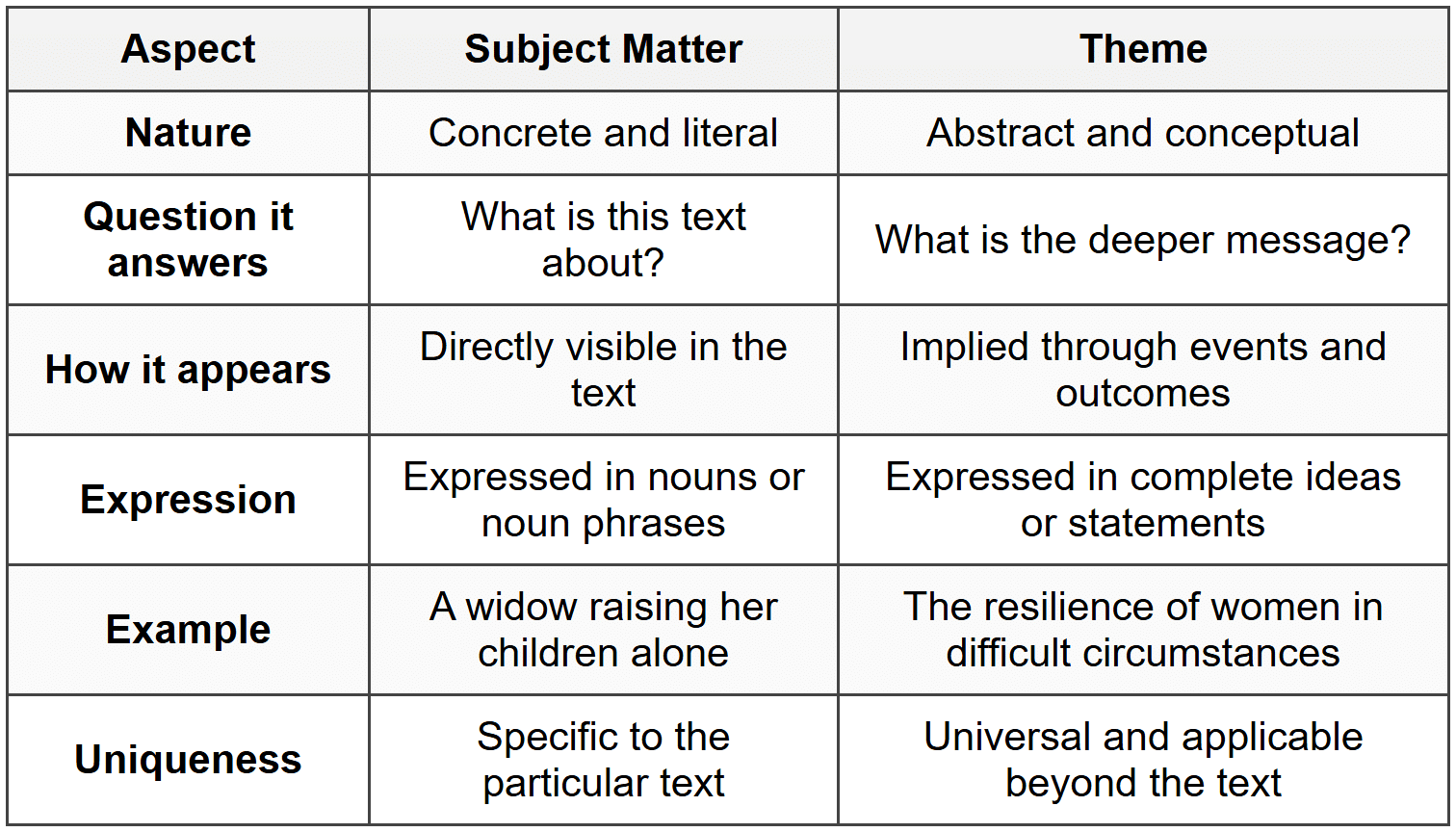
Subject Matter vs Theme: The Critical Difference
JAMB loves to test whether students can distinguish between these two concepts. Many students lose marks because they confuse subject matter with theme.
How to Identify Subject Matter in a Passage
When JAMB asks you to identify the subject matter, follow these steps:
- Read the entire passage carefully to understand what is happening
- Ask yourself: What events or situations are being described?
- Identify the main characters and their actions
- Look for the central situation or conflict that drives the passage
- Summarize in simple, factual terms what the passage discusses
Common JAMB Question Formats:
- "What is the passage about?"
- "The subject matter of this passage is..."
- "Which of the following best describes what happens in the passage?"
- "The passage deals with..."
How to Identify Theme in a Passage
Identifying theme requires deeper analysis. Follow these guidelines:
- Read beyond the surface events to understand the writer's purpose
- Ask yourself: What lesson or message is the writer trying to convey?
- Look for patterns in how characters behave and what happens to them
- Pay attention to the outcome of events-what do they teach?
- Consider the tone and attitude of the writer toward the subject
- Think about universal ideas that apply beyond this specific story
Common JAMB Question Formats:
- "The main theme of this passage is..."
- "The writer's message in this passage concerns..."
- "What central idea is the passage exploring?"
- "The passage primarily examines..."
- "Which statement best captures the theme?"
Common Themes in Nigerian and African Literature
Because JAMB often uses passages from Nigerian and African writers, knowing these recurring themes will help you:
- Colonialism and its aftermath: The impact of foreign rule on African societies
- Cultural conflict: Tension between traditional values and Western influence
- Corruption and leadership failure: How bad governance affects ordinary people
- Gender inequality: The challenges faced by women in patriarchal societies
- Education as liberation: The transformative power of learning
- Poverty and social injustice: The struggle of the poor and marginalized
- Family and communal values: The importance of kinship and community ties
- Religious faith and spirituality: The role of belief in human life
- Youth and generational conflict: Differences between old and young perspectives
Rules and Explanations
Rule 1: Subject Matter is Never the Same as Theme
If a question asks for the theme, never pick an option that simply describes what happens in the passage. The theme must express a deeper idea or message.
Wrong approach: "The passage is about a student who failed an exam" (This is subject matter)
Correct approach: "The passage explores the consequences of poor preparation and procrastination" (This is theme)
Rule 2: Theme is Usually Universal
A proper theme statement should apply beyond the specific characters and situations in the passage. It should reflect a truth about human experience that readers can relate to in their own lives.
Example: If a passage tells the story of Adaeze who loses her job because she refused to compromise her values, the theme is not "Adaeze's unemployment" but rather "the cost of maintaining integrity in a corrupt environment."
Rule 3: Look for Repeated Elements
Writers often emphasize their themes through repetition. Pay attention to:
- Ideas or words that appear multiple times
- Similar situations that different characters face
- Consequences that follow certain behaviors consistently
- Symbols or images that recur throughout the passage
Rule 4: Consider the Title (When Provided)
When JAMB provides a title for a passage, it often hints at either the subject matter or theme. Analyze how the title relates to the content.
Rule 5: Pay Attention to the Conclusion
The way a passage ends often reveals the writer's intended message. The outcome of events usually reinforces the theme.
Example: If a character who has been dishonest throughout the passage faces consequences at the end, the theme likely concerns honesty, integrity, or the consequences of deception.
Rule 6: Distinguish Between Minor and Major Themes
Some passages contain multiple themes, but JAMB typically asks for the main or primary theme-the one that is most developed and central to the passage.
When choosing between options:
- Pick the theme that relates to the main conflict or focus of the passage
- Choose the theme that is most thoroughly developed
- Avoid themes that appear only briefly or tangentially
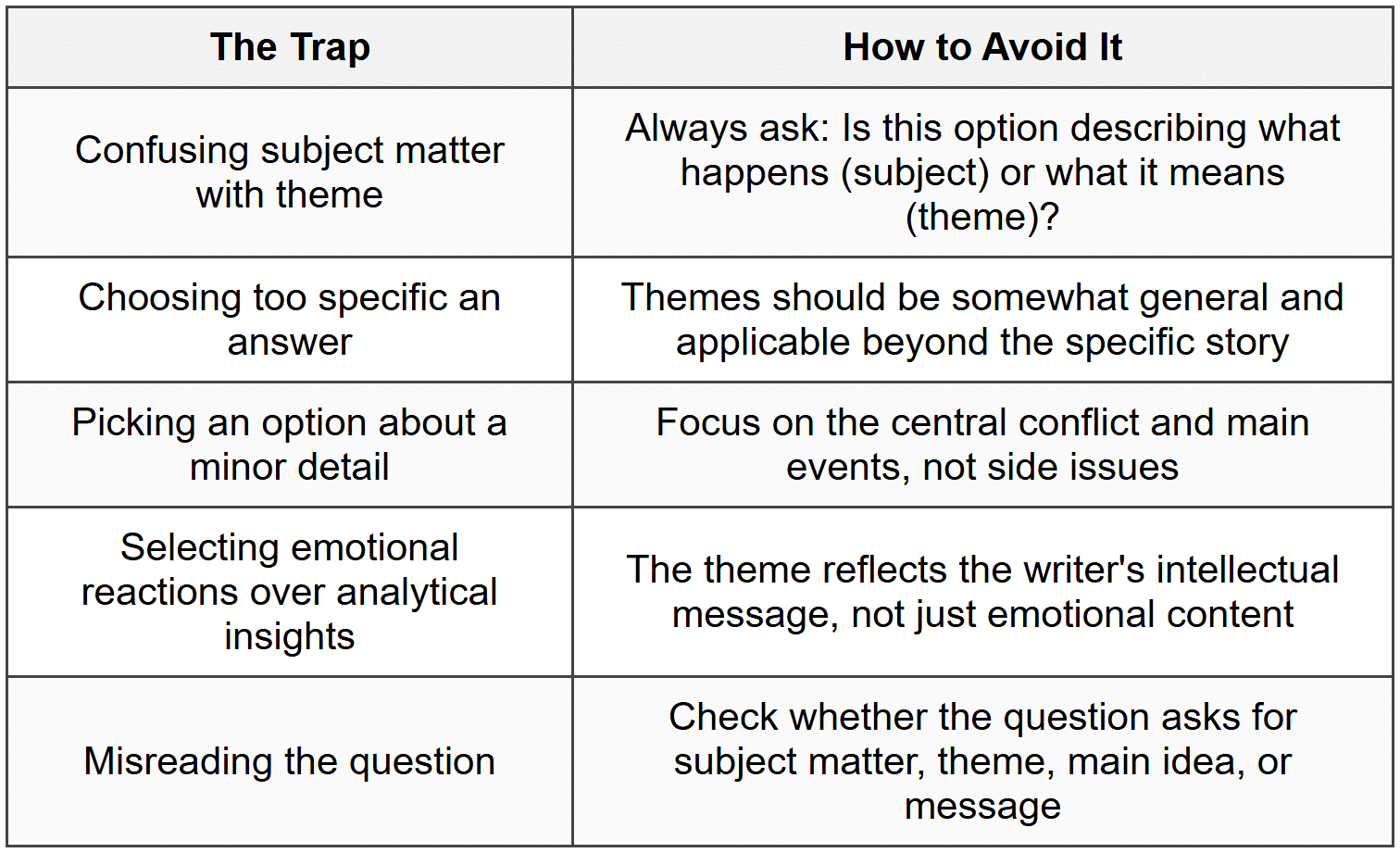
Common Traps in JAMB Questions
Worked Examples
Q1: Read the passage below and answer the question.
Chinedu had always been the brightest student in his class. When the final JAMB results were released, everyone expected him to score above 300. But Chinedu had spent the weeks before the exam attending parties and chatting with friends online, confident that his natural intelligence would carry him through. When his result came-a disappointing 189-he realized too late that talent without effort is wasted potential. His younger sister Ngozi, who had studied diligently despite being less naturally gifted, scored 276 and gained admission to study Medicine.
What is the main theme of this passage?
(a) Chinedu's disappointment with his JAMB score
(b) The importance of hard work over natural talent
(c) Sibling rivalry in academic achievement
(d) The difficulty of JAMB examinations
Ans: (b)
This passage explores the theme that hard work and preparation are more valuable than relying on natural ability alone. Option (a) merely describes what happens (subject matter), not the deeper message. Option (c) misreads the passage-there's no rivalry shown, just a contrast. Option (d) is not supported by the passage; the focus is on Chinedu's lack of preparation, not the exam's difficulty. The passage teaches us that consistent effort beats raw talent, which is a universal truth applicable beyond this specific situation.
Q2: Read the passage below and answer the question.
When the government announced the new policy, market women across Lagos protested vigorously. Mrs. Adebayo, who had sold vegetables at Oyingbo market for thirty years, joined the demonstrations despite her age. She remembered how her grandmother had fought against colonial taxes in the 1940s. "We will not be silenced," she told the younger women. "Our mothers resisted oppression, and we must do the same. If we accept this today, what will they take from us tomorrow?"
What is the subject matter of this passage?
(a) The spirit of resistance against injustice
(b) Market women protesting a government policy
(c) The history of women's activism in Nigeria
(d) The legacy of colonialism in modern Nigeria
Ans: (b)
The subject matter is simply what the passage describes on the surface level: market women protesting against a government policy. This is the concrete, factual content. Option (a) is actually closer to the theme-it expresses the deeper meaning about resistance. Options (c) and (d) touch on elements mentioned in the passage but are not what the passage is primarily about. Remember: subject matter answers "What is happening?" while theme answers "What does it mean?" This passage is literally about a protest (subject matter), though it conveys a message about resistance to oppression (theme).
Q3: Read the passage below and answer the question.
Chief Okonkwo had amassed wealth through dubious contracts and embezzlement. He built a mansion in his village and threw lavish parties, earning praise from those who didn't know the source of his riches. But when investigations began, his friends abandoned him. His children, who had grown accustomed to luxury, were ashamed when he was arrested. In his prison cell, Chief Okonkwo reflected on how the money he had stolen to secure his family's future had instead destroyed their peace and reputation.
The primary theme of this passage is:
(a) Chief Okonkwo's arrest and imprisonment
(b) The investigation of government officials
(c) Corruption ultimately destroys rather than builds
(d) The lifestyle of wealthy Nigerians
Ans: (c)
The passage's central message is that corruption and ill-gotten wealth, rather than providing security and happiness, ultimately lead to destruction and loss. This is reinforced by the irony that Chief Okonkwo's attempts to "secure his family's future" actually ruined it. Option (a) describes an event in the passage (subject matter) but not the underlying message. Option (b) is too narrow and factual. Option (d) is not what the passage is exploring; the focus is on the consequences of corruption, not wealth itself. The passage teaches a moral lesson about the self-destructive nature of corruption-a universal theme.
Quick Summary
- Subject matter is what a passage is literally about-the events, characters, and situations described
- Theme is the deeper message or central idea the writer wants to convey
- Subject matter is concrete and specific; theme is abstract and universal
- To find subject matter, ask: "What happens in this passage?"
- To find theme, ask: "What is the writer trying to teach or reveal?"
- A theme should be expressed as a complete idea, not just a topic word
- Multiple passages can share the same subject matter but have different themes
- Pay attention to how events conclude-outcomes often reveal theme
- Common themes in African literature include corruption, cultural conflict, colonialism, gender issues, and education
- Never confuse what happens (subject) with what it means (theme)
- Look for repeated patterns, symbols, and ideas to identify theme
- The main theme is the one most central and thoroughly developed in the passage
- JAMB often provides wrong options that describe subject matter when asking for theme
- Titles, when provided, often hint at subject matter or theme
- Theme statements should apply beyond the specific story to human experience generally
Practice Questions
Q1: A passage describes a young man who leaves his village to seek employment in the city, faces numerous hardships, but eventually finds success and returns home to help his community. What is most likely the theme?
(a) A young man's journey from village to city
(b) The challenges of urban unemployment
(c) Perseverance and giving back to one's community
(d) The differences between rural and urban life
Q2: In a passage, several characters engage in different forms of dishonesty, and each one suffers negative consequences by the end. The subject matter of this passage is:
(a) The consequences of dishonesty
(b) Various characters behaving dishonestly
(c) Moral lessons about truthfulness
(d) The importance of integrity
Q3: A passage describes how a traditional ruler must choose between maintaining ancient customs and accepting modern changes that would benefit his people. This passage explores the theme of:
(a) Traditional leadership in modern times
(b) The conflict between tradition and progress
(c) A king making difficult decisions
(d) The customs of African societies
Q4: Which of the following is most likely a theme rather than subject matter?
(a) A woman's struggle with infertility
(b) Two brothers fighting over inheritance
(c) The destructive power of jealousy and greed
(d) Students preparing for final examinations
Q5: A passage tells the story of Amina, who despite facing gender discrimination in her male-dominated profession, works hard and eventually becomes the first female chief engineer in her company. What is the subject matter?
(a) Gender equality in professional settings
(b) Amina's rise to become chief engineer
(c) The power of determination to overcome obstacles
(d) Discrimination against women in the workplace
Q6: In determining the theme of a passage, which question is most helpful?
(a) Who are the main characters?
(b) What happens in the story?
(c) What message is the writer conveying?
(d) Where and when does the story take place?
Answer Key
Q1: (c) Perseverance and giving back to one's community
This option expresses the deeper message about human values and behavior. Options (a) and (b) describe what happens (subject matter), not the underlying meaning. Option (d) might be discussed in the passage but doesn't capture the central message about perseverance and community responsibility. A theme should express a universal truth or insight, which option (c) does.
Q2: (b) Various characters behaving dishonestly
Subject matter describes what happens literally in the passage. This passage is about characters engaging in dishonest behavior-that's the concrete content. Options (a), (c), and (d) all express themes or messages about dishonesty rather than describing the actual content. Remember: subject matter is factual and descriptive, not interpretive.
Q3: (b) The conflict between tradition and progress
This expresses the central tension and deeper meaning of the passage. Option (a) describes the subject matter (what the passage is about) rather than its theme. Option (c) is too specific and literal-it describes what happens rather than what it means. Option (d) is too broad and doesn't capture the specific conflict being explored. The theme focuses on the universal tension between preserving tradition and embracing change.
Q4: (c) The destructive power of jealousy and greed
This is a complete idea expressing a universal truth about human behavior-the hallmark of theme. Options (a), (b), and (d) all describe situations or topics (subject matter) without expressing a deeper message or insight. They answer "what happens" rather than "what does it mean."
Q5: (b) Amina's rise to become chief engineer
Subject matter is the literal, factual content of what happens in the passage. This passage describes Amina's career progression-that's the subject matter. Options (a) and (d) address themes related to the passage, while option (c) expresses the message or lesson. The question specifically asks for subject matter, not theme, so we choose the option that describes what happens literally.
Q6: (c) What message is the writer conveying?
Theme is about the underlying message or central idea the writer wants to communicate. Questions (a), (b), and (d) help identify plot elements, setting, and subject matter, but don't directly address the deeper meaning. To find theme, you must always ask what the writer is trying to say about life, society, or human nature through the events described.
