Narrative Point Of View


Understanding the angle from which a story is told is a critical skill in prose analysis, and JAMB consistently tests your ability to identify and interpret narrative perspective. Every story has a narrator, and how that narrator sees, understands, and presents events dramatically shapes the reader's experience. In this chapter, you'll master the different types of narrative points of view, learn to distinguish between them quickly, and understand how each affects characterization, tone, and meaning-skills that will directly translate into marks in your examination.
Key Concepts and Definitions
What is Narrative Point of View?
Narrative point of view (also called narrative perspective) is the position from which a story is told. It determines who is telling the story, how much they know, and what information the reader receives. The narrator acts as the lens through which readers experience the events, characters, and setting of a narrative.
Think of it this way: if three people witness the same incident at a Lagos market-a trader, a customer, and a passerby-each will tell the story differently based on their involvement and perspective. Similarly, the narrative point of view shapes everything about how a story unfolds.
Why Narrative Point of View Matters in JAMB
JAMB prose passages frequently test your ability to:
- Identify which point of view is being used in a given extract
- Recognize how the narrator's perspective affects what readers know and don't know
- Understand how point of view influences characterization and reader sympathy
- Distinguish between reliable and unreliable narrators
- Analyze how perspective shapes tone and meaning
Questions often present a passage and ask: "From what point of view is this passage told?" or "The narrator's perspective can best be described as..." Understanding this concept thoroughly will help you tackle these questions with confidence.
The Main Types of Narrative Point of View
First-Person Point of View
In first-person narration, the story is told by a character within the story using pronouns like "I," "me," "my," "we," and "our." The narrator is a participant in the events being described.
Key characteristics:
- The narrator uses "I" or "we" to tell the story
- The narrator can only report what they personally see, hear, think, and feel
- The narrator cannot know what other characters are thinking unless told
- The reader experiences events directly through this character's perspective
- The narrator may be the protagonist or a minor character observing the main action
Example: "I woke up to the sound of rain pounding on our zinc roof. My mother was already in the kitchen, and I could smell the aroma of akara frying. I didn't know then that this would be the last normal morning of my life."
Notice how the narrator can only tell us what they experienced directly. They cannot tell us what their mother was thinking or what was happening elsewhere.
Advantages: Creates intimacy and immediacy; readers feel close to the narrator; builds trust and emotional connection.
Limitations: Limited knowledge-readers only know what the narrator knows; potential for bias or unreliability; cannot show events the narrator didn't witness.
Second-Person Point of View
In second-person narration, the story is told using "you" as the main pronoun, making the reader feel like a participant in the story. This perspective is rare in traditional prose but appears in some experimental fiction and instructional writing.
Key characteristics:
- Uses "you" to address the reader or a character
- Creates a sense of direct involvement or instruction
- Uncommon in JAMB-tested prose fiction
- Often feels conversational or directive
Example: "You walk into the examination hall with your heart pounding. You find your seat number and sit down carefully. The invigilator announces that you have three hours to complete the paper."
This perspective is rarely tested in JAMB prose passages, but you should be able to recognize it if it appears.
Third-Person Point of View
Third-person narration uses pronouns like "he," "she," "they," and "it" to tell the story. The narrator is not a character in the story but an outside observer. This perspective has important subdivisions that JAMB frequently tests.
Third-Person Omniscient (All-Knowing)
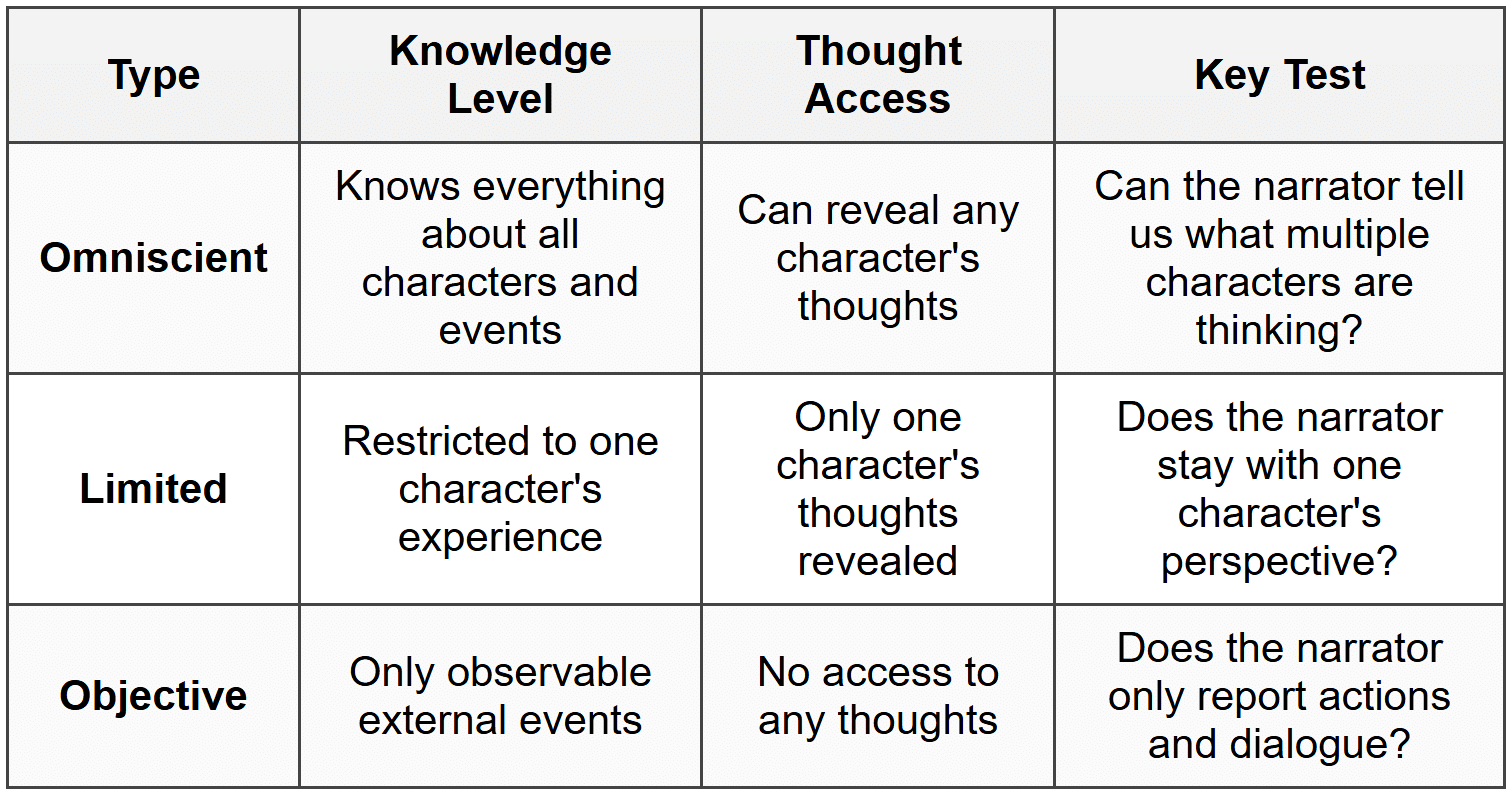
An omniscient narrator knows everything about all characters, events, and settings. This narrator can access the thoughts and feelings of multiple characters, move freely through time and space, and provide information that no single character could know.
Key characteristics:
- Narrator knows the thoughts and feelings of all characters
- Can reveal past, present, and future events
- Can be in multiple places at once
- May offer judgments or commentary on characters and events
- Provides the broadest, most complete perspective
Example: "While Chidi sat nervously in the waiting room, his sister Amaka was at home, wondering why he hadn't called. Neither of them knew that their father had already received the results and was deciding how to break the news. The doctor, reading through the file in his office, wished he had better information to share."
Notice how the narrator moves between four different characters' knowledge and locations-something only an omniscient narrator can do.
Third-Person Limited (Restricted)
A limited third-person narrator tells the story from outside but restricts the knowledge to what one character experiences, thinks, and feels. The narrator stays close to this character's perspective throughout.
Key characteristics:
- Uses third-person pronouns (he, she, they)
- Access to only one character's thoughts and feelings
- Shows other characters only from the outside
- Cannot reveal what happens beyond the focal character's awareness
- Combines the intimacy of first person with the flexibility of third person
Example: "Blessing watched her classmates celebrate their admission letters. She smiled and congratulated them, but inside, her stomach twisted with anxiety. Had her own results been released? She couldn't tell what the others were thinking as they looked at her; their faces revealed nothing."
Here, we only know Blessing's thoughts and feelings. We see the other students from the outside, as Blessing sees them.
Third-Person Objective (Dramatic)
An objective narrator reports only observable actions and dialogue, like a camera recording events. The narrator never enters any character's mind or reveals their thoughts and feelings.
Key characteristics:
- Reports only what can be seen and heard
- No access to any character's thoughts or feelings
- Readers must infer emotions and motivations from actions and dialogue
- Creates distance and requires active reader interpretation
- Similar to watching a play or film
Example: "The man entered the room and sat down heavily. He stared at the letter on the table for five minutes without moving. Then he stood up, walked to the window, and looked out at the street below. His hands gripped the windowsill."
We see what the man does but have no direct access to what he thinks or feels. We must infer his emotional state from his actions.
Comparison Table: Third-Person Perspectives
Important Distinctions JAMB Uses to Test You
First Person vs. Third Person Limited
These two perspectives can feel similar because both restrict knowledge to one character. The key difference is grammatical:
- First person: Uses "I" and "my"-the character tells their own story
- Third person limited: Uses "he," "she," or the character's name-someone else tells the character's story but stays close to their perspective
First person example: "I didn't trust him from the moment I saw him."
Third person limited example: "She didn't trust him from the moment she saw him."
The perspective and knowledge level are similar, but the grammatical person is different.
Omniscient vs. Limited Omniscient
Some texts describe a "limited omniscient" perspective-this is essentially the same as third-person limited. JAMB typically uses the simpler terms, but you should recognize both. The key question is: does the narrator access multiple characters' thoughts (omniscient) or just one character's thoughts (limited)?
Narrator vs. Author
This is crucial: the narrator is not the same as the author. The narrator is a constructed voice created by the author to tell the story. In first-person narration, students sometimes mistakenly think the narrator is the author, but this is rarely the case. The narrator is a fictional creation, even when using "I."
Narrator Reliability
An important advanced concept is narrator reliability. A reliable narrator presents events truthfully and accurately. An unreliable narrator may be biased, misinformed, deceptive, or limited in understanding.
Indicators of unreliability:
- The narrator is very young or mentally unstable
- The narrator has clear biases or strong emotions affecting judgment
- The narrator's account contradicts other evidence in the text
- The narrator admits to lying or hiding information
- The narrator has limited knowledge or understanding
JAMB may ask you to evaluate whether a narrator is presenting events accurately or whether their perspective is limited or biased.
How Point of View Affects Interpretation
Impact on Characterization
Point of view determines how readers understand characters:
- First person: Deep insight into narrator's character; other characters understood from outside
- Third person limited: Deep insight into focal character; others seen externally
- Third person omniscient: Balanced understanding of multiple characters
- Third person objective: All characters understood only through actions and words
Impact on Reader Sympathy
Point of view shapes which characters readers sympathize with:
- First person and third person limited often create strong sympathy for the narrator/focal character
- Omniscient narration can distribute sympathy among multiple characters
- Objective narration requires readers to form their own judgments
Impact on Suspense and Information
Point of view controls what readers know and when they know it:
- Limited perspectives: Create suspense by restricting information; readers discover alongside the character
- Omniscient narration: Can create dramatic irony (readers know more than characters) or provide reassurance
- Objective narration: Creates ambiguity; readers must interpret meaning
Rules and Strategies for JAMB Questions
Step-by-Step Identification Process
When answering a point of view question, follow these steps:
- Check pronouns: Look for "I/we" (first person), "you" (second person), or "he/she/they" (third person)
- Count perspectives: Does the narrator access one mind or multiple minds?
- Test knowledge limits: Does the narrator know only observable facts, one character's thoughts, or everyone's thoughts?
- Verify consistency: Check if the perspective remains stable throughout the passage
- Match to definition: Compare your observations with the definitions of each point of view type
Common JAMB Question Patterns
JAMB typically asks about point of view in these ways:
- "The passage is narrated from which point of view?"
- "The narrator's perspective can best be described as..."
- "The technique used in this passage is..."
- "The author employs which narrative method?"
- "The narrator's knowledge of events can be described as..."
Answer Choice Traps to Avoid
Trap 1: Confusing first person with third person limited because both focus on one character
Solution: Always check pronouns first
Trap 2: Calling any third-person narration "omniscient"
Solution: Verify whether the narrator actually accesses multiple characters' thoughts
Trap 3: Assuming a passage has multiple points of view because it mentions several characters
Solution: Focus on whose thoughts are revealed, not how many characters appear
Trap 4: Confusing narrator with author
Solution: Remember that the narrator is a constructed voice, not the writer themselves
Worked Examples
Q1: Read the following passage and identify the narrative point of view:
"Adaeze hurried down the street, glancing at her watch every few seconds. She was already twenty minutes late. What would her supervisor say? As she turned the corner, she saw Mr. Okonkwo standing outside the office, arms folded across his chest. His expression told her nothing."
What point of view is used in this passage?
(a) First person
(b) Second person
(c) Third person omniscient
(d) Third person limited
Ans: (d)
Explanation: This passage uses third person limited point of view. The narrator uses third-person pronouns ("she," "her") and stays close to Adaeze's perspective. We know her thoughts ("What would her supervisor say?") but we only observe Mr. Okonkwo from the outside ("His expression told her nothing"). We don't access his thoughts, which rules out omniscient narration. The use of "she" rather than "I" rules out first person.
Q2: Read the following passage:
"I walked into the examination hall with my heart racing. The invigilator looked at me sternly as I found my seat. I had no idea that she was actually worried about her daughter's own examination happening across town at the same moment."
What is problematic about the point of view in this passage?
(a) It switches from first person to third person
(b) It gives the first-person narrator knowledge they couldn't have
(c) It uses second person incorrectly
(d) It is written in objective point of view
Ans: (b)
Explanation: The passage begins in first person ("I walked," "my heart"), which means the narrator should only know what they personally experienced. However, the last sentence reveals information the narrator couldn't possibly know-the invigilator's private thoughts and concerns about her daughter. This is a point of view violation. A first-person narrator cannot access another character's thoughts unless told about them. This kind of inconsistency sometimes appears in JAMB passages to test whether you understand the limitations of each point of view.
Q3: Read the following passage:
"The woman sat on the bench. She opened her bag and took out an envelope. She stared at it for several minutes. Then she stood up and walked away, leaving the envelope on the bench."
This passage is written from which perspective?
(a) First person
(b) Third person limited
(c) Third person omniscient
(d) Third person objective
Ans: (d)
Explanation: This passage uses third person objective point of view. The narrator reports only observable actions-sitting, opening, taking out, staring, standing, walking, leaving. We never enter the woman's mind to know what she thinks or feels about the envelope. The narrator functions like a camera, recording only what can be seen. This differs from third person limited, which would reveal the woman's thoughts, and omniscient, which could tell us background information or other characters' thoughts.
Quick Summary
- Narrative point of view is the perspective from which a story is told
- First person uses "I/we"; narrator is a character in the story; limited to narrator's direct experience
- Second person uses "you"; rare in traditional prose; creates direct address to reader
- Third person uses "he/she/they"; narrator is outside the story; has three main types
- Third person omniscient knows everything; can access all characters' thoughts; moves freely through time and space
- Third person limited restricts knowledge to one character's experience; reveals only one character's thoughts
- Third person objective reports only observable actions and dialogue; no access to thoughts
- The narrator is not the same as the author; the narrator is a constructed voice
- Reliable narrators present events accurately; unreliable narrators may be biased, misinformed, or deceptive
- Point of view affects characterization, reader sympathy, suspense, and information flow
- To identify point of view: check pronouns first, then determine whose thoughts are revealed
- Watch for consistency-point of view shouldn't shift without clear reason
Practice Questions
Q1: "You enter the market early in the morning. The traders are just setting up their stalls. You can smell fresh vegetables and hear the morning greetings exchanged around you."
The narrative technique used in this passage is:
(a) First person point of view
(b) Second person point of view
(c) Third person limited
(d) Third person omniscient
Q2: "Kunle knew he had made a terrible mistake. As he stood before his parents, he could see disappointment in their eyes. His mother sighed deeply. His father's jaw tightened. Neither of them spoke, and Kunle wondered what punishment awaited him."
The point of view used in this passage is:
(a) First person
(b) Second person
(c) Third person objective
(d) Third person limited
Q3: "I have never trusted politicians," Bola said. She turned away from the television and looked at me. "Do you really believe anything will change?"
The narrative perspective in this passage is:
(a) Third person limited to Bola
(b) First person
(c) Third person objective
(d) Third person omniscient
Q4: "While Ngozi prepared for her interview in Lagos, her brother Emeka was boarding a plane in Abuja, unaware that their father had just been hospitalized in Enugu. Their mother sat by the hospital bed, wondering how to reach both children with the news. The doctor reviewed the test results in his office, hoping the family would arrive soon."
The narrator in this passage can best be described as:
(a) A first-person participant
(b) Limited to one character's knowledge
(c) Omniscient with access to multiple perspectives
(d) Objective and detached
Q5: "The man walked to the door. He paused, his hand on the doorknob. He looked back at the room once, then opened the door and left. The door closed behind him with a soft click."
This passage is told from which narrative perspective?
(a) First person
(b) Third person limited
(c) Third person objective
(d) Third person omniscient
Q6: "I watched my sister receive her admission letter with mixed feelings. I was happy for her, truly I was, but I couldn't help feeling envious. My own results hadn't arrived yet. I smiled and hugged her, hiding the anxiety that gnawed at me."
Which statement about this passage is correct?
(a) It uses third person limited point of view
(b) The narrator can access the sister's thoughts and feelings
(c) It is told from first person point of view with limited knowledge
(d) It demonstrates omniscient narration
Answer Key and Explanations
Q1 Answer: (b)
The passage uses second person point of view, employing "you" as the main pronoun. This perspective makes the reader feel like a participant in the experience, directly addressing them as the character entering the market. While rare in prose fiction, second person is occasionally used for stylistic effect and you should be able to identify it.
Q2 Answer: (d)
This is third person limited point of view. The narrator uses third person pronouns ("he," "his") and stays with Kunle's perspective. We access Kunle's thoughts ("he knew he had made a terrible mistake," "Kunle wondered what punishment awaited him") but only observe his parents from the outside. We see what they do (sigh, jaw tightens) but don't access their thoughts, confirming the perspective is limited to Kunle alone.
Q3 Answer: (b)
This passage uses first person point of view. The narrator uses "I" and "me," indicating they are a character within the story. The quote from Bola and her question to the narrator confirm this is a first-person narration where the narrator participates in the conversation. The use of "I" is the definitive marker of first person perspective.
Q4 Answer: (c)
The narrator is omniscient with access to multiple perspectives. The passage moves between four different locations and reveals what four different people are doing and thinking: Ngozi preparing in Lagos, Emeka boarding in Abuja (unaware of events), their mother at the hospital (wondering how to contact them), and the doctor reviewing results. Only an omniscient narrator can move freely between locations and access multiple characters' thoughts this way.
Q5 Answer: (c)
This passage uses third person objective point of view. The narrator reports only observable actions: walking, pausing, looking, opening, leaving, closing. We receive no access to the man's thoughts or feelings. We don't know why he paused or what he felt when looking back. The narrator functions like a camera, recording only external, visible actions. This creates distance and requires readers to infer the character's emotional state.
Q6 Answer: (c)
The passage is told from first person point of view with limited knowledge. The narrator uses "I" and "my," clearly establishing first person perspective. Importantly, the narrator can only tell us their own thoughts and feelings ("I was happy," "I couldn't help feeling envious," "anxiety that gnawed at me"). The narrator observes the sister from outside (receiving the letter) but cannot access the sister's inner thoughts-demonstrating the knowledge limitation inherent in first person narration. Option (a) is incorrect because it's first person, not third person. Option (b) is wrong because the narrator cannot access the sister's thoughts. Option (d) is incorrect because first person narration cannot be omniscient.



