Style And Language


When you write or speak, you're not just sharing information-you're choosing how to share it. Style and language refer to the way a writer or speaker uses words, sentence structures, tone, and literary devices to communicate meaning and evoke emotion. In JAMB, you are tested on your ability to identify and analyze different writing styles, recognize tone, understand figurative language, and interpret the purpose behind language choices. This chapter will teach you how to read beyond the surface and recognize the techniques writers use to make their work effective and memorable.
Key Concepts and Definitions
What is Style?
Style is the distinctive way a writer uses language to express ideas. It includes the choice of words, sentence structure, tone, and the use of literary devices. Style distinguishes one writer from another and shapes how readers respond to a text.
For example, Chinua Achebe writes in a simple, clear style that mirrors Igbo oral tradition, while Wole Soyinka uses complex, symbolic language rich in metaphors. Both are effective, but their styles are different.
What is Tone?
Tone is the attitude a writer takes toward the subject or the audience. It can be formal, informal, serious, humorous, sarcastic, sympathetic, angry, or neutral. Tone is revealed through word choice and sentence structure.
Example:
"The government's decision was unfortunate." (formal, neutral)
"The government messed up big time." (informal, critical)
What is Diction?
Diction refers to the choice of words and phrases in speech or writing. Diction can be formal, informal, colloquial, or technical depending on the audience and purpose.
- Formal diction: "The principal addressed the assembly."
- Informal diction: "The principal talked to everyone at assembly."
- Colloquial diction: "The principal gisted us at assembly."
What is Mood?
Mood is the emotional atmosphere a text creates in the reader. It is different from tone. Tone is the writer's attitude; mood is the reader's feeling. Mood is created through setting, imagery, and word choice.
Example:
"The wind howled through the empty streets as shadows crept along the walls." (creates a mood of fear or suspense)
Figurative Language
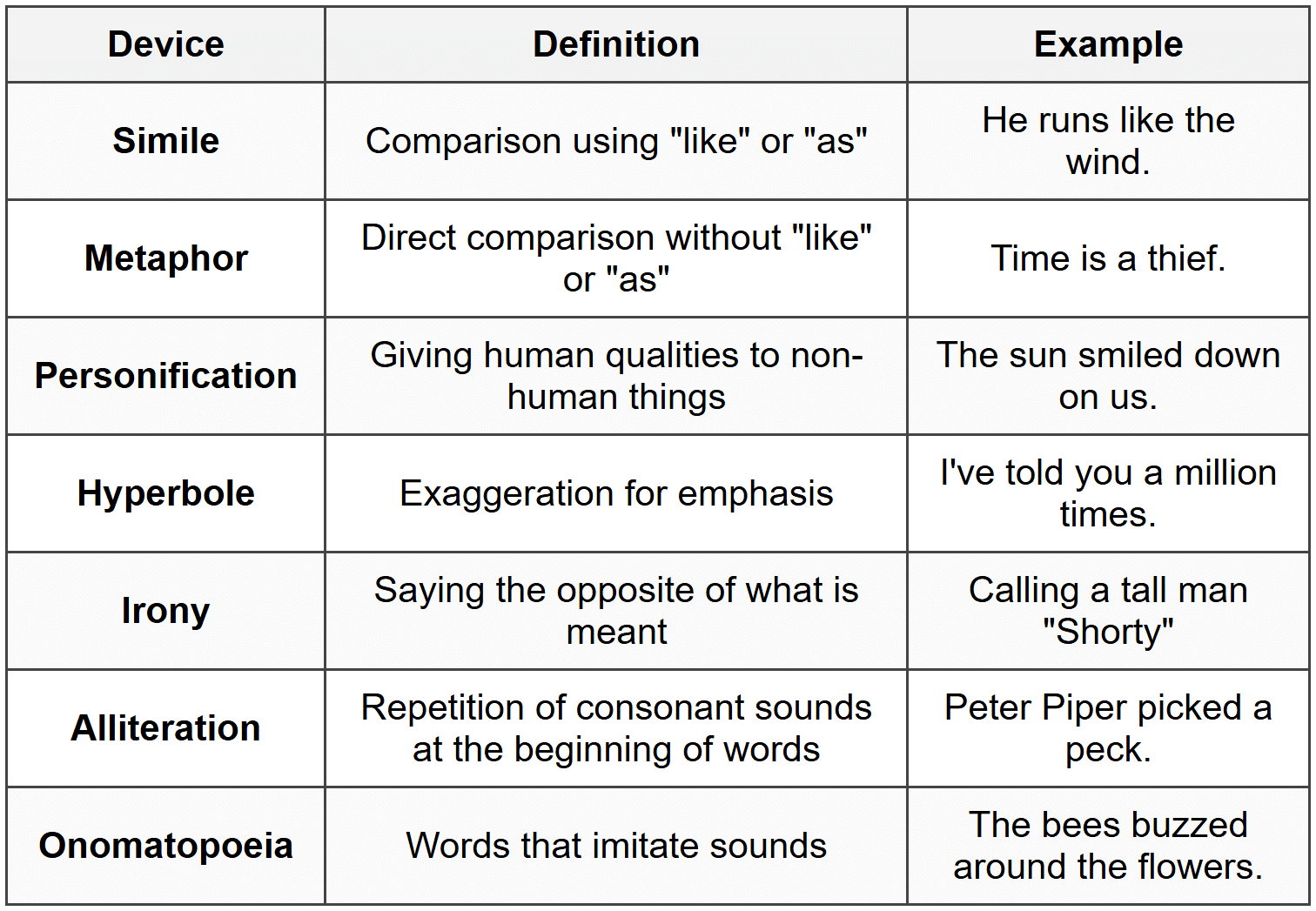
Figurative language uses words in ways that go beyond their literal meanings to create vivid images or emphasize ideas. JAMB frequently tests your ability to identify and interpret figurative expressions.
Common Types of Figurative Language
Register
Register is the level of formality in language use. It depends on context, audience, and purpose. There are different types of register:
- Frozen/Static Register: Fixed language, never changes (e.g., national anthem, prayers)
- Formal Register: Used in official settings (e.g., speeches, academic writing)
- Consultative Register: Professional but conversational (e.g., teacher-student interaction)
- Casual Register: Informal language among friends
- Intimate Register: Language among very close people (family, lovers)
Purpose of Writing
Every piece of writing has a purpose. JAMB tests your ability to identify why a writer wrote a text. The main purposes are:
- To inform: Provide facts or explain (e.g., news reports, textbooks)
- To persuade: Convince the reader (e.g., advertisements, editorials)
- To entertain: Amuse or engage (e.g., novels, comedy)
- To describe: Paint a picture with words (e.g., travelogues, descriptive essays)
- To narrate: Tell a story (e.g., biographies, short stories)
Rules and Explanations
How to Identify Tone in a Passage
To identify tone, focus on:
- Word choice: Are the words positive, negative, or neutral?
- Sentence structure: Are sentences short and blunt or long and elaborate?
- Punctuation: Exclamation marks show excitement or anger; question marks may show doubt or curiosity.
Example:
"What a brilliant idea! We should definitely try it!" (enthusiastic tone)
"Oh, great. Another brilliant idea." (sarcastic tone)
How to Recognize Figurative Language
When you see a sentence that doesn't make sense literally, it's probably figurative. Ask yourself:
- Is the writer comparing two things?
- Is something being exaggerated?
- Does the sentence create a vivid image?
Example:
"Her voice was music to his ears."
This is a metaphor because her voice is being directly compared to music without using "like" or "as."
Identifying Purpose
Look at the content and structure of the passage. Ask:
- Does it give facts and explain? (Informative)
- Does it try to change my mind? (Persuasive)
- Does it tell a story? (Narrative)
- Does it make me laugh or feel emotions? (Entertainment)
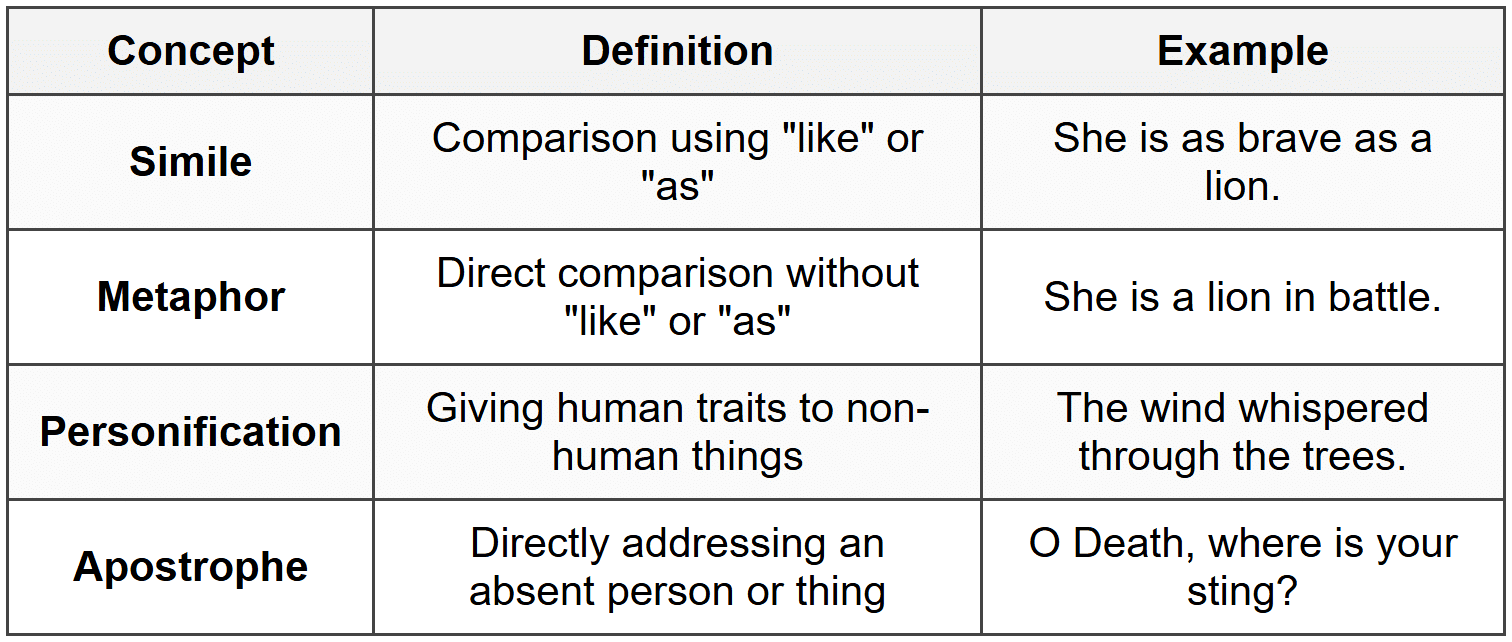
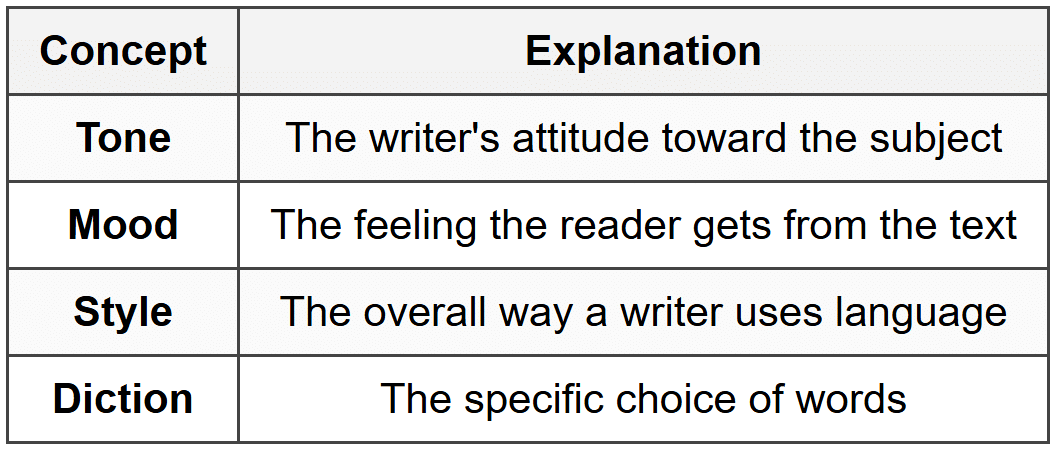
Distinguishing Between Similar Devices
JAMB often tests your ability to tell the difference between closely related concepts. Study this table carefully:
Context and Meaning
In JAMB, you'll be asked to interpret the meaning of words or expressions based on context. Don't just rely on dictionary definitions. Look at how the word is used in the sentence.
Example:
"The project was a complete disaster."
In this context, "disaster" doesn't mean a natural catastrophe. It means the project failed badly.
Worked Examples
Q1: Read the sentence below and identify the figurative device used:
"The classroom was a zoo during break time."
(a) Simile
(b) Metaphor
(c) Personification
(d) Hyperbole
Ans: (b) Metaphor
Explanation: The classroom is being directly compared to a zoo without using "like" or "as." This is a metaphor. The writer is saying the classroom was chaotic and noisy, just like a zoo. If the sentence had said "The classroom was like a zoo," it would have been a simile.
Q2: What is the tone of the following passage?
"Despite countless warnings from health experts, some people continue to ignore safety guidelines. This reckless behavior endangers not only themselves but also the entire community. It is both irresponsible and selfish."
(a) Sympathetic
(b) Humorous
(c) Critical
(d) Neutral
Ans: (c) Critical
Explanation: The writer is clearly disapproving and judging the behavior being described. Words like "reckless," "irresponsible," and "selfish" show a negative, critical attitude toward the subject. The tone is not neutral or sympathetic, and there is no humor in the passage.
Q3: Identify the purpose of the following text:
"Vote for Musa Ibrahim for Senior Prefect! He is hardworking, honest, and cares about every student. With Musa, our school will be better. Vote wisely!"
(a) To inform
(b) To entertain
(c) To persuade
(d) To describe
Ans: (c) To persuade
Explanation: The text is trying to convince readers to vote for Musa Ibrahim. It uses positive descriptions and a call to action ("Vote for Musa!") to influence the reader's decision. This is a clear example of persuasive writing, commonly used in campaign materials and advertisements.
Quick Summary
- Style is the unique way a writer uses language, including word choice, sentence structure, and literary devices.
- Tone is the writer's attitude toward the subject (e.g., formal, sarcastic, sympathetic).
- Mood is the emotional atmosphere created for the reader (e.g., suspenseful, joyful, gloomy).
- Diction refers to word choice and can be formal, informal, colloquial, or technical.
- Register is the level of formality, ranging from frozen to intimate.
- Figurative language includes simile, metaphor, personification, hyperbole, irony, alliteration, and onomatopoeia.
- Purpose of writing can be to inform, persuade, entertain, describe, or narrate.
- To identify tone, focus on word choice, sentence structure, and punctuation.
- To recognize figurative language, look for comparisons, exaggerations, and non-literal meanings.
- Context is key to interpreting meaning accurately in JAMB passages.
- Always distinguish between similar devices like simile and metaphor, or tone and mood.
Practice Questions
Q1: Which of the following sentences contains a simile?
(a) The stars danced in the night sky.
(b) Her smile was as bright as the sun.
(c) He is the backbone of the team.
(d) Time flies when you're having fun.
Q2: What is the tone of this sentence?
"Congratulations on your outstanding performance! You've made us all so proud."
(a) Sarcastic
(b) Angry
(c) Appreciative
(d) Indifferent
Q3: Identify the figurative device in the sentence:
"The thunder roared angrily across the sky."
(a) Metaphor
(b) Hyperbole
(c) Personification
(d) Simile
Q4: Which register of language is most appropriate for writing a formal application letter?
(a) Casual register
(b) Intimate register
(c) Formal register
(d) Consultative register
Q5: Read the sentence below:
"The government's new policy is a step in the right direction, though challenges remain."
What is the writer's tone?
(a) Completely negative
(b) Cautiously optimistic
(c) Indifferent
(d) Highly enthusiastic
Q6: What is the primary purpose of the following passage?
"Mount Kilimanjaro rises majestically above the plains, its snow-capped peak gleaming in the African sun. The surrounding landscape is dotted with acacia trees and wildlife, creating a scene of breathtaking beauty."
(a) To inform
(b) To persuade
(c) To describe
(d) To entertain
Answer Key and Explanations
Q1: Ans: (b)
Explanation: A simile is a comparison using "like" or "as." Option (b) compares her smile to the sun using "as," making it a simile. Option (a) is personification, option (c) is a metaphor, and option (d) is also a metaphor.
Q2: Ans: (c)
Explanation: The tone is appreciative because the writer is expressing praise and gratitude. Words like "Congratulations," "outstanding," and "proud" show a positive, supportive attitude. There is no sarcasm, anger, or indifference in the statement.
Q3: Ans: (c)
Explanation: Personification gives human qualities to non-human things. Thunder cannot literally roar angrily-only humans and animals can be angry. By giving thunder the human emotion of anger, the writer uses personification to make the description more vivid.
Q4: Ans: (c)
Explanation: A formal application letter requires formal register. This means using standard, polite, professional language without slang or colloquialisms. Casual and intimate registers are too informal, while consultative register is semi-formal and more suitable for professional conversations than written applications.
Q5: Ans: (b)
Explanation: The writer acknowledges something positive ("a step in the right direction") but also mentions problems ("though challenges remain"). This balanced view shows cautious optimism-neither completely negative nor overly enthusiastic, but hopeful with reservations.
Q6: Ans: (c)
Explanation: The passage uses vivid descriptive language to paint a picture of Mount Kilimanjaro and its surroundings. It does not provide facts to inform, attempt to persuade readers of anything, or tell a story for entertainment. The primary purpose is clearly to describe the scene in detail.
